A week or so ago, Third Man Records released a new Blue Series single from a Scandinavian duo named My Bubba (the group name is their names-- My Larsdotter and Guðbjörg "Bubba" Tómasdóttir). I assume most people who read this blog know what the Blue Series is, but for those who don't the in-a-nutshell description is that it's a series of singles produced by Jack White, by bands and musicians that strike his fancy and who are able record a couple of songs in a single day in his studio. They're of diverse genres and are nearly always bands and musicians I've never heard of before. There was a time when a single like this one would've barely registered on my radar, I would've acknowledged the news and sat back to wait for the next thing to come down the pike. But, as I've talked about before, I'm more adventurous musically than I used to be, and the announcement said the b-side of this Blue Series was a cover of Bob Dylan's You're Gonna Make Me Lonesome When You Go, which is one of my favorites from Blood On The Tracks. So, yadda yadda yadda, I ordered it and when it arrived I ripped both sides for the car, putting them in a folder on my flash drive that included another song released earlier this year by Third Man that you may've heard of, called Battle Cry.
Backing up a bit-- I felt like I should have been excited when Battle Cry came out in April. It was a brand-spanking new song from Jack, not a collaboration with anyone else, the first new music since Lazaretto was released in 2014! Granted, it was for a short film advertisement for the Warstic baseball bat company (of which he's co-owner) and walk-up music for Detroit Tigers player, Ian Kinsler. But still... new music! So many people I know were excited. But I wasn't. It's a good song, I do like it. It's the first song on my flash drive playlist, which means it plays when I turn the car on in the morning and hit the road for the commute to work. It's certainly appropriate for that. But it's a standard "Jack White" song. It fits the context for which it was written and has a great driving rhythm and a terrific guitar solo. But there are no surprises in it, nothing that hits you from left-field, to borrow a term from baseball.
On the other hand, this subtle and subdued new song from My Bubba, called Gone... It's surprised the hell out of me. After listening to it once at NPR's All Songs Considered, I thought it was pretty and pretty lethargic, but bought the single anyway, purely out of curiosity to hear the b-side. I figured it'd get filed away after a listen or two. But then today, when it came up in the car, it grabbed me so much I hit repeat and ended up listening to it for the majority of the 150 or so miles I drove.
It's the drums, the ones that made NPR's Bob Boilen describe the song as "rumbling". Played by Jack himself under one of his Blue Series pseudonyms, they're the sound that's missing from Battle Cry-- Not a single cymbal crash to be heard anywhere, just tribal rolls and thumps punctuating and giving shape to the hypnotic chant of My Bubba's vocals. Those drums are like the riffles and rapids that break up the inexorable, steady flow of a river, that keep it from carrying you away. They ground the song and transform it from a trance to a meditation. And they're unlike anything I've heard Jack play before. That makes them a surprise and a treat, not just for his playing of them, but also for his choice as a producer to include them. He could've made a similar choice for Battle Cry and directed drummer Daru Jones to play something like this on that song, but he didn't. He saved that sound for this song, one that many fans may, unfortunately for them, never hear. He seems to like doing perverse things like that.
The other thing that turns me on is that these little Blue Series production tricks of his make me want to listen to more music by artists like My Bubba, so that I can compare to hear how he's made their music different. And that has led me so many times to getting into a new musician or group that I probably wouldn't have been exposed to otherwise. It's what's made me, as I mentioned above, more musically adventurous, because I've found that the feeling of discovery and exploration is what stimulates me more than anything else.
As for their cover of You're Gonna Make Me Lonesome, I barely recognized it on first listen. My Bubba slow it down to the point that it only just holds on to Dylan's original melody. Both on the album and live, Dylan keeps the song uptempo, almost jaunty, so that it's more playful than lonesome.
But there's an ache in My Bubba's harmonies that turns it into a truly regretful lament.
It's kind of what I expected from that first listen to Gone on NPR, but at the same time... it's not. There's a depth there that I completely did not expect. And even though these songs aren't Jack's own music, they're an example of the sort of thing I will always want more of from him-- To be surprised.
Showing posts with label Bob Dylan. Show all posts
Showing posts with label Bob Dylan. Show all posts
July 9, 2017


January 25, 2016
A White weekend: Six year anniversary
I have an anniversary coming up in two weeks, but circumstance caused me to celebrate early. Six years ago, I found myself stuck at home during a historic blizzard and spent the hours indoors developing a musical infatuation. This weekend, the mid-Atlantic was hit by another blizzard of record-breaking proportion and I've been stuck at home for four days so far. I've spent these hours re-exploring that old infatuation and what it's come to mean to me.
Anyone who's familiar with this blog surely knows that I'm talking about the music of Jack White. I wrote about that weekend six years ago and he's been a predominant subject here ever since. On the surface it looks like an obsession but, really, it's grown into something else. Sure, I'm still infatuated with Jack. He's an endlessly fascinating personality and his music moves me in a way no other musician's ever has. But in following his work, I've begun to look at a bigger picture surrounding him and his music. He and the company he created, Third Man Records, have become symbols for me of a way to look at the world, primarily art and music, but also culture and society.
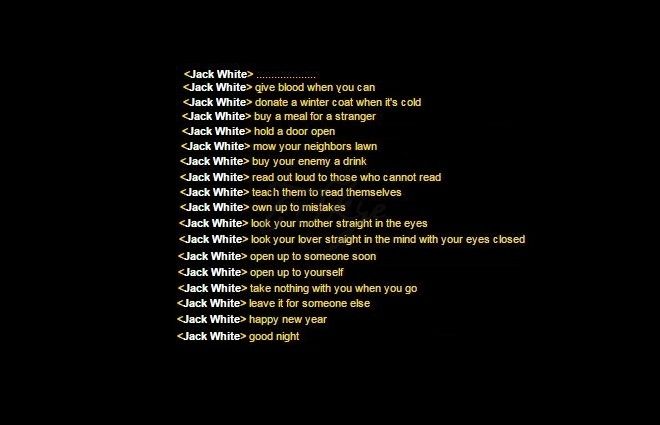
For a while now, I've been wearing a silver ring on my lefthand ring finger, a set of three bands that look like bones. I've never told anyone why, but this anniversary seems like an apropos time to talk about it. The ring is a symbol for me, just like a wedding band is a symbol for anyone who's married. As in the film Elizabeth, when Cate Blanchett's Queen Elizabeth proclaims to Lord Burley, "I am married. To England.", I also feel married to something rather than someone, to an ideal rather than to a person. (Though I am actually kind of married to Jack, seeing as how I was at the San Francisco show in 2014 during which he decided to marry every woman in the audience in the middle of the song Blunderbuss. But it was the night after he'd sprained his ankle on stage and he was probably high on Vicodin and for all I know he had it annulled two days later without bothering to tell the couple thousand of us.) That ideal I feel wed to may walk around wearing the form of Jack White, but I see so much more now when I look at him. I've read and been told enough about him, and observed a bit myself, to know the man is way too human to ever qualify for sainthood or keep his balance on any pedestal. But I also see him continually striving to grow, and to make the world a better place in his own way, on his own and with the help of the people he's brought into his organization. Whether it's his New Year's Day advice in the Vault chat room, his inquisitiveness about history and art and science that he shares with his fans through all of the projects he's involved in and things he mentions in interviews, his constant urging to remember the romance and ingenuity of the past while admiring the innovation of the future, the efforts by Third Man Books partners Ben Swank and Chet Weise to spread culture and beauty through poetry, or the many charity drives organized (there are four links in that string of words, click on 'em all) by Third Man Records, that striving is what inspires me. It's the one thing we can all do, regardless of our talent or ability or circumstance, we can always try to grow and be better-- Better at art, better at whatever it is we do, better human beings with a wider field of vision and curiosity and awareness.
Bob Dylan said in Last Thoughts on Woody Guthrie--
...You'll find God in the church of your choice
You'll find Woody Guthrie in Brooklyn State Hospital
And though it's only my opinion
I may be right or wrong
You'll find them both
In the Grand Canyon
At sundown
He wasn't talking about Woody in those last lines, or in any of the lines of that poem. He was talking about what Woody represented to him. I'm no poet like Dylan, but I understand exactly what he meant about Woody because it's very much the way I've come to feel about Jack. When someone creates something that moves us, or begins an organization or movement that inspires us, what that person represents can become something that's both incorporated within them and totally separate from them. Look at Martin Luther King Jr or Abraham Lincoln. On a much smaller scale, look at Woody Guthrie and, more and more, look at Jack White.
Of course, running underneath and through it all is the music. And there's so very much of that to celebrate, not just this weekend but every single day...
Anyone who's familiar with this blog surely knows that I'm talking about the music of Jack White. I wrote about that weekend six years ago and he's been a predominant subject here ever since. On the surface it looks like an obsession but, really, it's grown into something else. Sure, I'm still infatuated with Jack. He's an endlessly fascinating personality and his music moves me in a way no other musician's ever has. But in following his work, I've begun to look at a bigger picture surrounding him and his music. He and the company he created, Third Man Records, have become symbols for me of a way to look at the world, primarily art and music, but also culture and society.
For a while now, I've been wearing a silver ring on my lefthand ring finger, a set of three bands that look like bones. I've never told anyone why, but this anniversary seems like an apropos time to talk about it. The ring is a symbol for me, just like a wedding band is a symbol for anyone who's married. As in the film Elizabeth, when Cate Blanchett's Queen Elizabeth proclaims to Lord Burley, "I am married. To England.", I also feel married to something rather than someone, to an ideal rather than to a person. (Though I am actually kind of married to Jack, seeing as how I was at the San Francisco show in 2014 during which he decided to marry every woman in the audience in the middle of the song Blunderbuss. But it was the night after he'd sprained his ankle on stage and he was probably high on Vicodin and for all I know he had it annulled two days later without bothering to tell the couple thousand of us.) That ideal I feel wed to may walk around wearing the form of Jack White, but I see so much more now when I look at him. I've read and been told enough about him, and observed a bit myself, to know the man is way too human to ever qualify for sainthood or keep his balance on any pedestal. But I also see him continually striving to grow, and to make the world a better place in his own way, on his own and with the help of the people he's brought into his organization. Whether it's his New Year's Day advice in the Vault chat room, his inquisitiveness about history and art and science that he shares with his fans through all of the projects he's involved in and things he mentions in interviews, his constant urging to remember the romance and ingenuity of the past while admiring the innovation of the future, the efforts by Third Man Books partners Ben Swank and Chet Weise to spread culture and beauty through poetry, or the many charity drives organized (there are four links in that string of words, click on 'em all) by Third Man Records, that striving is what inspires me. It's the one thing we can all do, regardless of our talent or ability or circumstance, we can always try to grow and be better-- Better at art, better at whatever it is we do, better human beings with a wider field of vision and curiosity and awareness.
 |
| Thank you to the unknown person on Tumblr who captured and posted this. |
Bob Dylan said in Last Thoughts on Woody Guthrie--
...You'll find God in the church of your choice
You'll find Woody Guthrie in Brooklyn State Hospital
And though it's only my opinion
I may be right or wrong
You'll find them both
In the Grand Canyon
At sundown
He wasn't talking about Woody in those last lines, or in any of the lines of that poem. He was talking about what Woody represented to him. I'm no poet like Dylan, but I understand exactly what he meant about Woody because it's very much the way I've come to feel about Jack. When someone creates something that moves us, or begins an organization or movement that inspires us, what that person represents can become something that's both incorporated within them and totally separate from them. Look at Martin Luther King Jr or Abraham Lincoln. On a much smaller scale, look at Woody Guthrie and, more and more, look at Jack White.
Of course, running underneath and through it all is the music. And there's so very much of that to celebrate, not just this weekend but every single day...
August 14, 2015
The delights of music, math, and hokum
So I've been reading Bob Dylan's Chronicles, Volume One, getting close to the end at this point. Hit a passage the other night that struck me and got me excited, in which he talks about feeling stuck, like he can't perform anymore. Inspiration came to him through the memory of a lesson he'd learned from Lonnie Johnson, a blues/jazz musician I only have one record from but whom I absolutely love. Along with Little Willie John, Lonnie's one of my favorite crooners.
I owe a big thanks to thebobdylanfanclub.com for typing out that passage from Chronicles so that I don't have to. Here's the part that jumped out at me:
“Besides my devotion to a new vocal technique, something else would go along with helping me re-create my songs. It seemed like I had always accompanied myself on the guitar. I played in the casual Carter Family flat-picking style and the playing was more or less out of habit and routine. It always had been clear and readable but didn't reflect my psyche in any way. It didn't have to.
The style had been practical, but now I was going to push that away from the table, too, and replace it with something more active with more definition of presence.
I didn't invent this style. It had been shown to me in the early 60's by Lonnie Johnson. Lonnie was the great jazz and blues artist from the 30's who was still performing in the 60's. Robert Johnson had learned a lot from him. Lonnie took me aside one night and showed me a style of playing based on an odd- instead of even-number system. He had me play chords and he demonstrated how to do it. This was just something he knew about, not necessarily something he used because he did so many different kinds of songs. He said, "This might help you," and I had the idea that he was showing me something secretive, though it didn't make sense to me at that time because I needed to strum the guitar in order to get my ideas across. It's a highly controlled system of playing and relates to the notes of a scale, how they combine numerically, how they form melodies out of triplets and are axiomatic to the rhythm and the chord changes.
I never used this style, didn't see that there'd be any purpose to it. But now all of a sudden it came back to me, and I realized that this way of playing would revitalize my world. The method works on higher or lower degrees depending on different patterns and the syncopation of a piece. Very few would be converted to it because it had nothing to do with technique and musicians work their whole lives to be technically superior players. You probably wouldn't pay any attention to this method if you weren't a singer. It was easy for me to pick this up. I understood the rules and critical elements because Lonnie had showed them to me so crystal clear. It would be up to me now to expel everything that wasn't natural to it. I would have to master that style and sing to it.
The system works in a cyclical way. Because you're thinking in odd numbers instead of even numbers, you're playing with a different value system. Popular music is usually based on the number 2 and then filled in with fabrics, colors, effects, and technical wizardry to make a point. But the total effect is usually depressing and oppressive and a dead end which at the most can only last in a nostalgic way. If you're using an odd numerical system, things that strengthen a performance automatically begin to happen and make it memorable for the ages. You don't have to plan or think ahead. In a diatonic scale there are eight notes, in a pentatonic scale there are five. If you're using the first scale, and you hit 2, 5, and 7 to the phrase and then repeat it, a melody forms. Or you can use 2 three times. Or you can use 4 once and 7 twice. It's infinite what you can do, and each time you would create a different melody. The possibilities are endless. A song executes itself on several fronts and you can ignore musical customs. All you need is a drummer and a bass player, and all shortcomings become irrelevant as long as you stick to the system. With any type of imagination you can hit notes at intervals and between backbeats, creating counterpoint lines and then you sing off of it. There's no mystery to it and it's not a technical trick. The scheme is for real. For me, this style would be most advantageous, like a delicate design that would arrange the structure of whatever piece I was performing. The listener would recognize and feel the dynamics immediately. Things could explode or retreat back at any time and there would be no way to predict the consciousness of any song. And because this works on its own mathematical formula, it can't miss. I'm not a numerologist. I don't know why the number 3 is more metaphysically powerful than the number 2, but it is. Passion and enthusiasm, which sometimes can be enough to sway a crowd, aren't even necessary. You can manufacture faith out of nothing and there are an infinite number of patterns and lines that connect from key to key - all deceptively simple. You gain power with the least amount of effort, trust that the listeners make their own connections, and it's very seldom that they don't. Miscalculations can also cause no serious harm. As long as you recognize it, you can turn the dynamic around architecturally in a second."
I mentioned this at a message board where I've been talking to people about Dylan and was told by a guy who worked on the book for the publishing house that employs him that the passage I was so struck by was an example of the "delightfully Dylanesque hokum" that Chronicles is apparently full of. That may be true, and it didn't surprise me. I knew going in that Dylan has a reputation for deception and camouflage and I'd been wondering already what parts of the book were true vs hokum. He may've never met Lonnie Johnson or, if he did, was never schooled by him (though there are people out there who seem to think there's something to the tale). But that doesn't matter, doesn't diminish the beauty of the passage for me at all. It was the mathematics of it that fascinated me. I'm not a mathematically inclined person, my brain just doesn't work that way. I can do simple math in my head, most of the time, but algebraic stuff leaves me flummoxed. So the marriage of math and music is something that fascinates me.
Music is intangible, ethereal. Even if you own a record, you only own a piece of vinyl in which sound waves have been captured. What those sound waves contain, though, can't be held in your hand. Music is stories, notes that can break your heart or uplift you. Music can bring you to tears of sorrow or joy. Music is the only form of art that you can enjoy while doing other things, like driving or jogging or washing the dishes. It's the only form of art that makes us move. That's how we're able to connect other experiences to music and, I think, a large part of how music creates a sense of nostalgia in us.
Math is intangible, too, but there's nothing ethereal about it. It's fact, it's cold, hard, rational and logical. So the fact that music is based on mathematics blows my mind. And you can't really do other things while you're doing math, nor can I imagine the sight of an algebraic formula giving anyone but a mathematician a nostalgic pang. Math can make you cry, though. I remember sitting in algebra class in high school and yawning until tears came to my eyes, sometimes to the point that a few would slip out and roll down my cheek. One day I was wiping some of those tears away and the teacher asked me "Is this class that hard for you?" I said, "No, it's that boring". That's no hokum.
You were expecting Dylan videos, perhaps? Here, have one of Bob and John Lennon being silly in a London cab--
July 27, 2015
Random babblings: Blood On the Tracks and blood on my wrist
Hefted a rain-soaked fawn this morning, surprised at how flexible it was in its stiffness. Walked away with wet hands and a fleck of blood on my wrist.
After breakfast, an Idiot Wind blew me to Breezewood looking for a tunnel on an eroded highway. Wasn't sure how far I'd have to walk, but then suddenly there it was.
On a day like today, you don't realize how hot it is until you stop moving, then sweat and denim combine to smother you.
Other tunnels I've explored have had a light at the end. This one didn't, it was just a throat of hazy blackness. So I sat at its mouth, had a snack, read the graffiti, and watched the tunnel exhale a cool, dusty breath. After a while, fellow explorers were heard long before seen, so I got up and headed back before they could step out of the darkness and destroy the illusion.
Crossed paths with a couple of local boys on the way back and some thoughts crossed my mind that I didn't want to have. What a world we live in. As the young men went on their way, I turned my mind back to the fawn to make the thoughts go, too.
Back at the car, pulled out and hit the road in search of a road on a hill that defied gravity. Blood On the Tracks... blood on my wrist... a runaway truck axle-deep in gravel on the way to Bedford.
Lost my shit and was reduced to giggles coming down the mountain toward the junction with 522 when I took my foot off the gas to coast the descent and watched the speedometer slow down and down and down. Would've just let the car come to a stop in the middle of the highway, but someone was coming down behind me.
At a Pentecostal church along Jack Rd.: "Nothing ruins the truth like stretching it".
Never did find Bedford or that physics-defying hill, but gave into giggles again coming around the first bend of an S curve to see a sign warning to watch for cows in the road.
Looked for the fawn as I approached home, but it was gone. Guess the county came and took it away. Just as well. I can still feel the muscles of its neck on my fingertips and see the blood that flowed from its ear as I laid it down.
Subscribe to:
Posts (Atom)


 Posts


