I recently guested on an episode of the Jack White-centric (what else?) Third Men Podcast, talking about blues music. When asked to name my favorite of Jack's blues covers, I qualified my answer by saying the song I was going to name wasn't a cover per se, though in a sense it is. I went on to describe to the hosts, the Kaminski brothers, how excited I'd been to immediately recognize the source of the cover-that's-not-a-cover when I first heard it, as the song in question lifts sections almost word for word from the older version. I had so much more to say about this song and the unrecognized brilliance of it, but it would've been rude to hijack the podcast so here, in my own space, I can and will babble to my heart's content.
Three Dollar Hat, from the 2015 Dead Weather album Dodge and Burn, lists all four members of the band as songwriters, but it's very obviously Jack's baby because it's very obviously based on Mississippi John Hurt's version of Stack O' Lee Blues. Of all the members of the Dead Weather, Jack is the one who's likely to be most familiar with the Stack O'/Stagger Lee tradition that dates back some 120 years. And Jack is the one who's been driven throughout his career to become a part of musical tradition. Or, as he says in a scene in It Might Get Loud, to "join the family" of song-writers of the early blues era. After almost 20 years of covering half the blues songwriters most people can readily name and many that the average fan could not, and writing blistering blues of his own, he apparently finally felt ready to take his place in this specific, hallowed tradition, to join the huge and highly respectable family of musicians who've sung versions of this song.
"What I care about your two little babes and your darlin' lovely wife? You done stole my Stetson hat and I'm bound to take your life" (As a sidenote, one of the things I will always love most about Mississippi John Hurt is how he sang about such violent subject matter in such a mild and delicate manner. Like Grandpa telling a bedtime story... of murder.)
The tradition of Stack O' Lee becomes more extensive the further you explore it. As described at staggerlee.com--
The history of the song tells many stories. It is an anthem of the dispossessed. It expresses fear of the scary black man, the evolution of modern music, culture theft from black to white, hero worship of the outlaw, the origins of a legendary character and the writing of a Myth.
No other song has so transcended its humble beginnings and been re-invented in so many genres, in so many media and by so many artists.
That site's list of recorded versions of the song ends in 2008, leaving it wide open for Jack to come along. It's interesting to note that Jack's pal Beck covered it in 1996 (using it as inspiration for something different) and 2001, and his former antagonists The Black Keys did it in 2004. Maybe that's part of why he waited so long.
The initial reaction to Three Dollar Hat that I saw from fans in the Vault and at one of the message boards had people latching onto the Frankie and Johnny reference, or calling to mind Nick Cave's version of Stagger Lee. There are legitimate connections to both of those songs.
That little snippet of Frankie and Johnny tagged on at the end is blatant. But turning Stack O' Lee and Billy into Jackie Lee and Johnny does more than just make this a mash-up of two song references, it adds an interesting psychological twist-- Jack White is both a John (born John Gillis, the name on his Third Man Records business card is "John A. White") and a Jack, so just who are the sweethearts Jackie and Johnny? Did he push the Stack O' Lee myth into homoerotic territory, with his bad man Jackie Lee killing Johnny more out of jealousy toward that bad-ass wife than concern over a $3 hat? That idea brings to mind Omar of The Wire, a series busting at the seams with Staggerlees, of which Omar was one of the most intriguing. Or are Jackie Lee and Johnny two manifestations of the songwriter/narrator, a la Fight Club, and is the whole violent story taking place inside his own head, one side of his psyche destroying the other and then being destroyed in turn? Either or both, it skews the tale in a way that's gleefully perverse.
(I'm going to admit right now that I have no idea what Alison Mosshart's vocal part has to do with the rest of the story-line. If anyone out there has any ideas about that, please let me know.)
Three Dollar Hat has much of the punk grittiness of Cave's version. And considering the fact that his son is apparently named after another of Cave's songs, Henry Lee, Jack's surely familiar with this one. I think any similarity between Three Dollar Hat and Stagger Lee is coincidental, though, a reflection of a shared attitude in bringing the legend into the contemporary era. Because where Cave went for a sludgy rock'n'roll edge, Jack uses Three Dollar Hat as an opportunity to make the connection between blues and hip-hop apparent to anyone who hasn't caught on yet.
Another man who named his son after a song is Bobby Seale, co-founder of the Black Panthers. In the book Mystery Train, Greil Marcus opens a chapter about Sly Stone and the myth of Staggerlee by quoting a 1970 jailhouse interview with Seale--
I named my son Malik Nkrumah Staggerlee Seale. Right on, huh? He's named after his brother on the block, like all his brothers and sisters off the block. Staggerlee.
You'll find out. Huey [Newton] had a lot of Staggerlee qualities. I guess I lived a little bit of Staggerlee's life, too, here and there. That's where it's at. You move yourself up from a lower level to a higher level...
...Staggerlee is all the shootouts that went on between gamblers, and cats fightin' over women--- the black community.
Something else, huh? That's life. And all the little Staggerlees, a lot of 'em! Millions of 'em, know what I mean?
And so I named that brother, my little boy, Staggerlee, because... that's what his name is.
Farther on in the chapter, Marcus describes Staggerlee as a fearsome ideal--
...Nobody's fool, nobody's man, tougher than the devil and out of God's reach-- to those who followed his story and thus became a part of it, Stack-o-Lee was ultimately a stone-tough image of a free man.
From popular song, that ideal made its way onto the movie screen through the Blacksploitation films of the 70s. Shaft and Superfly, Curtis Mayfield's Pusherman, these are manifestations of that bad black man standing up to The Man. A few decades later, he veered back into music and emerged as rappers like Ice-T, Tupac Shakur, and Snoop Dog.
In the early days of the White Stripes, Jack White expressed disdain towards hip-hop. He was asked about it in a 2003 Rolling Stone interview--
And you're not a hip-hop fan.
Not particularly. I find Out Kast and Wu-Tang Clan interesting. But I consider music to be storytelling, melody and rhythm. A lot of hip-hop has broken music down. There are no instruments and no songwriting. So you're left with just storytelling and rhythm. And the storytelling can be so braggadocious, you're just left with rhythm. I don't find much emotion in that.
But somewhere along the line, he began to hear things differently. In an article just a couple years ago, which I can't find now to be able to link here, he mentioned that Jay-Z had told him that hip-hop is the blues. That idea gave me pause at first, but damned if he isn't right. Both genres are outlets for the trials and suffering of life, black life in particular. And both frequently take on that braggadocio Jack mentioned, boasting of things like sexual conquests and material possessions, building up the singer/rapper's fearsome rep. Following the trail of the Stack O' Lee myth shows how one genre followed from the other and Jack seems to have had that agenda in mind when writing his own entry into the tradition.
I've also seen complaints from fans over the past few years about the number of songs that Jack has begun rapping rather than singing, from I Cut Like a Buffalo to Freedom at 21 to Lazaretto. All of those songs, culminating in Three Dollar Hat (and his more recent contributions to A Tribe Called Quest's last album), must've been influenced by that conversation with Jay-Z. What the fans bothered by this don't realize is that Jack's doing exactly the same thing he's always done-- He's singing the blues. He's just exploring new avenues, new ways of expressing them. It's one of his typical subtle lessons in how music evolves. Which makes it a damned shame that this song ended up buried on a Dead Weather album that wasn't even toured. But according to comments Jack made months ago in the Vault chatroom, the band did make some sort of video/movie-type thing for Three Dollar Hat. He implied we fans are going to love it. With any luck, one of these days he'll give it to us. Not doing so is just him being perverse again.
As an extra treat, here's one of the first recorded versions of Stack O'Lee--
Showing posts with label Mississippi John Hurt. Show all posts
Showing posts with label Mississippi John Hurt. Show all posts
February 15, 2017


February 5, 2012
"Who doesn't want violence from love?"
On Monday, January 30th, one of the top-trending search terms on the web was "Love Interruption", which is the title of the first single from Jack White's upcoming debut solo album. The song was released to the internet that morning via a brand new site, jackwhiteiii.com, with no previous announcement, though there had been whispers of hints of rumors for a few weeks of something maybe, just possibly, coming up. Of course, the reaction in the fan community was pretty explosive, especially when the song was followed with the announcement of the new album and an accompanying world tour. For anyone who's into his music, that's a helluva lot of excitement to absorb at once, so it took a day or two for the single itself to sink into my head. After some extended listening, though, I quickly realized that it's quintessential Jack-- Deceptive in its simplicity, leaving one caught up in comparisons, contrasts, and contradictions.
The first contradiction is between the music and the lyrics. Musically, Love Interruption is hauntingly sweet, reminiscent of the White Stripes tune I'm Bound To Pack It Up, from the album De Stijl, released back in 2000. The two songs share a fairly simple arrangement of acoustic guitar which is layered with electric violin in the earlier song, clarinet and Wurlitzer organ in the more recent. The themes of both are expressed through plaintive vocals, with Love Interruption enriched by backup from the gorgeous voice of Ruby Amanfu (who Jack had previously enlisted for two other Third Man Records projects-- As a live backup singer for Wanda Jackson and again on the Blue Series single from Seasick Steve).
But the comparison of those two songs ends there and the next that sprang into my mind was Jack's recent cover of U2's Love Is Blindness, as much for the contrast as for the similarity. Both depict love as an overwhelming force, but the dramatically passionate vocal delivery of Love Is Blindness is an antithesis to the gentleness of Love Interruption.
A more apt comparison, though, one that gets to the heart of Love Interruption, might actually be with the old bluesman Mississippi John Hurt, who played and sang with a delicacy that belied the violent lyrics of some of the songs he performed.
That's the crux, the element that makes Love Interruption something insidious-- This simple and tender sounding song contains some of the most starkly dark imagery Jack's written yet. The very first two lines reflect this intense contradiction of tenderness and violence:
The lyrics go on to list metaphorical ways in which he wants love to destroy him and overwhelm other relationships. In seeming contrast to this, though, the chorus repeats an unconditional refrain of "I won't let love disrupt, corrupt or interrupt me anymore". To me, this was the primary contradiction of the song and it left me baffled.
The next evening, though, I had the chance to ask Jack about this when he unexpectedly popped into the chatroom of the Third Man Records Vault while I was there. My comment apparently left him baffled in return, as he countered with "what contradiction?". I pointed out the seeming inconsistency between wanting such violence from love, but not allowing it to disrupt or corrupt. He again came back at me with a question-- "who doesn't want violence from love?" (Which prompted someone else to ask "so you like it rough?", to which he replied "no, I like it real". Again, quintessential Jack.) I would have gone on to ask how he feels it's possible to prevent something so powerful and intense from being an interruption, but the chatroom was filling up and he's usually there with an agenda, so I let it drop. But his reply made me re-think the relationship between the verses and chorus. I began to consider that perhaps the song was about how he (or the character he'd created) wants love to be hard and challenging, to push him to a breaking point, while at the same time learning to rise above that difficulty and not succumb to it. At one of the two Jack-related message boards, I found someone who felt similarly, but who expressed it with a thoroughness I hadn't considered--
I think I would have to agree on Jack's point of "who doesn't want violence in love" and flattop and Kali's interpretation of finding a way to have intensity without being thrown off track. Love (and relationships) is something that is, and should be, forceful, extreme, intense, and (sometimes) painful. there are definitely highs and lows and extremes on both ends of the spectrum, otherwise it's just kind of bland and uninvolving. It's not like you're always going to agree with someone you love, and I personally don't buy that "we never fight or disagree", lovey-dovey crap that you see in some relationships. who wants to be completely subservient and complacent in a relationship?
I think people are going to get hung up on the imagery of the song and stuck in the typical idea of violence because of the imagery, while forgetting that some words have more than one definition. something that is violent isn't necessarily hurtful as the song's imagery conjures, but love is something violent (even if it doesn't come with the usual idea of what violence is)... forgive the dictionary post, but:
Violence:
3 a : intense, turbulent, or furious and often destructive action or force(the violence of the storm)
b : vehement feeling or expression : fervor; also : an instance of such action or feeling
c : a clashing or jarring quality : discordance
Violent:
1 : marked by extreme force or sudden intense activity (a violent attack)
2 a : notably furious or vehement (a violent denunciation)
b : extreme, intense (violent pain) (violent colors)
3 : caused by force : not natural (a violent death)
4 a : emotionally agitated to the point of loss of self-control (became violent after an insult)
Of course, though, not everyone will draw the same conclusions that I and a few others have. That's the magic of truly effective lyrics, when metaphors are obscure enough that the words can inspire a personal meaning for the listener that might be quite different from what the songwriter had in mind. Jack's a master of that sort of poetic ambiguity and it continuously puzzles me that his talent as a lyricist is still so often overlooked in favor of the frontman charisma and insane guitar skill he's universally known for. It seems he might feel this way himself, as he mentioned in an interview the day after the single's release that he wanted the first single to be "a lyrical taste", that he "wanted the words to resonate", before getting to the sort of songs that people expect from him. Personally, I think that's a mistake that people too often make with Jack-- having expectations. The only thing I've come to expect from him is to always be surprised. This song most definitely accomplished that, though I would have been equally astonished if it hadn't. And knowing that there are more surprises coming up has got me violently excited.
The first contradiction is between the music and the lyrics. Musically, Love Interruption is hauntingly sweet, reminiscent of the White Stripes tune I'm Bound To Pack It Up, from the album De Stijl, released back in 2000. The two songs share a fairly simple arrangement of acoustic guitar which is layered with electric violin in the earlier song, clarinet and Wurlitzer organ in the more recent. The themes of both are expressed through plaintive vocals, with Love Interruption enriched by backup from the gorgeous voice of Ruby Amanfu (who Jack had previously enlisted for two other Third Man Records projects-- As a live backup singer for Wanda Jackson and again on the Blue Series single from Seasick Steve).
But the comparison of those two songs ends there and the next that sprang into my mind was Jack's recent cover of U2's Love Is Blindness, as much for the contrast as for the similarity. Both depict love as an overwhelming force, but the dramatically passionate vocal delivery of Love Is Blindness is an antithesis to the gentleness of Love Interruption.
A more apt comparison, though, one that gets to the heart of Love Interruption, might actually be with the old bluesman Mississippi John Hurt, who played and sang with a delicacy that belied the violent lyrics of some of the songs he performed.
That's the crux, the element that makes Love Interruption something insidious-- This simple and tender sounding song contains some of the most starkly dark imagery Jack's written yet. The very first two lines reflect this intense contradiction of tenderness and violence:
I want love to roll me over slowly
Stick a knife inside me and twist it all around
I want love to grab my fingers gently
Slam them in a doorway, put my face into the ground
The lyrics go on to list metaphorical ways in which he wants love to destroy him and overwhelm other relationships. In seeming contrast to this, though, the chorus repeats an unconditional refrain of "I won't let love disrupt, corrupt or interrupt me anymore". To me, this was the primary contradiction of the song and it left me baffled.
The next evening, though, I had the chance to ask Jack about this when he unexpectedly popped into the chatroom of the Third Man Records Vault while I was there. My comment apparently left him baffled in return, as he countered with "what contradiction?". I pointed out the seeming inconsistency between wanting such violence from love, but not allowing it to disrupt or corrupt. He again came back at me with a question-- "who doesn't want violence from love?" (Which prompted someone else to ask "so you like it rough?", to which he replied "no, I like it real". Again, quintessential Jack.) I would have gone on to ask how he feels it's possible to prevent something so powerful and intense from being an interruption, but the chatroom was filling up and he's usually there with an agenda, so I let it drop. But his reply made me re-think the relationship between the verses and chorus. I began to consider that perhaps the song was about how he (or the character he'd created) wants love to be hard and challenging, to push him to a breaking point, while at the same time learning to rise above that difficulty and not succumb to it. At one of the two Jack-related message boards, I found someone who felt similarly, but who expressed it with a thoroughness I hadn't considered--
I think I would have to agree on Jack's point of "who doesn't want violence in love" and flattop and Kali's interpretation of finding a way to have intensity without being thrown off track. Love (and relationships) is something that is, and should be, forceful, extreme, intense, and (sometimes) painful. there are definitely highs and lows and extremes on both ends of the spectrum, otherwise it's just kind of bland and uninvolving. It's not like you're always going to agree with someone you love, and I personally don't buy that "we never fight or disagree", lovey-dovey crap that you see in some relationships. who wants to be completely subservient and complacent in a relationship?
I think people are going to get hung up on the imagery of the song and stuck in the typical idea of violence because of the imagery, while forgetting that some words have more than one definition. something that is violent isn't necessarily hurtful as the song's imagery conjures, but love is something violent (even if it doesn't come with the usual idea of what violence is)... forgive the dictionary post, but:
Violence:
3 a : intense, turbulent, or furious and often destructive action or force
b : vehement feeling or expression : fervor; also : an instance of such action or feeling
c : a clashing or jarring quality : discordance
Violent:
1 : marked by extreme force or sudden intense activity (a violent attack)
3 : caused by force : not natural (a violent death)
4 a : emotionally agitated to the point of loss of self-control (became violent after an insult)
Of course, though, not everyone will draw the same conclusions that I and a few others have. That's the magic of truly effective lyrics, when metaphors are obscure enough that the words can inspire a personal meaning for the listener that might be quite different from what the songwriter had in mind. Jack's a master of that sort of poetic ambiguity and it continuously puzzles me that his talent as a lyricist is still so often overlooked in favor of the frontman charisma and insane guitar skill he's universally known for. It seems he might feel this way himself, as he mentioned in an interview the day after the single's release that he wanted the first single to be "a lyrical taste", that he "wanted the words to resonate", before getting to the sort of songs that people expect from him. Personally, I think that's a mistake that people too often make with Jack-- having expectations. The only thing I've come to expect from him is to always be surprised. This song most definitely accomplished that, though I would have been equally astonished if it hadn't. And knowing that there are more surprises coming up has got me violently excited.
May 15, 2011
1 Mississippi, 2 Mississipi
Mississippi's been on my mind lately. The mighty river's flooding and I've been listening to Delta blues. The first situation's so stunning and what people in that part of the country are dealing with is so heart-breaking that I can't begin to figure out what to say about it. Farmland and homes inundated and lost. Not for the first time, of course-- The Great Flood of 1927 was just as horrendous, but when you see the seemingly passive devastation of water every-freaking-where, it's hard to imagine how anyone can clean up and rebuild from that.

As for the music, it's so much easier to think about, so pardon me for shifting gears in that direction. Two of my latest favorite bluesmen just happen to have been nicknamed for the state that's bordered by the river-- Mississippi Fred McDowell and Mississippi John Hurt.
Mississippi Fred played slide guitar in a way that sends chills down my spine and sang with a voice every bit as evocative as any of the better known blues players. Unknown outside of the hill country just north of the Mississippi Delta until Alan Lomax recorded him around 1960, McDowell made up for lost time by recording over a dozen records within a dozen years before cancer took him. A case of better late than never, but still makes you wonder what could've been if he'd been discovered sooner.
Mississippi John's blues had a folkier sound to them but were no less intense in their way, if you pay attention. In songs such as Stackolee and Nobody's Dirty Business, there's a subtly powerful contrast between the violence of the lyrics and the delicacy of Hurt's voice and acoustic finger-picking.
The current condition of much of the U.S. south is the stuff of which the blues are made. Though it's hard not to think that, thanks to artists like Mississippi Fred and John, we've got enough already.

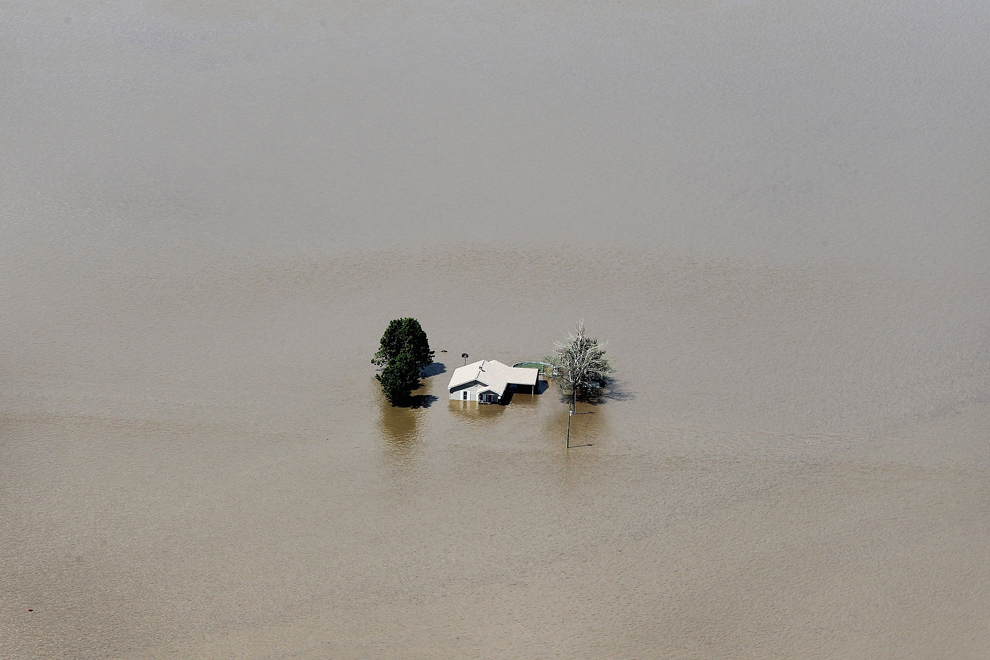 |
| Flood photos from The Big Picture, more at www.boston.com |
Mississippi Fred played slide guitar in a way that sends chills down my spine and sang with a voice every bit as evocative as any of the better known blues players. Unknown outside of the hill country just north of the Mississippi Delta until Alan Lomax recorded him around 1960, McDowell made up for lost time by recording over a dozen records within a dozen years before cancer took him. A case of better late than never, but still makes you wonder what could've been if he'd been discovered sooner.
Mississippi John's blues had a folkier sound to them but were no less intense in their way, if you pay attention. In songs such as Stackolee and Nobody's Dirty Business, there's a subtly powerful contrast between the violence of the lyrics and the delicacy of Hurt's voice and acoustic finger-picking.
The current condition of much of the U.S. south is the stuff of which the blues are made. Though it's hard not to think that, thanks to artists like Mississippi Fred and John, we've got enough already.
Subscribe to:
Posts (Atom)


 Posts
Posts


