Showing posts with label books. Show all posts
Showing posts with label books. Show all posts
June 25, 2014
Son House and Foucault on desperate passion
"Then the last type of madness: that of desperate passion. Love disappointed in its excess, and especially love deceived by the fatality of death, has no other recourse but madness. As long as there was an object, mad love was more love than madness; left to itself, it pursues itself in the void."
Michel Foucault, Madness and Civilization.


March 15, 2014
Ever wonder why they called him The King?
On June 23, Elvis recorded "If I Can Dream" in several passionate takes. To Binder and Howe [producers of Elvis' 1968 tv comeback special], his performance was so staggering as to seem almost a religious experience. Out on the floor with a hand mike, standing in front of the string section, Elvis fell to his knees. For a moment, he was back at Ellis Auditorium, at the gospel sings of his youth, or maybe down in Tupelo at the Assembly of God church. Howe, having worked with him before, might have anticipated such an immersion. Not everyone was prepared: "The string players sat there with their mouths open. They had never seen anything like this."
But the more astonishing performance came when the producers sent everybody home and Elvis rerecorded the vocal in the dark. Binder sat motionless, afraid to move as Elvis lost himself in the song. Once again, he fell to his knees. But this time, in a fervent act that was equal parts artistry and emotional regression, he assumed a fetal position, writhing on the cement floor. Then, after four takes, he got up and walked into the control room, and Binder played the recording back for him. Elvis sat in rapt attention and asked to hear it again, until Binder had played it some fifteen times. Only then was he satisfied.
From Baby, Let's Play House, Elvis Presley and the Women Who Loved Him.
February 13, 2011
Random babblings: On keys, seeking, doors, and music
There are moments in our lives when we come across things that open doors for us. The frame of it can be anything-- a book, a song, a place, a person --but what provides the key? So often we walk by doors that seem interesting, yet they remain locked because we aren't drawn to explore what's on the other side. It seems we have to be at the right place intellectually and/or emotionally for the door to swing open and that first step to be taken over the threshold.
I can easily think of the times when this has happened to me and every one of them relates to a significant interest in my life --
Reading Dostoevsky's Crime and Punishment in high school was the first big one. Class discussions of Nietzsche's idea of man vs. superman led to an exploration of existentialism that opened out into the entire field of philosophy.
A similar opening occurred upon hearing 46+2 by Tool, as I stepped straight from that song into Carl Jung's writings about the psyche and, specifically, the shadow.
It didn't take long after moving to Maryland in my early 20's to begin finding all of the U.S. Civil War battlefields that are practically in my backyard. The beauty of these preserved places drew me to the door, but the fascination of learning about the battles and the experiences of the people who lived (or died) during them was what pulled me through. It's continuously amazing to me just how much can be learned from such a short period in history.
One thing I've never written about is the vision quest that led to my discovery of Buddhism. The path through that door was a convoluted one but its eventual impact has probably made a bigger difference in my life than any other.
So what is it that puts the key into our hand? In Animals in Translation, Temple Grandin talks about the four primal emotions that drive animals: Rage, prey chase drive, fear, and curiosity/interest/anticipation. Obviously, these can easily be applied to human behavior and it's that last, curiosity/interest/anticipation, that opens these pivotal doors and pushes us through--
"...this part of the brain [is called] the SEEKING circuit. Animals and humans share a powerful and primal urge to seek out what they need in life. We depend on this emotion to stay alive, because curiosity and active interest in the environment help animals and people find good things, like food, shelter, and a mate, and it helps us stay away from bad things, like predators."
When projected beyond our most basic needs, such seeking keeps us not only alive but also sane by triggering our reception to those things that will stimulate us and make us grow intellectually and emotionally. Without it, we become stagnant and stunted, stumbling down an ever darkening hallway of locked doors.
I babbled recently about being stuck in that hallway and casting about for a key. Which is funny, really, because at the same time that I've felt stuck in so many ways, I've also been busy exploring an extraordinarily stimulating set of doors opened around this time last year by my discovery of Jack White. Anyone following this blog who's not a fan of Jack is probably becoming tired of seeing his name, but it's not going to end any time soon because the further I go the more I get. First was a compulsion to explore his music, then it was the blues music that inspires him, and now, suddenly, it's a desire to understand music in general. Why now? I've been exposed to a wide variety of music since I was old enough to hear-- No one in my family sang or played an instrument, but my parents constantly had music playing on the radio or stereo. You name a musical artist in the 60's-70's, from Burl Ives to the Beatles, and I listened to them at some point. Branching off into my own exploration of music took me down some unfortunate roads (Kiss and hair-metal), and perhaps that's why music was always an important soundtrack to my life, but not quite an inspiration. But Jack's passion for music is infectious and watching him play has apparently stimulated that SEEKING circuit in my brain.
The latest door opened yesterday when I picked up a copy of This Is Your Brain On Music, The Science of a Human Obsession, by Daniel Levitin. The combination of the words 'music' and 'obsession' in the title made me grab the book off of the shelf. The idea of understanding not only what music is but also why it's so addictive (a favorite theme of mine) is exactly where my head is at these days, and Levitin's book started out on just the right note: a comparison of how "the work of both artists and scientists is ultimately the pursuit of truth" leading into concise explanations of musical concepts such as pitch, timbre, melody, and harmony had me squirming in my chair in excitement. When he used the way children sing the alphabet song to explain rhythm, I almost laughed out loud because it was so simple and perfect. And yet so much of what this book is about is not simple, and that makes it intriguing.
Today's music lesson is on the element of harmony. As described by Levitin--
"Harmony has to do with relationships between the pitches of different tones, and with tonal contexts that these pitches set up that ultimately lead to expectations for what will come next in a musical piece-- expectations that a skillful composer can either meet or violate for artistic and expressive purposes."
As a band, the Raconteurs are a terrific example of this concept. Anyone who followed the White Stripes might have had trouble imagining Jack working in harmony with other musicians. Meg was as much muse as partner for him, a springboard that launched his ideas and allowed him the freedom to explore them in a different direction every night on stage. But sitting down with a song-writing partner? Adding not only that second singer/guitarist/songwriter, but also an experienced drummer and bass player to the equation? In many ways, working with these other musicians could have been as difficult a set of constraints for Jack as the red and white box he created for the music of the Stripes.
Typically, the results confounded the sort of expectations that Levitin described. The Racs created moments of gorgeous harmony in songs such as Together and These Stones Will Shout. Other songs like Intimate Secretary were a combination of both meeting and violating harmonic expectation, when Jack's voice or Patrick Keeler's crashing cymbals would be used as a jarring contrast to the mellowness of Brendan Benson's singing. Then they'd throw in an entire song that would be dissonant to the rest of the album, as with Broken Boy Soldier or Five On the Five. But one song sums up for me the dynamic that defined this band, that balance of harmony and dissonance that electrified them. From the glorious blending to the quirky separation of Jack and Brendan's voices and guitars, the only thing wrong with this song is that it's just too short.
Official video of the studio version of Level--
Live version recorded on set--
I've come to feel that discovering Jack has been like walking up to a huge mansion and being handed a ring of keys to every door inside it. It's led into one room after another, each containing new sounds, new genres, new understandings, new experiences... and for that I couldn't possibly thank him enough.
I can easily think of the times when this has happened to me and every one of them relates to a significant interest in my life --
Reading Dostoevsky's Crime and Punishment in high school was the first big one. Class discussions of Nietzsche's idea of man vs. superman led to an exploration of existentialism that opened out into the entire field of philosophy.
A similar opening occurred upon hearing 46+2 by Tool, as I stepped straight from that song into Carl Jung's writings about the psyche and, specifically, the shadow.
It didn't take long after moving to Maryland in my early 20's to begin finding all of the U.S. Civil War battlefields that are practically in my backyard. The beauty of these preserved places drew me to the door, but the fascination of learning about the battles and the experiences of the people who lived (or died) during them was what pulled me through. It's continuously amazing to me just how much can be learned from such a short period in history.
One thing I've never written about is the vision quest that led to my discovery of Buddhism. The path through that door was a convoluted one but its eventual impact has probably made a bigger difference in my life than any other.
So what is it that puts the key into our hand? In Animals in Translation, Temple Grandin talks about the four primal emotions that drive animals: Rage, prey chase drive, fear, and curiosity/interest/anticipation. Obviously, these can easily be applied to human behavior and it's that last, curiosity/interest/anticipation, that opens these pivotal doors and pushes us through--
"...this part of the brain [is called] the SEEKING circuit. Animals and humans share a powerful and primal urge to seek out what they need in life. We depend on this emotion to stay alive, because curiosity and active interest in the environment help animals and people find good things, like food, shelter, and a mate, and it helps us stay away from bad things, like predators."
When projected beyond our most basic needs, such seeking keeps us not only alive but also sane by triggering our reception to those things that will stimulate us and make us grow intellectually and emotionally. Without it, we become stagnant and stunted, stumbling down an ever darkening hallway of locked doors.
I babbled recently about being stuck in that hallway and casting about for a key. Which is funny, really, because at the same time that I've felt stuck in so many ways, I've also been busy exploring an extraordinarily stimulating set of doors opened around this time last year by my discovery of Jack White. Anyone following this blog who's not a fan of Jack is probably becoming tired of seeing his name, but it's not going to end any time soon because the further I go the more I get. First was a compulsion to explore his music, then it was the blues music that inspires him, and now, suddenly, it's a desire to understand music in general. Why now? I've been exposed to a wide variety of music since I was old enough to hear-- No one in my family sang or played an instrument, but my parents constantly had music playing on the radio or stereo. You name a musical artist in the 60's-70's, from Burl Ives to the Beatles, and I listened to them at some point. Branching off into my own exploration of music took me down some unfortunate roads (Kiss and hair-metal), and perhaps that's why music was always an important soundtrack to my life, but not quite an inspiration. But Jack's passion for music is infectious and watching him play has apparently stimulated that SEEKING circuit in my brain.
The latest door opened yesterday when I picked up a copy of This Is Your Brain On Music, The Science of a Human Obsession, by Daniel Levitin. The combination of the words 'music' and 'obsession' in the title made me grab the book off of the shelf. The idea of understanding not only what music is but also why it's so addictive (a favorite theme of mine) is exactly where my head is at these days, and Levitin's book started out on just the right note: a comparison of how "the work of both artists and scientists is ultimately the pursuit of truth" leading into concise explanations of musical concepts such as pitch, timbre, melody, and harmony had me squirming in my chair in excitement. When he used the way children sing the alphabet song to explain rhythm, I almost laughed out loud because it was so simple and perfect. And yet so much of what this book is about is not simple, and that makes it intriguing.
Today's music lesson is on the element of harmony. As described by Levitin--
"Harmony has to do with relationships between the pitches of different tones, and with tonal contexts that these pitches set up that ultimately lead to expectations for what will come next in a musical piece-- expectations that a skillful composer can either meet or violate for artistic and expressive purposes."
As a band, the Raconteurs are a terrific example of this concept. Anyone who followed the White Stripes might have had trouble imagining Jack working in harmony with other musicians. Meg was as much muse as partner for him, a springboard that launched his ideas and allowed him the freedom to explore them in a different direction every night on stage. But sitting down with a song-writing partner? Adding not only that second singer/guitarist/songwriter, but also an experienced drummer and bass player to the equation? In many ways, working with these other musicians could have been as difficult a set of constraints for Jack as the red and white box he created for the music of the Stripes.
Typically, the results confounded the sort of expectations that Levitin described. The Racs created moments of gorgeous harmony in songs such as Together and These Stones Will Shout. Other songs like Intimate Secretary were a combination of both meeting and violating harmonic expectation, when Jack's voice or Patrick Keeler's crashing cymbals would be used as a jarring contrast to the mellowness of Brendan Benson's singing. Then they'd throw in an entire song that would be dissonant to the rest of the album, as with Broken Boy Soldier or Five On the Five. But one song sums up for me the dynamic that defined this band, that balance of harmony and dissonance that electrified them. From the glorious blending to the quirky separation of Jack and Brendan's voices and guitars, the only thing wrong with this song is that it's just too short.
Official video of the studio version of Level--
Live version recorded on set--
I've come to feel that discovering Jack has been like walking up to a huge mansion and being handed a ring of keys to every door inside it. It's led into one room after another, each containing new sounds, new genres, new understandings, new experiences... and for that I couldn't possibly thank him enough.
September 15, 2009
Recent readings: Entering fantastic worlds
Despite the fact that we've yet to reach the equinox, autumn has come and, as usual, I'm being drawn to weird and unusual reading material. I'll be into Poe and similar Victorian-era stuff by the time Halloween rolls around, but this year I've begun the season with more contemporary works.


I started out by re-reading Neil Gaiman's Neverwhere, and continued with his acclaimed young adult book, Coraline (though I still haven't gotten around to seeing the movie). Definitely a fun tale with a message of bravery for kids, Coraline's also an entertaining, quick read for adults. (Last year about this time, I read half of his most recent young adult work, The Graveyard Book, and definitely need to pick up another copy to finish it. Much more there to sink one's teeth into. No pun intended, for those familiar with the book.)
But while I accept that Gaiman seems to be acknowledged as the current reigning prince of weird literature, Clive Barker did it first and Gaiman is his heir-apparent. Probably most well-known as a horror-meister thanks to the popularity of the Hellraiser films (based on his short novel, The Hellbound Heart), Barker's actually an incredible writer of fantasy. The basic premise of most of his books (the same frequently utilized by Gaiman) is generally that of an ordinary, commonplace person thrust into a world beyond their imagining, who is compelled to travel a hero's journey and in the process finds him- or herself to be more than expected. Standard myth-stuff, but it's the characters and the landscapes Barker creates that make his works so engrossing.

 In the realm of young adult fiction, the first two books of the Abarat series are as amazing as anything created by L. Frank Baum, but the Wicked Witch of the West has nothing on Barker's dark villains. And Dorothy's spunk pales beside that of Candy Quackenbush. These books are full of nightmare and beauty, and are only the beginning of what's apparently intended to be a five-part saga.

On a much more adult level, works such as my favorite, Weaveworld, contain a sensuality (and sexuality) that the kid's books understandably can't approach. Descriptions of both people and places are vivid, and Barker's worlds are so fully, fantastically developed that they go beyond just drawing the reader in to making them want to enter the pages and inhabit these amazing realms.
 At the moment, I've just dived into Imajica for the second time. It's been several years since my first reading, and so far it's both surprising and familiar at once. The book's huge (I've got the original 800-something page paperback that was printed with a very tiny font), which is both a good and a bad thing. Bad in that it's a pain to carry around, yet good in that the pleasure of it lasts for days. It's definitely not one that can be read through in a weekend, no matter how much you're sucked into it. As such, it's long-term escapism.
I'm normally an empirically-minded pragmatist, and yet this story of forgotten magic and forgotten selves puts me into a mood to wonder what sorts of mysteries the real (or should that be "real"?) world has disremembered. Which makes it a nicely appropriate prelude to the coming season of autumn and Halloween. From Barker to Poe, one fantastic master to another.


I started out by re-reading Neil Gaiman's Neverwhere, and continued with his acclaimed young adult book, Coraline (though I still haven't gotten around to seeing the movie). Definitely a fun tale with a message of bravery for kids, Coraline's also an entertaining, quick read for adults. (Last year about this time, I read half of his most recent young adult work, The Graveyard Book, and definitely need to pick up another copy to finish it. Much more there to sink one's teeth into. No pun intended, for those familiar with the book.)
But while I accept that Gaiman seems to be acknowledged as the current reigning prince of weird literature, Clive Barker did it first and Gaiman is his heir-apparent. Probably most well-known as a horror-meister thanks to the popularity of the Hellraiser films (based on his short novel, The Hellbound Heart), Barker's actually an incredible writer of fantasy. The basic premise of most of his books (the same frequently utilized by Gaiman) is generally that of an ordinary, commonplace person thrust into a world beyond their imagining, who is compelled to travel a hero's journey and in the process finds him- or herself to be more than expected. Standard myth-stuff, but it's the characters and the landscapes Barker creates that make his works so engrossing.

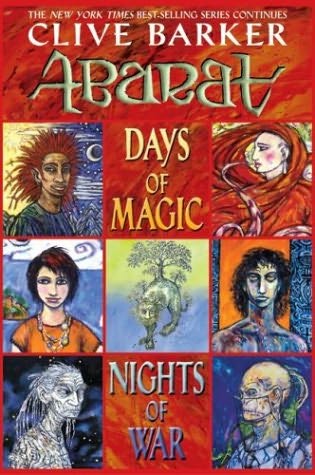 In the realm of young adult fiction, the first two books of the Abarat series are as amazing as anything created by L. Frank Baum, but the Wicked Witch of the West has nothing on Barker's dark villains. And Dorothy's spunk pales beside that of Candy Quackenbush. These books are full of nightmare and beauty, and are only the beginning of what's apparently intended to be a five-part saga.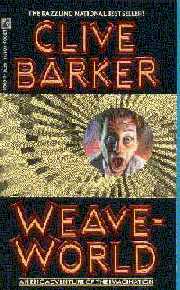
On a much more adult level, works such as my favorite, Weaveworld, contain a sensuality (and sexuality) that the kid's books understandably can't approach. Descriptions of both people and places are vivid, and Barker's worlds are so fully, fantastically developed that they go beyond just drawing the reader in to making them want to enter the pages and inhabit these amazing realms.

I'm normally an empirically-minded pragmatist, and yet this story of forgotten magic and forgotten selves puts me into a mood to wonder what sorts of mysteries the real (or should that be "real"?) world has disremembered. Which makes it a nicely appropriate prelude to the coming season of autumn and Halloween. From Barker to Poe, one fantastic master to another.
June 12, 2009
Farewell to Yr
What is it about madness that so fascinates? Is it a tentatively acknowledged fear that the grasp on sanity is tenuous? Or is it an attraction to the honesty of insanity, the letting go of our internal guard in exchange for freeing the deeply buried urges inside of us?
A couple of decades ago, perusing the crammed shelves of a used bookstore, I picked up a copy of I Never Promised You a Rose Garden. The story of Joanne Greenberg's experiences (told through the character of Deborah) is stunningly eye-opening, with stark descriptions of the patients' characters and behavior, and of the treatments they received, off-set by the intelligently sharp wit Greenberg possessed even then. One passage that's always stuck with me takes place after several patients gang up on one of the ward attendants and Deborah is called upon to explain what took place:
"Well... Hobbs came down the hall and then there was the fight. It was a good fight, too; not too loud and not too soft. Lucy Martenson's fist intruded into Mr. Hobbs's thought processes, and his foot found some of Lee Miller. I had a foot out, too, but nobody used it."
... Deborah knew why it was Hobbs and not McPherson... Hobbs was a little brutal sometimes, but it was more than that. He was frightened of the craziness he saw around him because it was an extension of something inside himself. He wanted people to be crazier and more bizarre than they really were so that he could see the line which separated him, his inclinations and random thoughts, and his half-wishes, from the full-bloomed, exploded madness of the patients. McPherson, on the other hand, was a strong man, even a happy one. He wanted the patients to be like him, and the closer they got to being like him, the better he felt. He kept calling to the similarity between them, never demanding, but subtly, secretly calling, and when a scrap of it came forth, he welcomed it. The patients had merely continued to give each man what he really wanted. There was no injustice done, and Deborah had realized earlier in the day that Hobbs's broken wrist was only keeping him a while longer from winding up on some mental ward as a patient.
That's it, right there. Experiencing the insane is to walk the fine line between Hobbs and McPherson. When I found out that I lived only a handful of miles from the sanitarium at which Greenberg was treated, I was of course elated. The place was Chestnut Lodge, in the historic district of Rockville, MD, a huge Addams Family-ish building set on 20 or so acres of huge old white oaks (the chestnut trees after which it was named fell victim to blight many years ago). In its time, the Lodge was world-famous for its treatments. A few decades later, those same treatments would bring it notoriety, as the doctors there clung to ice-packing and electro-shock, along with psychoanalysis, while the rest of psychiatry turned towards chemical treatment.

For years I would drive by and peer at the building through the foliage, wondering what went on behind the windows on the upper floors. But I never went there. Even after the hospital closed and the building sat empty, I never stopped the car, never got out and wandered under those trees to see what the place looked and, more importantly, felt like up close.
As it sat empty, a developer bought it and the grounds and began to build luxury homes behind the main building. The Lodge itself was apparently to someday become million-dollar condos, which would bring an end to it being a hangout for the homeless and partying teens.
And now it's gone. At 3:00am this past Sunday morning, ninety-five firefighters responded to a call that the building was on fire. The condition in which it was left apparently made it ripe for burning, and it ended up nothing but a shell. When I finally had a chance to drive by this evening, demolition had already begun and all but the rear portion of the building had been reduced to piles of bricks. But I snagged some memories of what was left, and finally spent some time close enough to see through those mysterious windows, and to wonder, for one final time, about the people who had once passed through those rooms.
Edit in 2020: Since Photobucket has become glitchy and won't display linked photos properly anymore, click here for the full album of including the images below.




A couple of decades ago, perusing the crammed shelves of a used bookstore, I picked up a copy of I Never Promised You a Rose Garden. The story of Joanne Greenberg's experiences (told through the character of Deborah) is stunningly eye-opening, with stark descriptions of the patients' characters and behavior, and of the treatments they received, off-set by the intelligently sharp wit Greenberg possessed even then. One passage that's always stuck with me takes place after several patients gang up on one of the ward attendants and Deborah is called upon to explain what took place:
"Well... Hobbs came down the hall and then there was the fight. It was a good fight, too; not too loud and not too soft. Lucy Martenson's fist intruded into Mr. Hobbs's thought processes, and his foot found some of Lee Miller. I had a foot out, too, but nobody used it."
... Deborah knew why it was Hobbs and not McPherson... Hobbs was a little brutal sometimes, but it was more than that. He was frightened of the craziness he saw around him because it was an extension of something inside himself. He wanted people to be crazier and more bizarre than they really were so that he could see the line which separated him, his inclinations and random thoughts, and his half-wishes, from the full-bloomed, exploded madness of the patients. McPherson, on the other hand, was a strong man, even a happy one. He wanted the patients to be like him, and the closer they got to being like him, the better he felt. He kept calling to the similarity between them, never demanding, but subtly, secretly calling, and when a scrap of it came forth, he welcomed it. The patients had merely continued to give each man what he really wanted. There was no injustice done, and Deborah had realized earlier in the day that Hobbs's broken wrist was only keeping him a while longer from winding up on some mental ward as a patient.
That's it, right there. Experiencing the insane is to walk the fine line between Hobbs and McPherson. When I found out that I lived only a handful of miles from the sanitarium at which Greenberg was treated, I was of course elated. The place was Chestnut Lodge, in the historic district of Rockville, MD, a huge Addams Family-ish building set on 20 or so acres of huge old white oaks (the chestnut trees after which it was named fell victim to blight many years ago). In its time, the Lodge was world-famous for its treatments. A few decades later, those same treatments would bring it notoriety, as the doctors there clung to ice-packing and electro-shock, along with psychoanalysis, while the rest of psychiatry turned towards chemical treatment.
For years I would drive by and peer at the building through the foliage, wondering what went on behind the windows on the upper floors. But I never went there. Even after the hospital closed and the building sat empty, I never stopped the car, never got out and wandered under those trees to see what the place looked and, more importantly, felt like up close.
As it sat empty, a developer bought it and the grounds and began to build luxury homes behind the main building. The Lodge itself was apparently to someday become million-dollar condos, which would bring an end to it being a hangout for the homeless and partying teens.
And now it's gone. At 3:00am this past Sunday morning, ninety-five firefighters responded to a call that the building was on fire. The condition in which it was left apparently made it ripe for burning, and it ended up nothing but a shell. When I finally had a chance to drive by this evening, demolition had already begun and all but the rear portion of the building had been reduced to piles of bricks. But I snagged some memories of what was left, and finally spent some time close enough to see through those mysterious windows, and to wonder, for one final time, about the people who had once passed through those rooms.
Edit in 2020: Since Photobucket has become glitchy and won't display linked photos properly anymore, click here for the full album of including the images below.
March 23, 2009
Out from the woods: Yet more random babblings
Got out on the bike yesterday for the first time in five months. I left the computer at home, and my intention was to just ride easy with no care for mileage, cadence, or speed. It started out well enough, easy as I'd intended, turning the pedals at a smooth, loping pace. But then it became... not quite hard, but... effortful. I can blame part of it on a slight wind that kicked up periodically (always a cross-wind, never a tail-wind, of course), but the rest? So many of last year's rides were like this, easy one moment, the next a concerted effort to keep the cranks turning smoothly at the same rhythm. I've begun a series of doctor's appointments to check out everything from my asthma to the heart flutters I experienced last summer and fall. There's got to be something at the root of this fatigue, whether it's my heart, my lungs, diet, poor sleep, the beginnings of inherited fybromyalgia, I want to find the deficiency and correct it.
So this morning I woke up feeling sluggish and out of it, not to mention sore in the saddle area. Not getting on the bike today, how about a nice, easy hike instead? Almost thought I was too tired even for that, but I finally forced the car in the direction of one of the many local trails and headed out. By that point I felt absolutely no desire to exert myself, but wanted badly to be out in the woods under the vibrant blue sky. After wandering probably less than a mile, I found a good spot and plopped my fatigued ass down by the creek, where my mind turned to a series of thoughts that've been fermenting in the vat of my brain over the last few weeks.
Between my own gradually increasing physical limitations (fuck it, let's call a spade a spade-- middle-age is slowing me down) and recent synchronistic reminders of Ego (it's a big subject, so it gets a capital 'E'), a bit of Baudelaire struck me that I may as well share...

Carrion
Remember, my soul, the thing we saw
that lovely summer day?
On a pile of stones where the path turned off,
the hideous carrion --
legs in the air, like a whore -- displayed,
indifferent to the last,
a belly slick with lethal sweat
and swollen with foul gas.
The sun lit up that rottenness
as though to roast it through,
restoring to Nature a hundredfold
what she had here made one.
And heaven watched the splendid corpse
like a flower open wide --
you nearly fainted dead away
at the perfume it gave off.
Flies kept humming over the guts
from which a gleaming clot
of maggots poured to finish off
what scraps of flesh remained.
The tide of trembling vermin sank,
then bubbled up afresh
as if the carcass, drawing breath,
by their lives lived again
and made a curious music there --
like running water, or wind,
or the rattle of chaff the winnower
loosens in his fan.
Shapeless -- nothing was left but a dream
the artist had sketched in,
forgotten, and only later on
finished from memory.
Behind the rocks the anxious bitch
eyed us reproachfully,
waiting for the chance to resume
her interrupted feast.
-- Yet you will come to this offence,
this horrible decay,
you, the light of my life, the sun
and moon and stars of my love!
Yes, you will come to this, my queen,
after the sacraments,
when you rot underground among
the bones already there.
But as their kisses eat you up,
my Beauty, tell the worms
I've kept the sacred essence, saved
the form of my rotted loves!
(as translated by Richard Howard)
Somehow, that's both alarming and comforting to me. Alarming when I think in the short, egoistic term, as it reminds me of the decay within that will only continue to make physical exertion more and more difficult. Comforting, though, when I let go of ego and realize that we all come to this. No matter our beauty, intelligence, physical prowess, or lack of any thereof, the one thing that unites us all, the greatest reminder of our sameness, is the way we end. The thought is humbling and reassuring, albeit a bit morbid in its inspiration.

So this morning I woke up feeling sluggish and out of it, not to mention sore in the saddle area. Not getting on the bike today, how about a nice, easy hike instead? Almost thought I was too tired even for that, but I finally forced the car in the direction of one of the many local trails and headed out. By that point I felt absolutely no desire to exert myself, but wanted badly to be out in the woods under the vibrant blue sky. After wandering probably less than a mile, I found a good spot and plopped my fatigued ass down by the creek, where my mind turned to a series of thoughts that've been fermenting in the vat of my brain over the last few weeks.
Between my own gradually increasing physical limitations (fuck it, let's call a spade a spade-- middle-age is slowing me down) and recent synchronistic reminders of Ego (it's a big subject, so it gets a capital 'E'), a bit of Baudelaire struck me that I may as well share...
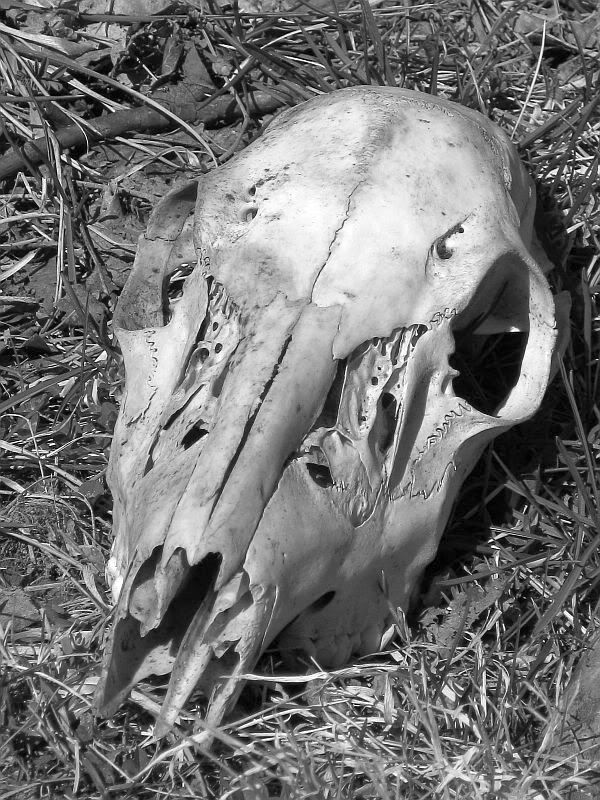
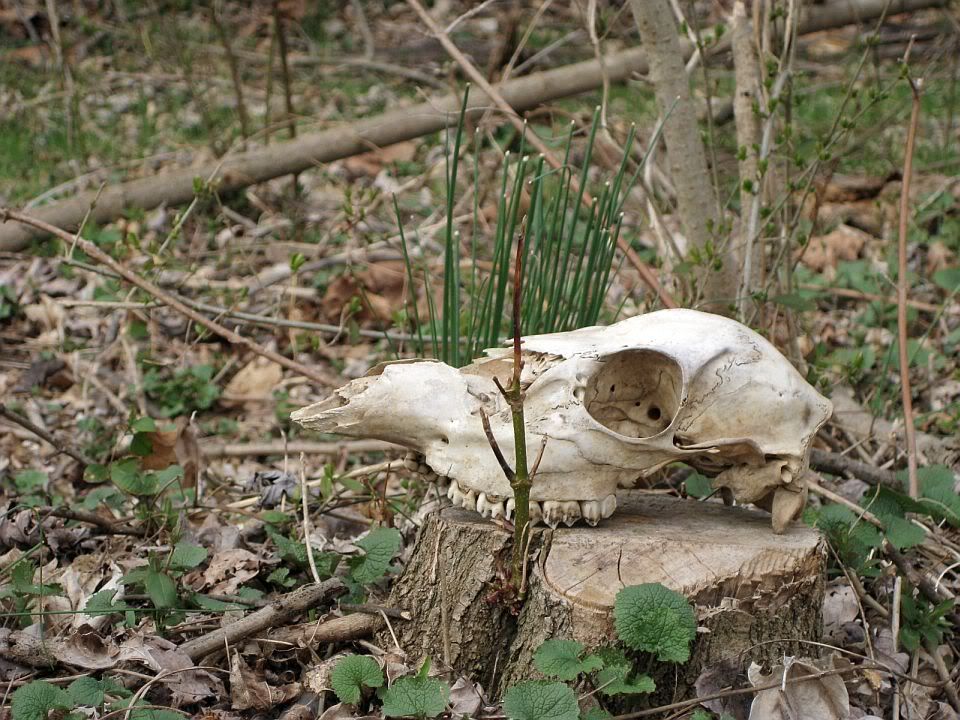
Carrion
Remember, my soul, the thing we saw
that lovely summer day?
On a pile of stones where the path turned off,
the hideous carrion --
legs in the air, like a whore -- displayed,
indifferent to the last,
a belly slick with lethal sweat
and swollen with foul gas.
The sun lit up that rottenness
as though to roast it through,
restoring to Nature a hundredfold
what she had here made one.
And heaven watched the splendid corpse
like a flower open wide --
you nearly fainted dead away
at the perfume it gave off.
Flies kept humming over the guts
from which a gleaming clot
of maggots poured to finish off
what scraps of flesh remained.
The tide of trembling vermin sank,
then bubbled up afresh
as if the carcass, drawing breath,
by their lives lived again
and made a curious music there --
like running water, or wind,
or the rattle of chaff the winnower
loosens in his fan.
Shapeless -- nothing was left but a dream
the artist had sketched in,
forgotten, and only later on
finished from memory.
Behind the rocks the anxious bitch
eyed us reproachfully,
waiting for the chance to resume
her interrupted feast.
-- Yet you will come to this offence,
this horrible decay,
you, the light of my life, the sun
and moon and stars of my love!
Yes, you will come to this, my queen,
after the sacraments,
when you rot underground among
the bones already there.
But as their kisses eat you up,
my Beauty, tell the worms
I've kept the sacred essence, saved
the form of my rotted loves!
(as translated by Richard Howard)
Somehow, that's both alarming and comforting to me. Alarming when I think in the short, egoistic term, as it reminds me of the decay within that will only continue to make physical exertion more and more difficult. Comforting, though, when I let go of ego and realize that we all come to this. No matter our beauty, intelligence, physical prowess, or lack of any thereof, the one thing that unites us all, the greatest reminder of our sameness, is the way we end. The thought is humbling and reassuring, albeit a bit morbid in its inspiration.
February 6, 2009
Recent readings: Chocolate-covered understanding
Zen... is nondoctrinal, concrete, existential, and seeks above all to come to grips with life itself, not with ideas about life, still less with party platforms in politics, religion, science or anything else.
(Thomas Merton, Zen and the Birds of Appetite)

Merton's description of Zen fairly well sums up the point of Brad Warner's latest book, Zen Wrapped in Karma Dipped in Chocolate. Brad uses himself and the chaos of his life in 2007 as a visceral example of the ways in which Buddhism, Zen specifically, is misunderstood. Now, I should say off the bat that Warner's writing is not for everyone. Near the end of the book, Brad describes himself as "too shy and indirect." That may be so in person, but his writing is blatant and direct, sometime vulgar, and very often goofily funny. His books tend to hit you like a Three Stooges poke in the eyes. After you rub the shock away, you can't help but see things differently.
Now, for that misunderstanding. I'll admit, I immediately fell for the neat little myth that Buddhism brings an all-encompassing calm to one's life. I mean, heck, folks like the Dalai Lama and Pema Chodron are always shown with happy, almost impish, grins on their faces. That's how we're all supposed to end up after enough time on the cushion, right? Wrong, at least where Zen is concerned:
The Middle Way was not some kind of spiritual path designed to make us all holy with shiny pink halos on our noggins. It was a way to live a life that wasn't a piece of shit. It was a way to find happiness and stability in an unhappy and unstable world. That's really all any of us are looking for, when it comes down to it. The stability of the Middle Way comes in our practice of zazen [meditation], which is the actual physical and mental practice of stability and happiness. A bit of zazen... radiates throughout the rest of the day and night and makes everything better. That's all there is to it.
And yet:
You may be wondering why, with all my Zen training, I would still feel this kind of tension. If you are, I understand. When I first started all this meditation stuff I also believed that it would fix me so that I'd never feel a bad feeling ever, ever again. It doesn't work that way, I'm afraid.
The practice does make this kind of stuff easier. But no amount of enlightenment will eliminate all stress and tension from your life. We all have a certain amount of karma to get through, and nothing can change that... The best you can do is learn how to add as little new garbage to the pile as possible. But this in itself is a very significant thing.
Sound a tad contradictory and confusing? What it all comes down to is expectation. Ultimately, the source of all our dukkha, all our squirmy dissatisfactions and outright suffering, is that we expect the world and our lives to be a certain way. We expect to be happy, to never feel emotional anguish or physical pain, to never be divorced or lose a job, to never break a leg or get cancer, and for the sun to always come out tomorrow. But we never see that the problem is the expectation itself. We become so caught up in the contrast between what is and what we were hoping for that just dealing with the situation as it is becomes unbearable. We forget to "...on every occasion ask thyself, what is there in this which is intolerable and past bearing?" (Marcus Aurelius, Meditations, Book VII, 36. Those Stoics sure had a lot in common with Buddhism.)
In ZWiKDiC, Warner clarified this for me succinctly, yet indirectly. In describing the questions he was asked during a sesshin dharma talk, he mentions that one participant asked how to avoid expectations in Zen practice. Brad's answer speaks specifically to all that crap I babbled about above:
...anyone doing this practice is going to have expectations. You expect to achieve peace of mind. You expect to deepen your understanding. You expect to get enlightenment.... There's no way to stop having expectations. The best you can do is understand that your expectations will never be realized... Just know that your expectations are only thoughts in your head, and keep on doing what you do.
Understand?
And speaking of chocolatey goodness, I need to find me some chocolate-covered Pop Rocks. Fizzy popping chocolate. Sounds like awesomeness.
(Thomas Merton, Zen and the Birds of Appetite)

Merton's description of Zen fairly well sums up the point of Brad Warner's latest book, Zen Wrapped in Karma Dipped in Chocolate. Brad uses himself and the chaos of his life in 2007 as a visceral example of the ways in which Buddhism, Zen specifically, is misunderstood. Now, I should say off the bat that Warner's writing is not for everyone. Near the end of the book, Brad describes himself as "too shy and indirect." That may be so in person, but his writing is blatant and direct, sometime vulgar, and very often goofily funny. His books tend to hit you like a Three Stooges poke in the eyes. After you rub the shock away, you can't help but see things differently.
Now, for that misunderstanding. I'll admit, I immediately fell for the neat little myth that Buddhism brings an all-encompassing calm to one's life. I mean, heck, folks like the Dalai Lama and Pema Chodron are always shown with happy, almost impish, grins on their faces. That's how we're all supposed to end up after enough time on the cushion, right? Wrong, at least where Zen is concerned:
The Middle Way was not some kind of spiritual path designed to make us all holy with shiny pink halos on our noggins. It was a way to live a life that wasn't a piece of shit. It was a way to find happiness and stability in an unhappy and unstable world. That's really all any of us are looking for, when it comes down to it. The stability of the Middle Way comes in our practice of zazen [meditation], which is the actual physical and mental practice of stability and happiness. A bit of zazen... radiates throughout the rest of the day and night and makes everything better. That's all there is to it.
And yet:
You may be wondering why, with all my Zen training, I would still feel this kind of tension. If you are, I understand. When I first started all this meditation stuff I also believed that it would fix me so that I'd never feel a bad feeling ever, ever again. It doesn't work that way, I'm afraid.
The practice does make this kind of stuff easier. But no amount of enlightenment will eliminate all stress and tension from your life. We all have a certain amount of karma to get through, and nothing can change that... The best you can do is learn how to add as little new garbage to the pile as possible. But this in itself is a very significant thing.
Sound a tad contradictory and confusing? What it all comes down to is expectation. Ultimately, the source of all our dukkha, all our squirmy dissatisfactions and outright suffering, is that we expect the world and our lives to be a certain way. We expect to be happy, to never feel emotional anguish or physical pain, to never be divorced or lose a job, to never break a leg or get cancer, and for the sun to always come out tomorrow. But we never see that the problem is the expectation itself. We become so caught up in the contrast between what is and what we were hoping for that just dealing with the situation as it is becomes unbearable. We forget to "...on every occasion ask thyself, what is there in this which is intolerable and past bearing?" (Marcus Aurelius, Meditations, Book VII, 36. Those Stoics sure had a lot in common with Buddhism.)
In ZWiKDiC, Warner clarified this for me succinctly, yet indirectly. In describing the questions he was asked during a sesshin dharma talk, he mentions that one participant asked how to avoid expectations in Zen practice. Brad's answer speaks specifically to all that crap I babbled about above:
...anyone doing this practice is going to have expectations. You expect to achieve peace of mind. You expect to deepen your understanding. You expect to get enlightenment.... There's no way to stop having expectations. The best you can do is understand that your expectations will never be realized... Just know that your expectations are only thoughts in your head, and keep on doing what you do.
Understand?
And speaking of chocolatey goodness, I need to find me some chocolate-covered Pop Rocks. Fizzy popping chocolate. Sounds like awesomeness.
February 1, 2009
Happy (belated) birthday, Eddie.
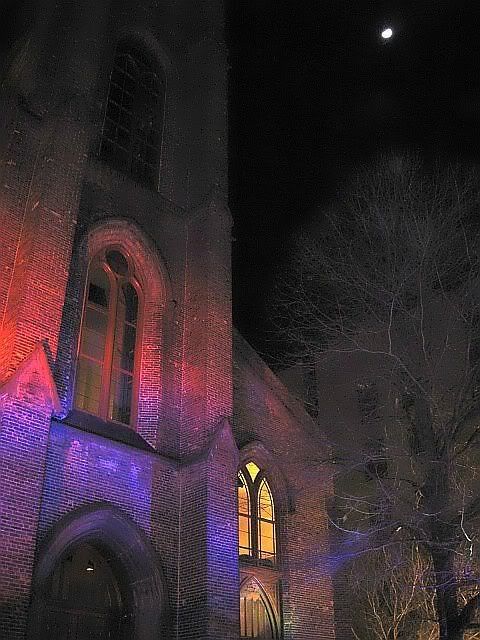
Today was the final day of the bicentennial edition of Baltimore's annual Edgar Allen Poe birthday celebration. I've attended a few times in years past, but had to go again to laud Eddie on his 200th year. The event took place, as always, at Westminster Hall, which was once Westminster Burial Ground, which is where Poe, his young wife/cousin and his mother-in-law/aunt are buried together. Unfortunately, photography was not allowed during the performances, so I'll have to try to sum it up in words.
The celebration began with the singing of "Annabel Lee" by a female soprano. I'm sure her voice would be considered lovely, but high-pitched female voices make me cringe so I could have done without. She was followed by a very cheesy, low-budget pantomime/puppet performance of Hop Frog, after which the event really got good. Third on the bill was local actor Tony Tsendeas in the role of the narrator of The Tell-Tale Heart. Tony's portrayal of this short story has been a recurring part of the annual Poe Halloween celebration at Westminster and this was probably the 5th or 6th time I've seen it. He still had me on the edge of my seat. I'd love to see him do a similar performance of Poe's The Black Cat.
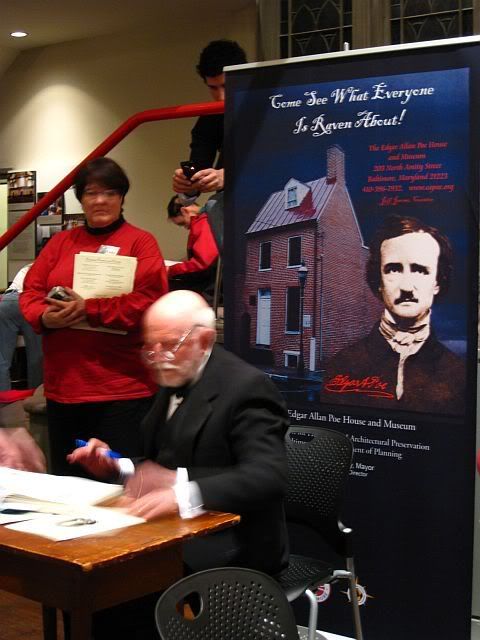
After a short intermission, Jeff Jerome (curator of the nearby Poe House and Museum) introduced the night's special guest, John Astin. It's been several years since Astin's last appearance at the birthday event. When I saw him on that occasion, he was a dead-ringer (no pun intended) for Poe. Tonight, I almost didn't recognize him as he strode up the aisle to the stage. The years have altered him from Gomez Adddams into a bald-pated, white-bearded grandfather-ly figure. Still hearty and spry, though, and dashing in his tuxedo as he sat on the stage in a chair once used by Poe himself. Then, in the unmistakable voice of Gomez, he read some of Eddie's darkest works as if they were bed-time stories, relating each piece to the highs and lows, the few joys and many losses, of Poe's life. I didn't recognize the first piece as it was brief and over too quickly, but the rest of Mr. Astin's selections were:
- "Conqueror Worm"
- The Masque of the Red Death
- "To Helen"
- "A Dream Within a Dream"
- "Eulalie"
- A portion of a letter written by Poe, in which he describes the prolonged death of his beloved Virginia from tuberculosis, and his resultant "insanity"
- "The Raven" (can't leave that one out, especially in Baltimore)
- "To One in Paradise"
- Passages from the prose poem, Eureka, which apparently displays Poe's prescient predictions in cosomology.
- "For Annie"
- '"Annabel Lee" (Astin's reading was much preferable to the female vocalist earlier in the evening)
And finally,
- "Eldorado"
The evening concluded with the annual apple cider toast to Poe and more squirming from me as the female vocalist returned to wail Amazing Grace and Auld Lang Syne. I'd have been happy for things to have just ended with Poe's own words from an 1844 letter, as quoted in the toast:
"You speak of 'an estimate' of my life'-- and, from what I have already said, you will see that I have none to give. I have been too deeply conscious of the mutability and evanescence of temporal things, to give any continuous effort to anything-- to be consistent in anything. My life has been whim-- impulse-- passion-- a longing for solitude-- a scorn of all things present, in an earnest desire for the future."
I'm sure Eddie had no clue just how those of us in the future would come to regard him. I hope it would have brought him satisfaction and a measure of peace.
Memorabilia of the night

Westminster Hall

John Astin signing autographs. The guy would not sit still-

The celebration began with the singing of "Annabel Lee" by a female soprano. I'm sure her voice would be considered lovely, but high-pitched female voices make me cringe so I could have done without. She was followed by a very cheesy, low-budget pantomime/puppet performance of Hop Frog, after which the event really got good. Third on the bill was local actor Tony Tsendeas in the role of the narrator of The Tell-Tale Heart. Tony's portrayal of this short story has been a recurring part of the annual Poe Halloween celebration at Westminster and this was probably the 5th or 6th time I've seen it. He still had me on the edge of my seat. I'd love to see him do a similar performance of Poe's The Black Cat.
After a short intermission, Jeff Jerome (curator of the nearby Poe House and Museum) introduced the night's special guest, John Astin. It's been several years since Astin's last appearance at the birthday event. When I saw him on that occasion, he was a dead-ringer (no pun intended) for Poe. Tonight, I almost didn't recognize him as he strode up the aisle to the stage. The years have altered him from Gomez Adddams into a bald-pated, white-bearded grandfather-ly figure. Still hearty and spry, though, and dashing in his tuxedo as he sat on the stage in a chair once used by Poe himself. Then, in the unmistakable voice of Gomez, he read some of Eddie's darkest works as if they were bed-time stories, relating each piece to the highs and lows, the few joys and many losses, of Poe's life. I didn't recognize the first piece as it was brief and over too quickly, but the rest of Mr. Astin's selections were:
- "Conqueror Worm"
- The Masque of the Red Death
- "To Helen"
- "A Dream Within a Dream"
- "Eulalie"
- A portion of a letter written by Poe, in which he describes the prolonged death of his beloved Virginia from tuberculosis, and his resultant "insanity"
- "The Raven" (can't leave that one out, especially in Baltimore)
- "To One in Paradise"
- Passages from the prose poem, Eureka, which apparently displays Poe's prescient predictions in cosomology.
- "For Annie"
- '"Annabel Lee" (Astin's reading was much preferable to the female vocalist earlier in the evening)
And finally,
- "Eldorado"
The evening concluded with the annual apple cider toast to Poe and more squirming from me as the female vocalist returned to wail Amazing Grace and Auld Lang Syne. I'd have been happy for things to have just ended with Poe's own words from an 1844 letter, as quoted in the toast:
"You speak of 'an estimate' of my life'-- and, from what I have already said, you will see that I have none to give. I have been too deeply conscious of the mutability and evanescence of temporal things, to give any continuous effort to anything-- to be consistent in anything. My life has been whim-- impulse-- passion-- a longing for solitude-- a scorn of all things present, in an earnest desire for the future."
I'm sure Eddie had no clue just how those of us in the future would come to regard him. I hope it would have brought him satisfaction and a measure of peace.
Memorabilia of the night
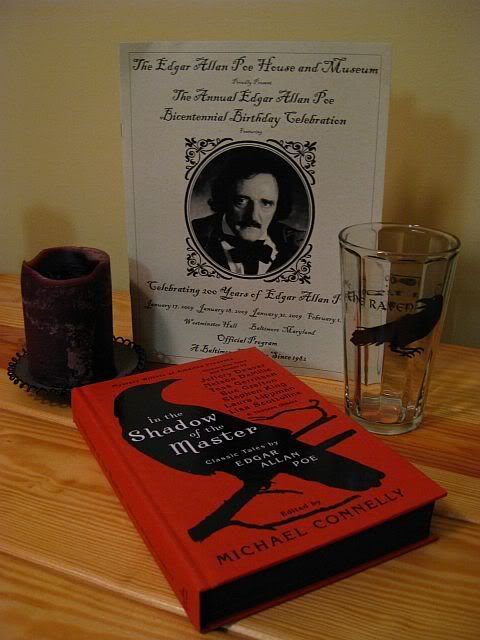
Westminster Hall
John Astin signing autographs. The guy would not sit still-
January 31, 2009
Recent readings: Living with the devil in the Maine woods
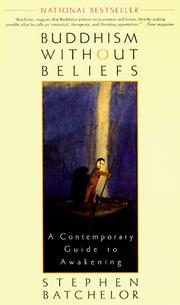 Living with the Devil, A Meditation on Good and Evil and Buddhism Without Beliefs, Stephen Batchelor:
I got into Batchelor's writing because I was attracted to the cover of Living With the Devil (human being, check it out). What I found inside was, as much as I hate to resort to cliche, a revelation. Like Brad Warner, Batchelor espouses a version of Zen Buddhism that doesn't so much strip away mysticism as make realism magical. In LWtD, he begins by explaining the importance of learning to "encounter the raw, unfiltered contingency of life itself":
...Contingency reveals a chaotic freedom at the heart of of causally ordered events. However tempting it is to invoke the hand of God, karma, or destiny to inject a hidden order into what seems random, embracing contingency requires a willingness to accept the inexplicable and unpredictable instead of reaching for the anesthetic comfort of metaphysics.
The opposite of "contingency" is "necessity." No matter how ephemeral and insignificant I recognize this human life of mine to be, I cannot shake off an intuitive conviction that, deep down, my existence is necessary in the scheme of things. By paying close and sustained attention to the contingent nature of experience, the practice of Buddhist meditation challenges the instinctive feeling that we are, in the words of Milton's Satan, "self-begot, self-raised / By our own quick'ning power." In eroding this sense of our own necessity, we come to see how the unprecedented and unrepeatable person we are emerges from a sublime matrix of myriad contingent events-- no one of which need have happened either. Insight into the emptiness of self is achieved not by eliminating self but by understanding it to be contingent rather than necessary.
In BWB, he takes this freedom from necessity further by applying it directly to Buddhism and stating that "the dharma is not something to believe in but something to do." The book begins with one of the most definitive of quotes from the Buddha's Kalama Sutta:
"Do not be satisfied with hearsay or with tradition or with legendary lore or with what has come down in scriptures or with conjecture or with logical inference or with weighing evidence or with liking for a view after pondering it over or with someone else's ability or with the thought 'The monk is our teacher.' When you know in yourselves: 'These things are wholesome, blameless, commended by the wise, and being adopted and put into effect they lead to welfare and happiness,' then you should practice and abide in them."
Both books encompass so much more than their titles suggest, and both have become manuals of a sort for me to use in navigating the pitfalls of both life and my own nature. Most concretely, Batchelor's meditation instruction was what it finally took for me to get my ass on the mat and begin a daily practice (well, almost daily. Let's say every other day). Settling my monkey-mind has been a serious challenge, as it is for so many others, and focusing on the breath has been more a distraction than a means to open into emptiness. The light bulb went off while reading LWtD, though, when Batchelor wrote:
The trick is to remain fully aware of the breath without awareness impeding its natural ebb and flow... One way to do this is to wait for the breath to happen. After each inhalation and exhalation, there follows a brief pause as the muscles change gear, as it were, before releasing the pent-up air or drawing a fresh breath. The self-consciousness of breathing is most pronounced at these two moments: suddenly it feels as though "I" must inhale or exhale. To dispel this sense of agency, during each pause remain a disinterested observer, curious to notice when and how the muscles will engage of their own accord to initiate the next inbreath or outbreath. Just wait for the next phase in the breathing to kick in: with no expectation as to when it should start, no preparation for it to be deep or shallow, no anticipation for it to be forceful or gentle.
I still often find the breath to be like Schrodinger's Cat-- being conscious of it does affect its nature, no matter how long I wait for that inhalation. But Batchelor's advice is something specific to practice, and that has made all the difference.
The change in my mood and equilibrium since finding these two books has been subtle yet profound. As Batchelor himself puts it, "life [has become] less of a defensive stance to preserve an immutable self and more of an ongoing task to complete an unfinished tale." And that's tremendously freeing.
(My impressions of Brad Warner's books can be found here, for anyone who's interested.)
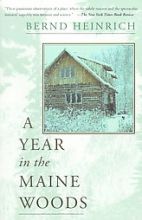
A Year in the Maine Woods, Bernd Heinrich:
The linked review is an excellent summation of this book, but I disagree strongly with its criticisms. I just re-read AYitMW for about the fourth time, and the elements that so disturb the reviewer are exactly what I love about it. It's to the point that, like Inman in Cold Mountain, randomly opening up his copy of Bartram's Travels and finding peace within the pages, I can open Heinrich's book to any page and become immersed. I did this recently when I found myself between books and unsure of what I was in the mood for, beginning sometime mid-winter both in the book and in the real world outside. When I reached the last page at spring-time, I went back to the start and continued into the beginning of summer. And all the while that I read about the return of song-birds and blossoming of leaves on trees, it was bitterly cold outside my window (thought nowhere near the minus temperatures Heinrich experienced in the Maine winter). The fact that the narrative follows the seasons rather than a linear story-line gives the book a circular quality that easily allows it to be read in this way, and Heinrich's descriptions are so explicit that the reader is transported and doesn't even realize the amount of scientific information being digested and tucked away. Anyone looking for a deeper connection to the natural world would do well to pick this one up.
January 2, 2009
On the path, but left of the murder
The process of awakening is like walking on a footpath. When we find such a path after hours of struggling through the undergrowth, we know at last that we are heading somewhere. Moreover, we suddenly find that we can move freely without obstruction. We settle into a rhythmic and easy pace. At the same time we are reconnected to others: men, women, and animals who have walked here before us. The path is maintained as a path only because of the tread of feet. Just as others have created this path for us, so by walking on it we maintain it for those who will come after us.
(Stephen Batchelor, Buddhism Without Beliefs)
As always, I read those words through the prism of my own experiences and mind-set, and used them as a springboard for self-analysis.
Paths are a common feature in my life, from the Buddhist path I've been attempting to follow to the literal paths I tromp through the woods. Along each of these sorts of paths, the greatest source of conflict for me has been that connection to others to which Batchelor refers. I've written before (ad naauuuuseaum) of how I go through periods of connection, when I find a handful or so of people with whom I can relate and try to develop friendships, and, at other times, through periods of solitude. Invariably, at some point, the periods of connection contain moments of inconvenience, annoyance, frustration, and/or anguish. It's often hard for me to balance all of that against the moments of fun, sharing, learning, and/or growth that are also part of connection. And the periods of solitude can be full of richness and contentment, yet at the same time feed my egoistic misanthropy.
In the woods, on those literal footpaths, I'm also frequently annoyed by the presence of others, and not just the noisy, oblivious folks who are so busy making sure they say "Hi!" that they scare away the deer I've been watching for five minutes... First, an example of that type: I recently headed up to a state park that allows hunting in season, hoping that would deter most other hikers. The trail I planned to hike is aptly named Old Misery. It's short, but ascends 500 feet or so within the first half-mile, through a series of switchbacks so rocky it's sometimes hard to follow where the trail's headed.

Beyond this, though, it levels out along the top of the ridge and passes through a dense fern sea.
Picture all of that orangey-red growth as lush green ferns in the summer-time...

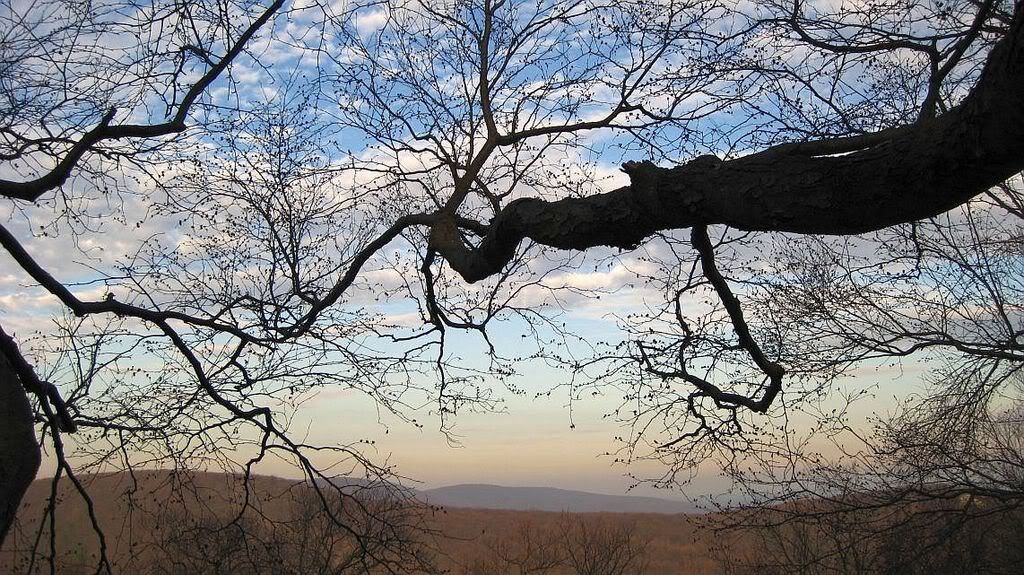
It then skirts the edge of the ridge and at one point runs next to a talus slope that overlooks the spine of the mountains heading north.

That's where I was, relaxing in the crook of a low-growing tree limb and taking in the vista. From behind, I suddenly heard "Hey! Hey there!" I turned and traded the beautiful view for the sight of a yuppie doofus in what appeared to be ski tights, big-ass shin-high climbing boots, and a backpack. He stood in the middle of the trail and called down the hill to ask me what was ahead. We went back and forth for a while as I tried to orient him to the area in order to explain what his options were. Three times I asked which way he had come to get to the trail (i.e. along what road), and three times I was told that he had come from the Old Misery trailhead down by the lake. No duh, dude, that's only way you could have come on the trail considering the direction you were headed. The equally big-booted teen-aged boy with the guy (who at least wore his big-ass boots with plain old jeans) finally spoke up and I was able to describe to him what other trails they would meet and where those led. But I spent the rest of my hike wondering what someone like that guy was doing out in the woods. What could he get out of it? Laughably over-equipped, he didn't know where he had come from and was clueless where he was going. Being so incredibly oblivious, what sort of connection could he possibly have with his surroundings, what intimacy with nature, if any? That boggles my mind.
Even when physically absent, the implied presence of other people on the trail irks me. As the population in the mid-Atlantic has grown, attendance in local parks has increased along with it. The result is trails that were once the width of my two feet are now side-walk wide. And trail stewards in the parks suddenly feel obliged to mark these trails with painted blazes every hundred feet or so. I assume this helps limit their liability, as there's less chance of oblivious types wandering off and getting lost if they can always see at least five blazes away into the distance and follow them like beacons. But for those of us who are more comfortable in the woods, such thoroughly defined trails spoil much of the fun. The tread of others may maintain the trail, but also diminishes the sense of discovery. Early on, I picked up a habit of bush-whacking-- wandering off the established trail to follow animal paths, or just picking a break in the trees and plunging in. The occasional struggle through the undergrowth was a challenge that could exhilarate at the same time that it frustrated. And, more often than not, these solitary, off-the-beaten-path wanderings have led to fantastic discoveries-- a gorgeous overlook, a small cave, a bleached turtle shell or deer antler.
So, just what sort of metaphor is this for the figurative path I've been stumbling along? What does it mean that I prefer the unbeaten path, the road less taken, or even no trail at all? Can I find just as many treasures on my own as I would through personal connections? Or can I awaken only by following the paths trod by others? I'd like to think that there's a middle ground to the Middle Way, that I can spend time on both sorts of paths, that I can be both "out of the line and indivisible", and yet still find my way to some semblance of enlightenment.
A Crow Left of the Murder
Unlearn me.
Ditch what I read
Behind what I heard.
Look. Find. Free.
Yet! Do you get it yet?
Do you get it?!
From here on it's instinctual,
Even straight roads meander.
Every piece contains a map of it all!
It all!
Evidence
In the march of the ants,
Pulse of the sea.
Look. Find. Free.
Yet! Do you get it yet?
Do you get it?!
From here on it's instinctual,
Even straight roads meander.
Every piece contains a map of it all!
It all!
Out of the line and indivisible,
A crow left of the murder.
Every piece contains a map of it all!
It all!
Everything I wanted,
Wanted to know...
Everything I wanted,
Wanted to see.
Unlearn me...
Do you get it yet?
Look, find, free.
Do you get it yet?
(Stephen Batchelor, Buddhism Without Beliefs)
As always, I read those words through the prism of my own experiences and mind-set, and used them as a springboard for self-analysis.
Paths are a common feature in my life, from the Buddhist path I've been attempting to follow to the literal paths I tromp through the woods. Along each of these sorts of paths, the greatest source of conflict for me has been that connection to others to which Batchelor refers. I've written before (ad naauuuuseaum) of how I go through periods of connection, when I find a handful or so of people with whom I can relate and try to develop friendships, and, at other times, through periods of solitude. Invariably, at some point, the periods of connection contain moments of inconvenience, annoyance, frustration, and/or anguish. It's often hard for me to balance all of that against the moments of fun, sharing, learning, and/or growth that are also part of connection. And the periods of solitude can be full of richness and contentment, yet at the same time feed my egoistic misanthropy.
In the woods, on those literal footpaths, I'm also frequently annoyed by the presence of others, and not just the noisy, oblivious folks who are so busy making sure they say "Hi!" that they scare away the deer I've been watching for five minutes... First, an example of that type: I recently headed up to a state park that allows hunting in season, hoping that would deter most other hikers. The trail I planned to hike is aptly named Old Misery. It's short, but ascends 500 feet or so within the first half-mile, through a series of switchbacks so rocky it's sometimes hard to follow where the trail's headed.
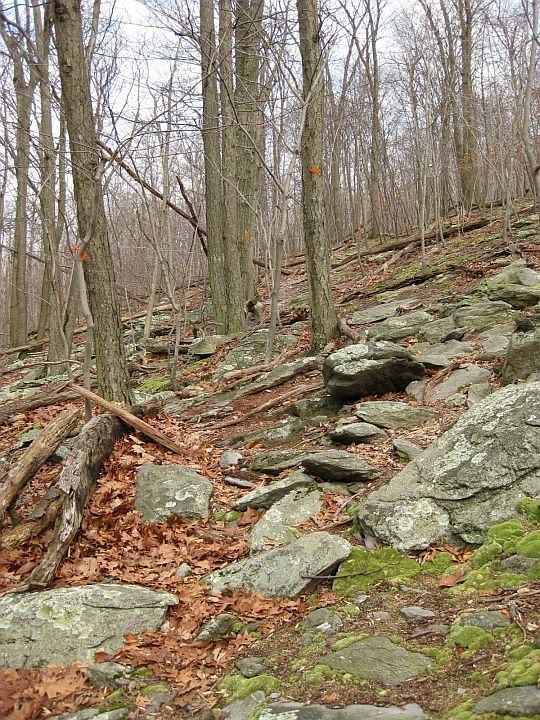
Beyond this, though, it levels out along the top of the ridge and passes through a dense fern sea.
Picture all of that orangey-red growth as lush green ferns in the summer-time...
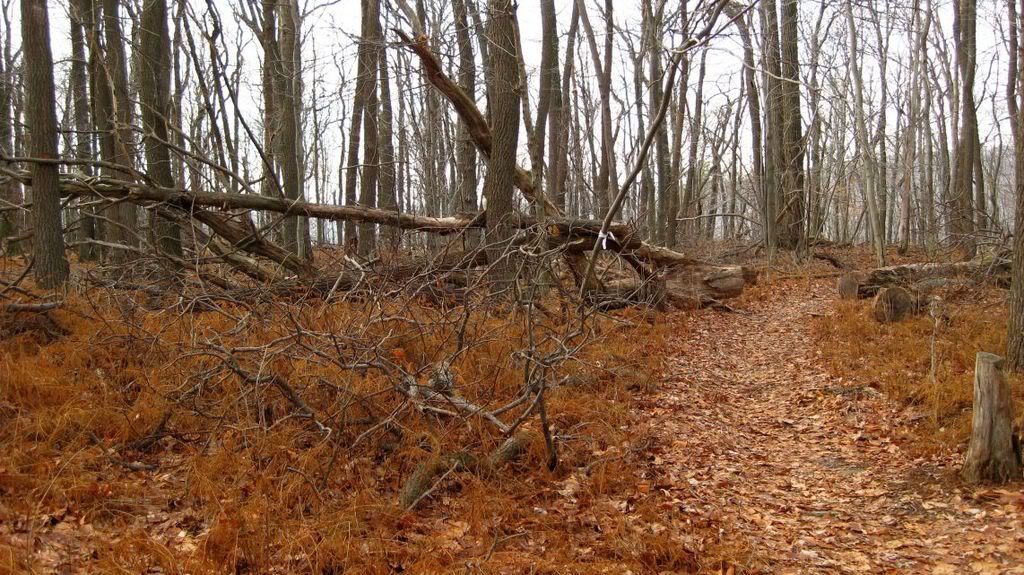
It then skirts the edge of the ridge and at one point runs next to a talus slope that overlooks the spine of the mountains heading north.
That's where I was, relaxing in the crook of a low-growing tree limb and taking in the vista. From behind, I suddenly heard "Hey! Hey there!" I turned and traded the beautiful view for the sight of a yuppie doofus in what appeared to be ski tights, big-ass shin-high climbing boots, and a backpack. He stood in the middle of the trail and called down the hill to ask me what was ahead. We went back and forth for a while as I tried to orient him to the area in order to explain what his options were. Three times I asked which way he had come to get to the trail (i.e. along what road), and three times I was told that he had come from the Old Misery trailhead down by the lake. No duh, dude, that's only way you could have come on the trail considering the direction you were headed. The equally big-booted teen-aged boy with the guy (who at least wore his big-ass boots with plain old jeans) finally spoke up and I was able to describe to him what other trails they would meet and where those led. But I spent the rest of my hike wondering what someone like that guy was doing out in the woods. What could he get out of it? Laughably over-equipped, he didn't know where he had come from and was clueless where he was going. Being so incredibly oblivious, what sort of connection could he possibly have with his surroundings, what intimacy with nature, if any? That boggles my mind.
Even when physically absent, the implied presence of other people on the trail irks me. As the population in the mid-Atlantic has grown, attendance in local parks has increased along with it. The result is trails that were once the width of my two feet are now side-walk wide. And trail stewards in the parks suddenly feel obliged to mark these trails with painted blazes every hundred feet or so. I assume this helps limit their liability, as there's less chance of oblivious types wandering off and getting lost if they can always see at least five blazes away into the distance and follow them like beacons. But for those of us who are more comfortable in the woods, such thoroughly defined trails spoil much of the fun. The tread of others may maintain the trail, but also diminishes the sense of discovery. Early on, I picked up a habit of bush-whacking-- wandering off the established trail to follow animal paths, or just picking a break in the trees and plunging in. The occasional struggle through the undergrowth was a challenge that could exhilarate at the same time that it frustrated. And, more often than not, these solitary, off-the-beaten-path wanderings have led to fantastic discoveries-- a gorgeous overlook, a small cave, a bleached turtle shell or deer antler.
So, just what sort of metaphor is this for the figurative path I've been stumbling along? What does it mean that I prefer the unbeaten path, the road less taken, or even no trail at all? Can I find just as many treasures on my own as I would through personal connections? Or can I awaken only by following the paths trod by others? I'd like to think that there's a middle ground to the Middle Way, that I can spend time on both sorts of paths, that I can be both "out of the line and indivisible", and yet still find my way to some semblance of enlightenment.
A Crow Left of the Murder
Unlearn me.
Ditch what I read
Behind what I heard.
Look. Find. Free.
Yet! Do you get it yet?
Do you get it?!
From here on it's instinctual,
Even straight roads meander.
Every piece contains a map of it all!
It all!
Evidence
In the march of the ants,
Pulse of the sea.
Look. Find. Free.
Yet! Do you get it yet?
Do you get it?!
From here on it's instinctual,
Even straight roads meander.
Every piece contains a map of it all!
It all!
Out of the line and indivisible,
A crow left of the murder.
Every piece contains a map of it all!
It all!
Everything I wanted,
Wanted to know...
Everything I wanted,
Wanted to see.
Unlearn me...
Do you get it yet?
Look, find, free.
Do you get it yet?
June 26, 2008
The Big Read
I stole this from Chrys.
The Big Read thinks the average adult has only read six of the top 100 books they've printed below.
1) Look at the list and bold those you have read.
2) Italicize those you intend to read.
3) Underline the books you LOVE. (Apparently you can't underline on Blogger so, like Chrys, I'm going to star the ones I LOVE).
4) Reprint this list in your own blog so we can try and track down these people who've read 6 and force books upon them.
1. Pride and Prejudice - Jane Austen
2. The Lord of the Rings - JRR Tolkien
3. Jane Eyre - Charlotte Bronte
* 4. Harry Potter Series - JK Rowling
* 5. To Kill a Mockingbird - Harper Lee
6. The Bible (I had parts of it read to me as a child)
7. Wuthering Heights - Emily Bronte
8. Nineteen Eighty Four - George Orwell
9. His Dark Materials - Philip Pullman
10. Great Expectations - Charles Dickens
* 11. Little Women - Louisa M Alcott
12. Tess of the D'Urbervilles - Thomas Hardy
13. Catch 22 - Joseph Heller
* 14. Complete Works of Shakespeare (I haven't read the complete works yet, but I've made it through a hefty percentage of them, hence the star)
15. Rebecca - Daphne Du Maurier
16. The Hobbit - JRR Tolkien
18. Catcher in the Rye - JD Salinger
19. The Time Traveler's Wife - Audrey Niffenegger
20. Middlemarch - George Eliot
21. Gone With The Wind - Margaret Mitchell (Does having seen the movie about a dozen times count?)
22. The Great Gatsby - F Scott Fitzgerald
23. Bleak House - Charles Dickens
24. War and Peace - Leo Tolstoy
25. The Hitch Hiker's Guide to the Galaxy - Douglas Adams (the first one)
26. Brideshead Revisited - Evelyn Waugh
* 27. Crime and Punishment - Fyodor Dostoyevsky
28. Grapes of Wrath - John Steinbeck
* 29. Alice in Wonderland - Lewis Carroll
30. The Wind in the Willows - Kenneth Grahame
31. Anna Karenina - Leo Tolstoy (Maybe, one day)
32. David Copperfield - Charles Dickens
33. Chronicles of Narnia - CS Lewis
34. Emma - Jane Austen
35. Persuasion - Jane Austen
36. The Lion, The Witch and The Wardrobe - CS Lewis
37. The Kite Runner - Khaled Hosseini
38. Captain Corelli's Mandolin - Louis De Bernieres
39. Memoirs of a Geisha - Arthur Golden
40. Winnie the Pooh - AA Milne
41. Animal Farm - George Orwell
42. The Da Vinci Code - Dan Brown
43. One Hundred Years of Solitude - Gabriel Garcia Marquez
44. A Prayer for Owen Meaney - John Irving
45. The Woman in White - Wilkie Collins
46. Anne of Green Gables - LM Montgomery (the first one)
47. Far From The Madding Crowd - Thomas Hardy
48. The Handmaid's Tale - Margaret Atwood
* 49. Lord of the Flies - William Golding
50. Atonement - Ian McEwan
51. Life of Pi - Yann Martel
52. Dune - Frank Herbert
53. Cold Comfort Farm - Stella Gibbons
54. Sense and Sensibility - Jane Austen
55. A Suitable Boy - Vikram Seth
56. The Shadow of the Wind - Carlos Ruiz Zafon
57. A Tale Of Two Cities - Charles Dickens
58. Brave New World - Aldous Huxley
59. The Curious Incident of the Dog in the Night-Time - Mark Haddon
60. Love In The Time Of Cholera - Gabriel Garcia Marquez
61. Of Mice and Men - John Steinbeck
62. Lolita - Vladimir Nabokov
63. The Secret History - Donna Tartt
64. The Lovely Bones - Alice Sebold
65. Count of Monte Cristo - Alexandre Dumas
66. On The Road - Jack Kerouac
67. Jude the Obscure - Thomas Hardy
68. Bridget Jones' Diary - Helen Fielding
69. Midnight's Children - Salman Rushdie
70. Moby Dick - Herman Melville
71. Oliver Twist - Charles Dickens
72. Dracula - Bram Stoker
73. The Secret Garden - Frances Hodgson Burnett
74. Notes From A Small Island - Bill Bryson
75. Ulysses - James Joyce
* 76. The Bell Jar - Sylvia Plath
77. Swallows and Amazons - Arthur Ransome
78. Germinal - Emile Zola
79. Vanity Fair - William Makepeace Thackeray
80. Possession - AS Byatt
81. A Christmas Carol - Charles Dickens
82. Cloud Atlas - David Mitchell
83. The Color Purple - Alice Walker
84. The Remains of the Day - Kazuo Ishiguro
85. Madame Bovary - Gustave Flaubert (Started it in Lit class, didn't finish...)
86. A Fine Balance - Rohinton Mistry
87. Charlotte's Web - EB White
88. The Five People You Meet In Heaven - Mitch Albom
* 89. Adventures of Sherlock Holmes - Sir Arthur Conan Doyle
90. The Faraway Tree Collection - Enid Blyton
91. Heart of Darkness - Joseph Conrad
92. The Little Prince - Antoine De Saint-Exupery
93. The Wasp Factory - Iain Banks
94. Watership Down - Richard Adams
95. A Confederacy of Dunces - John Kennedy Toole
96. A Town Like Alice - Nevil Shute
97. The Three Musketeers - Alexandre Dumas
* 98. Hamlet - William Shakespeare
99. Charlie and the Chocolate Factory - Roald Dahl
100. Les Miserables - Victor Hugo (Another one I started but didn't finish)
Interesting list. I'm surprised at how many of those I've read, and by how many of them I've never even heard of. Of course, though, like any "top 100" list, it's at least partially subjective, no matter what group of people compiled it.
So, who's next?
The Big Read thinks the average adult has only read six of the top 100 books they've printed below.
1) Look at the list and bold those you have read.
2) Italicize those you intend to read.
3) Underline the books you LOVE. (Apparently you can't underline on Blogger so, like Chrys, I'm going to star the ones I LOVE).
4) Reprint this list in your own blog so we can try and track down these people who've read 6 and force books upon them.
1. Pride and Prejudice - Jane Austen
2. The Lord of the Rings - JRR Tolkien
3. Jane Eyre - Charlotte Bronte
* 4. Harry Potter Series - JK Rowling
* 5. To Kill a Mockingbird - Harper Lee
6. The Bible (I had parts of it read to me as a child)
7. Wuthering Heights - Emily Bronte
8. Nineteen Eighty Four - George Orwell
9. His Dark Materials - Philip Pullman
10. Great Expectations - Charles Dickens
* 11. Little Women - Louisa M Alcott
12. Tess of the D'Urbervilles - Thomas Hardy
13. Catch 22 - Joseph Heller
* 14. Complete Works of Shakespeare (I haven't read the complete works yet, but I've made it through a hefty percentage of them, hence the star)
15. Rebecca - Daphne Du Maurier
16. The Hobbit - JRR Tolkien
18. Catcher in the Rye - JD Salinger
19. The Time Traveler's Wife - Audrey Niffenegger
20. Middlemarch - George Eliot
21. Gone With The Wind - Margaret Mitchell (Does having seen the movie about a dozen times count?)
22. The Great Gatsby - F Scott Fitzgerald
23. Bleak House - Charles Dickens
24. War and Peace - Leo Tolstoy
25. The Hitch Hiker's Guide to the Galaxy - Douglas Adams (the first one)
26. Brideshead Revisited - Evelyn Waugh
* 27. Crime and Punishment - Fyodor Dostoyevsky
28. Grapes of Wrath - John Steinbeck
* 29. Alice in Wonderland - Lewis Carroll
30. The Wind in the Willows - Kenneth Grahame
31. Anna Karenina - Leo Tolstoy (Maybe, one day)
32. David Copperfield - Charles Dickens
33. Chronicles of Narnia - CS Lewis
34. Emma - Jane Austen
35. Persuasion - Jane Austen
36. The Lion, The Witch and The Wardrobe - CS Lewis
37. The Kite Runner - Khaled Hosseini
38. Captain Corelli's Mandolin - Louis De Bernieres
39. Memoirs of a Geisha - Arthur Golden
40. Winnie the Pooh - AA Milne
41. Animal Farm - George Orwell
42. The Da Vinci Code - Dan Brown
43. One Hundred Years of Solitude - Gabriel Garcia Marquez
44. A Prayer for Owen Meaney - John Irving
45. The Woman in White - Wilkie Collins
46. Anne of Green Gables - LM Montgomery (the first one)
47. Far From The Madding Crowd - Thomas Hardy
48. The Handmaid's Tale - Margaret Atwood
* 49. Lord of the Flies - William Golding
50. Atonement - Ian McEwan
51. Life of Pi - Yann Martel
52. Dune - Frank Herbert
53. Cold Comfort Farm - Stella Gibbons
54. Sense and Sensibility - Jane Austen
55. A Suitable Boy - Vikram Seth
56. The Shadow of the Wind - Carlos Ruiz Zafon
57. A Tale Of Two Cities - Charles Dickens
58. Brave New World - Aldous Huxley
59. The Curious Incident of the Dog in the Night-Time - Mark Haddon
60. Love In The Time Of Cholera - Gabriel Garcia Marquez
61. Of Mice and Men - John Steinbeck
62. Lolita - Vladimir Nabokov
63. The Secret History - Donna Tartt
64. The Lovely Bones - Alice Sebold
65. Count of Monte Cristo - Alexandre Dumas
66. On The Road - Jack Kerouac
67. Jude the Obscure - Thomas Hardy
68. Bridget Jones' Diary - Helen Fielding
69. Midnight's Children - Salman Rushdie
70. Moby Dick - Herman Melville
71. Oliver Twist - Charles Dickens
72. Dracula - Bram Stoker
73. The Secret Garden - Frances Hodgson Burnett
74. Notes From A Small Island - Bill Bryson
75. Ulysses - James Joyce
* 76. The Bell Jar - Sylvia Plath
77. Swallows and Amazons - Arthur Ransome
78. Germinal - Emile Zola
79. Vanity Fair - William Makepeace Thackeray
80. Possession - AS Byatt
81. A Christmas Carol - Charles Dickens
82. Cloud Atlas - David Mitchell
83. The Color Purple - Alice Walker
84. The Remains of the Day - Kazuo Ishiguro
85. Madame Bovary - Gustave Flaubert (Started it in Lit class, didn't finish...)
86. A Fine Balance - Rohinton Mistry
87. Charlotte's Web - EB White
88. The Five People You Meet In Heaven - Mitch Albom
* 89. Adventures of Sherlock Holmes - Sir Arthur Conan Doyle
90. The Faraway Tree Collection - Enid Blyton
91. Heart of Darkness - Joseph Conrad
92. The Little Prince - Antoine De Saint-Exupery
93. The Wasp Factory - Iain Banks
94. Watership Down - Richard Adams
95. A Confederacy of Dunces - John Kennedy Toole
96. A Town Like Alice - Nevil Shute
97. The Three Musketeers - Alexandre Dumas
* 98. Hamlet - William Shakespeare
99. Charlie and the Chocolate Factory - Roald Dahl
100. Les Miserables - Victor Hugo (Another one I started but didn't finish)
Interesting list. I'm surprised at how many of those I've read, and by how many of them I've never even heard of. Of course, though, like any "top 100" list, it's at least partially subjective, no matter what group of people compiled it.
So, who's next?
April 13, 2008
Coming out of Agoraphobia
Agoraphobia
Two people touching lips
Hands on each other's hips
Nothing in else in the world but one another
The 42nd floor
On a distant shore
I wonder how we've strayed so far from this
Remember when we were
Just flesh and bone
You, sir, may have forgotten how good your world can be
So, put down your hollow tips
And kiss your lover's lips
And know that fate is what we make of it
Please end this, please end this
Before this ends us, ends us
I wanna stay inside
I wanna stay inside for good
I wanna stay inside
For good
I read the news today
And everything they say
Just makes me want to stay inside and wait
But the better part of me knows
That waiting in the throes
Is on par with reading with my eyes closed
"What can I do?" you say,
"It's just another day
in the life of apes with ego trips"
Put down your hollow tips
And kiss your lover's lips
And know that fate is what we make of it
Please end this, please end this
Before this ends us, ends us
I wanna stay inside
I wanna stay inside for good
I wanna stay inside
For good
I'm gonna stay inside
I'm gonna stay inside for good
I'm gonna stay inside
For good
I wanna stay inside
I wanna stay inside for good
I wanna stay inside
Don't want to stay inside for good
I was listening to this song while driving recently and originally decided to post it with little comment, just because I feel it's a good one. But since then I've finished reading Three Cups of Tea and watched the film Into the Wild, and I suddenly found some connections. In the latter, a man walks away from the evils that he perceives in society and into the massive solitude of the Alaskan wilderness, where he succumbs and perishes. In the former, a man wanders out of the solitude of a mountain wilderness and into a tiny Pakistani village, after which he devotes every bit of his financial, emotional, and physical resources to improving the lives of the people he encounters. Both are incredibly moving true stories, though only one of them continues as I write this.
I'm gonna cheat here and use Amazon's description of Three Cups of Tea:
Some failures lead to phenomenal successes, and this American nurse's unsuccessful attempt to climb K2, the world's second tallest mountain, is one of them. Dangerously ill when he finished his climb in 1993, [Greg] Mortenson was sheltered for seven weeks by the small Pakistani village of Korphe; in return, he promised to build the impoverished town's first school, a project that grew into the Central Asia Institute, which has since constructed more than 50 schools across rural Pakistan and Afghanistan. Co-author [David Oliver] Relin recounts Mortenson's efforts in fascinating detail, presenting compelling portraits of the village elders, con artists, philanthropists, mujahideen, Taliban officials, ambitious school girls and upright Muslims Mortenson met along the way. As the book moves into the post-9/11 world, Mortenson and Relin argue that the United States must fight Islamic extremism in the region through collaborative efforts to alleviate poverty and improve access to education, especially for girls.
What Greg Mortenson has done is absolutely amazing. He's the polar opposite of the anti-social creature described in Brandon's lyrics above, and of Christopher McCandless' disenchantment. I can't imagine doing anything like what he's accomplished, but that's ok. Not all of us have the drive and energy to dedicate our entire being to helping others. But the rest of us can certainly do small things here and there to support people like Mortenson, or to find other avenues to connect, give back, and avoid agoraphobic dissociation.
There was a time when I rarely thought about any of this. I actually once prided myself on my misanthropic tendencies, and I still have many, many days when I make every effort to escape into solitude away from other people. It was through exploring Buddhism that I first began considering not only being more tolerant of others, but also the possibility of taking steps to actually help someone else. In Ethics for the New Millenium, the Dalai Lama writes:
What is entailed, therefore, is... a reorientation of our heart and mind away from ourself and towards others. To develop a sense of universal responsibility-- of the universal dimension of our every act and of the equal right of all others to happiness and not to suffer-- is to develop an attitude of mind whereby, when we see an opportunity to benefit others, we will take it in preference to merely looking after our own narrow interests.
In a nutshell, looking beyond our own desires and perceived needs and doing something to alleviate the external suffering of others will, in turn, ameliorate our own internal suffering. Even the littlest thing can do the trick and, in the process, go a long way towards changing the atmosphere of evil in the world that has been perceived by souls like Chris McCandless.
Getting into Incubus and reading about their Make Yourself Foundation has further encouraged me. Knowing that buying the band's cds and dvds means I'm contributing in some small part to worthy causes has made me proud to be a fan, and motivated me to figure out ways in which I can do more. For anyone else out there who's considering the same, here are a few avenues I've found:
-- Three Cups of Tea homepage and the Central Asia Institute.
-- 10,000 Girls, an organization in Senegal providing education and employment for young girls through their own efforts.
-- Kiva.org, investing instead of charity as a means to help others.
-- FreeRice.com, an addictive word game that helps to provide food for the hungry.
-- Make Yourself Foundation MySpace profile, at which there's a PayPal donation box.
If anyone who reads this is so inclined, please feel free to add your own links in the comments section.
April 7, 2008
Anxiety and insuperable effort
In the world of the dreamer there is solitude: all the exaltations and joys came in a moment of preparation for living. They took place in solitude. But with action came anxiety and the sense of insuperable effort made match the dream, and with that came weariness, discouragement and the flight into solitude again. And then in solitude, in the opium den of remembrance, the possibility of pleasure again.
The above quote is from Anais Nin's Children of the Albatross. I first heard it in the opening footage of Incubus' tour documentary dvd, Look Alive. Brandon Boyd reads those words over a montage of video clips of the band members enjoying some free time, surfing, skate boarding, spending time with pets, re-charging themselves before coming back together to work through all the preparation necessary to launch a world tour. Brandon compares the feeling of Nin's quote to the "daunting" effort involved in preparing to hit the road. I find I can apply those words to my own life, as well, especially lately with all the details I'm having to plow through in making the decision whether or not to buy Shaharazade's.
The restaurant. Well. At this point, things are moving very slowly. It's tricky because I haven't told my current employer, so I can't make phone calls while I'm at work. I called in sick Friday a week ago (I actually was sick) and took advantage of the time to call a financial planner, then on Saturday I spent the afternoon with a neighbor who once owned an ice cream shop/cafe, then that Sunday I went up to Shaharazade's for breakfast and had the chance to introduce myself to the wife/owner (up till this time I've only talked to the husband/owner). I think she was a bit peeved because she had just stopped in to collect her husband so they could go to church and I caught her on her way out the door. Oh well. Then, on Monday, I called a bank loan officer to discuss what's required to apply for a loan and what some of my options might be, and called a second financial planner as a possible alternative to the first. On Thursday, I sent the owners of Shaharazade's an e-mail with a looong list of questions about the business and a request for their financial statements. But this is where it gets really hard for me. All of the phone calls wear me out, I'm just not used to talking that much and having to answer question after question, much less think of the questions I need to be asking. And anything financial is stressful for me, so I'm fighting my own resistance to dealing with this part of the situation. I keep telling myself, though, that if I can't handle the financial process of obtaining the restaurant, what on earth will I do if it becomes mine and I'm responsible for all of it? So this process is a good test. If I can buck up and get through everything I have to deal with (figuring out whether I can afford it, getting a loan, working with a lawyer and the current owners on a contract, fixing up my condo, renting my condo, finding a new place to live, learning the restaurant biz), then I would hopefully be able to deal with anything that comes at me once I'm a "restauranteur".
This past weekend was a serious struggle against Nin's "weariness, discouragement, and the flight into solitude". It's very easy for me to get stressed and frustrated and begin to feel that I should just forget this whole thing and stick with my boring, meaningless, yet very stable and well-paying, job. And then I get frustrated with that. On top of that, I've been needing to get out on my bike or to wander in the woods or something. I've really lost my connection to the outdoors over the last few months and that's having a bad effect. The cold I picked up the week before last triggered some extreme asthma symptoms and I've been coughing and wheezing since then. In spite of that, I was determined to get out and ride on Sunday because all last week the weather forecast was for sunshine and 60 degrees that day. On Saturday while I was at work, though, things turned around and it ended up raining all day Sunday. So instead of riding my bike, I watched tv (I had never seen Bridges of Madison County before. Damned sad movie, and the wrong thing for me to have watched on that particular day), went for a drive to get some lunch (at a very cool place called Beans in the Belfry), then came home and watched more tv and tried not to dissolve into anxiety-induced tears. I should have forced myself to do yoga or some other form of exercise, but between feeling so fucking blah because of stress and the weather, and still having some breathing issues, it was way too easy to just be a morose lump instead.
And on top of everything else, I've had a couple of slaps in the face lately that contributed to my being so shaken up over the weekend. I've mentioned before how much I love to drive, and how obeying the speed limit is something I don't love to do. This has caused me trouble before, back in my early twenties, when I received a warning from the MVA that I had too many points on my license. Since then, I'd fallen into a pattern of getting speeding tickets just far enough apart that points from the last ticket were almost ready to fall off my license. I've been slipping up the last year or so, though, and got another one of those little warnings from the MVA. Then, last month, I got two tickets over the course of one weekend, one of them courtesy of a brand-spanking new camera set-up in the small town of Poolesville. The irony is that small towns and residential areas are just about the only places in which I do normally obey speed limits. I received notice of the camera-generated ticket just this past Saturday, and paranoid visions of some MD traffic judge cutting up my driver's license contributed to Sunday's black mood. And, of course, I had to go out and drive to feel better. (Seriously, does anyone know if there's a such thing as Speed-Demon's Anonymous?)
The other factor contributing to a state of dukkha on that day was logging into my bank's website and finding out that some fucking moron had somehow gotten ahold of my check card number and used it to rack up charges of over $700 to Sprint (I don't have phone or any other kind of service through Sprint) and The Children's Place (I certainly don't have any children). So I called customer service and they immediately invalidated my check card, before I'd had the chance to pay any of my bills on-line or make it to the ATM to withdraw any money. Fortunately, grocery-store bank branches are open on Sunday (genius idea on someone's part) so I was able to get some cash. But this was just one more bit of anxiety I didn't need to deal with. Especially when finances are very much on my mind. Having something like that in my banking record might not work in my favor at a time when I'm going to be applying for loans, y'know?
So, I've been struggling to continue taking action and not revert back to Nin's world of the dreamer. In moving beyond that "preparation for living", I'm having to face so many issues I'd rather avoid and so many stresses of my own making. And consequence is one hell of a bitch.
Consequence
Blink and you miss a beat,
Keep one of your eyes open at all times.
Think that you're on the brink?
The shit hasn't even begun to hit the fan.
Consequence, you'll see, will be
stranger than a gang of drunken mimes.
Situation has a stink,
Better clear the air before your son
becomes a man.
Blink, everything's been augmented,
You've been left so far behind.
I think, for sure, next time you should
wear a pair of eyes in the back of your head.
Consequence, you've seen, has been
stranger than sci-fi of any kind.
Situation baffles me,
I guess it's true you too are one of
the walking dead.
You better think fast!
Cause' you never know what's comin'
around the bend.
You better not blink!
For consequence is a bigger word
than you think.
It's bigger than you or me.
The above quote is from Anais Nin's Children of the Albatross. I first heard it in the opening footage of Incubus' tour documentary dvd, Look Alive. Brandon Boyd reads those words over a montage of video clips of the band members enjoying some free time, surfing, skate boarding, spending time with pets, re-charging themselves before coming back together to work through all the preparation necessary to launch a world tour. Brandon compares the feeling of Nin's quote to the "daunting" effort involved in preparing to hit the road. I find I can apply those words to my own life, as well, especially lately with all the details I'm having to plow through in making the decision whether or not to buy Shaharazade's.
The restaurant. Well. At this point, things are moving very slowly. It's tricky because I haven't told my current employer, so I can't make phone calls while I'm at work. I called in sick Friday a week ago (I actually was sick) and took advantage of the time to call a financial planner, then on Saturday I spent the afternoon with a neighbor who once owned an ice cream shop/cafe, then that Sunday I went up to Shaharazade's for breakfast and had the chance to introduce myself to the wife/owner (up till this time I've only talked to the husband/owner). I think she was a bit peeved because she had just stopped in to collect her husband so they could go to church and I caught her on her way out the door. Oh well. Then, on Monday, I called a bank loan officer to discuss what's required to apply for a loan and what some of my options might be, and called a second financial planner as a possible alternative to the first. On Thursday, I sent the owners of Shaharazade's an e-mail with a looong list of questions about the business and a request for their financial statements. But this is where it gets really hard for me. All of the phone calls wear me out, I'm just not used to talking that much and having to answer question after question, much less think of the questions I need to be asking. And anything financial is stressful for me, so I'm fighting my own resistance to dealing with this part of the situation. I keep telling myself, though, that if I can't handle the financial process of obtaining the restaurant, what on earth will I do if it becomes mine and I'm responsible for all of it? So this process is a good test. If I can buck up and get through everything I have to deal with (figuring out whether I can afford it, getting a loan, working with a lawyer and the current owners on a contract, fixing up my condo, renting my condo, finding a new place to live, learning the restaurant biz), then I would hopefully be able to deal with anything that comes at me once I'm a "restauranteur".
This past weekend was a serious struggle against Nin's "weariness, discouragement, and the flight into solitude". It's very easy for me to get stressed and frustrated and begin to feel that I should just forget this whole thing and stick with my boring, meaningless, yet very stable and well-paying, job. And then I get frustrated with that. On top of that, I've been needing to get out on my bike or to wander in the woods or something. I've really lost my connection to the outdoors over the last few months and that's having a bad effect. The cold I picked up the week before last triggered some extreme asthma symptoms and I've been coughing and wheezing since then. In spite of that, I was determined to get out and ride on Sunday because all last week the weather forecast was for sunshine and 60 degrees that day. On Saturday while I was at work, though, things turned around and it ended up raining all day Sunday. So instead of riding my bike, I watched tv (I had never seen Bridges of Madison County before. Damned sad movie, and the wrong thing for me to have watched on that particular day), went for a drive to get some lunch (at a very cool place called Beans in the Belfry), then came home and watched more tv and tried not to dissolve into anxiety-induced tears. I should have forced myself to do yoga or some other form of exercise, but between feeling so fucking blah because of stress and the weather, and still having some breathing issues, it was way too easy to just be a morose lump instead.
And on top of everything else, I've had a couple of slaps in the face lately that contributed to my being so shaken up over the weekend. I've mentioned before how much I love to drive, and how obeying the speed limit is something I don't love to do. This has caused me trouble before, back in my early twenties, when I received a warning from the MVA that I had too many points on my license. Since then, I'd fallen into a pattern of getting speeding tickets just far enough apart that points from the last ticket were almost ready to fall off my license. I've been slipping up the last year or so, though, and got another one of those little warnings from the MVA. Then, last month, I got two tickets over the course of one weekend, one of them courtesy of a brand-spanking new camera set-up in the small town of Poolesville. The irony is that small towns and residential areas are just about the only places in which I do normally obey speed limits. I received notice of the camera-generated ticket just this past Saturday, and paranoid visions of some MD traffic judge cutting up my driver's license contributed to Sunday's black mood. And, of course, I had to go out and drive to feel better. (Seriously, does anyone know if there's a such thing as Speed-Demon's Anonymous?)
The other factor contributing to a state of dukkha on that day was logging into my bank's website and finding out that some fucking moron had somehow gotten ahold of my check card number and used it to rack up charges of over $700 to Sprint (I don't have phone or any other kind of service through Sprint) and The Children's Place (I certainly don't have any children). So I called customer service and they immediately invalidated my check card, before I'd had the chance to pay any of my bills on-line or make it to the ATM to withdraw any money. Fortunately, grocery-store bank branches are open on Sunday (genius idea on someone's part) so I was able to get some cash. But this was just one more bit of anxiety I didn't need to deal with. Especially when finances are very much on my mind. Having something like that in my banking record might not work in my favor at a time when I'm going to be applying for loans, y'know?
So, I've been struggling to continue taking action and not revert back to Nin's world of the dreamer. In moving beyond that "preparation for living", I'm having to face so many issues I'd rather avoid and so many stresses of my own making. And consequence is one hell of a bitch.
Consequence
Blink and you miss a beat,
Keep one of your eyes open at all times.
Think that you're on the brink?
The shit hasn't even begun to hit the fan.
Consequence, you'll see, will be
stranger than a gang of drunken mimes.
Situation has a stink,
Better clear the air before your son
becomes a man.
Blink, everything's been augmented,
You've been left so far behind.
I think, for sure, next time you should
wear a pair of eyes in the back of your head.
Consequence, you've seen, has been
stranger than sci-fi of any kind.
Situation baffles me,
I guess it's true you too are one of
the walking dead.
You better think fast!
Cause' you never know what's comin'
around the bend.
You better not blink!
For consequence is a bigger word
than you think.
It's bigger than you or me.
February 19, 2008
Entering the Nebula
Over the weekend, I began reading The Artist's Way, A Spiritual Path to Higher Creativity (Julia Cameron). My friend Leo has been telling me about this program for a few months and I couldn't make up my mind whether I was willing to check it out or not. I tend to shy away from anything that could be classified as "New Age" or "self-help". I'm just too much of a cynical pragmatist for most of that stuff. But various things that Leo told me about this really struck a chord. So when I happened to see a copy one day when we were in a nifty used bookstore in Baltimore, the moment spurred and I added the book to my purchase.
Unfortunately, it then sat on my desk for weeks while I went through my recent brain-dead "my job sucks and kittehs turned my brain to mush" period. As much as the idea of it appealed to me, it sounded like work and that made me apprehensive because I am, after all, a natural-born sloth. Over this past weekend, though, I finally dragged the book out to Shaharazade's with me and began reading through it.
Within the first two pages of the introduction, Cameron snagged me. She begins by discussing how The Artist's Way is a spiritual path to unblocking our natural creativity and this, of course, requires references to that word I have such issue with: "God". She immediately acknowledges, though, that many people might have these issues and encourages an open mind:
Remind yourself that to succeed in this course, no god concept is necessary. In fact, many of our commonly held god concepts get in the way. Do not allow semantics to become one more block for you. (Right there, she spoke directly to me)
When the word God is used in these pages, you may substitute the thought good orderly direction or flow. What we are talking about is a creative engergy. God is useful shorthand for many of us, but so is Goddess, Mind, Universe, Source, and Higher Power... The point is not what you name it. The point is that you try using it. For many of us, thinking of it as a form of spiritual electricity has been a very useful jumping-off place.
Aaahh, I can handle that. Bless her for getting that out of my way right off the bat. From that point on, I had my highlighter out and was dog-earing pages left and right. From there, she moves into describing the tools of the program, the first of which is referred to as morning pages. The idea is to sit down first thing every morning and write three pages of stream-of-consciousness for the purpose of clearing out the mental cobwebs. This writing becomes both a meditation and an opportunity for the right brain (the artistic side) to get a little exercise. The morning pages are a place to confront our internal Censor (our left brain) and come to terms with it, to let the Censor know that, as much as we appreciate it's efforts to protect us from shame and ridicule, we're ready to chance those things for the sake of allowing our artistic side a creative release.
I, of course, have yet to actually do any morning pages, but I'm working up to it. Really, I am.
Also, of course, reading this stuff immediately triggered the Incubus connection. That band has come to represent to me the epitomy of creativity. The five of them seem to continuously be creating some form of art, from Mike Einzinger's orchestral work-in-progress, to Ben Kenney's solo albums and recent tour with bandmate Chris Kilmore, to Jose Pasillas' painting... to Brandon Boyd. What does Brandon not do, artistically? The man sings, obviously, and writes the wonderful poetry that is Incubus' song lyrics. But the guy also plays a mean djembe, as well as a bit of guitar (admittedly badly); paints and draws; snaps great photos; and writes. In addition to creating albums and touring with Incubus, he's participated in at least one art show and has produced two books of artwork and journalistic scribblings. It wouldn't be at all surprising to see him turn next to acting or even something as far-fetched as interpretive dance. I imagine Brandon as a living, breathing conduit just crackling with that creative spiritual electricity that Julia Cameron says courses through all of us. As such (and I've said this before), he's a tremendous inspiration. He embodies for me the full potential of the artistic right brain, and will likely serve as my muse as I progress through the nebula that is The Artist's Way.
Nebula
Do you enjoy your sight inside?
Disconnect and let me drift
Until my upside down is right side in
Society must let the artist go
To wander off into the nebula
Wander off into your nebula, see your nectarine of
Multiplicity cum like orgasmatron on overdrive
Wander off into your nebula, your tangerine of
Electricity is ripe and on the vine, so pick your prize
In little black book do I confide...
Upon return, I conjure what was seen
I let it pulse and boil within my limbs
I lay my pencil to the porous page
And let my lunatic indulge itself
Wander off into your nebula, see your nectarine of
Multiplicity cum like orgasmatron on overdrive
Wander off into your nebula, your tangerine of
Electricity is ripe and on a vine, so pick your prize!
Unfortunately, it then sat on my desk for weeks while I went through my recent brain-dead "my job sucks and kittehs turned my brain to mush" period. As much as the idea of it appealed to me, it sounded like work and that made me apprehensive because I am, after all, a natural-born sloth. Over this past weekend, though, I finally dragged the book out to Shaharazade's with me and began reading through it.
Within the first two pages of the introduction, Cameron snagged me. She begins by discussing how The Artist's Way is a spiritual path to unblocking our natural creativity and this, of course, requires references to that word I have such issue with: "God". She immediately acknowledges, though, that many people might have these issues and encourages an open mind:
Remind yourself that to succeed in this course, no god concept is necessary. In fact, many of our commonly held god concepts get in the way. Do not allow semantics to become one more block for you. (Right there, she spoke directly to me)
When the word God is used in these pages, you may substitute the thought good orderly direction or flow. What we are talking about is a creative engergy. God is useful shorthand for many of us, but so is Goddess, Mind, Universe, Source, and Higher Power... The point is not what you name it. The point is that you try using it. For many of us, thinking of it as a form of spiritual electricity has been a very useful jumping-off place.
Aaahh, I can handle that. Bless her for getting that out of my way right off the bat. From that point on, I had my highlighter out and was dog-earing pages left and right. From there, she moves into describing the tools of the program, the first of which is referred to as morning pages. The idea is to sit down first thing every morning and write three pages of stream-of-consciousness for the purpose of clearing out the mental cobwebs. This writing becomes both a meditation and an opportunity for the right brain (the artistic side) to get a little exercise. The morning pages are a place to confront our internal Censor (our left brain) and come to terms with it, to let the Censor know that, as much as we appreciate it's efforts to protect us from shame and ridicule, we're ready to chance those things for the sake of allowing our artistic side a creative release.
I, of course, have yet to actually do any morning pages, but I'm working up to it. Really, I am.
Also, of course, reading this stuff immediately triggered the Incubus connection. That band has come to represent to me the epitomy of creativity. The five of them seem to continuously be creating some form of art, from Mike Einzinger's orchestral work-in-progress, to Ben Kenney's solo albums and recent tour with bandmate Chris Kilmore, to Jose Pasillas' painting... to Brandon Boyd. What does Brandon not do, artistically? The man sings, obviously, and writes the wonderful poetry that is Incubus' song lyrics. But the guy also plays a mean djembe, as well as a bit of guitar (admittedly badly); paints and draws; snaps great photos; and writes. In addition to creating albums and touring with Incubus, he's participated in at least one art show and has produced two books of artwork and journalistic scribblings. It wouldn't be at all surprising to see him turn next to acting or even something as far-fetched as interpretive dance. I imagine Brandon as a living, breathing conduit just crackling with that creative spiritual electricity that Julia Cameron says courses through all of us. As such (and I've said this before), he's a tremendous inspiration. He embodies for me the full potential of the artistic right brain, and will likely serve as my muse as I progress through the nebula that is The Artist's Way.
Nebula
Do you enjoy your sight inside?
Disconnect and let me drift
Until my upside down is right side in
Society must let the artist go
To wander off into the nebula
Wander off into your nebula, see your nectarine of
Multiplicity cum like orgasmatron on overdrive
Wander off into your nebula, your tangerine of
Electricity is ripe and on the vine, so pick your prize
In little black book do I confide...
Upon return, I conjure what was seen
I let it pulse and boil within my limbs
I lay my pencil to the porous page
And let my lunatic indulge itself
Wander off into your nebula, see your nectarine of
Multiplicity cum like orgasmatron on overdrive
Wander off into your nebula, your tangerine of
Electricity is ripe and on a vine, so pick your prize!
December 31, 2007
I haven't felt the way I feel today...
I hadn't intended to write a summation of the old year/intentions for the new year-type blog, but I've been thinking about this Incubus song more and more lately and the time seems apropo to explain its impact on me. I've posted the lyrics before, so apologies to anyone for whom this is repetitive:
"Nice to Know You"
Better than watching Gellar bending silver spoons.
Better than witnessing newborn nebulaes in bloom.
She who sees from 'up high' smiles and surely sings.
Perspective pries your once weighty eyes and it
gives you wings.
I haven't felt the way I feel today
in so long it's hard for me to specify.
I'm beginning to notice how much this feels
like a waking limb... pins and needles,
nice to know you, goodbye!
Deeper than the deepest Cousteau would ever go.
And higher than the heights of what we often think we know.
Blessed She who clearly sees the wood for the trees.
To obtain a 'bird's eye' is to turn a blizzard to a breeze.
I haven't felt the way I feel today
in so long it's hard for me to specify.
I'm beginning to notice how much this
feels like a waking limb... pins and needles,
nice to know you... Goodbye!
So could it be that it has been there all along?
Now I unfortunately have to admit that, sometimes, I'm a bit dense. I didn't totally get this song at first. It's always stirred a strong emotional response in me, but for a long while I wondered just what lyricist Brandon Boyd was saying goodbye to. My instinctive response was to hone in on the euphoria the song made me feel, which is very similar to that inspired by "Wish You Were Here", in which he beautifully describes a moment of serene contentment and the desire to share it. When, in "Nice to Know You", he sings "I haven't felt the way I feel today in so long", I related the words to experiencing a state of joy after being stuck in a long period of doldrums. But if Brandon were singing about a joyous mood, why would that be something to say goodbye to and let go of? So where I grasped the simplicity of "Wish You Were Here" immediately, "Nice to Know You" left me exuberant but puzzled. It turns out that I wasn't totally off-base, but I was missing the connection necessary to get the full meaning of the song. Then I found this old quote from Brandon:
I had a moment in my life about a year ago where I was way too close to everything that was going on and I was blind, I felt like I was asleep. And the clouds parted for kind of a strange reason and I gained perspective. What happened was my hand had fallen asleep on the airplane on the way to Europe and it remained asleep for about 10 days, which was kind of scary. I must have pinched a nerve or something. But as my hand started waking up, the clouds started breaking away from that emotional state as well. The two happened simultaneously, so I created a simple metaphor for it. So it's basically a song about gaining perspective on a situation.
Kapow. Not only does that make more sense than my original interpretation, it also makes the song so much more meaningful.
As a self-proclaimed "student of Buddhism", I've read a fair amount about enlightenment, which is sometimes described as waking up or an awakening. Better people than I have written about this more coherently than I could ever hope to. In fact, according to Brad Warner in Hardcore Zen, the Soto school of Zen Buddhism actually shies away from discussing the idea of enlightenment at all because it's basically ineffable. If it were so easy for our intellects to grasp, it'd be way easier to achieve. But, for the sake of this blog, I'll go ahead and say that my impression of enlightenment is that it's the ultimate state of perspective. It's stepping back from all of our desires and aversions, our assumptions and expectations, and seeing things as they really are. Beyond that, it's not just seeing them that way, but actually experiencing and dealing with true reality as it is. There's way more to it than I could begin to sum up here, but this little nutshell description is sufficient for the topic at hand **
So, while I understand on an intellectual level the idea of dropping delusion and dealing with reality, I've yet to actually grasp and live it any more than any other average schmoe. It's not as if one day the alarm clock goes off, you lift your head off your pillow and swing your legs off the side of the bed and into nirvana. It takes a commitment and then continual effort to strip away all the illusions and delusions and bullshit that we all cling to and swear are "reality". It's really very much like the metaphor Brandon created for "Nice to Know You": We sleep-walk through much of our life, sometimes feeling that the world is ok and things are good, but more often stuck in a state of dukkha, a Buddhist term that's translated in various ways from "suffering" all the way to merely "unsatisfactory experience". Brad Warner takes a different angle on it and describes dukkha as "idealism":
When you look at things from an idealistic viewpoint, everything sucks... Nothing can possibly live up to the ideals and fantasies you've created. So we suffer because things are not the way we think they ought to be. Rather than face what really is, we prefer to retreat and compare what we're living through with the way we think it oughtta be. Suffering comes from the comparison between the two.
So the trick is to shake out that metaphorical limb that's fallen asleep, to wake up and take off those idealistic blinders. What makes that so hard is those damned prickly pins and needles, our desires and aversions. Here's more from Brad:
...the origination of suffering [is] our wish that things be different from what they are when they cannot possibly be. Things can never be other than they are... So the "desire" often spoken of by Buddhist teachers isn't just the fact that we desire that big car or that busty redhead... Everyone has desires. We can't live without them. Nor should we. The problem isn't that we have desires and needs. It's that we have a compulsive (and ultimately stupid!) desire for our lives to be something other than what they actually are... The problem is the way we let our desires stand in the way of our enjoyment of what we already have.
Letting go of our intense attachment to those desires is like the blood trying to re-circulate in that sleeping limb. It hurts like hell, but if we want to get rid of the pins'n'needles we've gotta let it happen. Otherwise, we end up either remaining numb and asleep, or stuck in that prickly, unsatisfactory state.
In my own case, a couple of years of reading about Buddhism did nothing for me but put me through a series of waking limbs: I'd read something that really struck a chord and I'd set the intention to follow the Path, only to have personal issues and my habitual responses to those issues throw me right back into a state of dukkha. 2007 was a particularly chaotic year, what with an increasingly meaningless job, illnesses of my own and those of family members and, finally, having to euthanise my cat the week before Christmas. Over the last couple months of the past year, there've been two things that carried me through and seemed to begin lifting me out of the sleeping state I'd become stuck in-- Incubus' music and Brad Warner's books. Warner's shown me a form of Buddhism that I can fully embrace, and finally grasping the full meaning of "Nice to Know You" has woken me up and helped me to step back from the things I was too close to. As this new year begins, I'd like to say "pins and needles, nice to know you, goodbye!", but I know it's too soon for that. What I can say is this: "I haven't felt the way I feel today in so long, it's hard for me to specify..."
** If you're really interested in a more thorough explanation of Buddhism in general and enlightenment in particular, I highly recommend both of Warner's books: Hardcore Zen and Sit Down and Shut Up. Great stuff, especially if you, like me, are leery of concepts such as "reincarnation" and "loving-kindness".
"Nice to Know You"
Better than watching Gellar bending silver spoons.
Better than witnessing newborn nebulaes in bloom.
She who sees from 'up high' smiles and surely sings.
Perspective pries your once weighty eyes and it
gives you wings.
I haven't felt the way I feel today
in so long it's hard for me to specify.
I'm beginning to notice how much this feels
like a waking limb... pins and needles,
nice to know you, goodbye!
Deeper than the deepest Cousteau would ever go.
And higher than the heights of what we often think we know.
Blessed She who clearly sees the wood for the trees.
To obtain a 'bird's eye' is to turn a blizzard to a breeze.
I haven't felt the way I feel today
in so long it's hard for me to specify.
I'm beginning to notice how much this
feels like a waking limb... pins and needles,
nice to know you... Goodbye!
So could it be that it has been there all along?
Now I unfortunately have to admit that, sometimes, I'm a bit dense. I didn't totally get this song at first. It's always stirred a strong emotional response in me, but for a long while I wondered just what lyricist Brandon Boyd was saying goodbye to. My instinctive response was to hone in on the euphoria the song made me feel, which is very similar to that inspired by "Wish You Were Here", in which he beautifully describes a moment of serene contentment and the desire to share it. When, in "Nice to Know You", he sings "I haven't felt the way I feel today in so long", I related the words to experiencing a state of joy after being stuck in a long period of doldrums. But if Brandon were singing about a joyous mood, why would that be something to say goodbye to and let go of? So where I grasped the simplicity of "Wish You Were Here" immediately, "Nice to Know You" left me exuberant but puzzled. It turns out that I wasn't totally off-base, but I was missing the connection necessary to get the full meaning of the song. Then I found this old quote from Brandon:
I had a moment in my life about a year ago where I was way too close to everything that was going on and I was blind, I felt like I was asleep. And the clouds parted for kind of a strange reason and I gained perspective. What happened was my hand had fallen asleep on the airplane on the way to Europe and it remained asleep for about 10 days, which was kind of scary. I must have pinched a nerve or something. But as my hand started waking up, the clouds started breaking away from that emotional state as well. The two happened simultaneously, so I created a simple metaphor for it. So it's basically a song about gaining perspective on a situation.
Kapow. Not only does that make more sense than my original interpretation, it also makes the song so much more meaningful.
As a self-proclaimed "student of Buddhism", I've read a fair amount about enlightenment, which is sometimes described as waking up or an awakening. Better people than I have written about this more coherently than I could ever hope to. In fact, according to Brad Warner in Hardcore Zen, the Soto school of Zen Buddhism actually shies away from discussing the idea of enlightenment at all because it's basically ineffable. If it were so easy for our intellects to grasp, it'd be way easier to achieve. But, for the sake of this blog, I'll go ahead and say that my impression of enlightenment is that it's the ultimate state of perspective. It's stepping back from all of our desires and aversions, our assumptions and expectations, and seeing things as they really are. Beyond that, it's not just seeing them that way, but actually experiencing and dealing with true reality as it is. There's way more to it than I could begin to sum up here, but this little nutshell description is sufficient for the topic at hand **
So, while I understand on an intellectual level the idea of dropping delusion and dealing with reality, I've yet to actually grasp and live it any more than any other average schmoe. It's not as if one day the alarm clock goes off, you lift your head off your pillow and swing your legs off the side of the bed and into nirvana. It takes a commitment and then continual effort to strip away all the illusions and delusions and bullshit that we all cling to and swear are "reality". It's really very much like the metaphor Brandon created for "Nice to Know You": We sleep-walk through much of our life, sometimes feeling that the world is ok and things are good, but more often stuck in a state of dukkha, a Buddhist term that's translated in various ways from "suffering" all the way to merely "unsatisfactory experience". Brad Warner takes a different angle on it and describes dukkha as "idealism":
When you look at things from an idealistic viewpoint, everything sucks... Nothing can possibly live up to the ideals and fantasies you've created. So we suffer because things are not the way we think they ought to be. Rather than face what really is, we prefer to retreat and compare what we're living through with the way we think it oughtta be. Suffering comes from the comparison between the two.
So the trick is to shake out that metaphorical limb that's fallen asleep, to wake up and take off those idealistic blinders. What makes that so hard is those damned prickly pins and needles, our desires and aversions. Here's more from Brad:
...the origination of suffering [is] our wish that things be different from what they are when they cannot possibly be. Things can never be other than they are... So the "desire" often spoken of by Buddhist teachers isn't just the fact that we desire that big car or that busty redhead... Everyone has desires. We can't live without them. Nor should we. The problem isn't that we have desires and needs. It's that we have a compulsive (and ultimately stupid!) desire for our lives to be something other than what they actually are... The problem is the way we let our desires stand in the way of our enjoyment of what we already have.
Letting go of our intense attachment to those desires is like the blood trying to re-circulate in that sleeping limb. It hurts like hell, but if we want to get rid of the pins'n'needles we've gotta let it happen. Otherwise, we end up either remaining numb and asleep, or stuck in that prickly, unsatisfactory state.
In my own case, a couple of years of reading about Buddhism did nothing for me but put me through a series of waking limbs: I'd read something that really struck a chord and I'd set the intention to follow the Path, only to have personal issues and my habitual responses to those issues throw me right back into a state of dukkha. 2007 was a particularly chaotic year, what with an increasingly meaningless job, illnesses of my own and those of family members and, finally, having to euthanise my cat the week before Christmas. Over the last couple months of the past year, there've been two things that carried me through and seemed to begin lifting me out of the sleeping state I'd become stuck in-- Incubus' music and Brad Warner's books. Warner's shown me a form of Buddhism that I can fully embrace, and finally grasping the full meaning of "Nice to Know You" has woken me up and helped me to step back from the things I was too close to. As this new year begins, I'd like to say "pins and needles, nice to know you, goodbye!", but I know it's too soon for that. What I can say is this: "I haven't felt the way I feel today in so long, it's hard for me to specify..."
** If you're really interested in a more thorough explanation of Buddhism in general and enlightenment in particular, I highly recommend both of Warner's books: Hardcore Zen and Sit Down and Shut Up. Great stuff, especially if you, like me, are leery of concepts such as "reincarnation" and "loving-kindness".
Subscribe to:
Posts (Atom)


 Posts
Posts


