Showing posts with label Kali. Show all posts

August 16, 2010

What's behind the (screen) name, part II


 After explaining the second half of my name, guess I might as well cover the first also...

Kali (Sanskrit: काली, Bengali: কালী, both Kālī), also known as Kalika (Bengali: কালিকা, Kālikā), is the Hindu goddess associated with eternal energy. The name Kali comes from Kāla which means black, time, death, lord of death, Shiva. Kali means "the black one". Since Shiva is called Kāla - the eternal time, Kālī, his consort, also means "the Time" or "Death" (as in time has come). Hence, Kali is considered the goddess of time and change. Although sometimes presented as dark and violent, her earliest incarnation as a figure of annihilation still has some influence. Various Shakta Hindu cosmologies, as well as Shakta Tantric beliefs, worship her as the ultimate reality or Brahman. She is also revered as Bhavatarini (literally "redeemer of the universe"). Comparatively recent devotional movements largely conceive Kali as a benevolent mother goddess.

Kali is represented as the consort of Lord Shiva, on whose body she is often seen standing. She is associated with many other Hindu goddesses like Durga, Bhadrakali, Sati, Rudrani, Parvati and Chamunda. She is the foremost among the Dasa Mahavidyas, ten fierce Tantric goddesses.

Kālī is the feminine of kāla ("black, dark coloured").[2] Kāla primarily means "black," but also means "time." Kālī means "the black one" and also "time" or "beyond time." Kali is strongly associated with Shiva, and Shaivas derive her feminine name from the masculine Kāla (an epithet of Shiva). The early Sanskrit dictionary, the Shabdakalpadrum, states: कालः शिवः । तस्य पत्नीति - काली । kālaḥ śivaḥ । tasya patnīti kālī - "Shiva is Kala, thus his wife is Kali."


Kali's association with blackness stands in contrast to her consort, Shiva, whose body is covered by the white ashes of the cremation ground (Sanskrit: śmaśāna) in which he meditates, and with which Kali is also associated, as śmaśāna-kālī.

In the Mahanirvana-tantra, Kali is one of the epithets for the primordial sakti, and in one passage Shiva praises her:
At the dissolution of things, it is Kala [Time] Who will devour all, and by reason of this He is called Mahakala [an epithet of Lord Shiva], and since Thou devourest Mahakala Himself, it is Thou who art the Supreme Primordial Kalika. Because Thou devourest Kala, Thou art Kali, the original form of all things, and because Thou art the Origin of and devourest all things Thou art called the Adya [primordial Kali]. Resuming after Dissolution Thine own form, dark and formless, Thou alone remainest as One ineffable and inconceivable. Though having a form, yet art Thou formless; though Thyself without beginning, multiform by the power of Maya, Thou art the Beginning of all, Creatrix, Protectress, and Destructress that Thou art.
The figure of Kali conveys death, destruction, and the consuming aspects of reality. As such, she is also a "forbidden thing", or even death itself. In the Pancatattva ritual, the sadhaka boldly seeks to confront Kali, and thereby assimilates and transforms her into a vehicle of salvation. This is clear in the work of the Karpuradi-stotra, a short praise to Kali describing the Pancatattva ritual unto her, performed on cremation grounds. (Samahana-sadhana)
He, O Mahakali who in the cremation-ground, naked, and with dishevelled hair, intently meditates upon Thee and recites Thy mantra, and with each recitation makes offering to Thee of a thousand Akanda flowers with seed, becomes without any effort a Lord of the earth. 0 Kali, whoever on Tuesday at midnight, having uttered Thy mantra, makes offering even but once with devotion to Thee of a hair of his Sakti [his female companion] in the cremation-ground, becomes a great poet, a Lord of the earth, and ever goes mounted upon an elephant.
The Karpuradi-stotra clearly indicates that Kali is more than a terrible, vicious, slayer of demons who serves Durga or Shiva. Here, she is identified as the supreme mistress of the universe, associated with the five elements. In union with Lord Shiva, who is said to be her spouse, she creates and destroys worlds. Her appearance also takes a different turn, befitting her role as ruler of the world and object of meditation.[10] In contrast to her terrible aspects, she takes on hints of a more benign dimension. She is described as young and beautiful, has a gentle smile, and makes gestures with her two right hands to dispel any fear and offer boons. The more positive features exposed offer the distillation of divine wrath into a goddess of salvation, who rids the sadhaka of fear. Here, Kali appears as a symbol of triumph over death.

All text in this and the previous post was lifted from Wikipedia.

What's behind the (screen) name


A gentleman over at Tumblr just posted something highly relevant.  Every now and again I'm asked for an explanation of my intarwebs name.  I kind of hate to dispel the mystery, but for anyone who's ever wondered yet not asked, here's part of it.  But before you go thinking that this is how I grandiosely see myself, allow me to clarify-- These goddesses are symbolic references for me.  They are examples, not identifiers.  

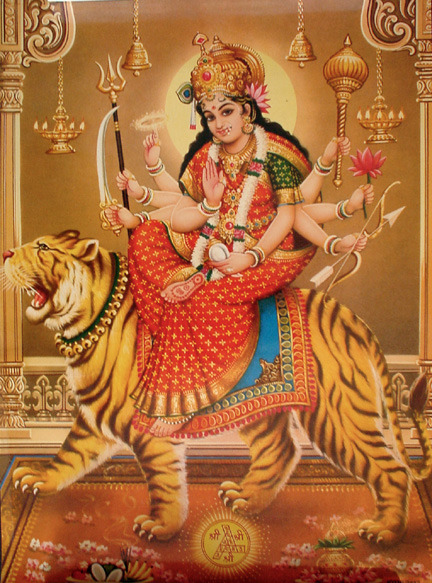
In HinduismDurga (Sanskritदुर्गा, meaning “the inaccessible”  or “the invincible”; Bengaliদুর্গাdurga) orMaa Durga (Bengaliমা দুর্গাma durga, meaning “Mother Durga”) “one who can redeem in situations of utmost distress”. Durga is a form of Devi, the supremely radiant goddess, depicted as having ten arms, riding a lion or atiger, carrying weapons and a lotus flower, maintaining a meditative smile, and practicing mudras, or symbolic hand gestures.
An embodiment of creative feminine force (Shakti), Durga exists in a state of svātantrya (independence from the universe and anything/anybody else, i.e., self-sufficiency) and fierce compassion. Kali is considered by Hindus to be an aspect of Durga. Durga is also the mother of Ganesha and Kartikeya.  She is thus considered the fiercer, demon-fighting form of Shiva’s wife, goddess Parvati. Durga manifests fearlessness and patience, and never loses her sense of humor, even during spiritual battles of epic proportion.
The word Shakti means divine feminine force, and Durga is the warrior aspect of the Divine Mother. Other incarnations include Annapurna and Karunamayi (karuna= kindness). Durga’s darker aspect Kali is represented as the consort of the god Shiva, on whose body she is often seen standing.
As a goddess, Durga’s feminine power contains the energies of the gods. Each of her weapons was gifted to her by various gods: Rudra’s trident, Vishnu’s discus, Indra’s thunderbolt, Brahma’s kamandalu, Kuber’s Ratnahar, etc.
According to a narrative in the Devi Mahatmya story of the Markandeya Purana text, Durga was created as a warrior goddess to fight an asura (an inhumane force/demon) named Mahishasur. He had unleashed a reign of terror on earth, heaven and the nether worlds, and he could not be defeated by any man or god, anywhere. The gods went to Brahma, who had given Mahishasura the power to be the invincible conqueror of the universe. Brahma could do nothing. They made Brahma their leader and went to Vaikuntha — the place where Vishnu lay on Ananta Naag. They found bothVishnu and Shiva, and Brahma eloquently related the reign of terror Mahishasur had unleashed on the three worlds. Hearing this Vishnu, Shiva and all of the gods became very angry and beams of fierce light emerged from their bodies. The blinding sea of light met at the Ashram of a priest named Katyan. The goddess Durga took the name Katyani from the priest and emerged from the sea of light. She introduced herself in the language of the Rig-Veda, saying she was the form of the supreme Brahman who had created all the gods. Now she had come to fight the demon to save the gods. They did not create her; it was her lila that she emerged from their combined energy. The gods were blessed with her compassion.
It is said that upon initially encountering Durga, Mahishasura underestimated her, thinking: “How can a woman kill me, Mahishasur — the one who has defeated the trinity of gods?” However, Durga roared with laughter, which caused an earthquake which made Mahishasur aware of her powers.
And the terrible Mahishasur rampaged against her, changing forms many times. First he was a buffalo demon, and she defeated him with her sword. Then he changed forms and became an elephant that tied up the goddess’s tiger and began to pull it towards him. The goddess cut off his trunk with her sword. The demon Mahishasur continued his terrorizing, taking the form of a lion, and then the form of a man, but both of them were gracefully slain by Durga.
Then Mahishasur began attacking once more, starting to take the form of a buffalo again. The patient goddess became very angry, and as she sipped divine wine from a cup she smiled and proclaimed to Mahishasur in a colorful tone — “Roar with delight while you still can, O illiterate demon, because when I will kill you after drinking this, the gods themselves will roar with delight”. When Mahashaur had half emerged into his buffalo form, he was paralyzed by the extreme light emitting from the goddess’s body. The goddess then resounded with laughter before cutting Mahishasur’s head down with her sword.

All text in this and the following post was lifted from Wikipedia.