Showing posts with label White weekend. Show all posts

February 3, 2021

White Weekend #11: Now my mind is filled with rubber tires and forest fires

Drove up to Shepherdstown today just to buy a bag of tea from the Lost Dog, on what would have been my sister's 50th birthday, 10 years and a day after the breakup of the White Stripes, and a few days before the 11th anniversary of my first White Weekend.  There was snow on the ground along the West Virginia roads and a blue sky between the clouds above just like there was 11 years ago when I fell down the Jack White rabbit hole, which feels like it was half a lifetime ago even though it's only been a fifth of my life.  Of course, I had to pull up the song that started it all, the final line of which still raises goosebumps on my arms.


Lotta reflection going on lately.  I'm more than half a century old and feel like I've been in a mid-life crisis for a good 15 years or so.  And now we're in the middle of a deadly global pandemic, at risk of hatred becoming mainstream, my sister died of Alzheimer's a few months ago, I've become distant from friends, and it's hard to not wonder just what's so dear about life. 

But through most of that "crisis" time, there's been Jack and everything he's brought into my life.  I've learned so much through him, either directly or from other musicians and artists that orbit around him (like Brendan Benson, above).  I wanted to write a whole series of posts about all of those things last year in honor of my 10th White Weekend anniversary, but when I got started it became too overwhelming. I couldn't find enough words to go into it all-- The breadth and depth of blues music; the African-American history and culture that birthed the blues and evolved all the way to hip-hop; country music and it's indebtedness to multiple cultures; an acceptance of women's voices, for both the sound of them and what they have to say; the meditative elegance of baseball; the symbolic vibrations of colors; Bob Dylan's sense of humor; my own need for attention and capacity for petty jealousy; and that an awareness of the world outside your own little bubble is necessary, though it can be both rewarding and frustrating. 

I've been lead to Son House, Charlie Patton, Elvis Presley, Pokey LaFarge, C.W. Stoneking, Margo Price, Hasil Adkins, Eddie Hazel & Funkadelic, Ma Rainey, James Booker, Mattiel, Loretta Lynn, Hank Williams, Skip James, Beck, Dex Romweber, Captain Beefheart, Beyonce, Radkey, Alexis Zoumbas, Mick Collins, William Tyler, the Soul Surfers, the J.B.s, Shovels & Rope, Patsy Cline, Moondog, Little Willie John, Joshua Hedley, the Greenhornes, Courtney Barnett, Alison Mosshart, Danny Kroha, Chicano Batman, the 5.6.7.8.s, and so much more. 

For a long time all of this brought me great joy and excitement, but those've been commodities in short supply over the past year.  Blame it on Covid, that never-ending mid-life crisis, work, Icky Trump & the GOP, lack of travel and musical events, a dearth of exposure to Jack, whatever.  

I need a chance to set myself on fire.  But I'd probably just end up doing the same thing.


February 9, 2020

A White Weekend 10 Year Anniversary: Everything I've Ever Learned, Part 1

It's been 10 years since my first White Weekend, but there's been no snow in the DC area this year. And this anniversary celebration is actually not about Jack and his music so much as it is a recognition of Everything I've Ever Learned from the entity called Jack White.  Because that's a lot, and it's going to take a couple of posts to cover it all.  Hopefully you'll follow along.


For the couple of decades pre-Jack, I was fairly musically monogamous. I would latch onto one, maybe two bands or musicians and listen to them pretty much exclusively. I'd dabble here and there in other stuff, but my primary focus would be that one or two that resonated with me on an emotional level. And my tastes ran in sequence from the cartoon rock of Kiss in my high school years, to the raunchy rock of Guns'n'Roses, to the operatic rock of Queensryche, to the esoteric rock of T00l,  the grungy rock of Soundgarden and Audioslave, and then whatever Incubus is considered.  T00l led me into things like the ideas of Carl Jung, but none of the other bands I listened to over the years really opened me up to anything else.

That changed immediately in 2010 because getting into Jack meant also getting into the blues.  It was impossible to not be curious about all of the music and other elements that he talked about-- It Might Get Loud had just come out the year before and he went on and on about the blues in that film and in pretty much every old White Stripes interview I was digging up. Right away, I was buying music by Robert Johnson, Blind Willie McTell, and Son House right alongside all of the White Stripes, Raconteurs, and Dead Weather albums.  I went as deep down that rabbit hole as I did down the Jack hole.  I've never read any of the books written about the White Stripes, but I've read a dozen or more about blues music and countless essays and articles.  And it blows my mind that I made it all the way to my mid-40s, having grown up hearing Led Zeppelin and the Rolling Stones and the rest of those blues revival bands, without ever hearing any of the original artists who inspired the revivalists.  If I hadn't been exposed to it all by Jack, it's possible I might've lived my entire life without ever consciously listening to Howlin' Wolf or Muddy Waters or Skip James or Fred McDowell or Geechie Wiley. And there's still so much that I haven't gotten to, so many people like Tampa Red, Sonny Terry and Brownie McGhee, and both Sonny Boy Williamsons whose music I've yet to dig into, and who knows how many I've not even heard of yet.


Actually, thinking back, I remember at some point when I was younger, George Thorogood's Bad to the Bone was a big hit and I heard it all the time, and someone said that was "blues music".  And then other guys like Stevie Ray Vaughen came along and, again, were described as "the blues".  But back then I just listened to music, I didn't bother to explore it, and those guys didn't grab me that strongly anyway.  So I accepted what I heard and my early, very vague conception of "the blues" became something created by white people.  Now that the circle of people I share and discuss music with has broadened, it feels like everyone I know knows where blues music came from, but what about outside of that circle?  Are we still just a bunch of Seymours in a world of Blues Hammer fans?


When Third Man Records released their two Paramount Records sets and Documents Records reissue series in 2013/2014, my world really exploded. It wasn't just that they'd opened a doorway to old music and genres that I'd never considered before. That in itself was tremendous, but I soon realized that along with the music, I was developing a totally different awareness of United States history and culture.  It's difficult to read extensively about blues music without also learning about the post-Civil War reconstruction era and the beginnings of the Civil Rights era, about the history of African-American people. The history of not only blues but also jazz, soul, R&B, rap, and hip-hop music is obviously enmeshed in the African-American experience. But is it that obvious?  How many people, even those educated in the history of the music, really stop to think about it at that level?  White versions of all of those genres can be deeply enjoyable, but to listen to the white versions and not acknowledge that their basis lies in the black experience is to naively believe that the tip of the iceberg is the whole thing. Even listening to Charley Patton and Robert Johnson can be just peeking below the surface if you don't take the time to learn about the experiences of those musicians. When Black Lives Matter became prominent in the news in 2015, I found myself able to understand why specifically because I'd read Alan Lomax's description of having been hauled to the police station for being caught recording music with Son House, and because I knew that Blind Willie McTell's Southern Can Is Mine wasn't necessarily written about beating a woman.  I can say with no pretension or irony that this music woke me up to a whole new form of empathy.


Touching on another currently prominent social issue and at the risk of being accused of misogyny, I have to admit that, up until 2010, I didn't have much appreciation for female singers and vocalists. There's something about soprano voices that is frequently like nails on a chalkboard for me.  Even Jack's high-pitched tenor kept me from diving into the White Stripes for a year or so.  Up until that time, there was only a small handful of female singers I could stand to hear, which included Tina Turner, Annie Lennox, Janis Joplin, and sometimes Alanis Morissette. So my musical world was shaped by an almost completely male-centric perspective.  But Jack is recognized for his associations with female musicians so his fans can't help but be exposed to female voices. The first on the list for me was, of course, Alison Mosshart of the Dead Weather.  Can't say I've become a full-on fan, but she does have a good rough'n'ready rock'n'roll voice. Next was Loretta Lynn, through the album Jack produced, Van Lear Rose, and I found myself wanting to hear more of Loretta's straightforward, conversational style. Then Cary Ann Hearst's scratchy tone grabbed me, when I saw Shovels and Rope open for Jack in 2012. Then came the old blues queens  included on the Paramount Records sets-- Ma Rainey, Ethel Waters, Alberta Hunter, and Ida Cox-- and the women who played harder blues as well as any man-- Louise Johnson, Geechie Wiley, and Elvie Thomas.  


Slowly I realized that there were more female voices that my ears could tolerate than I'd thought, and that I actually enjoyed. Yet I was still shocked at myself in 2016, when Third Man Records signed Margo Price, who sings country songs in a powerful-yet-soft soprano that's exactly the sort that used to make me cringe.  There's something about Margo's delivery of her smart and raw lyrics, though, that connected with me and made me end up not just enjoying her sound, but loving to sing along with her.  And then Jack collaborated on a song on Beyonce's album Lemonade and I gave the whole record a listen and, holy hell, it blew me away.  If you'd told me in 2010 that I would one day buy a record by someone like Beyonce, I probably would've laughed in your face. As with Alison Mosshart, I can't say I've become a Beyonce fan, but Lemonade resonates with me deeply.  Others I've come to love are Rachel Nagy of the Detroit Cobras, and Mattiel, who's got a clarion voice and writes songs that sound like a cross between Nancy Sinatra and avant-garde garage band The Monks.  Most recently, Third Man released a 3-record compilation of Patsy Cline's Decca Records singles, and I can't stop singing along with her in the car. Why was I never exposed to her music before???  Though if I had been, would my ears have been prepared to appreciate it the way I can now?  That's the thing.  I think it took having my mind opened by all the myriad things Jack has exposed me to in order to make this shift.  There are still a lot of female voices out there that grate on my ears, but I've learned to at least listen before dismissing most of them outright and that's significant, because it's been necessary for me (and anyone else who might not realize this yet) to recognize that these women have important stories to tell.


Along with Loretta Lynn's country stylings, Jack introduced me to Hank Williams when he joined Bob Dylan's project of writing music to unfinished Hank lyrics, released as The Lost Notebooks of Hank Williams in 2011.  Throughout my childhood, Johnny Cash was the definition of country music, but Loretta and Hank and, again, the two massive Paramount Records sets and then Jack's American Epic project have put me on the path of Cash's predecessors. As with blues music, it's opened up a whole 'nother world for me.  

For the sake of brevity, though, that world and more are gonna be explored in Part 2 of this anniversary celebration.


February 13, 2019

Nine years of White weekends: A new chapter?

I'm late this year in acknowledging the ninth anniversary of my first White weekend.  I was in Florida visiting family, so it slipped my mind. I'd like to say it was because the visit was so much fun, but it wasn't.  My 48 year old sister, who has Down Syndrome, is in the advanced stages of Alzheimer's. She lives at home with my 76 year old parents, whose lives now revolve around caring for her.  Just before Christmas last year, my sister had a seizure in the middle of the night and apparently aspirated while she was lying unconscious, which led to pneumonia.  While in the hospital, she wasn't allowed out of bed for fear that she'd fall. She falls a lot, it began happening a few years ago and was one of the first signs of dementia.  The hospital staff didn't want to fill out all the paperwork that would be required if she fell, so they kept her in bed for almost two weeks. When my parents brought her home to continue recovering from the pneumonia, she got out of bed a couple of times, and fell a couple of times. Despite having a physical therapist come for a month of sessions to work on her strength, she's been in bed ever since.

Understand what this means--  She can't get up and walk to the kitchen for meals, or to the bathroom. She can't even stand up to get into a wheelchair.  She has to be fed in bed, and as for the bathroom...  I spent my recent visit helping my parents, who have their own health issues, change my sister's diapers. My sister is not only sedentary, she's massively overweight. And yet, when it's time to roll her around to clean her up and change her disposable underwear (and often the sheets as well), she suddenly has the strength of three people and it's like she's auditioning for a role on G.L.O.W., Gorgeous Ladies of Wrestling.   


So this is how my parents live these days, an endless, exhausting round of feeding, cleaning up, washing up, working with a temporary nurse and occupational therapist to try to figure out how to get permanent help paid for by Medicaid because they don't want to put my sister into a care facility and they can't afford to pay for help.  Oh, and while I was visiting, my brother called and told us he'd been laid off (again) and he couldn't come visit because his car was broken down.  

I came home from Florida to my quiet, shabby, comfortable apartment in Maryland and have had trouble sleeping because I feel guilty that I have the luxury of getting into bed at night knowing that I can sleep without interruptions and then get up the next morning to drive to work at a job that pays me a decent living.  And that on the weekends, I can go out and do fun and interesting things without worrying too much about what it costs, or having to take care of anyone but myself and a pair of cats.  I shouldn't have much to complain about, should I?  And yet how can I go happily about my life knowing what my family is dealing with?  We're not a close family and expressions of affection are strained, but just because I don't feel close to them doesn't mean I can't recognize that they didn't ask for their lives to end up this way. So the sense of obligation is strong.  I feel guilt that I'm not doing more for them, but then the obligation smothers me and what more can I do, anyway?

All of that aside, it feels lately like a chapter in my life is ending and I've no idea how the next one might develop.  Going down the Jack White rabbit hole nine years ago was the beginning of this chapter that seems to be closing--  Nothing's changed as far as my addiction to Jack's music goes, but the peripheral stuff is definitely shifting.  I made a lot of friends through his music, and now, lately, it feels like I'm losing many of them.  A couple of them died, others became friends with other people, some are taking breaks from social media, and some maybe weren't really friends to begin with.  Considering how much of the fun of new records and tours from Jack revolved around making plans with and seeing all of these people, feeling that I don't have these friends to talk and plan with anymore has diminished my excitement about the recent announcement of a new Raconteurs album and a potential tour.  


I'm self-aware enough to realize that my own behavior is part of the problem--  Any hint of rejection makes me withdraw. It's been the pattern throughout my life, from elementary school on.  I make friends, something happens to bring those friendships to an end (changing schools, changing jobs, moving, disagreements, whatever), I end up alone until some other impetus brings some new people into my life to try to connect with.  I've never mastered the art of reaching out.  My hermit crab shell fits too tightly.  I keep feeling like I need to make more effort to maintain the connections with some of these friends that I feel slipping away, but some of the times when I've tried to do that... it hasn't worked.  So instead of reaching out, I step back, back to the familiarity of being on my own.


And I really thought all of this 17 yr old "woe is me" emo angst would've been done with by the time I reached middle age. 


March 24, 2018

A late White weekend: Addicted to the Mind Shaft

Hello. My name is Tam and I am an addict.  It's been just over eight years since I first wrote about Jack White here in my little corner of the interwebs and he and his music have kind of taken over since then.   I should probably be embarrassed by this, but I'm not.  The high of being a fan-girl is too rewarding, being occasionally mocked for it only makes me laugh that those mocking have no idea what they're missing out on.  

It was eight years and a month and a half ago when I had the epiphany that opened up the rabbit-hole and allowed me to fall in, on a clear blue winter day driving the backroads of West Virginia, listening to the Raconteurs album Broken Boy Soldiers for the first time. And this weekend I had a similar experience-- On Friday, March 23rd, Jack released his third solo album, Boarding House Reach.  On Saturday, I went driving with the album on those same West Virginia roads under the same sort of clear blue winter sky. (Technically this was the first weekend of Spring, but the remnants of last week's snow were still on the ground.) And this album has hit me with the same sort of feeling I had that day eight years ago, that there's something to this music that I need and that I'm not going to get anywhere else. And so I celebrate my addiction.

As for this new record, I'm not one for rating systems so I have no idea how to give it a neat quantification.  It's not a perfect record, but it is an astonishing and, for me, delightful one.  It's also highly perverse, beginning with that strange title--  Boarding House Reach.  When it was first announced, a British friend of mine quickly identified the phrase as an English colloquialism referring to the way guests in boarding houses used to reach across the communal table to make a grab for food if they wanted to get a good meal.  It implies rudeness, but also the way we have to adapt and sometimes be tolerant in our dealings with others, while still making sure our own needs are met.  As the youngest of ten children, this is of course pertinent to understanding Jack's mind-set. As a metaphor, it also implies a broadness of reach, a pulling in and consuming of a variety of comestibles, whether they be food or music.  Again, this sums him up quintessentially.


The album was first introduced with a collection of soundbites in a video called  Servings and Portions, then with a handful of songs released as digital "singles", and then a day of listening parties at selected record stores around the world.  After attending one of those listening parties two weeks before the release date, I found myself juggling a contradictory set of reactions. I was excited and delighted and disappointed and apprehensive all at once. But as a fan of Keats' concept of negative capability, this didn't disturb me.  Rather, it was stimulating and upped my anticipation.  As Jack sings in Everything You've Ever Learned, 'the one who is prepared is never surprised'.  When it comes to him, I am always prepared to BE surprised.  Are you?


As always, this is not a review. I can be as critical as any critic, but I'm just a junkie-fan describing my own experience of the music. Your mileage may and probably will vary. So, on to the songs...


I wrote a few weeks ago about how Connected By Love, the first single and first song on the album, disappointed me. Hearing it in the context of the album hasn’t changed that. In fact, when I heard the full album at the listening party I went to, I was convinced that Jack had for some perverse (that word again) reason chosen to release the weakest songs on the album to preview it, because everything that I had not previously heard was so much more interesting to me than this song. It doesn’t disappoint me because it’s a bad song, though, but rather because it’s an extremely beautiful song that doesn’t live up to its potential. The music is gorgeous and the vocal performance is earnest and moving, but he tripped himself up with the word-play. I completely understand what he was going for, it’s a trick he’s done before—The repeated V sounds of Forever For Her (Is Over For Me) and the “Who is the who?” of Want and Able. But in this song, the repeated –ecteds of connected, rejected, protected, infected, etc, are too unlovely a sound to come across as clever, they instead add a clumsiness to lyrics already verging on corny and diminish the power of the song.


Why Walk a Dog impressed me at the listening party, but that may have been due to its novelty at the time.  Jack’s singing and the music are fantastic, especially that scuzzy guitar solo. But hearing it again left me perplexed—What the hell is it about? Is it the literal condemnation of puppy mills that it sounds like? Or are the dogs the sort of obscure metaphor he’s loved to employ in the past? Maybe it’s the mention of birds, but it reminds me of I Think I Found the Culprit from Lazaretto, they're both perfectly enjoyable songs that would’ve made better b-sides than album tracks.


My immediate impression of Corporation when it was released as a digital single was that it was lyrically lightweight but would be a blast to dance to at shows. When I flew to Nashville for one of the three pre-release shows at Third Man Records last weekend, I found that was absolutely correct. It’s not a head-banging pogoing tune, it’s a hip-swiveler like Trash Tongue Talker from Blunderbuss, and I love it for that reason.


Initial reactions from friends and early reviews pretty much unanimously singled out Abulia and Akrasia as a track to skip over, but I am the anomalous weirdo who will not only not skip over that song, but put it on repeat for multiple listenings in a row. This song reflects Jack’s reputed standing as a Scrabble pro, with its tongue-twisting, twist-of-an-ending exhortation, read by gravelly-voiced Aussie bluesman C.W. Stoneking against a lovely gypsy-flavored tune on violin, piano, horns, and tambourine. Surprisingly, Jack doesn't perform on the song at all, neither vocals nor instrument. It's just his words performed by other musicians and this is one more reason why it makes me smile every single time I hear it.


Hypermisophoniac is another one that both delights and perplexes. Both musically and lyrically, it’s a depiction of the condition of misophonia, intentionally meant to aggravate at the same time that it fascinates.  I really look forward to hearing it live.  But what the hell does robbing a bank have to do with the rest of it?


Ice Station Zebra is, simply put, Jack’s manifesto. Where the White Stripes song Little Room summed up an aspect of his work ethic, this one sums up so many of the beliefs and philosophies he’s expressed in interviews over the years—Choosing the box he puts himself in rather than letting others box him in; being part of the tradition, the family, of songwriters he respects and “letting God in the room” when he writes; his bemusement with people who expect him to remain one thing so that he can live up to their expectations. To take the edge off some of these potentially pedantic statements, he sets his highly clever, rapped lyrics to an almost impossibly catchy, beat-changing break-down that reflects where his head is at musically these days. It’s bound to become a live show staple, and deservedly so.


Over and Over and Over is the first pre-release song that I saw other people really get excited about. With minor modifications, it could have come from any of Jack’s other bands, but though he tried with all of them, he couldn’t get the riff he’d been carrying in his head since 2005 to cohere until now. It’s a killer of a riff and the spat lyrics are an easy live show chant. But to me, as enjoyable as it is, it’s exactly what he rails against in Ice Station Zebra—A song that lives up to what the majority of fans seem to expect from him. So I like it very much, especially the existential Descartes reference in “I think therefore I die, anxiety and I rollin’ down a mountain”, but it’s not likely to end up on any of my “Top whatever” lists of Jack’s songs. But his pronunciation of “perfidy” to rhyme with belly and Isotta Fraschini makes me giggle every time.


When Servings and Portions was posted, I ripped the audio and put it on a cd so that I could put the cd into my alarm clock/cd player and wake up every morning to the purred “Helllooooo” at the beginning. I was eager to hear how that fit into a song and I was not disappointed in any way when I heard it pop up in Everything You’ve Ever Learned. One of my favorites on the album, it’s another philosophical manifesto, one that I can wholeheartedly get behind, with that digitally enhanced purring speech at the beginning that erupts into a propulsive, thrashing, snarling, shrieking thought-provoker. I want to hear it live so, so badly. But I also learned today that I need to be careful of listening to it while driving.


Respect Commander is the other song that disturbed and disappointed me when it was released as the b-side to Connected By Love. It begins compellingly, with more of that hip-swiveling funk, descending into a sultry interlude leading to… lyrics that unfortunately fill my mind with images from the music video for the Warrant song, Cherry Pie. The line "Every time she gets the satisfaction/I want her to control me all night long" just sounds so hair metal.  And again he's piling up the –ecteds. I compared this song to my favorite song by Son House, Pearline, which is the story of a love affair told by guitar with only two sung lines. I will always wish Jack had let the music do the talking in this song and not sung the words he wrote, because the music is fucking fabulous and says all that needs to be said.


Ezmerelda Steals the Show is another that many fans and reviewers are planning to skip over on this album, but it enchants me. Jack’s a whimsical poet, a master of imagery, and lectures with a wink.   This song expresses all of that. I can’t help but wonder if it’s a story he made up to tell his kids.  And I want to scream that final line everywhere I go in public.


Get In the Mind Shaft.  Not only is this my favorite song on this record, it may very well become one of my favorite Jack White songs.  It’s highly unique, and not only because there are multiple versions of it— depending on which album pressing you ended up with, you can hear it begin with one of apparently more than half a dozen different stories that Jack recorded.  They’re all little pieces of #JackWhiteWisdom, ranging from him learning to pick out chords on a piano in an abandoned house, to the sound of frequencies in nature, to the mental battle of baseball pitching, to likening himself to a fisherman selling his catch at a dollar a head.  Regardless of which you hear, the background music of dramatically swelling strings gives weight to the words, making them profound. The story fades into an electronic break-down of synthesizer and digitalized voices singing “It’s strange, let’s try it. Can you hear me now? Am I invisible to you?” The voices are all Jack’s, apparently sung through a vocoder, but the effect makes them sound like alien children, like an eerie memory of how he made Meg White’s voice sound more child-like on St.Andrew/This Battle Is In the Air by speeding up the tape. It brings a touchingly innocent gravity to the second half of the song, turning it into a plea for connection. At the moment when the repeated refrain of “Can it be? Can it be? Can it be? Can it be?” erupts into soaring “Aaaaaaahhh”s, my face splits into an ear-to-ear smile even as a lump forms in my chest and my eyes fill with tears. For me, it’s a powerful song that hits me just as hard as my most favorite of his songs, 300MPH Torrential Outpour Blues. That song struck me immediately as an expression of the sardonic angst I’ve lived with almost every day of my life.  This one reminds me to not let that angst close me off, to always remain open to curiosity, beauty, and wonder, which is one of the most profound rewards of this addiction of mine, one that I’ll carry with me the rest of my life, no matter what kind of music Jack decides to make in the future.


What’s Done Is Done keeps being described as the only country song on the album but, to my ears, the only thing country about it is the twang in Jack’s vocal delivery. The music, on the other hand, is hard to categorize. It’s got the sort of intensely deep kick-drum as in Love Drought from Beyonce’s Lemonade, simple acoustic piano and brush drums, accented with Hammond organ and synth, then ending with a touch of softly strummed acoustic guitar. None of that is overtly country, at least not to me. But it is definitely beautiful. It’s also a fun performance from Jack, with that little whistle/hiccup at the beginning of “what’s”, and Esther Rose’s soft folk-infused voice is a beautiful accompaniment to his. I’ve heard her sing before, back when she performed with Luke Winslow-King, and I didn’t love her voice so much then, but I think I prefer her with Jack over either Ruby Amanfou or Lillie Mae Rische. And that whispered exchange at the end is the niftiest of touches.


Jack has always known how to end an album and Humoresque proves his skill yet again. After the cacophony of the rest of the album, it follows the relative quiet of WDID for the softest and gentlest of send-offs. The only cover song on the album, with lyrics by Howard Johnson (an early 1900s songwriter, not the guy who opened the hotel chain) over a classical interlude by Antonin
Dvořák, Jack keeps it simple with an almost heart-breakingly husky vocal over piano and drums. Its reminiscence of early White Stripes covers like Look Me Over Closely and Mr. Cellophane proves that, no matter how far his boarding house reach into different genres and styles, underneath it all, Jack really is that “same boy” we’ve always known.

There’ve been a lot of hyperbolic reviews of this album, both reviling and acclaiming it. I’m not going to define it either way. To me, it’s just a perverse thing of beauty that confirms me more than ever as a fan of this musician who has opened so. Many. Fucking. Doors for me. I’ve climbed inside the mind shaft  and I don’t plan to climb out any time soon. 


January 25, 2016

A White weekend: Six year anniversary

I have an anniversary coming up in two weeks, but circumstance caused me to celebrate early. Six years ago, I found myself stuck at home during a historic blizzard and spent the hours indoors developing a musical infatuation.  This weekend, the mid-Atlantic was hit by another blizzard of record-breaking proportion and I've been stuck at home for four days so far. I've spent these hours re-exploring that old infatuation and what it's come to mean to me.  

Anyone who's familiar with this blog surely knows that I'm talking about the music of Jack White.  I wrote about that weekend six years ago and he's been a predominant subject here ever since. On the surface it looks like an obsession but, really, it's grown into something else. Sure, I'm still infatuated with Jack. He's an endlessly fascinating personality and his music moves me in a way no other musician's ever has. But in following his work, I've begun to look at a bigger picture surrounding him and his music. He and the company he created, Third Man Records, have become symbols for me of a way to look at the world, primarily art and music, but also culture and society. 

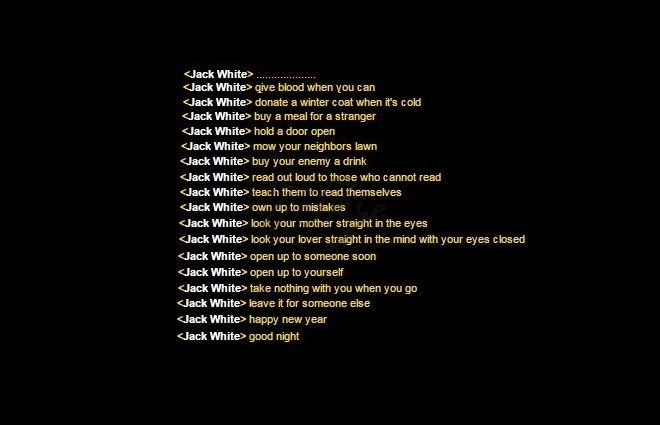
For a while now, I've been wearing a silver ring on my lefthand ring finger, a set of three bands that look like bones. I've never told anyone why, but this anniversary seems like an apropos time to talk about it. The ring is a symbol for me, just like a wedding band is a symbol for anyone who's married. As in the film Elizabeth, when Cate Blanchett's Queen Elizabeth proclaims to Lord Burley, "I am married. To England.", I also feel married to something rather than someone, to an ideal rather than to a person. (Though I am actually kind of married to Jack, seeing as how I was at the San Francisco show in 2014 during which he decided to marry every woman in the audience in the middle of the song Blunderbuss. But it was the night after he'd sprained his ankle on stage and he was probably high on Vicodin and for all I know he had it annulled two days later without bothering to tell the couple thousand of us.)  That ideal I feel wed to may walk around wearing the form of Jack White, but I see so much more now when I look at him.  I've read and been told enough about him, and observed a bit myself, to know the man is way too human to ever qualify for sainthood or keep his balance on any pedestal. But I also see him continually striving to grow, and to make the world a better place in his own way, on his own and with the help of the people he's brought into his organization. Whether it's his New Year's Day advice in the Vault chat room, his inquisitiveness about history and art and science that he shares with his fans through all of the projects he's involved in and things he mentions in interviews, his constant urging to remember the romance and ingenuity of the past while admiring the innovation of the future, the efforts by Third Man Books partners Ben Swank and Chet Weise to spread culture and beauty through poetry, or the many charity drives organized (there are four links in that string of words, click on 'em all) by Third Man Records, that striving is what inspires me.  It's the one thing we can all do, regardless of our talent or ability or circumstance, we can always try to grow and be better-- Better at art, better at whatever it is we do, better human beings with a wider field of vision and curiosity and awareness.


Thank you to the unknown person on Tumblr who captured and posted this.

Bob Dylan said in Last Thoughts on Woody Guthrie--

...You'll find God in the church of your choice
You'll find Woody Guthrie in Brooklyn State Hospital
And though it's only my opinion
I may be right or wrong
You'll find them both
In the Grand Canyon
At sundown


He wasn't talking about Woody in those last lines, or in any of the lines of that poem. He was talking about what Woody represented to him.  I'm no poet like Dylan, but I understand exactly what he meant about Woody because it's very much the way I've come to feel about Jack.  When someone creates something that moves us, or begins an organization or movement that inspires us, what that person represents can become something that's both incorporated within them and totally separate from them.  Look at Martin Luther King Jr or Abraham Lincoln. On a much smaller scale, look at Woody Guthrie and, more and more, look at Jack White.   

Of course, running underneath and through it all is the music.  And there's so very much of that to celebrate, not just this weekend but every single day...


February 8, 2015

A White weekend: Five year anniversary

Wish me a happy anniversary, it's been five years since my first White weekend. Between that and a bunch of recent shows, this be-log's been a little inundated by Jack White the last couple of days (weeks, months, whatever).  Might need to take a break and try to write about other things for a while, even I'm beginning to need a little relief from the addiction (just a very little).  But before I do that, I'm gonna reminisce over how it all began and then draw a parallel.  

So it's been five years since my epiphany but, really, it's been longer than that since I first began trying to get into Jack's music.  I heard of the White Stripes on the message board for another band I was into at the time, where people were discussing the Stripes' tour of Canada for Icky Thump.  The crazy b-shows they were playing struck my fancy and I began paying attention to conversation about the band.  But I didn't go looking for their music, not yet.  I was just fascinated by the idea of what they were doing up there in Canada and the whole nothing but drums'n'guitar, brother'n'sister thing.  It wasn't until an October night in Baltimore that I heard their music. 

Some friends and I were in B'more for the annual Fells Point Festival, one of the largest, longest-running festivals on the east coast.  For lunch, we escaped the crowds by ducking into the restaurant upstairs at Sláinte, where we ended up with an especially flirtatious waiter. Yeah, I know this seems like quite a digression, but this guy is The One Behind It All. He told us he was tending the bar downstairs that evening and that we should come back later to see him. How could three single women resist an invitation like that?  So we finished lunch and headed back out to wander the festival until evening.  

The bar was packed when we came back. And our buddy the waiter was now a very harried bartender, with people placing food orders in addition to drinks and no one from the restaurant upstairs bussing for him. There were stacks of plates and cutlery all over the floor behind the bar. He was pissed as hell about it and acting out his anger in an alarmingly maniacal manner.  He flirted up a storm with us again as he took our orders, then headed to the other end of the bar, cussing out loud and kicking plates along the way.  But we settled in and after a while he brought our drinks.  By that time, I'd been struck by the music playing in the bar and asked him who it was. He said it was the White Stripes.  Ok, I was finally hearing this band I'd heard so much about.  A few songs later, I was still digging the mix and when he waded through the debris of dishes down to our end of the bar, I asked him again "What's this song?"  Again, he said it was such-and-such song from such-and-such album by the Stripes.  Then he picked up a glass from behind the bar and, while looking me straight in the eye, threw it over his shoulder where it smashed into a pile of plates.  The dude was insane, but I was seriously excited about his choice in music. This went on and on, every single song I asked about was the White Stripes and he finally said that was all he was playing, just their six cds on rotation. I asked which of their records I should start with and he told me the later ones were best because Meg finally learned how to keep time (if I'd known more about the band at that point, I might've chastised him for dissing her. Meg was integral to the band whether she kept proper time or no.).  By that point we'd finished our drinks and realized he was keeping us hostage by not bringing our check, so I headed upstairs to find a manager and get us out of the line of flying glassware.  I hope to this day that I didn't get the guy in trouble, because I owe him a huge debt of gratitude, crazy as he was.

It was still a while before I picked up any of the band's records, though. Dunno what held me back.  And when I did finally get ahold of a copy of Icky Thump, I was held back again. The music was immediately appealing, and I was struck hard by Jack's lyrics.  Four songs on the album resonated with me especially-- 300mph Torrential Outpour Blues ("I'm getting hard on myself, sitting in my easy chair".  The simple profundity of that line was like a punch in the sternum. To this day, if you held a gun to my head and forced me to name a favorite White Stripes song, this would be it.), Little Cream Soda, Rag and Bone, and Martyr For My Love For You.  The word-play in all was so witty and clever and the sardonic angst expressed in them was something I related to strongly.  But then there was Jack's voice, so high-pitched and nasal and unpolished compared to singers like Chris Cornell and Maynard James Keenan, who I was heavily into at the time.  I just couldn't connect with it. 


For almost two years I kept coming back to Icky Thump, knowing there was something there that I should be into, but unable to make it click.  Finally my buddy Leo told me that if I was interested in Jack's music, I should check out one of his other bands that she'd seen at Lollapalooza a couple years before, the Raconteurs.  We just happened to be in a record store as she told me this, and that record store just happened to have a copy of the first Raconteurs record, Broken Boy Soldiers, on cd. So I bought it. But I didn't listen to it that day.  No, it wasn't until a week later, on a bright, clear, cold day at the end of January, when I was out driving the curvy backroads along the border of Maryland and West Virginia, that I popped that cd in and gave it a go.  Like Icky, the music struck me as appealing, but it was just that-- appealing. Not profound or astonishing.  Until Blue Veins came up.  

You know how sometimes things happen to you and you know that you will never, ever forget where you were at that moment?  I feel like I'll go to my grave still seeing that bright blue winter sky through the windshield of the car, that I'll always remember the exact spot along the road paralleling the Potomac River when Jack sang the final line of that song and the lightning bolt came down from heaven and I finally... got it.  The combination of intensity and delicacy in his voice in those final few words was exactly what I needed to hear and changed everything. 


I feel like I've learned a lot about Jack since then, and I don't mean personal, gossipy, trivia shit.  I mean about his art and his philosophy.  I've been accused of "verbosity and mind-numbing analysis of... mundane detail" but, for crying out loud, when something moves you in such a way why shouldn't you throw yourself into it deeply and express the things it makes you think and feel?  To that end, I'm going to explore a little parallel before wrapping this up.
 
Around this time last year, I decided to finally get into Elvis Presley's music and went down a similar rabbit-hole to the one I went down with Jack, though not quite to the same degree.  A few months later, Jack covered Elvis's Power of My Love as a b-side to the World's Fastest Record.  To my knowledge, it was the first time he'd covered an Elvis tune and I was struck by the synchronicity (or was my brain just looking for patterns?).  Since then, I and other folks have been seeing what seem to be little nods to Elvis from Jack. Some of the parallels are superficial, such as Jack's recent pompadour haircut. Others are more profound, as in the way both blurred genre lines to make their music appeal to a widely diverse audience and to introduce that audience to styles of music they might otherwise have remained ignorant of. And there's no denying that both have (had) the same intense magnetism, the ability to hold crowds large or small in the palm of their hand. But there's one way in which Jack will presumably always differ from Elvis and it's a vital difference-- Where Elvis allowed decisions to be taken out of his hands by his manager, Colonel Parker, Jack has from the very beginning exerted a strong effort to protect his music. Third Man Records, his headquarters in Nashville (record label, venue, storefront, distribution warehouse) was created for just that purpose, to allow him to maintain control of his art. He will always do what inspires him and just hope that people dig it. So far, his instincts, much like Elvis's in the very beginning, have proven pretty much infallible. It's a sad shame that Elvis didn't have Jack's confidence and strength of will. He seemed to crave love, acceptance, and fame too much, whereas Jack may want those things (it's obvious he gets intense fulfillment from connecting with an audience and his ambition is palpable) but doesn't seem to need them the way Elvis did.

I read this the other day in Greil Marcus's Mystery Train--

"...When an artist gives an all-encompassing Yes to his audience (and Elvis's Yes implicitly includes everyone, not just those who say Yes to him), there is nothing more he can tell his audience, nothing he can really do for them, except maybe throw them a kiss.

Only the man who says No is free, Melville once wrote. We don't expect such a stance in popular culture, and those who do might best be advised to take their trade somewhere else. But the refusal that lurks on the margins of the affirmation of American popular culture... is what gives the Yes of our culture its vitality and its kick. Elvis's Yes is the grandest of all, his presentation of mastery the grandest fantasy of freedom, but it is finally a counterfeit of freedom: it takes place in a world that for all its openness (Everybody Welcome!) is aesthetically closed, where nothing is left to be mastered, where there is only more to accept. For all its irresistible excitement and enthusiasm, this freedom is complacent, and so the music that it produces is empty of real emotion-- there is nothing this freedom could be for, nothing to be won or lost.
" 


For all the little signs over the past year that Jack seems to be channeling Elvis, the thing that will always set them apart (or that I assume and hope will always set them apart) is that Jack will never give that all-encompassing Yes to his audience. He constantly walks the line between Yes and a hint, or threat, if you will, of No. The "are you with me or against me?" question at so many shows on the Lazaretto tour, voiced so vehemently recently in Austin and New York, the immediate switch from semi-scripted arena shows in New York and Nashville to spontaneity in Ohio, and to lecture/complaint and willfulness at shows after that in the southwest, are indications that the No will always lurk on the edge of Jack's art. He will never succumb to the complacence that Elvis did. He can pay all the homage in the world with his cover of Power of My Love, his pompadour, playing the stages Elvis played... Hell, tell me that hair, shiny jacket and open collar, and even some of the motions of his recent performance on The Tonight Show don't call to mind the King's early days--

Update 3/14/2017: Thanks for taking this down, NBC. Y'all reading this are just going to have to take my word for it.
 
He could even hit the stage in a rhinestone-emblazoned white jumpsuit, but he will never become what Elvis became. He will always make demands of his audience. One of the best reviews I've read of one of his shows included this line that's become my signature at the two Jack-related message boards--  
 
"And the message is clear: if we want Jack White as our hero, he will entertain, but not pander. We have to accept all his flaws, whims, caprices and manias as a critical, sometimes uncomfortable, part of the contract."

In other words, he will sometimes tell us No. And, as Greil Marcus put it, that is exactly what gives his Yes such vitality and kick.  After five years of addiction to that vitality and kick, I still crave it as much as I did from the very beginning.  And, heaven help me, I hope to still be verbosely expressing mind-numbing analysis of every mundane detail of Jack's art five years from now.  


And is it just my brain looking for patterns again when I notice that this post about my 5 year anniversary is the 55th in which I've written about Jack?  It ain't 3s, but hmmmm... 


February 10, 2013

A White weekend: Looking up at vultures and back over three years of song

Spent this weekend celebrating the third anniversary of my White weekend.  Drove many, many roads in between West Va and Baltimore. Listened to many, many glorious songs.  In between those, spent some time in woods and fields and saw many wondrous things.  

Picked up a cardinal's feather and marveled at how it shifted from rust to scarlet depending on how the sunlight hit it.   

Saw a lady bug crawling sluggishly in the leaf duff on the trail, surprising on such a cold day. 

A crow flew overhead and muttered a "grokgrokgrok" at me around an unidentifiable object clamped in its beak. 

Was startled by a trio of grey-headed black vultures that swooped up from a ditch not ten yards away and soared in loops above me for a minute or so, one seemingly harassing another and the third just along for the ride. 

Stopped on the way home for something I've never seen the like of before-- Dozens of turkey vultures- hell, it had to have been at least a hundred or more- lazily wheeling and whirling over a Victorian-era train station.  I've seen those giant flocks of small birds that resemble clouds rising and shifting in the air in perfect sync, but I've never seen anywhere near so many vultures in one spot.  The sight forced me to stop, get out, and lie back against the hood of the car to watch.  When the huge birds were angled just right in flight, the 5:00pm sun shining up from below turned the white undersides of their wings golden and they looked just like late autumn maple seedpods, those winged whirlygigs that spin to the ground like helicopters.  Then, ever so gradually, the vultures just... dispersed, and were gone. 

Drove past one of the best street names ever--  Trackless Sea Court.  Would be a wonderful thing to live in a place that was a constant reminder of the seemingly infinite expanse of the ocean.

Yesterday, despite such arresting sights and experiences, the music was foremost in my perceptions.  Today, frustration interfered and kept distracting me from the songs I was trying to celebrate.  Just couldn't get a particularly troubling idea out of my head--  When is indifference truly indifferent, and when it is a mask for uglier things?  And in the latter situation, is it actually a mask... or is it a defense mechanism?  

People make me sad as often as they make me happy, but there is one thing that I don't think will ever, ever fail to make me glad--


Here's to many more years, Jack. Thank you for everything.


February 5, 2012

"Who doesn't want violence from love?"

On Monday, January 30th, one of the top-trending search terms on the web was "Love Interruption", which is the title of the first single from Jack White's upcoming debut solo album.  The song was released to the internet that morning via a brand new site, jackwhiteiii.com, with no previous announcement, though there had been whispers of hints of rumors for a few weeks of something maybe, just possibly, coming up.  Of course, the reaction in the fan community was pretty explosive, especially when the song was followed with the announcement of the new album and an accompanying world tour. For anyone who's into his music, that's a helluva lot of excitement to absorb at once, so it took a day or two for the single itself to sink into my head.  After some extended listening, though, I quickly realized that it's quintessential Jack-- Deceptive in its simplicity, leaving one caught up in comparisons, contrasts, and contradictions.   

The first contradiction is between the music and the lyrics.  Musically, Love Interruption is hauntingly sweet, reminiscent of the White Stripes tune I'm Bound To Pack It Up, from the album De Stijl, released back in 2000.  The two songs share a fairly simple arrangement of acoustic guitar which is layered with electric violin in the earlier song, clarinet and Wurlitzer organ in the more recent.  The themes of both are expressed through plaintive vocals, with Love Interruption enriched by backup from the gorgeous voice of Ruby Amanfu (who Jack had previously enlisted for two other Third Man Records projects-- As a live backup singer for Wanda Jackson and again on the Blue Series single from Seasick Steve).   


But the comparison of those two songs ends there and the next that sprang into my mind was Jack's recent cover of U2's Love Is Blindness, as much for the contrast as for the similarity.  Both depict love as an overwhelming force, but the dramatically passionate vocal delivery of Love Is Blindness is an antithesis to the gentleness of Love Interruption.  


A more apt comparison, though, one that gets to the heart of Love Interruption, might actually be with the old bluesman Mississippi John Hurt, who played and sang with a delicacy that belied the violent lyrics of some of the songs he performed.


That's the crux, the element that makes Love Interruption something insidious-- This simple and tender sounding song contains some of the most starkly dark imagery Jack's written yet.  The very first two lines reflect this intense contradiction of tenderness and violence:


I want love to roll me over slowly 
Stick a knife inside me and twist it all around 
I want love to grab my fingers gently 
Slam them in a doorway, put my face into the ground

The lyrics go on to list metaphorical ways in which he wants love to destroy him and overwhelm other relationships.  In seeming contrast to this, though, the chorus repeats an unconditional refrain of "I won't let love disrupt, corrupt or interrupt me anymore".  To me, this was the primary contradiction of the song and it left me baffled. 


The next evening, though, I had the chance to ask Jack about this when he unexpectedly popped into the chatroom of the Third Man Records Vault while I was there.  My comment apparently left him baffled in return, as he countered with "what contradiction?".  I pointed out the seeming inconsistency between wanting such violence from love, but not allowing it to disrupt or corrupt.  He again came back at me with a question-- "who doesn't want violence from love?" (Which prompted someone else to ask "so you like it rough?", to which he replied "no, I like it real".  Again, quintessential Jack.)  I would have gone on to ask how he feels it's possible to prevent something so powerful and intense from being an interruption, but the chatroom was filling up and he's usually there with an agenda, so I let it drop.  But his reply made me re-think the relationship between the verses and chorus.  I began to consider that perhaps the song was about how he (or the character he'd created) wants love to be hard and challenging, to push him to a breaking point, while at the same time learning to rise above that difficulty and not succumb to it.  At one of the two Jack-related message boards, I found someone who felt similarly, but who expressed it with a thoroughness I hadn't considered--

I think I would have to agree on Jack's point of "who doesn't want violence in love" and flattop and Kali's interpretation of finding a way to have intensity without being thrown off track. Love (and relationships) is something that is, and should be, forceful, extreme, intense, and (sometimes) painful. there are definitely highs and lows and extremes on both ends of the spectrum, otherwise it's just kind of bland and uninvolving. It's not like you're always going to agree with someone you love, and I personally don't buy that "we never fight or disagree", lovey-dovey crap that you see in some relationships. who wants to be completely subservient and complacent in a relationship?

I think people are going to get hung up on the imagery of the song and stuck in the typical idea of violence because of the imagery, while forgetting that some words have more than one definition. something that is violent isn't necessarily hurtful as the song's imagery conjures, but love is something violent (even if it doesn't come with the usual idea of what violence is)... forgive the dictionary post, but:

Violence:
3 a : intense, turbulent, or furious and often destructive action or force
(the violence of the storm)
   b : vehement feeling or expression : fervor; also : an instance of such action or feeling
   c : a clashing or jarring quality : discordance

Violent:
1 : marked by extreme force or sudden intense activity (a violent attack)

2 a : notably furious or vehement (a violent denunciation)
   b : extreme, intense (violent pain) (violent colors)
3 : caused by force : not natural (a violent death)

4 a : emotionally agitated to the point of loss of self-control (became violent after an insult)


Of course, though, not everyone will draw the same conclusions that I and a few others have.  That's the magic of truly effective lyrics, when metaphors are obscure enough that the words can inspire a personal meaning for the listener that might be quite different from what the songwriter had in mind.  Jack's a master of that sort of poetic ambiguity and it continuously puzzles me that his talent as a lyricist is still so often overlooked in favor of the frontman charisma and insane guitar skill he's universally known for.  It seems he might feel this way himself, as he mentioned in an interview the day after the single's release that he wanted the first single to be "a lyrical taste", that he "wanted the words to resonate", before getting to the sort of songs that people expect from him.  Personally, I think that's a mistake that people too often make with Jack--  having expectations.  The only thing I've come to expect from him is to always be surprised.  This song most definitely accomplished that, though I would have been equally astonished if it hadn't.  And knowing that there are more surprises coming up has got me violently excited.