Teavolve was too busy,
Lebanese Taverna was not.
Fest in full swing in Fells.
A sweet pitch of orioles in the sculpture garden
(without a ball or bat among them),
a raucous murder of crows in Wyman Park Dell.
Playing spoons with a jug band in the museum.
This is Baltimore.
Showing posts with label Teavolve. Show all posts
Showing posts with label Teavolve. Show all posts
October 25, 2015
November 22, 2014
This is Baltimore: Puerh, pierogi, and plique-a-jour
Within the past week or so, two different articles about the dark side of Baltimore have popped up in my news feed. One about Leakin Park's notoriety as a dumping ground for corpses, the other about the difficulty of overcoming the negative image created by shows like The Wire and the new podcast, Serial. I'd heard the reputation of Leakin Park before I ever rode my bike through it along the Gwynns Falls Trail and, yes, I'll admit to moments of paranoia in a few spots, especially opening the door of the public restroom in Leakin where a murder victim had been found just a year before my first ride there. But on that ride and others since, I've not once experienced anything more alarming than having a homeless person yell at me as I blew past him in the tunnel near Carroll Park Golf Course. I've not yet listened to Serial, but I have watched The Wire and have driven many times through neighborhoods that feature prominently in it. I've seen kids hanging out around those corner convenience stores who very well could have been dealing drugs just like the kids in The Wire. But mostly I've seen working class folks whose circumstances force them to live in down-trodden neighborhoods that are unfortunately subject to a high level of crime. Those are the same folks I've seen on the last Friday night of the month when the Baltimore Bike Party rolls past their row-houses, sitting out on their front stoops and smiling while their children line the sidewalk to cheer and high-five us crazy, mostly white, cyclists as we ride by. The more gentrified neighborhoods we pass through never give us that sort of greeting.
I've gotten to know a pretty large portion of this city, and yet I still feel like there's so much more to explore in its widely varied neighborhoods. Today I stuck with some old standbys yet still managed to have new experiences. Started the morning with brunch at Teavolve, a place I've watched evolve from a teeny little tea shop in Fells Point to a terrifically popular restaurant in Harbor East that serves from breakfast through dinner, tea through cocktails, and that has a vibrant connection to the local music and art scene. Their staff hustles and the brunch maitre'd, Gary, always gets me quickly seated in a nice cozy spot. With a pot of Puerh tea and an Eden omelet (sorry, no food porn photos, I was too busy eating), accompanied by a good book, I have trouble imagining a better spot for breakfast anywhere in the city.
From there I headed over to Canton for some shopping. It was on the way back towards downtown, passing alongside Patterson Park on Eastern Avenue, that I made an impulsive and fortuitous stop. I've been entranced for years by the golden onion domes of St. Michael the Archangel Ukrainian Catholic Church.
For a few years now, I've thought of stopping to see if I could go inside. A place sitting in the middle of Baltimore with such fantastical architecture would have to have an interesting interior, right? But I just never got around to it. Until today, when a sign in front of the church reading "Pyrohý sale 10 - 2" forced me to grab the nearest parking space and bolt across the street. The wooden doors at the front of the church were locked tight, but in a little annex down some steps next door, I found a small dining hall and kitchen where they were selling boiled potato, cheese, and sauerkraut pierogi from the kitchen service window. After handing over $16 for a dozen potato and hearing from the woman manning the window about her recently broken tooth, I asked if the church was open. She said no but asked if I wanted to see inside. When I said I'd love to, she turned around to a gentleman in a sweat suit and said, "Father, this lady would like to see inside the church". Next thing I know, I'm following the casually-dressed priest back up the steps to a side door of the church, which he unlocked and then ushered me through into a small space so beautifully painted with icons that it literally made me gasp.
In a Ukrainian accent so thick I only understood about two-thirds of what he was telling me, the priest described scenes painted on the two side walls and the row of icons of saints martyred during the Stalinist era. I must've looked like a wide-eyed fool over it all, it was so gorgeous, but he was very obviously proud of showing it to me and invited me to come back for Sunday mass to hear the church choir-- "No music, only voices like angels", he said. I may very well go back some other weekend, but via the magic of the interwebs, I found a taste of them--
After that impromptu stop, it was back to the day's planned itinerary, which meant heading up Charles Street to the Walters Art Museum to check out the current exhibit on the history and breadth of the collection that William and Henry Walters gifted to the city. That gift is an incredible treasure. One of only two free museums in Baltimore (the other being the BMA), it's a labyrinthine building combining 19th century and modern architecture, full of surprises from ancient cultures, through the Baroque, and into the 18th and 19th centuries. I've a handful of favorite rooms and items there, but today was struck by a piece I've never seen before. In a dark blue side-room of the From Rye to Raphael: The Walters Story exhibit, I found a deceptively simple little Japanese bowl made of silver and plique a jour. I've seen plique a jour before, both in the Walters collection and in the vintage estate cases of the jewelry store where I work. It's a form of enameling that allows light to shine through the enamel and create a luminous effect. But I'd not seen any like this before. Usually it's in small pieces of jewelry, cigarette cases, small bowls or dishes, sometimes larger dishes on stands. Louis Comfort Tiffany, famous for his stained glass, also worked in plique a jour, so you may've seen it, too. But this simple Japanese bowl was so very different. It looked to have been made of a single sheet of silver molded into the shape of the bowl, and then pierced with hundreds, I mean hundreds, of small scallop-shaped slivers interspersed with many-petaled chrysanthemums, some singly and some in small groups. Into the scallops was inlaid pale grass-green enamel. Into the chrysanthemums, tender gradations of pink and soft bright yellow. The lighting in the gallery was almost criminally wrong for truly showing off the beauty of this bowl, as it shone straight down from a fixture in the ceiling so that much of it was blocked by the inward curve at the top of the bowl. You could see the silver framework of the design and the prettiness of the colors, but in order to see the luminous glow of the enamel you had to crouch down next to the display case and look up at the bottom sides of the bowl. But that crouching was worth it, as the thing left me stunned. Much plique a jour is created like stained glass, with bars or wires of metal laid down in a frame-work and soldered together. If one piece gets messed up, it can be removed or fixed without disturbing the rest. But the walls of this bowl were smooth, inside and out. There were no separate sections, no solder. The artist who created it obviously took the initial solid silver bowl and pierced through the metal to create those hundreds of slivers and petals. If he'd messed up one, he'd have had to scrap that bowl, melt down the metal, and start all over. The craftsmanship of it was so exquisite and subtle that it made the Lalique and Tiffany pieces in the same room look ham-fisted and over-wrought in comparison.
And once again, via the magic of the interwebs...
Don't ever, ever let anyone convince you that Baltimore is a scary place with nothing worth seeing.
I've gotten to know a pretty large portion of this city, and yet I still feel like there's so much more to explore in its widely varied neighborhoods. Today I stuck with some old standbys yet still managed to have new experiences. Started the morning with brunch at Teavolve, a place I've watched evolve from a teeny little tea shop in Fells Point to a terrifically popular restaurant in Harbor East that serves from breakfast through dinner, tea through cocktails, and that has a vibrant connection to the local music and art scene. Their staff hustles and the brunch maitre'd, Gary, always gets me quickly seated in a nice cozy spot. With a pot of Puerh tea and an Eden omelet (sorry, no food porn photos, I was too busy eating), accompanied by a good book, I have trouble imagining a better spot for breakfast anywhere in the city.
From there I headed over to Canton for some shopping. It was on the way back towards downtown, passing alongside Patterson Park on Eastern Avenue, that I made an impulsive and fortuitous stop. I've been entranced for years by the golden onion domes of St. Michael the Archangel Ukrainian Catholic Church.
 |
| Image source |
For a few years now, I've thought of stopping to see if I could go inside. A place sitting in the middle of Baltimore with such fantastical architecture would have to have an interesting interior, right? But I just never got around to it. Until today, when a sign in front of the church reading "Pyrohý sale 10 - 2" forced me to grab the nearest parking space and bolt across the street. The wooden doors at the front of the church were locked tight, but in a little annex down some steps next door, I found a small dining hall and kitchen where they were selling boiled potato, cheese, and sauerkraut pierogi from the kitchen service window. After handing over $16 for a dozen potato and hearing from the woman manning the window about her recently broken tooth, I asked if the church was open. She said no but asked if I wanted to see inside. When I said I'd love to, she turned around to a gentleman in a sweat suit and said, "Father, this lady would like to see inside the church". Next thing I know, I'm following the casually-dressed priest back up the steps to a side door of the church, which he unlocked and then ushered me through into a small space so beautifully painted with icons that it literally made me gasp.
 |
| Image source |
After that impromptu stop, it was back to the day's planned itinerary, which meant heading up Charles Street to the Walters Art Museum to check out the current exhibit on the history and breadth of the collection that William and Henry Walters gifted to the city. That gift is an incredible treasure. One of only two free museums in Baltimore (the other being the BMA), it's a labyrinthine building combining 19th century and modern architecture, full of surprises from ancient cultures, through the Baroque, and into the 18th and 19th centuries. I've a handful of favorite rooms and items there, but today was struck by a piece I've never seen before. In a dark blue side-room of the From Rye to Raphael: The Walters Story exhibit, I found a deceptively simple little Japanese bowl made of silver and plique a jour. I've seen plique a jour before, both in the Walters collection and in the vintage estate cases of the jewelry store where I work. It's a form of enameling that allows light to shine through the enamel and create a luminous effect. But I'd not seen any like this before. Usually it's in small pieces of jewelry, cigarette cases, small bowls or dishes, sometimes larger dishes on stands. Louis Comfort Tiffany, famous for his stained glass, also worked in plique a jour, so you may've seen it, too. But this simple Japanese bowl was so very different. It looked to have been made of a single sheet of silver molded into the shape of the bowl, and then pierced with hundreds, I mean hundreds, of small scallop-shaped slivers interspersed with many-petaled chrysanthemums, some singly and some in small groups. Into the scallops was inlaid pale grass-green enamel. Into the chrysanthemums, tender gradations of pink and soft bright yellow. The lighting in the gallery was almost criminally wrong for truly showing off the beauty of this bowl, as it shone straight down from a fixture in the ceiling so that much of it was blocked by the inward curve at the top of the bowl. You could see the silver framework of the design and the prettiness of the colors, but in order to see the luminous glow of the enamel you had to crouch down next to the display case and look up at the bottom sides of the bowl. But that crouching was worth it, as the thing left me stunned. Much plique a jour is created like stained glass, with bars or wires of metal laid down in a frame-work and soldered together. If one piece gets messed up, it can be removed or fixed without disturbing the rest. But the walls of this bowl were smooth, inside and out. There were no separate sections, no solder. The artist who created it obviously took the initial solid silver bowl and pierced through the metal to create those hundreds of slivers and petals. If he'd messed up one, he'd have had to scrap that bowl, melt down the metal, and start all over. The craftsmanship of it was so exquisite and subtle that it made the Lalique and Tiffany pieces in the same room look ham-fisted and over-wrought in comparison.
And once again, via the magic of the interwebs...
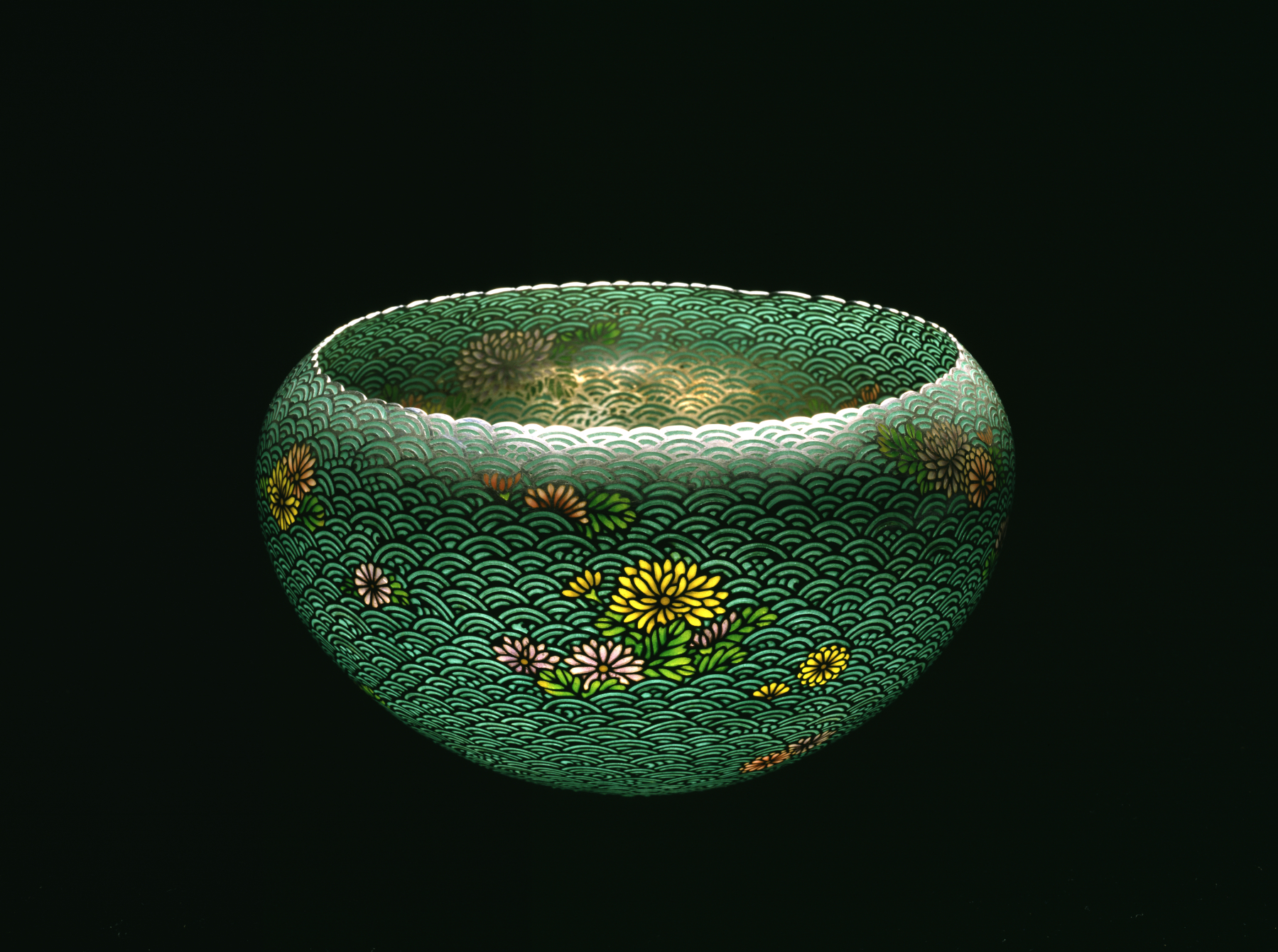 |
| Image source. For a larger view, click here and then click again. |
Don't ever, ever let anyone convince you that Baltimore is a scary place with nothing worth seeing.
February 11, 2007
Tea with Maynard & Carl
Lunch at Teavolve in B'more. Sun-dried tomato quiche and a pot of Keemun hairpoint. Such a serene spot, and it was especially nice that Sunni, the proprietress, apparently recognized me when I walked in. After my first visit three weeks ago, I messaged her through MySpace to ask about the paint color in the shop's bathroom. As I was ordering today, I asked again and she knew exactly what I was talking about. Though I guess most patrons don't inquire about the decorating details of the 'loo…
I've been on a synchronous kick lately of Carl Jung and T00l. As I stated in my post about "Forty-six&2", that song got me into Jung in the first place, through the exploration of the Shadow archetype. On their next album, Lateralus, the song "Reflection" also steers me towards Jungian contemplations. (Man, I'm gettin' deep already tonight. Anyway…) Here are the lyrics:
I have come curiously close to the end, down
Beneath my self-indulgent pitiful hole,
Defeated, I concede and
Move closer
I may find comfort here
I may find peace within the emptiness
How pitiful
It's calling me...
And in my darkest moment, fetal and weeping
The moon tells me a secret - my confidant
As full and bright as I am
This light is not my own and
A million light reflections pass over me
Its source is bright and endless
She resuscitates the hopeless
Without her, we are lifeless satellites drifting
And as I pull my head out I am without one doubt
Don't wanna be down here feeding my narcissism.
I must crucify the ego before it's far too late
I pray the light lifts me out
Before I pine away.
So crucify the ego, before it's far too late
To leave behind this place so negative and blind and cynical,
And you will come to find that we are all one mind
Capable of all that's imagined and all conceivable.
Just let the light touch you
And let the words spill through
And let them pass right through
Bringing out our hope and reason ...
before we pine away.
What I always wonder about this song is how Maynard defines the term "ego". When he sings that he must "crucify the ego", he seems to be using the standard connotation of ego as something that becomes inflated and takes over our better selves, as opposed to the Jungian interpretation, or even the Freudian, for that matter.
The book I've been working on lately is Jung's Map of the Soul, by Murray Stein. It's basically an introductory overview of Jung's theories regarding psyche, the ego, the self, persona/shadow, anima/us, complexes and consciousness. Stein starts out in his introduction comparing Jung's exploration and explanation of the psyche to a map, but the impression I keep getting is of a solar system or a universe, with just a bit of a skew. At the core of Jung's 'universe' is the ego: "It forms, as it were, the centre of the field of consciousness; and, in so far as this comprises the empirical personality, the ego is the subject of all personal acts of consciousness" (Jung). As the center of the 'universe' I keep picturing, the ego becomes not the Sun but, as in an antiquated view of our solar system, the Earth. It is "one's experience of oneself as a center of willing, desiring, reflecting and acting" (Stein). "The ego is a kind of mirror in which the psyche can see itself and can become aware. The degree to which a psychic content is taken up and reflected by the ego is the degree to which it can be said to belong to the realm of consciousness" (Stein). What's important to keep in mind with Jung's concept of ego is that it is not consciousness itself- consciousness is awareness, it contains the ego as well as the other complexes that revolve in the solar system of the psyche. Floating throughout this solar system are the various contents of consciousness- thoughts, memories, identity, fantasies, emotions, images and words. As the center of consciousness, the ego plays a large role in determining "which contents remain within the realm of consciousness and which ones drop away into the unconscious" (Stein). Here's where we begin to get into repression: the ego can choose to repress contents that it doesn't like or finds painful or incompatible with other contents (which leads to the development of the Shadow).
The ego can also be said to be the factor that sets us apart from other creatures, as well as from fellow human beings. It gives our conscious behavior focus and direction. It wills and acts, it represents our free will. Stein gives the very basic example of choosing to go to the post office as an action decided upon and directed by the ego, but it goes far beyond that. "Because we have an ego, we possess the freedom to make choices that may defy our instincts for self-preservation, propagation, and creativity… A strong ego is one that can obtain and move around in a deliberate way large amounts of conscious content. A weak ego cannot do very much of this kind of work and more easily succumbs to impulses and emotional reactions" (Stein).
The ego is developed via "what he [Jung] called 'collisions.' In other words, conflict, trouble, anguish, sorrow, suffering… As the ego tries to apply its will, it meets a certain measure of resistance from the environment, and if this collision is handled well the result will be the ego's growth… A moderate amount of conflict with the environment and some frustration are, therefore… the best conditions for ego growth" (Stein). A strong, well-developed ego is necessary to deal with the various complexes buried within us that throw our psyche out of balance at the touch of a button. "What the ego can do, if it is strong enough, is to contain some of the complex's energy within itself and to minimize emotional and physical outbursts" (Stein) that can occur when we are in the grip of a stimulated complex.
Similarly, Freud's definition of the ego implies a "a set of psychic functions such as reality-testing, defence, synthesis of information, intellectual functioning, and memory" (Wikipedia: Ego, super-ego, and id). It is "based on the reality principle. The ego understands that other people have needs and desires and that sometimes being impulsive or selfish can hurt us in the long run. Its job is to meet the needs of the id [the source of our most basic drives and impulses], while taking into consideration the reality of the situation" (AllPsych On-line: Freud's Structural and Topographical Models of Personality. On the flipside, while satisfying the desires of the id, the ego must take care to not upset the super-ego, which is the seat of our conscience and sense of morality. A weak ego, in the Freudian sense, would not be able to maintain this balance, leading to a personality either given to impulsive self-gratification or a rigid and judgmental morality. A strong ego is one that is able to balance these other aspects of the psyche to keep us centered and able to cope with reality.
Considering these definitions of ego, it seems that Maynard has it backwards. Rather than crucifying the ego, what is needed to escape that "self-indulgent pitiful hole" is to strengthen the ego, to develop it in order to prevent our descent into that hole in the first place.
Now, when I look at this song from a Buddhist perspective, I pick up on other elements of it with which to disagree (Sorry, MJK) First off, Maynard describes finding peace within emptiness as "pitiful." This is in contrast to the Buddhist idea of emptiness: "This concept, known as sunyata… is a key feature of Mahayana Buddhism. Such a term may appear, on the face of it, to have negative connotations, as though something is lacking. The opposite is in fact true. In Buddhism, the realization of emptiness equates to the experience of nibbana (nirvana) and therefore the cessation of suffering or dukkha" (About.com: Buddhism- Emptiness). As such, the concept of emptiness is a comforting one to Buddhists, and not a pitiful state to which one concedes in defeat.
"So crucify the ego, before it's far too late
To leave behind this place so negative and blind and cynical,
And you will come to find that we are all one mind
Capable of all that's imagined and all conceivable."
There is one line in which MJK sounds a tad Buddhist, in his assertion that "we are all one mind." The idea of interdependency is just as basic to the study of Buddhism as is that of emptiness. We are all one and inseparable. This lack of separation, this oneness, means that the self-indulgent narcissism Maynard sings of is a delusory state that leads to that painfully blind cynicism. Baaaaad Buddhist that I am, I have to admit that this idea actually kind of scares me sometimes. When I look at the people around me, the idea of being of one mind with some of them just freaks me out. I mean, I'm of "one mind" with that Larry-the-cable-guy clone in the pickup truck that just leered at me as he cut me off in traffic? I'm of "one mind" with the Ebonics-talking woman in the Sheetz restroom, screaming at her kids while carrying on a raucous conversation over the cellphone growing out of her ear? Forgive my blind, cynical and narcissistic ego here, but can't I just be of "one mind" with somebody like MJK and leave it at that?
And the Buddha's probably now rolling in whatever entity he's currently incarnated in… (Oh wait, I've used that joke already. It wasn't funny the first time, either.)
That'th all folkth!
Revision added 2/14/07:
Seriously, though, in spite of my nit-picking contradictions with MJK's use of certain terms, the overall message of this song is a valuable one. The idea that letting go of the narcissistic b.s. we all cling to will open us up to oneness and peace is very Buddhist, and certainly something to aspire towards. And the music to which these words are set is beautiful and haunting. On those rare occassions that I make an effort, I've found this a wonderful song to meditate to. (Note to self: Make that effort a little more frequently!!)
I've been on a synchronous kick lately of Carl Jung and T00l. As I stated in my post about "Forty-six&2", that song got me into Jung in the first place, through the exploration of the Shadow archetype. On their next album, Lateralus, the song "Reflection" also steers me towards Jungian contemplations. (Man, I'm gettin' deep already tonight. Anyway…) Here are the lyrics:
I have come curiously close to the end, down
Beneath my self-indulgent pitiful hole,
Defeated, I concede and
Move closer
I may find comfort here
I may find peace within the emptiness
How pitiful
It's calling me...
And in my darkest moment, fetal and weeping
The moon tells me a secret - my confidant
As full and bright as I am
This light is not my own and
A million light reflections pass over me
Its source is bright and endless
She resuscitates the hopeless
Without her, we are lifeless satellites drifting
And as I pull my head out I am without one doubt
Don't wanna be down here feeding my narcissism.
I must crucify the ego before it's far too late
I pray the light lifts me out
Before I pine away.
So crucify the ego, before it's far too late
To leave behind this place so negative and blind and cynical,
And you will come to find that we are all one mind
Capable of all that's imagined and all conceivable.
Just let the light touch you
And let the words spill through
And let them pass right through
Bringing out our hope and reason ...
before we pine away.
What I always wonder about this song is how Maynard defines the term "ego". When he sings that he must "crucify the ego", he seems to be using the standard connotation of ego as something that becomes inflated and takes over our better selves, as opposed to the Jungian interpretation, or even the Freudian, for that matter.
The book I've been working on lately is Jung's Map of the Soul, by Murray Stein. It's basically an introductory overview of Jung's theories regarding psyche, the ego, the self, persona/shadow, anima/us, complexes and consciousness. Stein starts out in his introduction comparing Jung's exploration and explanation of the psyche to a map, but the impression I keep getting is of a solar system or a universe, with just a bit of a skew. At the core of Jung's 'universe' is the ego: "It forms, as it were, the centre of the field of consciousness; and, in so far as this comprises the empirical personality, the ego is the subject of all personal acts of consciousness" (Jung). As the center of the 'universe' I keep picturing, the ego becomes not the Sun but, as in an antiquated view of our solar system, the Earth. It is "one's experience of oneself as a center of willing, desiring, reflecting and acting" (Stein). "The ego is a kind of mirror in which the psyche can see itself and can become aware. The degree to which a psychic content is taken up and reflected by the ego is the degree to which it can be said to belong to the realm of consciousness" (Stein). What's important to keep in mind with Jung's concept of ego is that it is not consciousness itself- consciousness is awareness, it contains the ego as well as the other complexes that revolve in the solar system of the psyche. Floating throughout this solar system are the various contents of consciousness- thoughts, memories, identity, fantasies, emotions, images and words. As the center of consciousness, the ego plays a large role in determining "which contents remain within the realm of consciousness and which ones drop away into the unconscious" (Stein). Here's where we begin to get into repression: the ego can choose to repress contents that it doesn't like or finds painful or incompatible with other contents (which leads to the development of the Shadow).
The ego can also be said to be the factor that sets us apart from other creatures, as well as from fellow human beings. It gives our conscious behavior focus and direction. It wills and acts, it represents our free will. Stein gives the very basic example of choosing to go to the post office as an action decided upon and directed by the ego, but it goes far beyond that. "Because we have an ego, we possess the freedom to make choices that may defy our instincts for self-preservation, propagation, and creativity… A strong ego is one that can obtain and move around in a deliberate way large amounts of conscious content. A weak ego cannot do very much of this kind of work and more easily succumbs to impulses and emotional reactions" (Stein).
The ego is developed via "what he [Jung] called 'collisions.' In other words, conflict, trouble, anguish, sorrow, suffering… As the ego tries to apply its will, it meets a certain measure of resistance from the environment, and if this collision is handled well the result will be the ego's growth… A moderate amount of conflict with the environment and some frustration are, therefore… the best conditions for ego growth" (Stein). A strong, well-developed ego is necessary to deal with the various complexes buried within us that throw our psyche out of balance at the touch of a button. "What the ego can do, if it is strong enough, is to contain some of the complex's energy within itself and to minimize emotional and physical outbursts" (Stein) that can occur when we are in the grip of a stimulated complex.
Similarly, Freud's definition of the ego implies a "a set of psychic functions such as reality-testing, defence, synthesis of information, intellectual functioning, and memory" (Wikipedia: Ego, super-ego, and id). It is "based on the reality principle. The ego understands that other people have needs and desires and that sometimes being impulsive or selfish can hurt us in the long run. Its job is to meet the needs of the id [the source of our most basic drives and impulses], while taking into consideration the reality of the situation" (AllPsych On-line: Freud's Structural and Topographical Models of Personality. On the flipside, while satisfying the desires of the id, the ego must take care to not upset the super-ego, which is the seat of our conscience and sense of morality. A weak ego, in the Freudian sense, would not be able to maintain this balance, leading to a personality either given to impulsive self-gratification or a rigid and judgmental morality. A strong ego is one that is able to balance these other aspects of the psyche to keep us centered and able to cope with reality.
Considering these definitions of ego, it seems that Maynard has it backwards. Rather than crucifying the ego, what is needed to escape that "self-indulgent pitiful hole" is to strengthen the ego, to develop it in order to prevent our descent into that hole in the first place.
Now, when I look at this song from a Buddhist perspective, I pick up on other elements of it with which to disagree (Sorry, MJK) First off, Maynard describes finding peace within emptiness as "pitiful." This is in contrast to the Buddhist idea of emptiness: "This concept, known as sunyata… is a key feature of Mahayana Buddhism. Such a term may appear, on the face of it, to have negative connotations, as though something is lacking. The opposite is in fact true. In Buddhism, the realization of emptiness equates to the experience of nibbana (nirvana) and therefore the cessation of suffering or dukkha" (About.com: Buddhism- Emptiness). As such, the concept of emptiness is a comforting one to Buddhists, and not a pitiful state to which one concedes in defeat.
"So crucify the ego, before it's far too late
To leave behind this place so negative and blind and cynical,
And you will come to find that we are all one mind
Capable of all that's imagined and all conceivable."
There is one line in which MJK sounds a tad Buddhist, in his assertion that "we are all one mind." The idea of interdependency is just as basic to the study of Buddhism as is that of emptiness. We are all one and inseparable. This lack of separation, this oneness, means that the self-indulgent narcissism Maynard sings of is a delusory state that leads to that painfully blind cynicism. Baaaaad Buddhist that I am, I have to admit that this idea actually kind of scares me sometimes. When I look at the people around me, the idea of being of one mind with some of them just freaks me out. I mean, I'm of "one mind" with that Larry-the-cable-guy clone in the pickup truck that just leered at me as he cut me off in traffic? I'm of "one mind" with the Ebonics-talking woman in the Sheetz restroom, screaming at her kids while carrying on a raucous conversation over the cellphone growing out of her ear? Forgive my blind, cynical and narcissistic ego here, but can't I just be of "one mind" with somebody like MJK and leave it at that?
And the Buddha's probably now rolling in whatever entity he's currently incarnated in… (Oh wait, I've used that joke already. It wasn't funny the first time, either.)
That'th all folkth!
Revision added 2/14/07:
Seriously, though, in spite of my nit-picking contradictions with MJK's use of certain terms, the overall message of this song is a valuable one. The idea that letting go of the narcissistic b.s. we all cling to will open us up to oneness and peace is very Buddhist, and certainly something to aspire towards. And the music to which these words are set is beautiful and haunting. On those rare occassions that I make an effort, I've found this a wonderful song to meditate to. (Note to self: Make that effort a little more frequently!!)
Labels:
Buddhism,
Carl Jung,
Lateralus,
Maynard James Keenan,
Reflection,
Sigmund Freud,
tea,
Teavolve,
Tool


January 21, 2007
Tea, Zen and snow
Ok, I'm a (somewhat) happy camper this evening. Drove up to Baltimore today to finally check out a tea shop that I found through, of all places, MySpace: Teavolve. Coffee shops are cool spots but, as a non-coffee drinker, I find the alternative offerings sometimes a bit lacking. So, now I have a great tea spot for my wanderings to the west (Sharazade's in Shep'town) and a great tea spot for my wanderings to the east (Teavolve in B'more). That makes me happy.
I'm close to the end of Zen...Motor Maint. Anyone watching my facial expressions as I was reading in the tea shop this afternoon probably thought I was nuts but, man, this book just keeps astonishing me. Near the end of his quest to explain Quality, Phaedrus (Yeah, it's a weird name. Want an explanation? You have to read the book.) goes back to pre-Aristotelian/Platonic/Socratic Greek philosophy for a study of the Cosmologists and Sophists. I recall passing references to all of the above in Intro to Philosophy, but then I got hooked on the Stoics (who bear more than a passing resemblance to Buddhists) and never explored any of the others. I think it's time, especially in the case of the Sophists. Phaedrus' revelation was my own this afternoon, on discovering the concept of arete:
Phaedrus is fascinated too by the description of the motive of "duty towards self" which is an almost exact translation of the Sanskrit word dharma, sometimes described as the "one" of the Hindus. Can the dharma of the Hindus and the "virtue" of the Greeks be identical?
That which we translate 'virtue' but is in Greek 'excellence.'"
Quality! Virtue! Dharma! That is what the Sophists were teaching. Not ethical relativism. Not pristine "virtue". But arete. Excellence. Dharma!...
"...Arete implies a respect for the wholeness or oneness of life, and a consequent dislike of specialization. It implies a contempt for efficiency ---or rather a much higher idea of efficiency, an efficiency which exists not in one department of life but in life itself."
Now, I consider myself something of an efficiency expert. I'm organized, detail-oriented and, usually, very focused. It's what makes me good at my job. In many ways, my job is great. It's very well suited to my natural aptitudes, and I've been allowed a lot of flexibility in tailoring it to be that way. For the most part, the people I work with are thoughtful and intelligent. And the pay don't suck. But as I've learned more about myself in recent years, I've realized that this job is diametrically opposed to many of the principles I've formed. I'm the inventory manager for a high-end jewelry store. Everything I do in my position is for the encourgagement of conspicuous consumption. The cost (not the retail price, the cost) of a single diamond could buy at least one new car, or feed half the homeless people in the city for who knows how long. And then there are the issues with child labor in Indian diamond cutting facilities, and "blood" diamonds in Sierra Leone (Supposedly all of the stones we sell have been certified conflict-free according to the Kimberly Process. I guess I believe that.). Normally, I try to squelch these thoughts and focus on what I do in a more abstract sense, looking at the inventory as a big puzzle to be solved rather than a bunch of over-priced baubles no one needs. I realize what a freaking hypocrite this makes me, but the damned job pays for me to have a nice home and indulge in things like books, vacations, a bicycle and a kayak. And, as I said, the work environment is great, and the company donates a fair amount of money and merchandise to charitable organizations (with an advertising tag, though. Of course.).
Plus, the fact that I have a purely retail background and only a handful of college-level classes on my resume would make it damned hard to find anything else to do that wouldn't require starting from scratch with at least a 50% reduction in pay. What would you do? Seriously. If anyone reading this would give up a comfortable lifestyle working in the only industry they know purely for the sake of principle, then I'll nominate you for Buddhahood. (And please don't message me that you would. I've been making myself depressed enough over this lately.)
So, how to deal with it? How to incorporate the career path I've been walking with the new dharma path I'm attempting to walk? Is striving for arete enough? If I can acheive that higher idea of efficiency, that excellence, in some departments of life, is that enough? Or am I just fooling myself?
The other thing I wondered about this afternoon is the amount of time I've been spending in tea and coffee shops lately, instead of outdoors. My "thing" is spending my days off outside, hiking, pedaling, paddling, exploring... It's not like this winter's been a rough one, what with the bizarrely warm temperatures the east coast had up until this week. I was heavily into cycling until the first or second weekend in December, at which time I thought I'd head back into the woods for hiking. But I haven't felt compelled to. Part of the past few weeks has been dedicated to retail/family/general holiday stuff, but there've been days in between when all I've wanted to get out of the house for was a good meal and a good book. Plus, there's been this MySpace thing and my new obsession with communicating with strangers. As with so many other things, I realize it's not going to be this intense an obsession for too long, so I'm calling this my "intellectual, analytical phase" and letting it go at that. The woods will still be there when I come out of it (if the damned developers haven't paid the governor of Maryland to let them pave over every tree in the state by then).
It began to snow lightly while I was in B'more. As I headed out of town, there was probably, maybe, a quarter of an inch of snow on the roads. It took twice as long to drive home than usual because of four (4) serious accidents I passed on the way. Give me a dry road and I'll put my lead foot on the gas and fly. But I learned at a young age that when the road's wet, snowy, or icy, you slow the hell down to a reasonable speed. People who can't learn that make me want to get a bazooka. And the Buddha's probably now rolling in whatever entity he currently resides in (Get it? He can't roll in his grave because his spirit would have moved on to a new incarnation... Yeah, well, I've never claimed to be a comedian.).
Enough.
I'm close to the end of Zen...Motor Maint. Anyone watching my facial expressions as I was reading in the tea shop this afternoon probably thought I was nuts but, man, this book just keeps astonishing me. Near the end of his quest to explain Quality, Phaedrus (Yeah, it's a weird name. Want an explanation? You have to read the book.) goes back to pre-Aristotelian/Platonic/Socratic Greek philosophy for a study of the Cosmologists and Sophists. I recall passing references to all of the above in Intro to Philosophy, but then I got hooked on the Stoics (who bear more than a passing resemblance to Buddhists) and never explored any of the others. I think it's time, especially in the case of the Sophists. Phaedrus' revelation was my own this afternoon, on discovering the concept of arete:
That which we translate 'virtue' but is in Greek 'excellence.'"
Quality! Virtue! Dharma! That is what the Sophists were teaching. Not ethical relativism. Not pristine "virtue". But arete. Excellence. Dharma!...
"...Arete implies a respect for the wholeness or oneness of life, and a consequent dislike of specialization. It implies a contempt for efficiency ---or rather a much higher idea of efficiency, an efficiency which exists not in one department of life but in life itself."
Now, I consider myself something of an efficiency expert. I'm organized, detail-oriented and, usually, very focused. It's what makes me good at my job. In many ways, my job is great. It's very well suited to my natural aptitudes, and I've been allowed a lot of flexibility in tailoring it to be that way. For the most part, the people I work with are thoughtful and intelligent. And the pay don't suck. But as I've learned more about myself in recent years, I've realized that this job is diametrically opposed to many of the principles I've formed. I'm the inventory manager for a high-end jewelry store. Everything I do in my position is for the encourgagement of conspicuous consumption. The cost (not the retail price, the cost) of a single diamond could buy at least one new car, or feed half the homeless people in the city for who knows how long. And then there are the issues with child labor in Indian diamond cutting facilities, and "blood" diamonds in Sierra Leone (Supposedly all of the stones we sell have been certified conflict-free according to the Kimberly Process. I guess I believe that.). Normally, I try to squelch these thoughts and focus on what I do in a more abstract sense, looking at the inventory as a big puzzle to be solved rather than a bunch of over-priced baubles no one needs. I realize what a freaking hypocrite this makes me, but the damned job pays for me to have a nice home and indulge in things like books, vacations, a bicycle and a kayak. And, as I said, the work environment is great, and the company donates a fair amount of money and merchandise to charitable organizations (with an advertising tag, though. Of course.).
Plus, the fact that I have a purely retail background and only a handful of college-level classes on my resume would make it damned hard to find anything else to do that wouldn't require starting from scratch with at least a 50% reduction in pay. What would you do? Seriously. If anyone reading this would give up a comfortable lifestyle working in the only industry they know purely for the sake of principle, then I'll nominate you for Buddhahood. (And please don't message me that you would. I've been making myself depressed enough over this lately.)
So, how to deal with it? How to incorporate the career path I've been walking with the new dharma path I'm attempting to walk? Is striving for arete enough? If I can acheive that higher idea of efficiency, that excellence, in some departments of life, is that enough? Or am I just fooling myself?
The other thing I wondered about this afternoon is the amount of time I've been spending in tea and coffee shops lately, instead of outdoors. My "thing" is spending my days off outside, hiking, pedaling, paddling, exploring... It's not like this winter's been a rough one, what with the bizarrely warm temperatures the east coast had up until this week. I was heavily into cycling until the first or second weekend in December, at which time I thought I'd head back into the woods for hiking. But I haven't felt compelled to. Part of the past few weeks has been dedicated to retail/family/general holiday stuff, but there've been days in between when all I've wanted to get out of the house for was a good meal and a good book. Plus, there's been this MySpace thing and my new obsession with communicating with strangers. As with so many other things, I realize it's not going to be this intense an obsession for too long, so I'm calling this my "intellectual, analytical phase" and letting it go at that. The woods will still be there when I come out of it (if the damned developers haven't paid the governor of Maryland to let them pave over every tree in the state by then).
It began to snow lightly while I was in B'more. As I headed out of town, there was probably, maybe, a quarter of an inch of snow on the roads. It took twice as long to drive home than usual because of four (4) serious accidents I passed on the way. Give me a dry road and I'll put my lead foot on the gas and fly. But I learned at a young age that when the road's wet, snowy, or icy, you slow the hell down to a reasonable speed. People who can't learn that make me want to get a bazooka. And the Buddha's probably now rolling in whatever entity he currently resides in (Get it? He can't roll in his grave because his spirit would have moved on to a new incarnation... Yeah, well, I've never claimed to be a comedian.).
Enough.
Subscribe to:
Posts (Atom)


 Posts
Posts


