It's been 10 years since my first White Weekend, but there's been no snow in the DC area this year. And this anniversary celebration is actually not about Jack and his music so much as it is a recognition of Everything I've Ever Learned from the entity called Jack White. Because that's a lot, and it's going to take a couple of posts to cover it all. Hopefully you'll follow along.
For the couple of decades pre-Jack, I was fairly musically monogamous. I would latch onto one, maybe two bands or musicians and listen to them pretty much exclusively. I'd dabble here and there in other stuff, but my primary focus would be that one or two that resonated with me on an emotional level. And my tastes ran in sequence from the cartoon rock of Kiss in my high school years, to the raunchy rock of Guns'n'Roses, to the operatic rock of Queensryche, to the esoteric rock of T00l, the grungy rock of Soundgarden and Audioslave, and then whatever Incubus is considered. T00l led me into things like the ideas of Carl Jung, but none of the other bands I listened to over the years really opened me up to anything else.
That changed immediately in 2010 because getting into Jack meant also getting into the blues. It was impossible to not be curious about all of the music and other elements that he talked about-- It Might Get Loud had just come out the year before and he went on and on about the blues in that film and in pretty much every old White Stripes interview I was digging up. Right away, I was buying music by Robert Johnson, Blind Willie McTell, and Son House right alongside all of the White Stripes, Raconteurs, and Dead Weather albums. I went as deep down that rabbit hole as I did down the Jack hole. I've never read any of the books written about the White Stripes, but I've read a dozen or more about blues music and countless essays and articles. And it blows my mind that I made it all the way to my mid-40s, having grown up hearing Led Zeppelin and the Rolling Stones and the rest of those blues revival bands, without ever hearing any of the original artists who inspired the revivalists. If I hadn't been exposed to it all by Jack, it's possible I might've lived my entire life without ever consciously listening to Howlin' Wolf or Muddy Waters or Skip James or Fred McDowell or Geechie Wiley. And there's still so much that I haven't gotten to, so many people like Tampa Red, Sonny Terry and Brownie McGhee, and both Sonny Boy Williamsons whose music I've yet to dig into, and who knows how many I've not even heard of yet.
Actually, thinking back, I remember at some point when I was younger, George Thorogood's Bad to the Bone was a big hit and I heard it all the time, and someone said that was "blues music". And then other guys like Stevie Ray Vaughen came along and, again, were described as "the blues". But back then I just listened to music, I didn't bother to explore it, and those guys didn't grab me that strongly anyway. So I accepted what I heard and my early, very vague conception of "the blues" became something created by white people. Now that the circle of people I share and discuss music with has broadened, it feels like everyone I know knows where blues music came from, but what about outside of that circle? Are we still just a bunch of Seymours in a world of Blues Hammer fans?
When Third Man Records released their two Paramount Records sets and Documents Records reissue series in 2013/2014, my world really exploded. It wasn't just that they'd opened a doorway to old music and genres that I'd never considered before. That in itself was tremendous, but I soon realized that along with the music, I was developing a totally different awareness of United States history and culture. It's difficult to read extensively about blues music without also learning about the post-Civil War reconstruction era and the beginnings of the Civil Rights era, about the history of African-American people. The history of not only blues but also jazz, soul, R&B, rap, and hip-hop music is obviously enmeshed in the African-American experience. But is it that obvious? How many people, even those educated in the history of the music, really stop to think about it at that level? White versions of all of those genres can be deeply enjoyable, but to listen to the white versions and not acknowledge that their basis lies in the black experience is to naively believe that the tip of the iceberg is the whole thing. Even listening to Charley Patton and Robert Johnson can be just peeking below the surface if you don't take the time to learn about the experiences of those musicians. When Black Lives Matter became prominent in the news in 2015, I found myself able to understand why specifically because I'd read Alan Lomax's description of having been hauled to the police station for being caught recording music with Son House, and because I knew that Blind Willie McTell's Southern Can Is Mine wasn't necessarily written about beating a woman. I can say with no pretension or irony that this music woke me up to a whole new form of empathy.
Touching on another currently prominent social issue and at the risk of being accused of misogyny, I have to admit that, up until 2010, I didn't have much appreciation for female singers and vocalists. There's something about soprano voices that is frequently like nails on a chalkboard for me. Even Jack's high-pitched tenor kept me from diving into the White Stripes for a year or so. Up until that time, there was only a small handful of female singers I could stand to hear, which included Tina Turner, Annie Lennox, Janis Joplin, and sometimes Alanis Morissette. So my musical world was shaped by an almost completely male-centric perspective. But Jack is recognized for his associations with female musicians so his fans can't help but be exposed to female voices. The first on the list for me was, of course, Alison Mosshart of the Dead Weather. Can't say I've become a full-on fan, but she does have a good rough'n'ready rock'n'roll voice. Next was Loretta Lynn, through the album Jack produced, Van Lear Rose, and I found myself wanting to hear more of Loretta's straightforward, conversational style. Then Cary Ann Hearst's scratchy tone grabbed me, when I saw Shovels and Rope open for Jack in 2012. Then came the old blues queens included on the Paramount Records sets-- Ma Rainey, Ethel Waters, Alberta Hunter, and Ida Cox-- and the women who played harder blues as well as any man-- Louise Johnson, Geechie Wiley, and Elvie Thomas.
Slowly I realized that there were more female voices that my ears could tolerate than I'd thought, and that I actually enjoyed. Yet I was still shocked at myself in 2016, when Third Man Records signed Margo Price, who sings country songs in a powerful-yet-soft soprano that's exactly the sort that used to make me cringe. There's something about Margo's delivery of her smart and raw lyrics, though, that connected with me and made me end up not just enjoying her sound, but loving to sing along with her. And then Jack collaborated on a song on Beyonce's album Lemonade and I gave the whole record a listen and, holy hell, it blew me away. If you'd told me in 2010 that I would one day buy a record by someone like Beyonce, I probably would've laughed in your face. As with Alison Mosshart, I can't say I've become a Beyonce fan, but Lemonade resonates with me deeply. Others I've come to love are Rachel Nagy of the Detroit Cobras, and Mattiel, who's got a clarion voice and writes songs that sound like a cross between Nancy Sinatra and avant-garde garage band The Monks. Most recently, Third Man released a 3-record compilation of Patsy Cline's Decca Records singles, and I can't stop singing along with her in the car. Why was I never exposed to her music before??? Though if I had been, would my ears have been prepared to appreciate it the way I can now? That's the thing. I think it took having my mind opened by all the myriad things Jack has exposed me to in order to make this shift. There are still a lot of female voices out there that grate on my ears, but I've learned to at least listen before dismissing most of them outright and that's significant, because it's been necessary for me (and anyone else who might not realize this yet) to recognize that these women have important stories to tell.
Along with Loretta Lynn's country stylings, Jack introduced me to Hank Williams when he joined Bob Dylan's project of writing music to unfinished Hank lyrics, released as The Lost Notebooks of Hank Williams in 2011. Throughout my childhood, Johnny Cash was the definition of country music, but Loretta and Hank and, again, the two massive Paramount Records sets and then Jack's American Epic project have put me on the path of Cash's predecessors. As with blues music, it's opened up a whole 'nother world for me.
For the sake of brevity, though, that world and more are gonna be explored in Part 2 of this anniversary celebration.
Showing posts with label Blues music. Show all posts
Showing posts with label Blues music. Show all posts
February 9, 2020


May 7, 2017
A lifetime of blues
Of all the old blues guys who were rediscovered in the 1960s, none changed as obviously and profoundly over the intervening years as Son House. In that Paramount Records recording up there, from way back in 1930, it's obvious he's a young man in the prime of his life. His voice is rich with vitality, his singing is strong and effortless. In 1965, when Alan Wilson was asked to help him remember how to play his own songs for the Father of the Delta Blues record, his voice was still resonant, but it wasn't youthful vitality that gave it its hypnotic power-- It was the sound of weariness coming out of that aged throat, as if the weight of the world was pressing on his shoulders as he sat in front of the mic.
Try playing these two songs together at the same time. You won't hear this dramatic a difference in the singing of Skip James, Mississippi John Hurt, Howlin' Wolf, or any of House's contemporaries who were still performing in the 60s. As extraordinary as all of those other musicians were, this is what makes him the superlative representative of blues music. You don't even have to know anything about him to know that he lived what he sang. It's in his voice, or rather, what his voice became.
February 15, 2017
Jackie Lee, son of Stagger Lee
I recently guested on an episode of the Jack White-centric (what else?) Third Men Podcast, talking about blues music. When asked to name my favorite of Jack's blues covers, I qualified my answer by saying the song I was going to name wasn't a cover per se, though in a sense it is. I went on to describe to the hosts, the Kaminski brothers, how excited I'd been to immediately recognize the source of the cover-that's-not-a-cover when I first heard it, as the song in question lifts sections almost word for word from the older version. I had so much more to say about this song and the unrecognized brilliance of it, but it would've been rude to hijack the podcast so here, in my own space, I can and will babble to my heart's content.
Three Dollar Hat, from the 2015 Dead Weather album Dodge and Burn, lists all four members of the band as songwriters, but it's very obviously Jack's baby because it's very obviously based on Mississippi John Hurt's version of Stack O' Lee Blues. Of all the members of the Dead Weather, Jack is the one who's likely to be most familiar with the Stack O'/Stagger Lee tradition that dates back some 120 years. And Jack is the one who's been driven throughout his career to become a part of musical tradition. Or, as he says in a scene in It Might Get Loud, to "join the family" of song-writers of the early blues era. After almost 20 years of covering half the blues songwriters most people can readily name and many that the average fan could not, and writing blistering blues of his own, he apparently finally felt ready to take his place in this specific, hallowed tradition, to join the huge and highly respectable family of musicians who've sung versions of this song.
"What I care about your two little babes and your darlin' lovely wife? You done stole my Stetson hat and I'm bound to take your life" (As a sidenote, one of the things I will always love most about Mississippi John Hurt is how he sang about such violent subject matter in such a mild and delicate manner. Like Grandpa telling a bedtime story... of murder.)
The tradition of Stack O' Lee becomes more extensive the further you explore it. As described at staggerlee.com--
The history of the song tells many stories. It is an anthem of the dispossessed. It expresses fear of the scary black man, the evolution of modern music, culture theft from black to white, hero worship of the outlaw, the origins of a legendary character and the writing of a Myth.
No other song has so transcended its humble beginnings and been re-invented in so many genres, in so many media and by so many artists.
That site's list of recorded versions of the song ends in 2008, leaving it wide open for Jack to come along. It's interesting to note that Jack's pal Beck covered it in 1996 (using it as inspiration for something different) and 2001, and his former antagonists The Black Keys did it in 2004. Maybe that's part of why he waited so long.
The initial reaction to Three Dollar Hat that I saw from fans in the Vault and at one of the message boards had people latching onto the Frankie and Johnny reference, or calling to mind Nick Cave's version of Stagger Lee. There are legitimate connections to both of those songs.
That little snippet of Frankie and Johnny tagged on at the end is blatant. But turning Stack O' Lee and Billy into Jackie Lee and Johnny does more than just make this a mash-up of two song references, it adds an interesting psychological twist-- Jack White is both a John (born John Gillis, the name on his Third Man Records business card is "John A. White") and a Jack, so just who are the sweethearts Jackie and Johnny? Did he push the Stack O' Lee myth into homoerotic territory, with his bad man Jackie Lee killing Johnny more out of jealousy toward that bad-ass wife than concern over a $3 hat? That idea brings to mind Omar of The Wire, a series busting at the seams with Staggerlees, of which Omar was one of the most intriguing. Or are Jackie Lee and Johnny two manifestations of the songwriter/narrator, a la Fight Club, and is the whole violent story taking place inside his own head, one side of his psyche destroying the other and then being destroyed in turn? Either or both, it skews the tale in a way that's gleefully perverse.
(I'm going to admit right now that I have no idea what Alison Mosshart's vocal part has to do with the rest of the story-line. If anyone out there has any ideas about that, please let me know.)
Three Dollar Hat has much of the punk grittiness of Cave's version. And considering the fact that his son is apparently named after another of Cave's songs, Henry Lee, Jack's surely familiar with this one. I think any similarity between Three Dollar Hat and Stagger Lee is coincidental, though, a reflection of a shared attitude in bringing the legend into the contemporary era. Because where Cave went for a sludgy rock'n'roll edge, Jack uses Three Dollar Hat as an opportunity to make the connection between blues and hip-hop apparent to anyone who hasn't caught on yet.
Another man who named his son after a song is Bobby Seale, co-founder of the Black Panthers. In the book Mystery Train, Greil Marcus opens a chapter about Sly Stone and the myth of Staggerlee by quoting a 1970 jailhouse interview with Seale--
I named my son Malik Nkrumah Staggerlee Seale. Right on, huh? He's named after his brother on the block, like all his brothers and sisters off the block. Staggerlee.
You'll find out. Huey [Newton] had a lot of Staggerlee qualities. I guess I lived a little bit of Staggerlee's life, too, here and there. That's where it's at. You move yourself up from a lower level to a higher level...
...Staggerlee is all the shootouts that went on between gamblers, and cats fightin' over women--- the black community.
Something else, huh? That's life. And all the little Staggerlees, a lot of 'em! Millions of 'em, know what I mean?
And so I named that brother, my little boy, Staggerlee, because... that's what his name is.
Farther on in the chapter, Marcus describes Staggerlee as a fearsome ideal--
...Nobody's fool, nobody's man, tougher than the devil and out of God's reach-- to those who followed his story and thus became a part of it, Stack-o-Lee was ultimately a stone-tough image of a free man.
From popular song, that ideal made its way onto the movie screen through the Blacksploitation films of the 70s. Shaft and Superfly, Curtis Mayfield's Pusherman, these are manifestations of that bad black man standing up to The Man. A few decades later, he veered back into music and emerged as rappers like Ice-T, Tupac Shakur, and Snoop Dog.
In the early days of the White Stripes, Jack White expressed disdain towards hip-hop. He was asked about it in a 2003 Rolling Stone interview--
And you're not a hip-hop fan.
Not particularly. I find Out Kast and Wu-Tang Clan interesting. But I consider music to be storytelling, melody and rhythm. A lot of hip-hop has broken music down. There are no instruments and no songwriting. So you're left with just storytelling and rhythm. And the storytelling can be so braggadocious, you're just left with rhythm. I don't find much emotion in that.
But somewhere along the line, he began to hear things differently. In an article just a couple years ago, which I can't find now to be able to link here, he mentioned that Jay-Z had told him that hip-hop is the blues. That idea gave me pause at first, but damned if he isn't right. Both genres are outlets for the trials and suffering of life, black life in particular. And both frequently take on that braggadocio Jack mentioned, boasting of things like sexual conquests and material possessions, building up the singer/rapper's fearsome rep. Following the trail of the Stack O' Lee myth shows how one genre followed from the other and Jack seems to have had that agenda in mind when writing his own entry into the tradition.
I've also seen complaints from fans over the past few years about the number of songs that Jack has begun rapping rather than singing, from I Cut Like a Buffalo to Freedom at 21 to Lazaretto. All of those songs, culminating in Three Dollar Hat (and his more recent contributions to A Tribe Called Quest's last album), must've been influenced by that conversation with Jay-Z. What the fans bothered by this don't realize is that Jack's doing exactly the same thing he's always done-- He's singing the blues. He's just exploring new avenues, new ways of expressing them. It's one of his typical subtle lessons in how music evolves. Which makes it a damned shame that this song ended up buried on a Dead Weather album that wasn't even toured. But according to comments Jack made months ago in the Vault chatroom, the band did make some sort of video/movie-type thing for Three Dollar Hat. He implied we fans are going to love it. With any luck, one of these days he'll give it to us. Not doing so is just him being perverse again.
As an extra treat, here's one of the first recorded versions of Stack O'Lee--
Three Dollar Hat, from the 2015 Dead Weather album Dodge and Burn, lists all four members of the band as songwriters, but it's very obviously Jack's baby because it's very obviously based on Mississippi John Hurt's version of Stack O' Lee Blues. Of all the members of the Dead Weather, Jack is the one who's likely to be most familiar with the Stack O'/Stagger Lee tradition that dates back some 120 years. And Jack is the one who's been driven throughout his career to become a part of musical tradition. Or, as he says in a scene in It Might Get Loud, to "join the family" of song-writers of the early blues era. After almost 20 years of covering half the blues songwriters most people can readily name and many that the average fan could not, and writing blistering blues of his own, he apparently finally felt ready to take his place in this specific, hallowed tradition, to join the huge and highly respectable family of musicians who've sung versions of this song.
"What I care about your two little babes and your darlin' lovely wife? You done stole my Stetson hat and I'm bound to take your life" (As a sidenote, one of the things I will always love most about Mississippi John Hurt is how he sang about such violent subject matter in such a mild and delicate manner. Like Grandpa telling a bedtime story... of murder.)
The tradition of Stack O' Lee becomes more extensive the further you explore it. As described at staggerlee.com--
The history of the song tells many stories. It is an anthem of the dispossessed. It expresses fear of the scary black man, the evolution of modern music, culture theft from black to white, hero worship of the outlaw, the origins of a legendary character and the writing of a Myth.
No other song has so transcended its humble beginnings and been re-invented in so many genres, in so many media and by so many artists.
That site's list of recorded versions of the song ends in 2008, leaving it wide open for Jack to come along. It's interesting to note that Jack's pal Beck covered it in 1996 (using it as inspiration for something different) and 2001, and his former antagonists The Black Keys did it in 2004. Maybe that's part of why he waited so long.
The initial reaction to Three Dollar Hat that I saw from fans in the Vault and at one of the message boards had people latching onto the Frankie and Johnny reference, or calling to mind Nick Cave's version of Stagger Lee. There are legitimate connections to both of those songs.
That little snippet of Frankie and Johnny tagged on at the end is blatant. But turning Stack O' Lee and Billy into Jackie Lee and Johnny does more than just make this a mash-up of two song references, it adds an interesting psychological twist-- Jack White is both a John (born John Gillis, the name on his Third Man Records business card is "John A. White") and a Jack, so just who are the sweethearts Jackie and Johnny? Did he push the Stack O' Lee myth into homoerotic territory, with his bad man Jackie Lee killing Johnny more out of jealousy toward that bad-ass wife than concern over a $3 hat? That idea brings to mind Omar of The Wire, a series busting at the seams with Staggerlees, of which Omar was one of the most intriguing. Or are Jackie Lee and Johnny two manifestations of the songwriter/narrator, a la Fight Club, and is the whole violent story taking place inside his own head, one side of his psyche destroying the other and then being destroyed in turn? Either or both, it skews the tale in a way that's gleefully perverse.
(I'm going to admit right now that I have no idea what Alison Mosshart's vocal part has to do with the rest of the story-line. If anyone out there has any ideas about that, please let me know.)
Three Dollar Hat has much of the punk grittiness of Cave's version. And considering the fact that his son is apparently named after another of Cave's songs, Henry Lee, Jack's surely familiar with this one. I think any similarity between Three Dollar Hat and Stagger Lee is coincidental, though, a reflection of a shared attitude in bringing the legend into the contemporary era. Because where Cave went for a sludgy rock'n'roll edge, Jack uses Three Dollar Hat as an opportunity to make the connection between blues and hip-hop apparent to anyone who hasn't caught on yet.
Another man who named his son after a song is Bobby Seale, co-founder of the Black Panthers. In the book Mystery Train, Greil Marcus opens a chapter about Sly Stone and the myth of Staggerlee by quoting a 1970 jailhouse interview with Seale--
I named my son Malik Nkrumah Staggerlee Seale. Right on, huh? He's named after his brother on the block, like all his brothers and sisters off the block. Staggerlee.
You'll find out. Huey [Newton] had a lot of Staggerlee qualities. I guess I lived a little bit of Staggerlee's life, too, here and there. That's where it's at. You move yourself up from a lower level to a higher level...
...Staggerlee is all the shootouts that went on between gamblers, and cats fightin' over women--- the black community.
Something else, huh? That's life. And all the little Staggerlees, a lot of 'em! Millions of 'em, know what I mean?
And so I named that brother, my little boy, Staggerlee, because... that's what his name is.
Farther on in the chapter, Marcus describes Staggerlee as a fearsome ideal--
...Nobody's fool, nobody's man, tougher than the devil and out of God's reach-- to those who followed his story and thus became a part of it, Stack-o-Lee was ultimately a stone-tough image of a free man.
From popular song, that ideal made its way onto the movie screen through the Blacksploitation films of the 70s. Shaft and Superfly, Curtis Mayfield's Pusherman, these are manifestations of that bad black man standing up to The Man. A few decades later, he veered back into music and emerged as rappers like Ice-T, Tupac Shakur, and Snoop Dog.
In the early days of the White Stripes, Jack White expressed disdain towards hip-hop. He was asked about it in a 2003 Rolling Stone interview--
And you're not a hip-hop fan.
Not particularly. I find Out Kast and Wu-Tang Clan interesting. But I consider music to be storytelling, melody and rhythm. A lot of hip-hop has broken music down. There are no instruments and no songwriting. So you're left with just storytelling and rhythm. And the storytelling can be so braggadocious, you're just left with rhythm. I don't find much emotion in that.
But somewhere along the line, he began to hear things differently. In an article just a couple years ago, which I can't find now to be able to link here, he mentioned that Jay-Z had told him that hip-hop is the blues. That idea gave me pause at first, but damned if he isn't right. Both genres are outlets for the trials and suffering of life, black life in particular. And both frequently take on that braggadocio Jack mentioned, boasting of things like sexual conquests and material possessions, building up the singer/rapper's fearsome rep. Following the trail of the Stack O' Lee myth shows how one genre followed from the other and Jack seems to have had that agenda in mind when writing his own entry into the tradition.
I've also seen complaints from fans over the past few years about the number of songs that Jack has begun rapping rather than singing, from I Cut Like a Buffalo to Freedom at 21 to Lazaretto. All of those songs, culminating in Three Dollar Hat (and his more recent contributions to A Tribe Called Quest's last album), must've been influenced by that conversation with Jay-Z. What the fans bothered by this don't realize is that Jack's doing exactly the same thing he's always done-- He's singing the blues. He's just exploring new avenues, new ways of expressing them. It's one of his typical subtle lessons in how music evolves. Which makes it a damned shame that this song ended up buried on a Dead Weather album that wasn't even toured. But according to comments Jack made months ago in the Vault chatroom, the band did make some sort of video/movie-type thing for Three Dollar Hat. He implied we fans are going to love it. With any luck, one of these days he'll give it to us. Not doing so is just him being perverse again.
As an extra treat, here's one of the first recorded versions of Stack O'Lee--
January 28, 2017
Spitting out these 300 M.P.H. Outpour Blues
I love the way Jack White talks about the music that's meaningful to him. In a panel discussion about the Rise and Fall of Paramount Records back in 2013, surrounded by erudite, scholarly types and people who write about music for a living, his descriptions of the songs and the impact they had on him was down-to-earth and easily relateable. In that snippet above, what he says about the song Mama's Angel Child especially resonated with me-- That part about "he's speaking for me", that's one of the things that definitely draws us to music. Those songs that speak for us, the ones that make us feel as if the song-writer pulled our own thoughts and feelings out of us and set them to a melody, are intensely powerful.
"I'm getting hard on myself, sitting in my easy chair..."
So many of us go through that dance with self-loathing angst-- "I'm not this enough, I'm not that enough, I'm not good enough, I'm not doing enough, why did I do that?, why did I say that?, why didn't I say that?, I really screwed up, I'm really screwed up...." And yet our lives, to anyone looking in from the outside, are perfectly fine. We have food, shelter, family, friends. Money may or may not be a little tight, but we can pay our bills, buy some records, and go see a movie once in a while. And yet we suffer. We get hard on ourselves sitting in our easy chairs. Why?
"Safe to say somebody out there's got a problem with almost everything you do..."
So much wisdom, and again so simple. But one of the hardest lessons for some of us to learn, something we get hung up on over and over again and that leads us right back to that easy chair, getting hard on ourselves. For what?
"Well, sooner or later, the ground's gonna be holdin' all of my ashes, too..."
And yet, there's a defiance of all those troubles at the end, the strength to stand up to those who have a problem with everything we do and, just as hard, to stand up to our own selves. That final twist, that's the reassurance this song gives us--
"One thing's for sure, in that graveyard... I'm gonna have the shiniest pair of shoes."
If that's not the blues, I don't know what the hell is.
January 2, 2016
Christmas road-trip, Md to Fla 2015: Coming back
Started the drive home with the Danger episode of Bob Dylan’s Theme Time Radio, then set the flashdrive back to shuffle. Ended up with a great assortment of tunes along the way, so this road-trip tale is gonna be as much music as babbling...
And of course I found the historic Ocala cemetery when passing through to get from route 75 to 301. Of course I did. That’s what I do, I find cemeteries. Driving along, I glance down a side street and, boom, I see headstones a couple blocks away. This was an interesting one, too, decrepit and falling apart, but relatively well groomed. Wandered around it accompanied by songs blasting from an oldies radio station playing all the way across a field on the other side the road at what looked like a lumberyard. Since I’d not brought my camera on this trip, I had to take photos with my tablet, first time I’ve attempted that. The shots came out tolerably well, despite being barely able to see what I was shooting because of glare on the screen. Made them somewhat serendipitous. Though I always feel that cemetery photos should be black and white, so after some internal debate I ended up editing them before uploading.
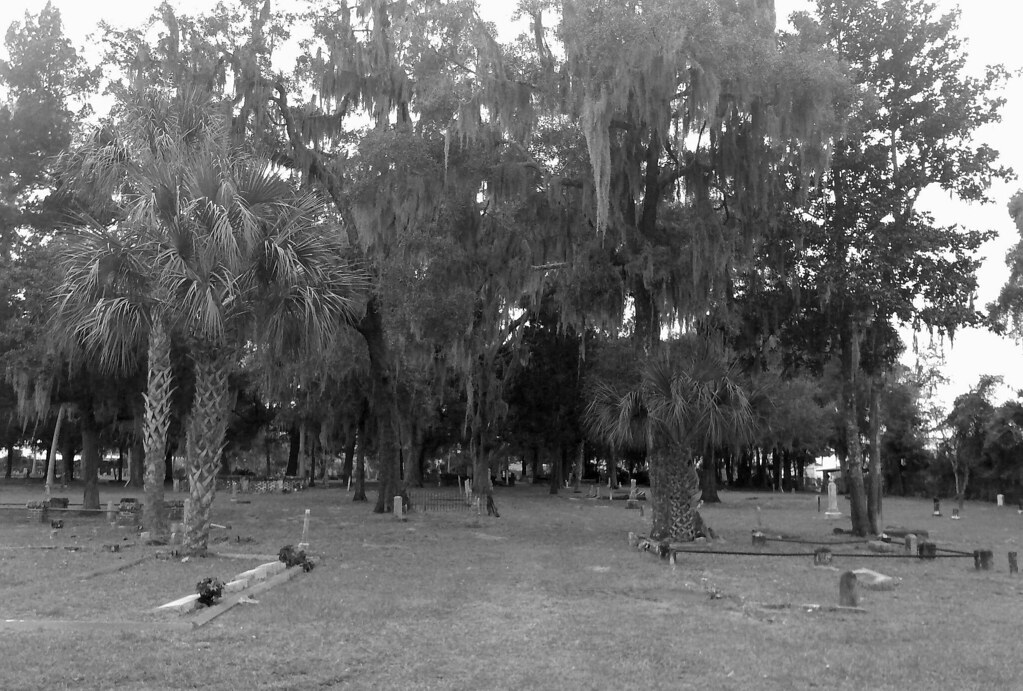
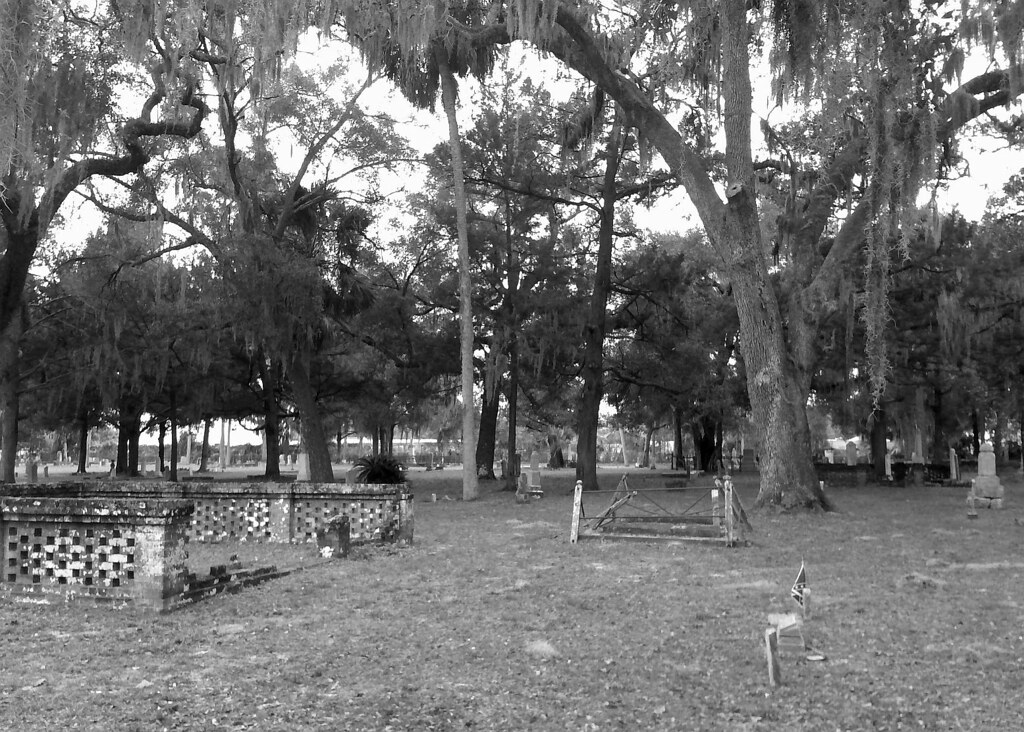
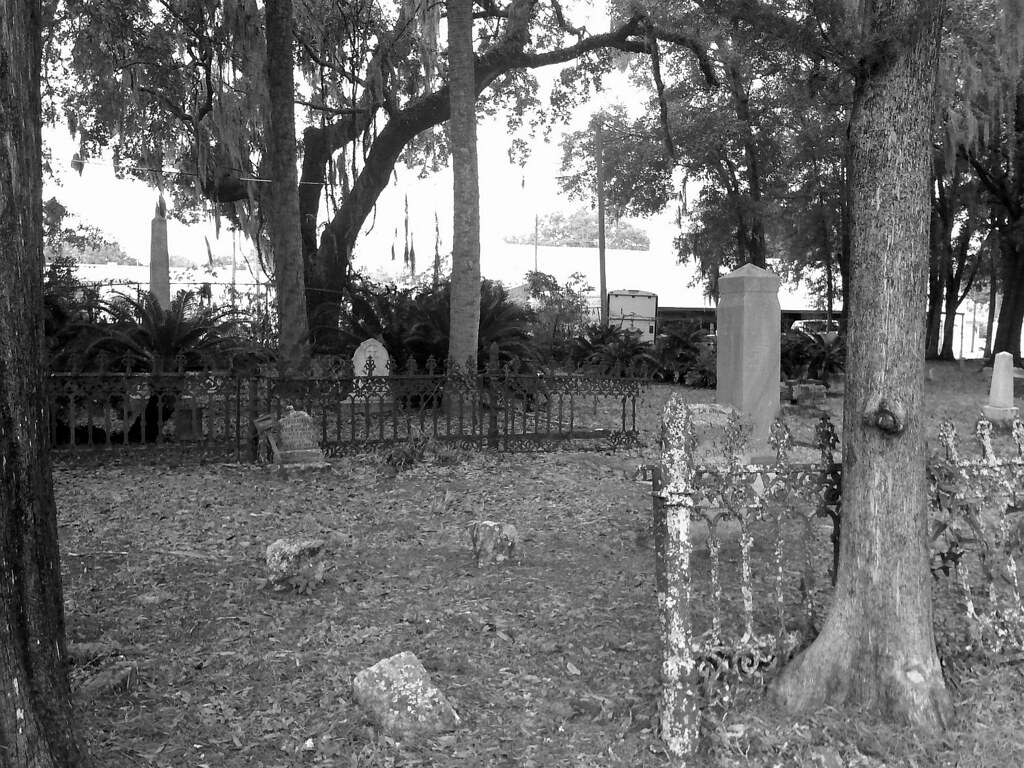
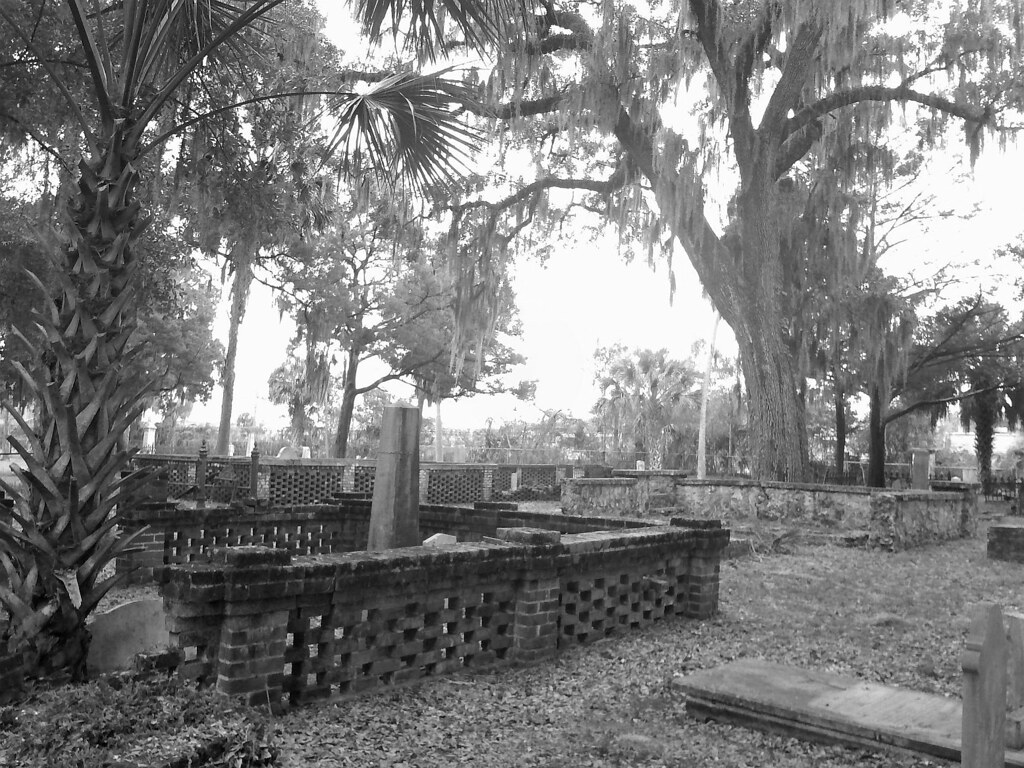
A little ways beyond the sprawling horse farms north of Ocala, I passed both The Orange Shop and a turnoff to the site of Marjorie Kinnan Rawlings Historic State Park. Decided a few miles further on that those were stops I had to make, so I whipped a quick'n'vicious U-turn and headed back to check out both.
What better souvenir of Florida than fresh-squeezed-on-site orange juice? And The Orange Shop itself looked to have been around way back when Hank Williams recorded what may've been his only political song--
Marjorie Kinnan Rawlings’ homestead was definitely worth the prolonged stop. You have to squint a bit to block out the highway you’ve just turned off of, and the two-lane blacktop leading back to the park, and the park and boat ramp next to the homestead, in order to get a feel for the wilderness Rawlings moved to in 1928. Just inside the old gate at the entrance is a sign that helps. It reads “It is necessary to leave the impersonal highway, to step inside the rusty gate and close it behind. One is now inside the orange grove, out of one world and in the mysterious heart of another. And after long years of spiritual homelessness, of nostalgia, here is that mystic loveliness of childhood. Here is home.” And down the path is exactly what she describes, as you come around a slight curve into an opening that was once her orange grove. There are only a few more than a dozen trees now, but enough to give a feeling of what it was like, what with the old barn and big glossy chickens strutting around and roosting in the low branches of the orange trees. And Rawlings’ house beyond, maintained by staffers in period clothing. It wasn’t open this day, but I was able to walk around and peek in the windows, and wander the short trail through what’s left of the wilderness. I wondered as I walked what she meant by “here is home”. Literally, her home? Or a spiritual home that she felt all who entered the place would arrive at? The house appeared cozy enough, but the woods… not so much. They’re compelling, though, and certainly mysterious. The alien-ness of hanging mosses, strangling figs, palms that grow like ferns, and cypress knees creates a definite enchantment. But there’s also something forbidding in their mystery, in the way sandy soil gives way to springy marshiness, and then to swamp. What threats are hidden behind the fans of palm and in those clumps of Spanish moss? In my childhood, I saw the film of Rawlings’ book The Yearling, which makes the place seem innocent enough, despite the difficulty of life there. But I also saw Frogs and had nightmares about Spanish moss, so there you go.
As I was coming back through the grove from the trail through the woods, the gentleman working there invited me to pick a few oranges to take with me. Take my word for it, the taste of historically significant oranges has a noticeable edge over anything you'll get in the grocery store.
Was a bit jarring to have this come up immediately when I turned the key in the ignition, but the two that followed brought me back to a more appropriate mood.
The rest of the way up 301 to route 10 to the Jacksonville beltway and then onto 95 was swift despite construction squashing three lanes worth of traffic into two. The shuffling stereo got caught in a blue mood…
But somewhere in the midst of Georgia, it brought up an appropriate tune (despite the fact that 95 runs by Savannah rather than Atlanta)-
And then, as twilight ended, up came Blind Willie Johnson and some gospel…
As I passed the exit for Effingham (which made me chuckle because I once passed another Effingham in another state and the same lame joke crossed my mind then), it was back to some roadtrip-appropriate hard stuff…
Got off at an exit with three motels only to find that none of them had any available rooms. Decided to cross over the highway to see if there were more options on the other side, but what I thought was a road to somewhere suddenly turned into an exit that dumped me back onto 95 heading southbound, which was not what I wanted. When you’re hauling ass along a dark highway trying to get to the next exit to get back in the right direction, you could do a lot worse than My Life With The Thrill Kill Kult…
That next exit back was for a town called Coosawhatchie. Instead of looping across the overpass to get back on the highway going north, I decided I had to see what Coosawhatchie looked like, even in the dark, so I headed in the direction the sign pointed. Either it wasn’t much of a town or I missed a turnoff to it, but I suddenly realized the dark road I was heading along was running parallel to the highway going north. Sure enough, it came back up to the previous exit where I’d had no luck getting a room. So I got back on 95 going in the right direction and high-tailed it some more to an exit with more hotel options, where it took three stops to finally get one of apparently the last five rooms around.
A room that, even after turning on the air conditioner, had a decidedly muggy, clammy feel to it. Floor, sheets, pillows, even my clothes the next morning felt ever so slightly damp. Plus, no wi-fi. Tossed all night, and did not sleep late the next morning. Got out of damp Dodge as quick as I could, with the Captain and Seu Jorge setting the tone for the morning.
Stopped two exits down for breakfast at the Olde House Café, because “Country cookin’ makes you good lookin’”. We’ll see.
Made serious time through the rest of S.C. and into N.C. thanks to another woman driving a red car. Can’t recall who initially caught up with whom, but we leap-frogged a few times, I ended up following her for a while, then got in front of her and maintained the lead for a long time. Then we got caught behind a slow pickup truck. When I was finally able to whip around and get ahead of him, I looked back and saw her roll down her window and throw a gesture of some sort at him as she passed. After that, it wasn’t so much fun having her follow me, so I put a little more pressure on the gas pedal and took it up to a speed she wasn’t as comfortable at. Though every now and again, when I’d get caught behind slower cars, I’d look back and see a red car coming around the side of the cars way back behind, as if she were trying to catch up. But once I was in the clear again, I’d step down and lose sight of her again. And then suddenly I didn’t see her no mo’. Which was a bit of a relief, but also left me feeling a little bit lonely. Just a very little bit, though.
Along the way, just shy of Florence, I noticed that all the trees that weren’t pine were no longer covered with either Spanish moss or leaves. Though still down south, that made me suddenly feel like I was already back up north.
Made a stop in Smithfield, NC to visit the Ava Gardner Museum. Don't have much profound to say about her other than that what I learned at the museum put her right up there with Elizabeth Taylor in the list of women I admire. Stunningly gorgeous, yet apparently a strong, down-to-earth broad through and through. Definitely need to see more of her films.
The skies began pouring down a monsoon rain as I pulled onto the highway from Smithfield. Obligingly, the stereo shuffled up an appropriate tune for what was ahead, again from Hank.
Because the rain just would not let up. Other cars on the road became just pairs of barely visible red lights, until I came right up on them and got a glimpse of a vaguely car-shaped mass ahead or next to me. I passed so many lakes alongside the highway that would have been fields on any other day, to the point that I was less concerned about having an accident with another car and more about coming upon a flood across the road. Especially when the stereo began shuffling up a string of damned fine driving tunes and I just could not speed up...
And this one, highly apropos to Ava Gardner's love of bullfighting and bullfighters...
Finally stopped for dinner somewhere in Virginia and came across this great quote in the most recent music issue of Oxford American, about why so much great music is made in Georgia: "Because of the humidity that surrounds us. You lose your stinking mind and have to go crazy to remain sane! Things are so backwards here. Frontwords is backwards. You know? One and one is two, but what's one? Southern people are fucking crazy. And if you're not crazy, you're driven crazy. And if you don't have that crazy in you, you're not any good."
It ain't the humidity, it's all that scratchy pine and swampy water, I know it is.
And the second truism of the road is... a rainy highway is a rainy highway is a rainy highway. Fortunately, the car stereo was yet again in tune with the drive and shuffled up a couple different versions of this one over the last hundred or so miles home...
Because if you're not in tune with your car, you just can't have a good road trip.
And of course I found the historic Ocala cemetery when passing through to get from route 75 to 301. Of course I did. That’s what I do, I find cemeteries. Driving along, I glance down a side street and, boom, I see headstones a couple blocks away. This was an interesting one, too, decrepit and falling apart, but relatively well groomed. Wandered around it accompanied by songs blasting from an oldies radio station playing all the way across a field on the other side the road at what looked like a lumberyard. Since I’d not brought my camera on this trip, I had to take photos with my tablet, first time I’ve attempted that. The shots came out tolerably well, despite being barely able to see what I was shooting because of glare on the screen. Made them somewhat serendipitous. Though I always feel that cemetery photos should be black and white, so after some internal debate I ended up editing them before uploading.
A little ways beyond the sprawling horse farms north of Ocala, I passed both The Orange Shop and a turnoff to the site of Marjorie Kinnan Rawlings Historic State Park. Decided a few miles further on that those were stops I had to make, so I whipped a quick'n'vicious U-turn and headed back to check out both.
What better souvenir of Florida than fresh-squeezed-on-site orange juice? And The Orange Shop itself looked to have been around way back when Hank Williams recorded what may've been his only political song--
Marjorie Kinnan Rawlings’ homestead was definitely worth the prolonged stop. You have to squint a bit to block out the highway you’ve just turned off of, and the two-lane blacktop leading back to the park, and the park and boat ramp next to the homestead, in order to get a feel for the wilderness Rawlings moved to in 1928. Just inside the old gate at the entrance is a sign that helps. It reads “It is necessary to leave the impersonal highway, to step inside the rusty gate and close it behind. One is now inside the orange grove, out of one world and in the mysterious heart of another. And after long years of spiritual homelessness, of nostalgia, here is that mystic loveliness of childhood. Here is home.” And down the path is exactly what she describes, as you come around a slight curve into an opening that was once her orange grove. There are only a few more than a dozen trees now, but enough to give a feeling of what it was like, what with the old barn and big glossy chickens strutting around and roosting in the low branches of the orange trees. And Rawlings’ house beyond, maintained by staffers in period clothing. It wasn’t open this day, but I was able to walk around and peek in the windows, and wander the short trail through what’s left of the wilderness. I wondered as I walked what she meant by “here is home”. Literally, her home? Or a spiritual home that she felt all who entered the place would arrive at? The house appeared cozy enough, but the woods… not so much. They’re compelling, though, and certainly mysterious. The alien-ness of hanging mosses, strangling figs, palms that grow like ferns, and cypress knees creates a definite enchantment. But there’s also something forbidding in their mystery, in the way sandy soil gives way to springy marshiness, and then to swamp. What threats are hidden behind the fans of palm and in those clumps of Spanish moss? In my childhood, I saw the film of Rawlings’ book The Yearling, which makes the place seem innocent enough, despite the difficulty of life there. But I also saw Frogs and had nightmares about Spanish moss, so there you go.
As I was coming back through the grove from the trail through the woods, the gentleman working there invited me to pick a few oranges to take with me. Take my word for it, the taste of historically significant oranges has a noticeable edge over anything you'll get in the grocery store.
Was a bit jarring to have this come up immediately when I turned the key in the ignition, but the two that followed brought me back to a more appropriate mood.
The rest of the way up 301 to route 10 to the Jacksonville beltway and then onto 95 was swift despite construction squashing three lanes worth of traffic into two. The shuffling stereo got caught in a blue mood…
But somewhere in the midst of Georgia, it brought up an appropriate tune (despite the fact that 95 runs by Savannah rather than Atlanta)-
And then, as twilight ended, up came Blind Willie Johnson and some gospel…
As I passed the exit for Effingham (which made me chuckle because I once passed another Effingham in another state and the same lame joke crossed my mind then), it was back to some roadtrip-appropriate hard stuff…
Got off at an exit with three motels only to find that none of them had any available rooms. Decided to cross over the highway to see if there were more options on the other side, but what I thought was a road to somewhere suddenly turned into an exit that dumped me back onto 95 heading southbound, which was not what I wanted. When you’re hauling ass along a dark highway trying to get to the next exit to get back in the right direction, you could do a lot worse than My Life With The Thrill Kill Kult…
That next exit back was for a town called Coosawhatchie. Instead of looping across the overpass to get back on the highway going north, I decided I had to see what Coosawhatchie looked like, even in the dark, so I headed in the direction the sign pointed. Either it wasn’t much of a town or I missed a turnoff to it, but I suddenly realized the dark road I was heading along was running parallel to the highway going north. Sure enough, it came back up to the previous exit where I’d had no luck getting a room. So I got back on 95 going in the right direction and high-tailed it some more to an exit with more hotel options, where it took three stops to finally get one of apparently the last five rooms around.
A room that, even after turning on the air conditioner, had a decidedly muggy, clammy feel to it. Floor, sheets, pillows, even my clothes the next morning felt ever so slightly damp. Plus, no wi-fi. Tossed all night, and did not sleep late the next morning. Got out of damp Dodge as quick as I could, with the Captain and Seu Jorge setting the tone for the morning.
Stopped two exits down for breakfast at the Olde House Café, because “Country cookin’ makes you good lookin’”. We’ll see.
Made serious time through the rest of S.C. and into N.C. thanks to another woman driving a red car. Can’t recall who initially caught up with whom, but we leap-frogged a few times, I ended up following her for a while, then got in front of her and maintained the lead for a long time. Then we got caught behind a slow pickup truck. When I was finally able to whip around and get ahead of him, I looked back and saw her roll down her window and throw a gesture of some sort at him as she passed. After that, it wasn’t so much fun having her follow me, so I put a little more pressure on the gas pedal and took it up to a speed she wasn’t as comfortable at. Though every now and again, when I’d get caught behind slower cars, I’d look back and see a red car coming around the side of the cars way back behind, as if she were trying to catch up. But once I was in the clear again, I’d step down and lose sight of her again. And then suddenly I didn’t see her no mo’. Which was a bit of a relief, but also left me feeling a little bit lonely. Just a very little bit, though.
Along the way, just shy of Florence, I noticed that all the trees that weren’t pine were no longer covered with either Spanish moss or leaves. Though still down south, that made me suddenly feel like I was already back up north.
Made a stop in Smithfield, NC to visit the Ava Gardner Museum. Don't have much profound to say about her other than that what I learned at the museum put her right up there with Elizabeth Taylor in the list of women I admire. Stunningly gorgeous, yet apparently a strong, down-to-earth broad through and through. Definitely need to see more of her films.
The skies began pouring down a monsoon rain as I pulled onto the highway from Smithfield. Obligingly, the stereo shuffled up an appropriate tune for what was ahead, again from Hank.
Because the rain just would not let up. Other cars on the road became just pairs of barely visible red lights, until I came right up on them and got a glimpse of a vaguely car-shaped mass ahead or next to me. I passed so many lakes alongside the highway that would have been fields on any other day, to the point that I was less concerned about having an accident with another car and more about coming upon a flood across the road. Especially when the stereo began shuffling up a string of damned fine driving tunes and I just could not speed up...
And this one, highly apropos to Ava Gardner's love of bullfighting and bullfighters...
Finally stopped for dinner somewhere in Virginia and came across this great quote in the most recent music issue of Oxford American, about why so much great music is made in Georgia: "Because of the humidity that surrounds us. You lose your stinking mind and have to go crazy to remain sane! Things are so backwards here. Frontwords is backwards. You know? One and one is two, but what's one? Southern people are fucking crazy. And if you're not crazy, you're driven crazy. And if you don't have that crazy in you, you're not any good."
It ain't the humidity, it's all that scratchy pine and swampy water, I know it is.
And the second truism of the road is... a rainy highway is a rainy highway is a rainy highway. Fortunately, the car stereo was yet again in tune with the drive and shuffled up a couple different versions of this one over the last hundred or so miles home...
Because if you're not in tune with your car, you just can't have a good road trip.
December 8, 2015
Jug bands and Joe Bussard
 |
| Image borrowed from Dust & Grooves |
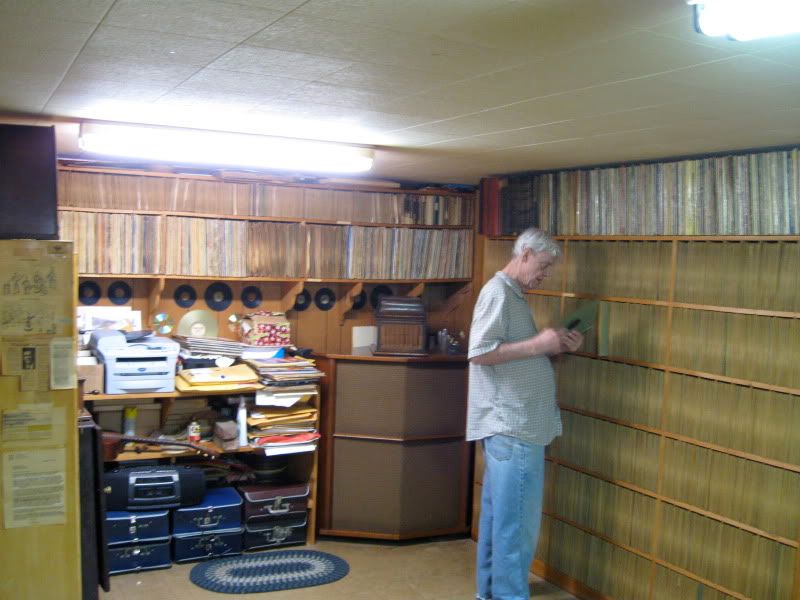
Joe's well known in a small, somewhat esoteric circle of music historians, record collectors, lovers of old-time music. The Dust and Grooves article linked below the photo above is where I first heard of him. I was tickled by the fact that he lived so nearby, but figured I'd never meet him. I learned more about him and that incredible room in his basement when I read Amanda Petrusich's Do Not Sell At Any Price, an essential read for anyone interested in the history of American music, but still figured I'd never run into him on the streets of downtown Frederick. And then one of my favorite local record shops posted on Facebook that they were going to host a release party for The Year of Jubilo, a new cd compilation of Civil War songs culled by Joe from his collection. Hot damn, I could meet the man. When I did, he got a kick out of the way I bopped around to the live music provided by The Capitol Hillbillies and said "You should come up sometime and I'll play you some records!" You have no idea how excited that invitation left me. A week or two later, after an e-mail exchange and a phone call, I was on my way to Joe's house on a wet, chilly Saturday morning.
I tried to take notes of the records he played for me during the three and a half hours I was there, but I didn't want to talk while the music was playing and when each song ended, he was either flipping the record in a flash or slipping it in its sleeve and jumping up to comb the shelves for another one faster than I could write. I ended up with a piece of paper full of scribbles down the middle and around the edges and feel like I didn't write down even half of what I heard. Joe started with 20s jazz, then into jug band, harmonica music, country blues, then he sat down on his couch and played me a bit of screwdriver slide guitar (beautifully, too), and then went back to the records with a dive into 40s and 50s country. And then I had to get on the road, but not before he played a couple of wax cylinder records and some Edison diamond discs on a windup player.
My education in this sort of music began a couple of years ago with the two volume set, The Rise and Fall of Paramount Records, from Revenant Records and Third Man Records. They're a fantastic start to studying American music history, with 1,600 songs and a couple of books thick with information, like four years of high school devoted entirely to the vast catalogue of music released by Paramount. Stepping into Joe's basement and having him play dj for you is like graduating and going off to college. There are so many directions to go in, so many connections to make, and he's a challenging professor to keep up with. On this first morning, the first lesson I came away with had to do with jug bands.
If you're like me, the idea of a jug band most likely initially summons up an image of Appalachia and hillbilly music. And yet, like so much of American music, jug music originated with African-American musicians in urban environments. Which explains the surprising diversity of jug music, as African-American players of that era were apparently rarely as conscious of genre as the historians who've come along since to classify them. They just played, using whatever instruments were at hand or creating new ones from whatever was lying around. As a result, the jug became a bridge between styles, providing a bass line for pretty much any combination of instruments you could think of. Pair it up with a clarinet and piano, and you've got sophisticated, swinging jazz. With a guitar and maybe a harmonica, you could create deeply mournful blues. Throw in a fiddle and there's the Appalachian tone that I think most people would associate with it. And it can be incredibly subtle-- On at least one song, I didn't even realize what I was listening to was a jug rather than a stand-up bass until I heard the musician's breath.
Some highlights of jug music and a few other things Joe played for me that I was able to find on YouTube--
Lordie, that harmonica... And to close it out, a tune used in a documentary about Joe--
And, holy heck, look at the lone speaker there in the corner that Joe plays his music through. Filled that room like nothing I've heard before.
 |
| Image borrowed from this person's tale of his own Joe experience |
Needless to say, there will be as many more lessons as Joe's willing to give me. Soon as I can get a free weekend to head back down into that basement.
January 4, 2015
Another day at the museum: Exploring synchronicity through Setlists for a Setting Sun
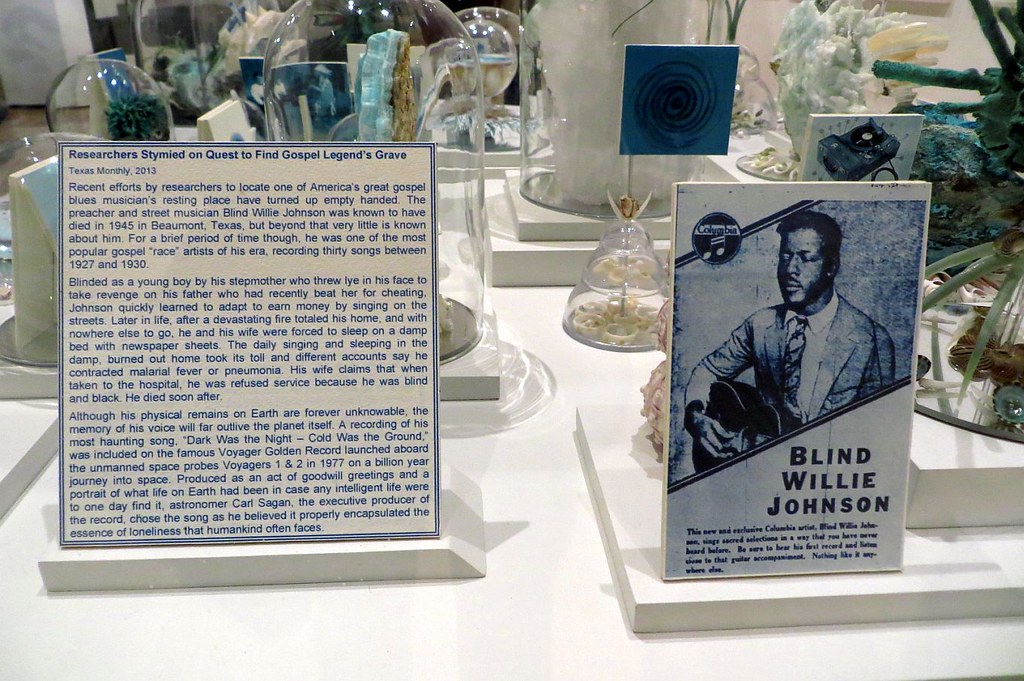
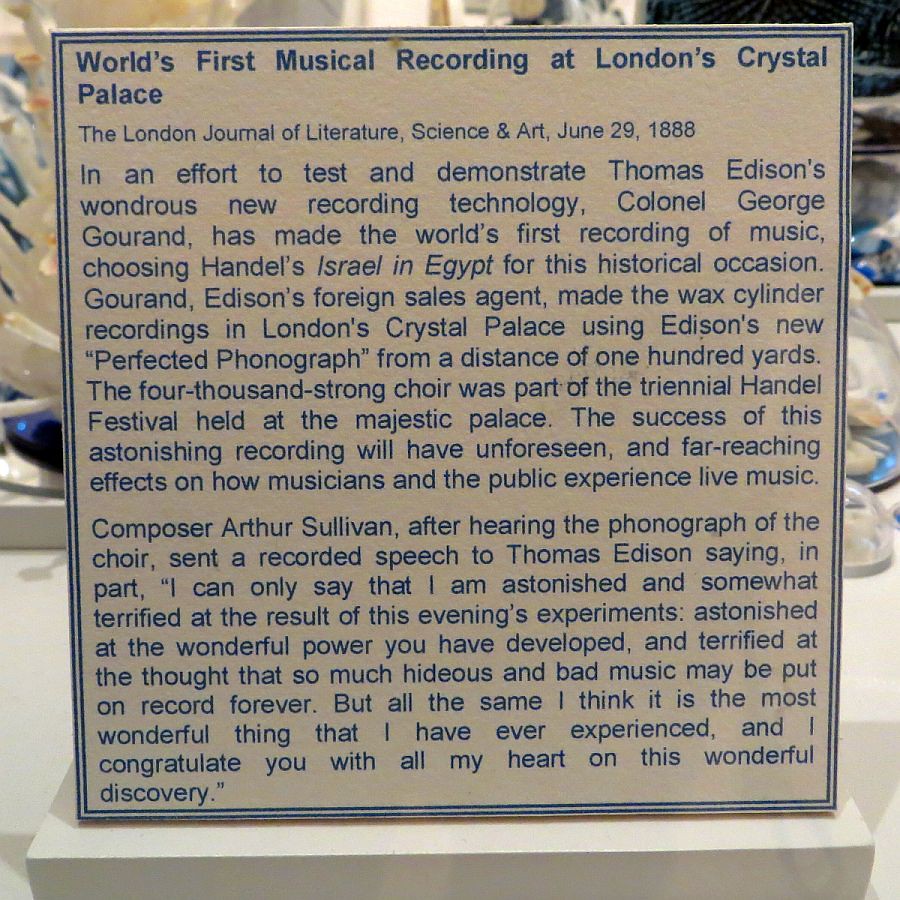
On one side of the room, one Setlist for a Setting Sun, The Crystal Palace. Blues and whites and bone beiges. Glass domes over crystals and shells and butterfly wings. A Victorian palace inaugurated by Victoria herself. Four thousand voices singing Handel phoned in via Edison's phonograph. Hearing crystal-clear reality through a scrim of staticky needle scratches is still startling even now. Cylinder rotations thumping like heartbeats or, as John Fahey said, the furious beating of angels' wings. Is this what angels' voices would sound like to our human ears?
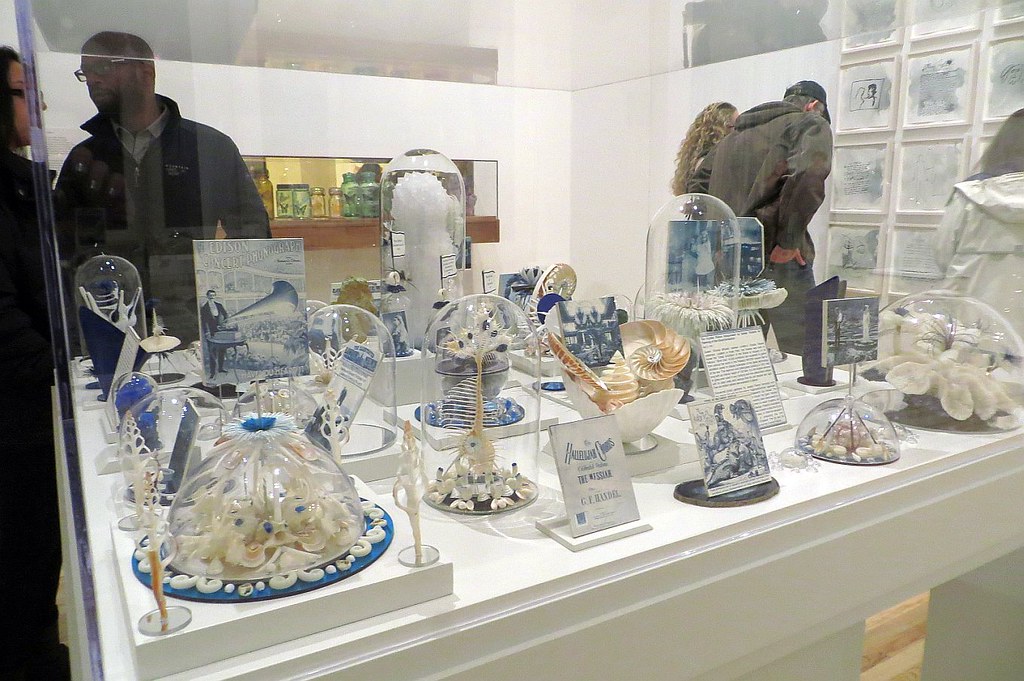
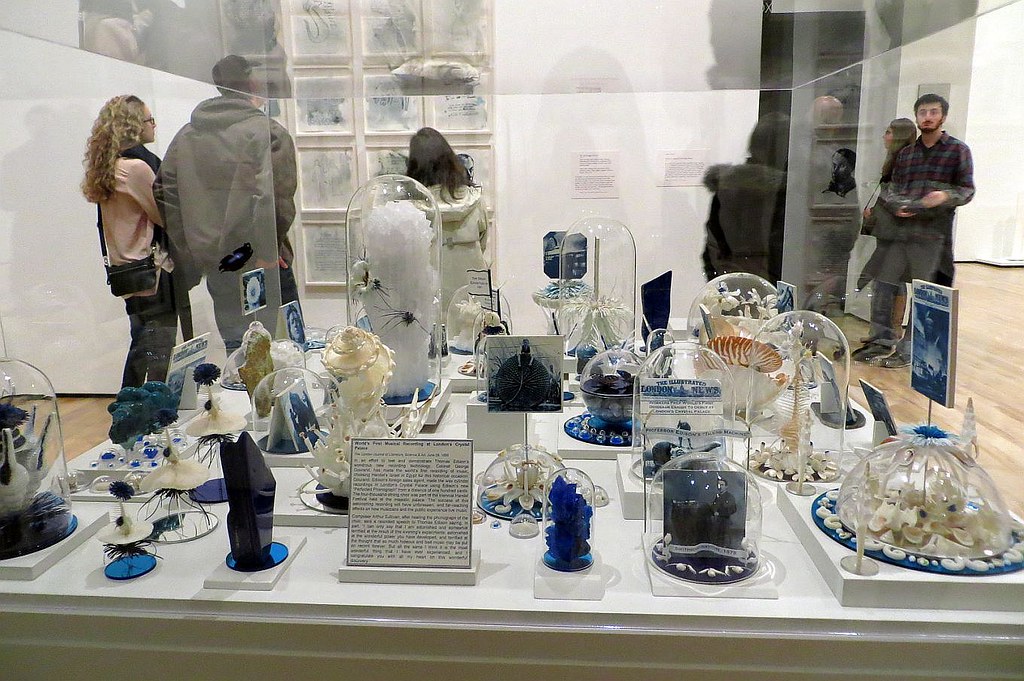
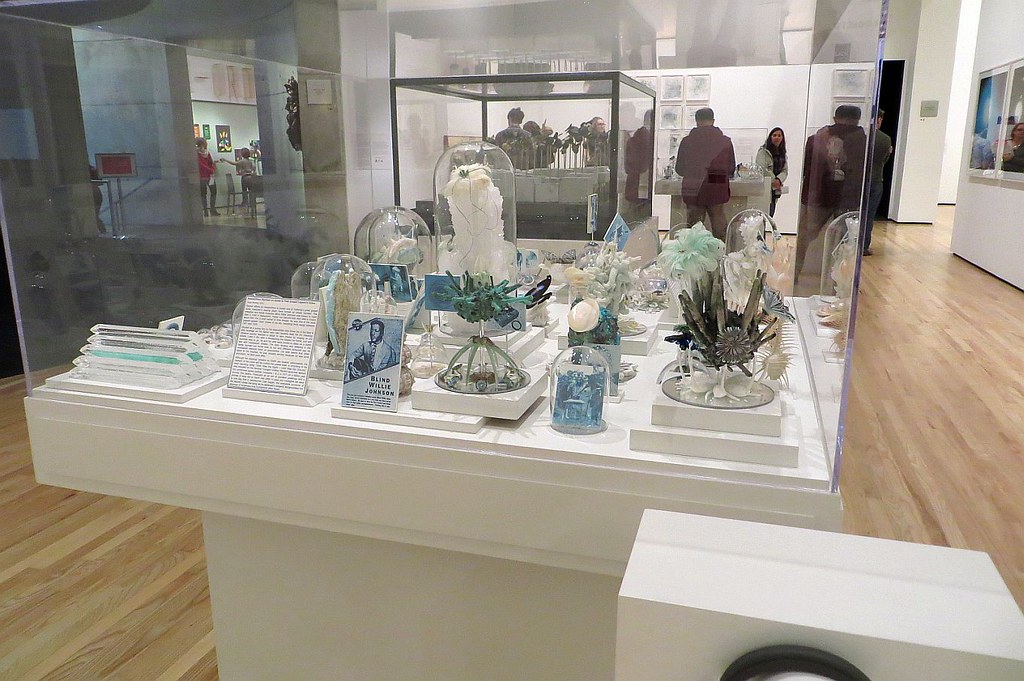
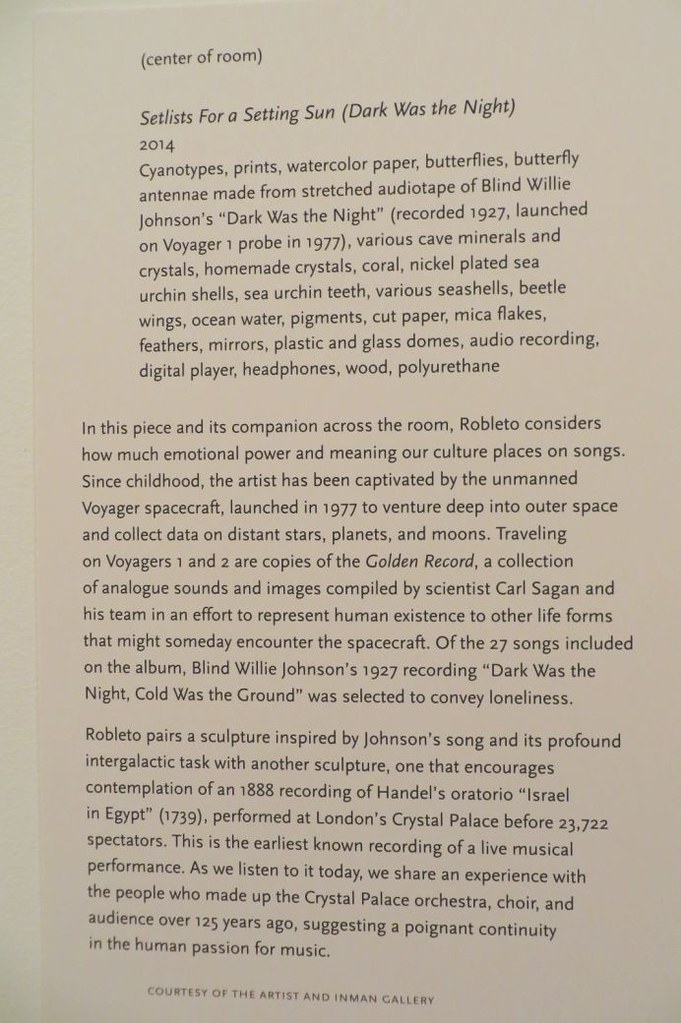
On the other side of the room, another Setlist for a Setting Sun, this time Dark Was the Night. Still blue and white, with more crystals, shells, and iridescent wings under glass, but this time with rockets taking off for the dark expanses of space. A Voyager in search of other voyagers, carrying the sounds of a man who could only see darkness. We've kept track of Voyager all these years, but have no idea where Willie Johnson, whose spectral humming and eerie bottleneck are an angel's song of a different sort, ended up.

And Robleto's message is important. The need to communicate is one of mankind's earliest and most primary. We've been using art and music as means of communication since we could speak, if not even earlier. And we're using music now to try to communicate with species beyond our own world. Art such as Robleto's reminds us of this, makes us understand how music can bring us together and connect us, and how vital it is to not take the need or the method for granted. Words are great for getting a point across, but music can communicate feelings so much more succinctly.
Excellent review of the exhibit from Baltimore's City Paper, here.
 |
| A couple of photos I snuck when the museum guard's back was turned. For more views, go here. |
On the other side of the room, another Setlist for a Setting Sun, this time Dark Was the Night. Still blue and white, with more crystals, shells, and iridescent wings under glass, but this time with rockets taking off for the dark expanses of space. A Voyager in search of other voyagers, carrying the sounds of a man who could only see darkness. We've kept track of Voyager all these years, but have no idea where Willie Johnson, whose spectral humming and eerie bottleneck are an angel's song of a different sort, ended up.
 |
| Again, my own surreptitious photos. More from the artist's site here. |
It's always exciting to me when I run into things that are meaningful to me presented in entirely knew contexts. Dario Robleto's current exhibit at the Baltimore Museum of Art is a perfect example and I got a bit giddy when the pieces came together. At a distance, it's just an assortment of shells and glass and bits of stuff inside a pair of plexiglass cubes and I almost walked past without taking the time to catch the connections. Fortunately, I stopped long enough to read the little card about the Edison phonograph recording of Handel's oratorio at the London Crystal Palace. You see, it wasn't too many months ago that I read a book called Perfecting Sound Forever, by Greg Milner, which begins with accounts of several of Thomas Edison's "tone tests" such as took place at the Crystal Palace. So to read that card, then to pop on the headphones hanging next to the exhibit and hear what that London audience heard was fairly amazing. It was a digital copy I was listening to, yes, but still, the effect it must've had on those people, people who were hearing for the very first time an early, unsophisticated version of the recorded sound that we take for granted, was so easy to imagine.
And then I stepped across the room and put on a second pair of headphones and heard Blind Willie Johnson's Dark Was the Night, Cold Was the Ground, a song I first heard a couple of years ago, early on in my exploration of blues music, and one that immediately defined the blues for me. And here it was, this primal, innately human sound, linked with man's attempts to communicate with alien species.
What was the one thing that tied all of these elements together and made them significant to me? If you've read more than a few entries here, I'm sure you can guess. Yup, that's right, it all comes back to Jack White. The musician who was my gateway to blues music, without whom I'd never have heard of Blind Willie Johnson or known that Johnson's song was chosen by Carl Sagan for inclusion on Voyager's Golden Record (I'd learned about this originally in the companion book to Martin Scorsese's PBS series, The Blues, and it coincidentally came up again recently in an interview that Dan Rather conducted with Jack). Whose songs have inspired a craving in me to learn how music is made and whose mention of Milner's book led me to pick up a copy and learn about the effect of those early phonograph recordings on concert-hall audiences. Is this meaningful synchronicity or the delusions of apophenia? I know it seems maddeningly myopic but, from my perspective, it's just the opposite-- The things I've been exposed to through Jack have opened up a whole world for me and broadened my appreciation of so many forms of music and art and even science. If not for my obsession with him, I would have walked right past those plexiglass cubes at the BMA and thought, "Shells and shit under glass. Pretty, but how is this really art?" I would have missed the connections that made me stop long enough to understand the message of Dario Robleto's art. The message itself wouldn't have meant as much to me.
And Robleto's message is important. The need to communicate is one of mankind's earliest and most primary. We've been using art and music as means of communication since we could speak, if not even earlier. And we're using music now to try to communicate with species beyond our own world. Art such as Robleto's reminds us of this, makes us understand how music can bring us together and connect us, and how vital it is to not take the need or the method for granted. Words are great for getting a point across, but music can communicate feelings so much more succinctly.
Excellent review of the exhibit from Baltimore's City Paper, here.
November 6, 2014
Contradictions of Paramount proportions
How to Make a Paramount Record (1930) from kellianderson on Vimeo.
I've written about Jack White (ad nauseum, some might feel), I've written about Third Man Records, I've written about blues music. But it occurred to me that I've not yet written about The Rise and Fall of Paramount Records, which is an oddly glaring omission as it's the pinnacle of those three things which have become such a focus in my life, my three primary addictions of recent years.
Addiction is a perverse and contrary thing. There's almost a stereotype in the picture of an addict doing things that make absolutely no sense in order to fulfill their need, especially when the need itself makes questionable sense. My own addiction recently compelled me yet again to travel hundreds of miles to see Jack White. But this wasn't for a show by him, though there was music. No, instead of being surrounded by a band, on this night at Battell Chapel on the campus of Yale University in New Haven, Connecticut, Jack was surrounded by a panel consisting of a Yale professor of African-American studies, two music writers, a female blues singer, and a fellow record label owner. This group was in New Haven for the follow-up to an event last year at the New York Public Library, which I also attended, discussing The Rise and Fall of Paramount Records, Volumes One and Two, released by Revenant Records and Third Man Records.
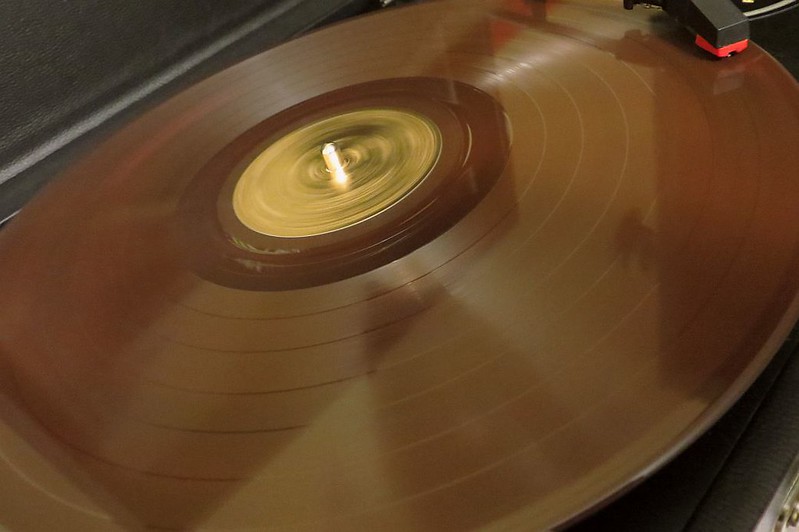
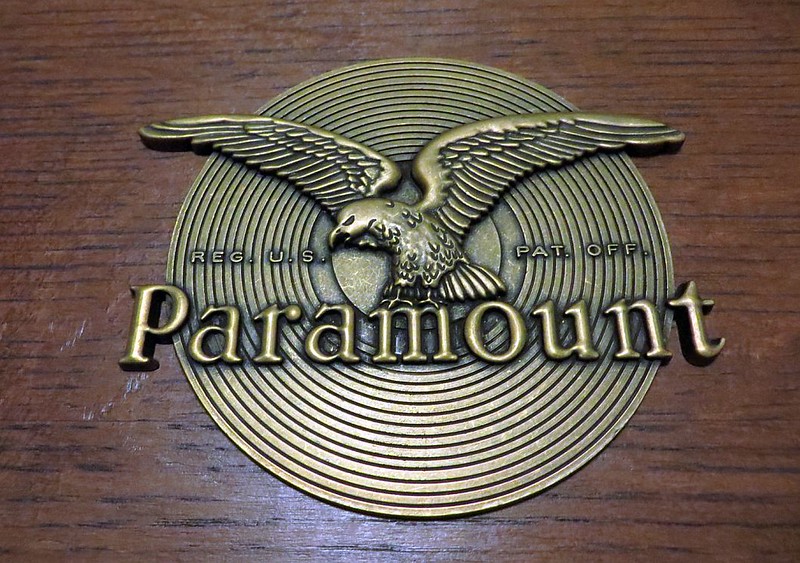
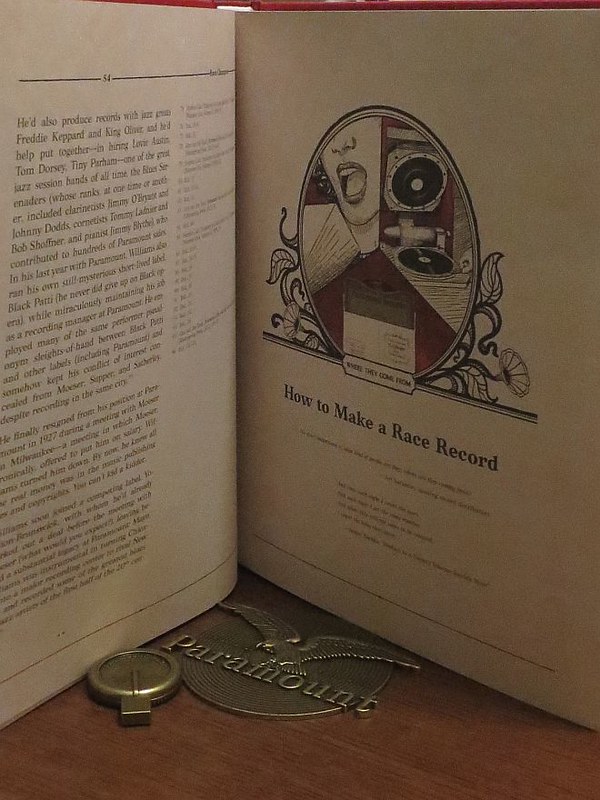
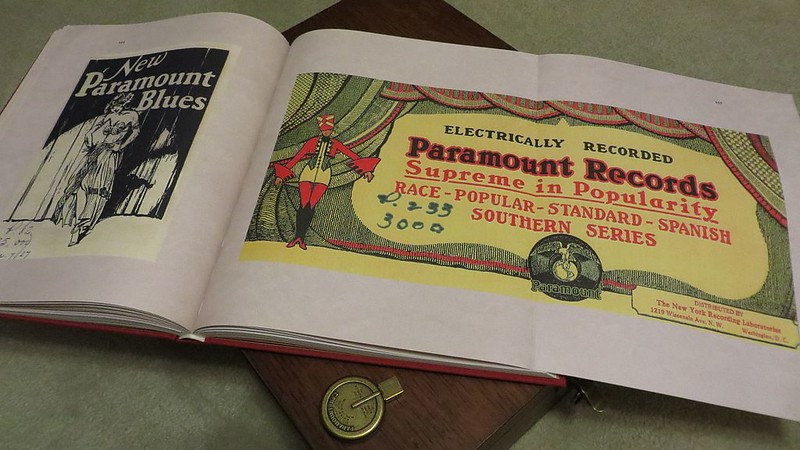
But it wasn't only Jack that motivated me to make the drive from D.C. to Connecticut. There was also my covetousness of these Cabinets of Wonder and everything they represent. When Volume One was released at the end of October of last year, I already had plans to be in Nashville that very week. So the very first day it became available, I walked into Third Man Records, drooled over the components of the set for a while, debated about the physical mass of it and the gigantic carton it was packaged in and how the heck I was going to get it home, then said "Damn the torpedoes" and plunked down my credit card. Two days later, I bought a 50 foot roll of bubble-wrap, a large roll of tape, and spent an evening of my vacation removing the two large books from the cabinet (they went into my suitcase) and then painstakingly wrapping it, with the records enclosed, in almost the entire roll of bubble so that I could carry it home with me on the airplane. Heading home from Nashville, I thought my arms were going to stretch by a good couple of inches from the weight of the solid oak box as I hauled it through the airport. Had two moments of panic, the first at the security gate when the screener asked what was inside all that bubble and warned that they might have to un-wrap it if they couldn't get a clear view in the x-ray machine. The second was when I got to the plane and was informed by the flight attendant that it would not fit into the overhead bins of the tiny three-seat-across plane. She asked what was in it and then wondered why I hadn't just shipped it from Nashville. After insisting that it was very fragile and I had no faith in UPS or FedEx to safely transport it (the real reason was that I'd wanted to open it up and go through the contents, fondle the box, look through the books, and play the usb while I was there on vacation- I couldn't wait til I got home), she relented and let me slip it behind the last row of seats on the plane and then, since the plane wasn't full, let me change my seat to that row so I could sit in front of it.
When I arrived home, before even unpacking my luggage, I delicately cut through the mass of bubble and spread the treasures of the cabinet out on my living room floor to glory in it all.
 |
| Full set of my photos of Volume 1 here |
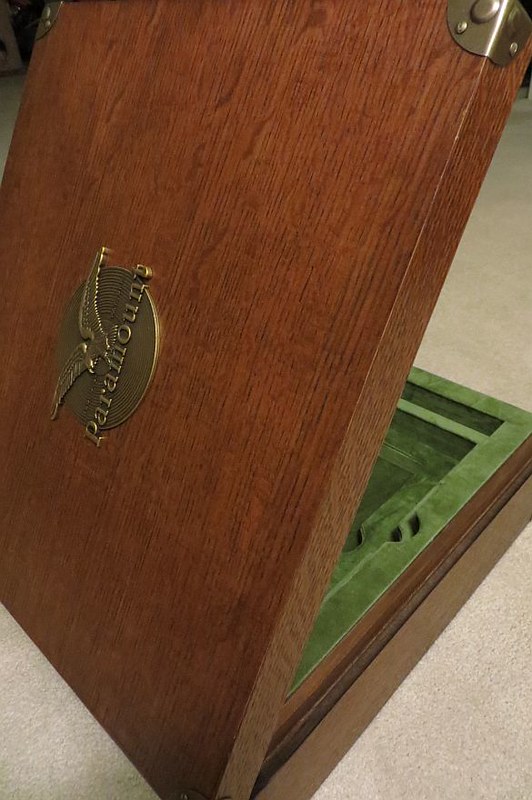 |
| That ain't plywood, folks, it's solid oak |
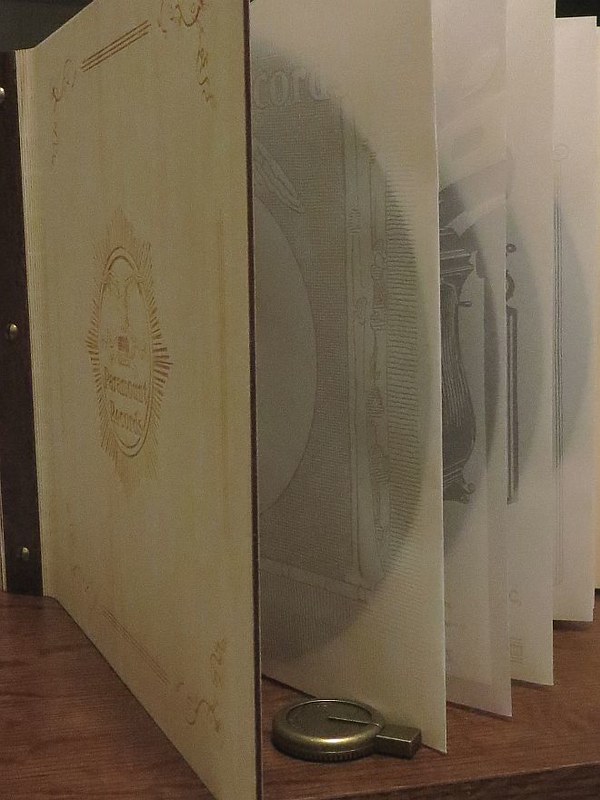 |
Volume two is just as physically gorgeous, updated to match the Art Deco period of its music, all aluminum, silver, midnight blue, and pink--
 |
| All Vol.2 photos from Third Man Records |


The chief contradiction of Paramount was summed up by Jack at Yale when he said "What’s beautiful about [the company] is … the accidental capturing of American culture for the sake of a dollar". At both panel discussions, much was made of how Paramount didn't care who or what they recorded, didn't even care how the records were pressed-- Greil Marcus spoke of how they were so cheap that they mixed clay from the Milwaukee River that flowed below their factory into the shellac, making records literally from dirt. And Jack mentioned that, at nearly the same time Paramount was combing the country for musicians to record, archivists such as John Lomax, working for the Library of Congress, were doing the same but with a much more methodical and discriminating intent. But where those archivists did much to define the genres they collected examples of, Paramount did not. Their focus was not on what they were recording, but on who was going to buy those recordings and, subsequently, the expensively housed record players that were the company's primary product. The records and the music on them were almost an afterthought, created as an accessory to the record players, but an accessory that ended up selling in the hundreds of thousands of units, though never really making any money for the company.
But what happened to those records when Paramount closed in 1935? Amongst other things, there's the tale of angry employees going up to the roof of the factory and sailing masters of the records into the Milwaukee River, not even realizing that they were, essentially, setting that music on a course towards extinction. Those records could never be re-pressed and when the existing copies became scratched or broke or were just thrown away as technology advanced beyond 78rpms, that was it. As the years went by, Paramount's bounty went the way of the dinosaurs.
Fortunately, enough collectors held onto enough scratchy old copies of enough songs that, when Revenant and Third Man came along, they had a few thousand tunes to go through, which they culled down to one-thousand and six-hundred. That's eight-hundred songs per set. Seems like an overwhelming amount to sit down at your record player and listen to, doesn't it? And it's enough that, when people ask me about Volume 1, I'm hard-pressed to describe the diversity of the recordings included in it. And there are eight-hundred more coming on Volume 2. And yet these sixteen-hundred songs are just a fraction, a small fossil representation of the thousands that Paramount released in their 20 year existence. As Greil Marcus put it in the discussion at Yale, what we still have "is so rich and so great and so varied that I think you don't even think about what might be lost [because] you can't imagine that anything is better than what is left."
So along come Revenant and Third Man, pulling together what's left and giving us this glorious representation of what wasn't lost, and doing it with a mindset of "how would Paramount have done this if they gave a shit... and had the money?". The crux is that these sets ended up being too expensive for the masses. This music that was originally produced for a mass audience is now, despite the best of intentions, only available to those who have the money for it. Few people have been able to listen to the old 78s that existed over the years because the scarcity of those records has made them prohibitively expensive, up to tens of thousands of dollars for a single two-song record. And yet these Cabinets of Wonder, for all their value (fifty cents a song, if you do the math, plus the cabinets themselves and two chock-full books of information!), are still priced beyond the means of the average fan.
I can understand why they did it this way. Just sticking these songs on a handful of records and selling them in a series, or even just selling the two 800-tune flash drives by themselves, would pique a bit of interest, certainly. Third Man's project of reissuing the catalog of Document records, artist by artist, garnered some news and got fans talking. And I'm sure they've sold a fair number of the Document records. But to tell a story like Paramount's, to make the music and its history important, to make it desirable, you've got to present it in a special way. And yet, doing so ups the price and paradoxically limits the number of sets that will sell. It makes this music that was once of the masses more accessible than it's been for many decades, and yet still keeps it rarefied. This is frustrating to fans of Third Man Records, many of whom already scrimp just to afford $60 for a quarterly subscription to Jack White's Third Man Records Vault. Those fans just can't justify spending $400 for a bunch of old music, no matter how historic it is or how appealingly it's been presented. Should it have been done this way? Should Third Man and Revenant have created the gorgeous Cabinets of Wonder for people who want the full experience and then also sold the 800-song usb separately for those who want to experience the music but can't afford the whole shebang? Or would that just defeat the purpose of the full set? They've made it clear that, in contrast to Paramount's quest to make a buck, they're not making any money off of these sets. Jack stressed when Volume 1 was released that they priced them as cheaply as was possible and that they would have to sell the entire 5,000 run of sets created in order to just break even. Should they have done it differently and made the music more accessible and, in turn, made more money from it, the way Paramount did? I don't know. I do know, though, that I covet the hell out of my Volume 1 Cabinet of Wonder and all that it contains, and that I was practically drooling as I ogled the Volume 2 cabinet last week in Battell Chapel. If that sort of reaction was their intent then, yeah, they definitely did it right.
As for my own contradictions involving these sets and the panel discussion at Yale, there was a bit of a tussle between my inner fan-girl and my more rational side (they do that sometimes). The fan-girl, who unfailingly surges to the fore and tries to take over where Jack's concerned, wanted to sit there the whole evening and just stare at him, take in every detail of his face, his physique, the clothes he'd chosen to wear, how he listened to the songs played. I can do that when he's whirling around a stage, I can glue my eyes to him and forget that there's anyone else up there with him. But in this situation, just as at last year's event at the NYPL, I couldn't. My rational side won out for a change. I couldn't just sit and stare at him while the other speakers were talking, I couldn't be that rude when what they were saying was so very interesting, from Adia Victoria telling of the body of a lynched black boy being thrown into the lobby of a theater where Ethel Waters was performing, to Greil Marcus describing a scene from the film Ghostworld in which the character Enid first hears Skip James' Devil Got My Woman...
And when the music began... forget it. My eyes traveled up to the gorgeous ceiling of the nave behind and above where the panelists were sitting and then closed as the voices took me over and my head began moving in time with the rhythm of the piano and acoustic guitar. Something about the place made those sounds even more ghostly than they seem coming out of my record player at home, something about the way they floated around the rounded walls of the nave amplified their intensity. The sound coupled with the ideas and images all of the panelists were talking about made it impossible to focus solely on Jack. The fan-girl was perturbed by this, but I was in bliss. Rocking back and forth and waving the paper fan they'd given us on the way in to the chapel, I felt like I'd been transported to an old-time revival meeting and was being moved to motion by the spirit of the music.

Even more contrary and less rational was the financial aspect of this little road-trip. I've been whining to anyone who'll listen that I can't afford to order Volume 2 right now because I spent so much money travelling to shows on Jack's Lazaretto tour this summer, and yet I didn't hesitate to spend the equivalent of a Vol.2 to drive up to Connecticut and stay two nights just to hear a discussion of it. Perverse, huh? Yeah. But I've no regrets. The Cabinet will be available for a while and I'll just have to pine away until I can justify shelling out the money for it. What I felt in that sacred place that night, listening to the songs played and the ideas discussed in such a beautiful atmosphere, couldn't be bought in any store.
For those folks wanting to understand more, learn the history, and hear some of the music, the magics of the interwebs come to your rescue-- Here are both panel discussions in their entirety:
And a couple of good articles about the historical aspects of Paramount Records:
- Paramount Records: The Label Inadvertently Crucial To The Blues
- The Story of Paramount Records – Black History Month in Wisconsin
- Why Nerdy White Guys Who Love the Blues Are Obsessed With a Wisconsin Chair Factory
- Revisiting The Grandaddy Of Record Labels, Paramount Records
I hope you get sucked in like I did.
Subscribe to:
Posts (Atom)


 Posts
Posts


