I wrote a letter down to you,
Like I'm Sullivan Ballou...
It's a recipe for blue,
Like it's 1862
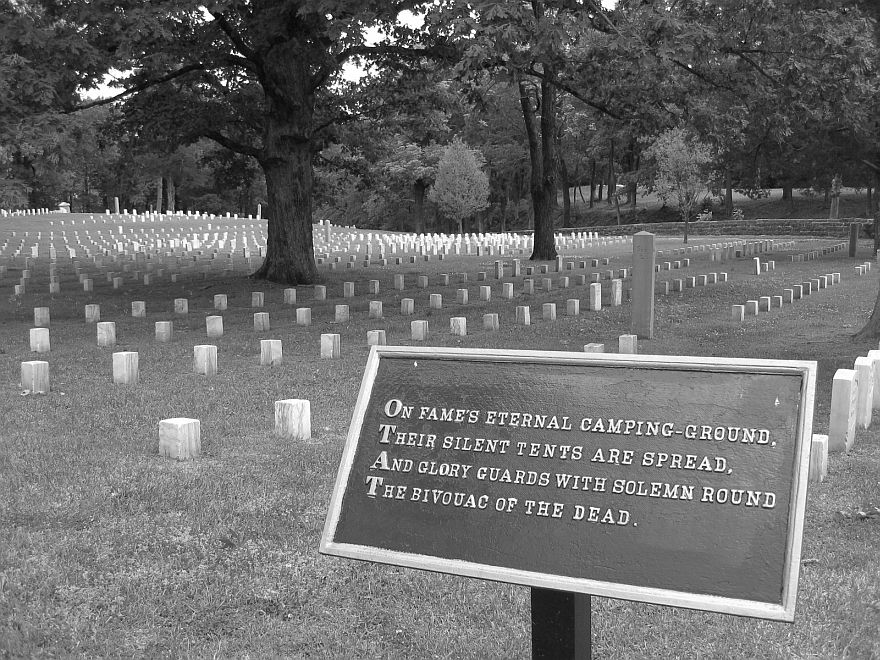
I've spent a lot of time on U.S. Civil War battlefields-- Gettysburg, Antietam, Monocacy, Manassas, Harper's Ferry, and many lesser-known sites are within an hour of my home in Maryland. Richmond, Fredericksburg, and the Wilderness, down in Virginia, are about a two or so hour drive. Living in the D.C. area, you're surrounded by memorials to that war and, if you pay attention to the signs, it can get into your blood if you've grown up there. It wasn't until I was an adult and out on my own and had the means to really explore that I began being fully conscious of it. So I dove in-- Devouring books and magazine articles, and driving, bicycling, and hiking the battlefield parks. I've read the Shaara trilogy, and listened to Shelby Foote wax rhapsodic in the epic Ken Burns documentary.
For a while, I idealized Stonewall Jackson, with his destroyed arm buried all by itself and the sweetness of his final deathbed words, “Let us cross over the river and rest under the shade of the trees.” And Lee, who put state before country and sat so regally on his white horse, Traveller. Long-suffering Longstreet, who took all the blame for the Confederate loss at Gettysburg which should have been directed at Lee. And Grant, so inept as a businessman but frighteningly effective as a general, who supposedly drank himself into a stupor over the horrific result of his decisions at Cold Harbor.
But then I began reading different sorts of books, focusing not on the battles and the presumably larger-than-life men who orchestrated them, but on the effects of the war. In the bookstore at Antietam Battlefield Park, I found Too Afraid to Cry: Maryland Civilians in the Antietam Campaign and I learned of what the citizens of that town experienced both during and in the aftermath of the battle, of what they had to go through to put their homes and their lives back together. Then I came across This Republic of Suffering, which describes how our very religious nation had to come to grips with death on a scale it'd not experienced before, death without the salvation of confession or last rites, and loss that decimated families. The song lyric at the top of this post references a letter from Major Sullivan Ballou to his wife Sarah, written a week before he was killed at the First Battle of Bull Run. It's a very romantic letter, but only serves to highlight that this was not a romantic war, it was horrible and painful--
My very dear Sarah: The indications are very strong that we shall move in a few days — perhaps tomorrow. Lest I should not be able to write again, I feel impelled to write a few lines that may fall under your eye when I shall be no more …
I have no misgivings about, or lack of confidence in the cause in which I am engaged, and my courage does not halt or falter. I know how strongly American Civilization now leans on the triumph of the Government and how great a debt we owe to those who went before us through the blood and sufferings of the Revolution. And I am willing — perfectly willing — to lay down all my joys in this life, to help maintain this Government, and to pay that debt …
Sarah my love for you is deathless, it seems to bind me with mighty cables that nothing but Omnipotence could break; and yet my love of Country comes over me like a strong wind and bears me unresistibly on with all these chains to the battle field.
The memories of the blissful moments I have spent with you come creeping over me, and I feel most gratified to God and to you that I have enjoyed them for so long. And hard it is for me to give them up and burn to ashes the hopes of future years, when, God willing, we might still have lived and loved together, and seen our sons grown up to honorable manhood, around us. I have, I know, but few and small claims upon Divine Providence, but something whispers to me — perhaps it is the wafted prayer of my little Edgar, that I shall return to my loved ones unharmed. If I do not my dear Sarah, never forget how much I love you, and when my last breath escapes me on the battle field, it will whisper your name. Forgive my many faults and the many pains I have caused you. How thoughtless and foolish I have often times been! How gladly would I wash out with my tears every little spot upon your happiness …
But, O Sarah! If the dead can come back to this earth and flit unseen around those they loved, I shall always be near you; in the gladdest days and in the darkest nights … always, always, and if there be a soft breeze upon your cheek, it shall be my breath, as the cool air fans your throbbing temple, it shall be my spirit passing by. Sarah do not mourn me dead; think I am gone and wait for thee, for we shall meet again …
I have no misgivings about, or lack of confidence in the cause in which I am engaged, and my courage does not halt or falter. I know how strongly American Civilization now leans on the triumph of the Government and how great a debt we owe to those who went before us through the blood and sufferings of the Revolution. And I am willing — perfectly willing — to lay down all my joys in this life, to help maintain this Government, and to pay that debt …
Sarah my love for you is deathless, it seems to bind me with mighty cables that nothing but Omnipotence could break; and yet my love of Country comes over me like a strong wind and bears me unresistibly on with all these chains to the battle field.
The memories of the blissful moments I have spent with you come creeping over me, and I feel most gratified to God and to you that I have enjoyed them for so long. And hard it is for me to give them up and burn to ashes the hopes of future years, when, God willing, we might still have lived and loved together, and seen our sons grown up to honorable manhood, around us. I have, I know, but few and small claims upon Divine Providence, but something whispers to me — perhaps it is the wafted prayer of my little Edgar, that I shall return to my loved ones unharmed. If I do not my dear Sarah, never forget how much I love you, and when my last breath escapes me on the battle field, it will whisper your name. Forgive my many faults and the many pains I have caused you. How thoughtless and foolish I have often times been! How gladly would I wash out with my tears every little spot upon your happiness …
But, O Sarah! If the dead can come back to this earth and flit unseen around those they loved, I shall always be near you; in the gladdest days and in the darkest nights … always, always, and if there be a soft breeze upon your cheek, it shall be my breath, as the cool air fans your throbbing temple, it shall be my spirit passing by. Sarah do not mourn me dead; think I am gone and wait for thee, for we shall meet again …
Reading things like this opened my eyes to the stark reality behind the gorgeous technicolor "suffering" depicted in films like Gone With the Wind. And then I read the Declarations of Secession of some of the Confederate states-- Georgia's, in particular, is quite a peach--
The people of Georgia having dissolved their political connection with the Government of the United States of America, present to their confederates and the world the causes which have led to the separation. For the last ten years we have had numerous and serious causes of complaint against our non-slaveholding confederate States with reference to the subject of African slavery. They have endeavored to weaken our security, to disturb our domestic peace and tranquility, and persistently refused to comply with their express constitutional obligations to us in reference to that property, and by the use of their power in the Federal Government have striven to deprive us of an equal enjoyment of the common Territories of the Republic. This hostile policy of our confederates has been pursued with every circumstance of aggravation which could arouse the passions and excite the hatred of our people, and has placed the two sections of the Union for many years past in the condition of virtual civil war. Our people, still attached to the Union from habit and national traditions, and averse to change, hoped that time, reason, and argument would bring, if not redress, at least exemption from further insults, injuries, and dangers. Recent events have fully dissipated all such hopes and demonstrated the necessity of separation. Our Northern confederates, after a full and calm hearing of all the facts, after a fair warning of our purpose not to submit to the rule of the authors of all these wrongs and injuries, have by a large majority committed the Government of the United States into their hands. The people of Georgia, after an equally full and fair and deliberate hearing of the case, have declared with equal firmness that they shall not rule over them. A brief history of the rise, progress, and policy of anti-slavery and the political organization into whose hands the administration of the Federal Government has been committed will fully justify the pronounced verdict of the people of Georgia. The party of Lincoln, called the Republican party, under its present name and organization, is of recent origin. It is admitted to be an anti-slavery party. While it attracts to itself by its creed the scattered advocates of exploded political heresies, of condemned theories in political economy, the advocates of commercial restrictions, of protection, of special privileges, of waste and corruption in the administration of Government, anti-slavery is its mission and its purpose. By anti-slavery it is made a power in the state. The question of slavery was the great difficulty in the way of the formation of the Constitution. While the subordination and the political and social inequality of the African race was fully conceded by all, it was plainly apparent that slavery would soon disappear from what are now the non-slave-holding States of the original thirteen. The opposition to slavery was then, as now, general in those States and the Constitution was made with direct reference to that fact. But a distinct abolition party was not formed in the United States for more than half a century after the Government went into operation. The main reason was that the North, even if united, could not control both branches of the Legislature during any portion of that time.
That's just the first paragraph. The word "slavery" is used 27 times throughout the full Declaration. Twenty. Seven. I began to understand the politics behind the Emancipation Proclamation, and just how deluded discussions of this having been a war for "state's rights" really are. And when Confederate statues and memorials began being vandalized and removed in recent years, I decided that, to quote Lincoln's Gettysburg Address, it was "altogether fitting and proper that we should do this " at this time.
Full transcript of Mayor Landrieu's speech can be read here.
I've seen defenses of the removal of these monuments that draw comparison to post-WW II Germany, making the point that you don't see memorials and statues to Hitler and the Third Reich because the German people understand that there's nothing romantic about those men or the cause they fought for and they certainly should not be idealized, revered, or memorialized. Was Nathan Bedford Forrest as inhumane as Joseph Goebbels? A lot of people don't seem to think so, and it's that sort of belief that contributes to the divides in this country.
"There is a difference between remembrance of history, and the reverence of it". How many more generations will it take for us to stop romanticizing this war and instead begin learning from it?








 Posts
Posts


