The spotlight was an ugly thing. Metal fixtures clustered high on a metal pole, yellowish glaring light that could blind you if you accidentally raised your eyes in its direction. But the silhouette its harshness created-- crepe myrtle branches cast like a photographic plate in black and sepia against the marble wall, sharply focused where the branches were close to the building and blurred where they were farther-- was so strikingly lovely it took my breath away. I'd driven through heavy traffic all the way to Baltimore after a long day at work and spent $30 on a ticket for an event that proved so dull I walked out during intermission, but that shadow on the wall was worth it all.
Showing posts with label Baltimore Museum of Art. Show all posts
Showing posts with label Baltimore Museum of Art. Show all posts
November 8, 2015


October 25, 2015
This is Baltimore, vol. 238
Teavolve was too busy,
Lebanese Taverna was not.
Fest in full swing in Fells.
A sweet pitch of orioles in the sculpture garden
(without a ball or bat among them),
a raucous murder of crows in Wyman Park Dell.
Playing spoons with a jug band in the museum.
This is Baltimore.
Lebanese Taverna was not.
Fest in full swing in Fells.
A sweet pitch of orioles in the sculpture garden
(without a ball or bat among them),
a raucous murder of crows in Wyman Park Dell.
Playing spoons with a jug band in the museum.
This is Baltimore.
January 4, 2015
Another day at the museum: Exploring synchronicity through Setlists for a Setting Sun
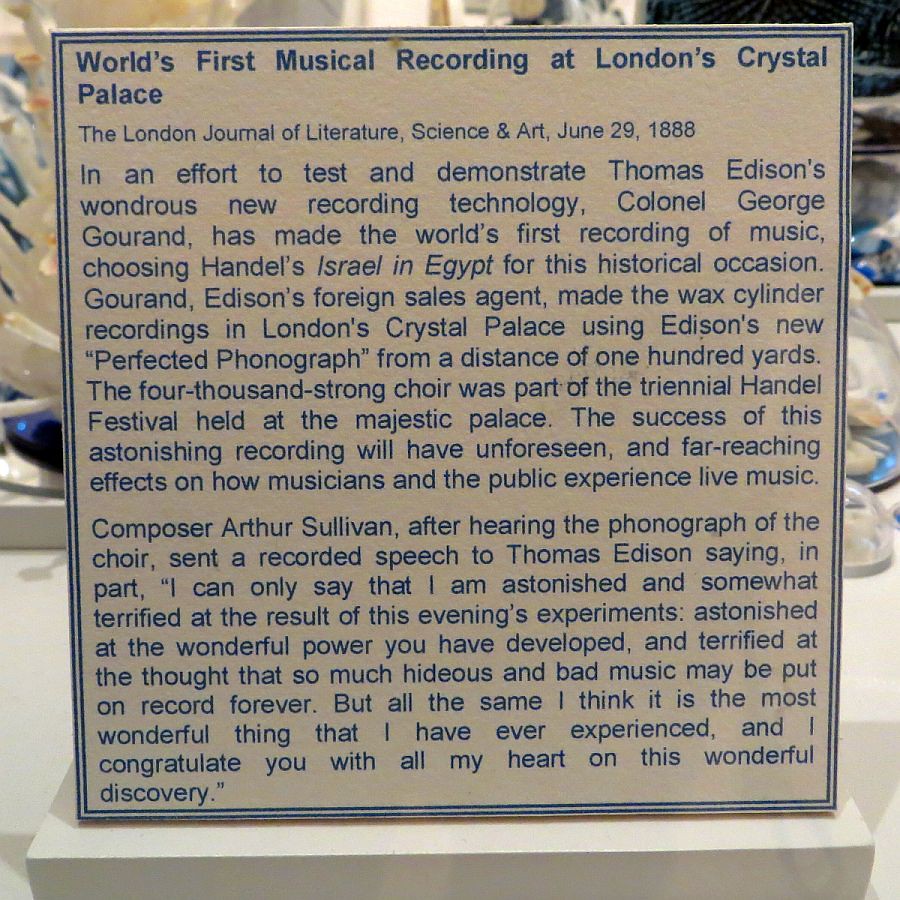
On one side of the room, one Setlist for a Setting Sun, The Crystal Palace. Blues and whites and bone beiges. Glass domes over crystals and shells and butterfly wings. A Victorian palace inaugurated by Victoria herself. Four thousand voices singing Handel phoned in via Edison's phonograph. Hearing crystal-clear reality through a scrim of staticky needle scratches is still startling even now. Cylinder rotations thumping like heartbeats or, as John Fahey said, the furious beating of angels' wings. Is this what angels' voices would sound like to our human ears?
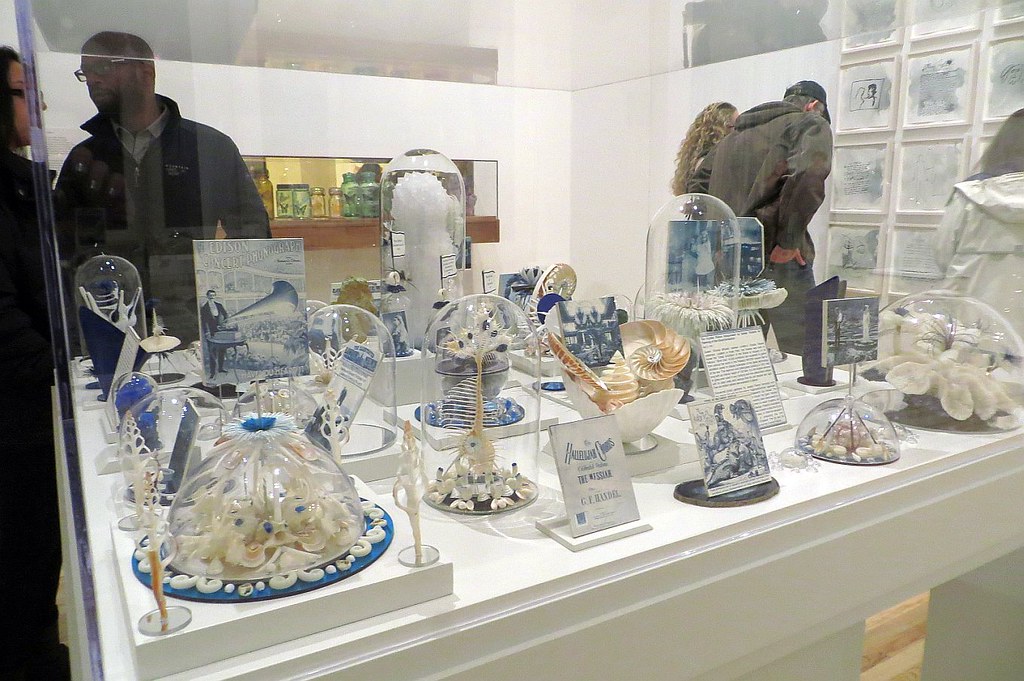
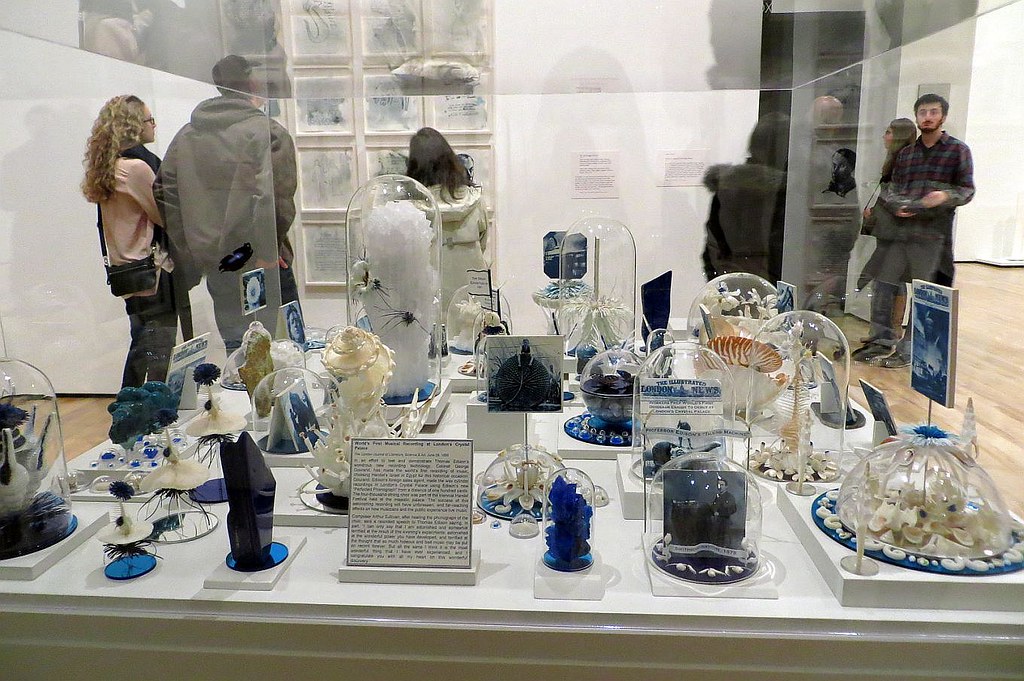
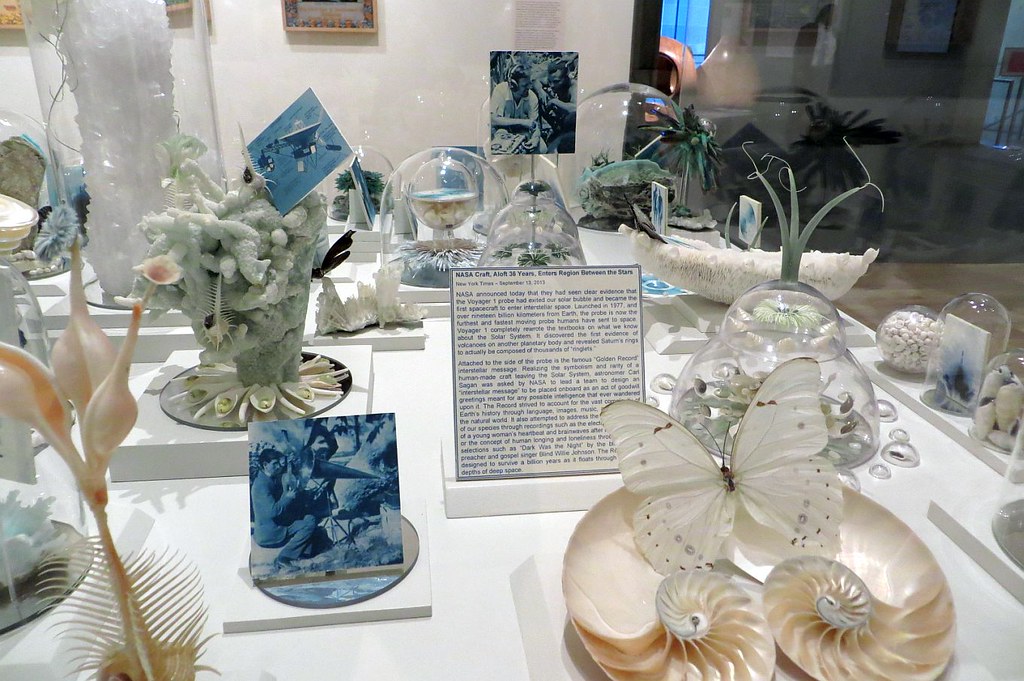
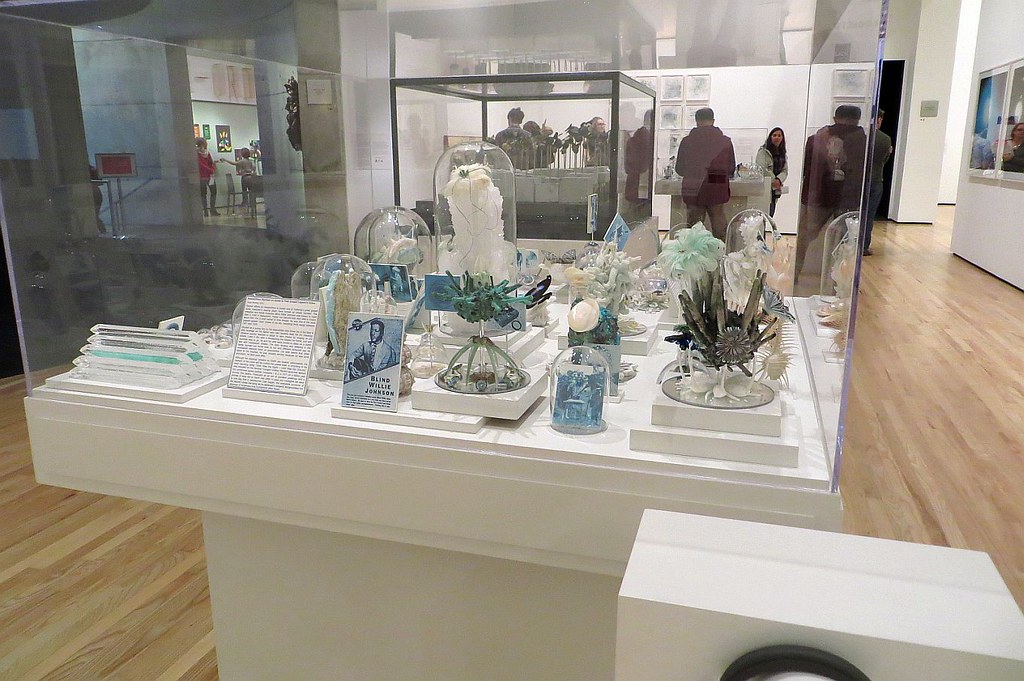
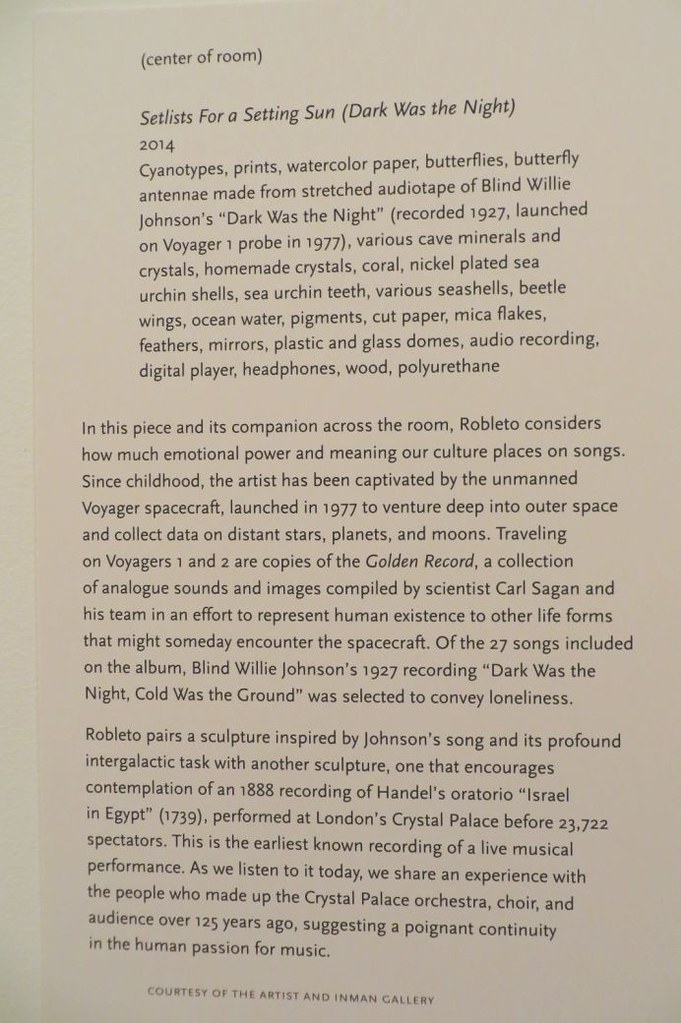
On the other side of the room, another Setlist for a Setting Sun, this time Dark Was the Night. Still blue and white, with more crystals, shells, and iridescent wings under glass, but this time with rockets taking off for the dark expanses of space. A Voyager in search of other voyagers, carrying the sounds of a man who could only see darkness. We've kept track of Voyager all these years, but have no idea where Willie Johnson, whose spectral humming and eerie bottleneck are an angel's song of a different sort, ended up.
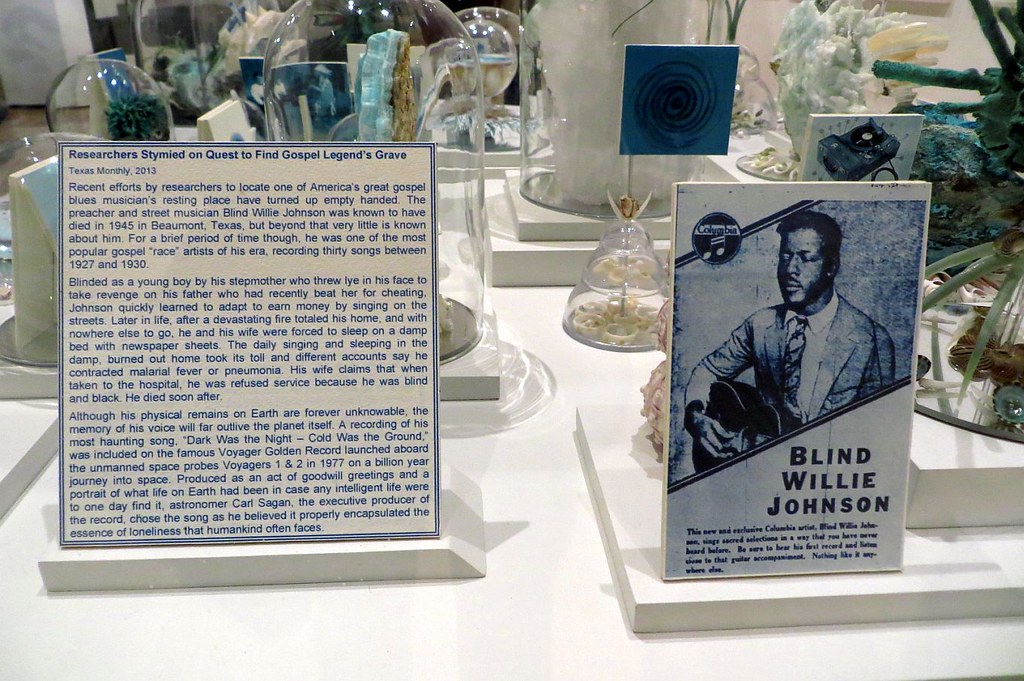
And Robleto's message is important. The need to communicate is one of mankind's earliest and most primary. We've been using art and music as means of communication since we could speak, if not even earlier. And we're using music now to try to communicate with species beyond our own world. Art such as Robleto's reminds us of this, makes us understand how music can bring us together and connect us, and how vital it is to not take the need or the method for granted. Words are great for getting a point across, but music can communicate feelings so much more succinctly.
Excellent review of the exhibit from Baltimore's City Paper, here.
 |
| A couple of photos I snuck when the museum guard's back was turned. For more views, go here. |
On the other side of the room, another Setlist for a Setting Sun, this time Dark Was the Night. Still blue and white, with more crystals, shells, and iridescent wings under glass, but this time with rockets taking off for the dark expanses of space. A Voyager in search of other voyagers, carrying the sounds of a man who could only see darkness. We've kept track of Voyager all these years, but have no idea where Willie Johnson, whose spectral humming and eerie bottleneck are an angel's song of a different sort, ended up.
 |
| Again, my own surreptitious photos. More from the artist's site here. |
It's always exciting to me when I run into things that are meaningful to me presented in entirely knew contexts. Dario Robleto's current exhibit at the Baltimore Museum of Art is a perfect example and I got a bit giddy when the pieces came together. At a distance, it's just an assortment of shells and glass and bits of stuff inside a pair of plexiglass cubes and I almost walked past without taking the time to catch the connections. Fortunately, I stopped long enough to read the little card about the Edison phonograph recording of Handel's oratorio at the London Crystal Palace. You see, it wasn't too many months ago that I read a book called Perfecting Sound Forever, by Greg Milner, which begins with accounts of several of Thomas Edison's "tone tests" such as took place at the Crystal Palace. So to read that card, then to pop on the headphones hanging next to the exhibit and hear what that London audience heard was fairly amazing. It was a digital copy I was listening to, yes, but still, the effect it must've had on those people, people who were hearing for the very first time an early, unsophisticated version of the recorded sound that we take for granted, was so easy to imagine.
And then I stepped across the room and put on a second pair of headphones and heard Blind Willie Johnson's Dark Was the Night, Cold Was the Ground, a song I first heard a couple of years ago, early on in my exploration of blues music, and one that immediately defined the blues for me. And here it was, this primal, innately human sound, linked with man's attempts to communicate with alien species.
What was the one thing that tied all of these elements together and made them significant to me? If you've read more than a few entries here, I'm sure you can guess. Yup, that's right, it all comes back to Jack White. The musician who was my gateway to blues music, without whom I'd never have heard of Blind Willie Johnson or known that Johnson's song was chosen by Carl Sagan for inclusion on Voyager's Golden Record (I'd learned about this originally in the companion book to Martin Scorsese's PBS series, The Blues, and it coincidentally came up again recently in an interview that Dan Rather conducted with Jack). Whose songs have inspired a craving in me to learn how music is made and whose mention of Milner's book led me to pick up a copy and learn about the effect of those early phonograph recordings on concert-hall audiences. Is this meaningful synchronicity or the delusions of apophenia? I know it seems maddeningly myopic but, from my perspective, it's just the opposite-- The things I've been exposed to through Jack have opened up a whole world for me and broadened my appreciation of so many forms of music and art and even science. If not for my obsession with him, I would have walked right past those plexiglass cubes at the BMA and thought, "Shells and shit under glass. Pretty, but how is this really art?" I would have missed the connections that made me stop long enough to understand the message of Dario Robleto's art. The message itself wouldn't have meant as much to me.
And Robleto's message is important. The need to communicate is one of mankind's earliest and most primary. We've been using art and music as means of communication since we could speak, if not even earlier. And we're using music now to try to communicate with species beyond our own world. Art such as Robleto's reminds us of this, makes us understand how music can bring us together and connect us, and how vital it is to not take the need or the method for granted. Words are great for getting a point across, but music can communicate feelings so much more succinctly.
Excellent review of the exhibit from Baltimore's City Paper, here.
August 17, 2014
The difficulty of knowing when to give something your attention
I almost missed a tremendous experience this afternoon. Wandering the contemporary wing of the Baltimore Museum of Art, I stepped into the room in which they set up revolving video installations. I'd heard the hummed tune coming from the room a few galleries away and was, as always, curious. Coming around the corner inside the darkened black-walled room I found myself facing a screen projecting 15 pairs of lips humming the same song. Contemplated it for a moment, then began to decide that there wasn't anything to get out of it and turned to go. But then I stopped myself, partly because I'd wanted the opportunity to sit down for a bit and partly because I told myself I should give the thing another chance. Worst case scenario, I'd get a little rest and hear a soothing melody.
So instead of plopping down on one of the two benches, I stepped into the farthest back corner of the room and sat down on the floor against the wall facing the screen. As I watched with eyes flickering from one set of lips to another, my ears began to pick out individual voices and variations of the song. After a while, I closed my eyes to listen to let it relax me. Within a few seconds, I realized that the sound had changed. It had become one voice, one harmonious tone, like a symphony. I opened my eyes and again, within a few seconds, without even realizing what I was doing, again began picking out unique tones as I watched, the individual voices within the harmony. At that point, a big, silly, delighted grin spread over my face in the dimness of the room and I sat there alternating between open- and closed-eyed listening. Various people came in and out of the room, doing what I'd initially begun to do-- Watching for a moment and then turning around to leave. I noticed a few glance over at me in the times when I had my eyes open and wondered if my smile made them wonder whether they were missing something or if I was just goofy. After the song had played a dozen or so times, a group had formed in the room and, listening to the whispers of a woman standing near me, it seemed some of them were more interested than others had been. I pushed myself up from the floor and, on my way out, leaned over to the woman who'd whispered and said "Close your eyes and see if you notice that the sound changes". But I didn't stay to see if she tried it.
At the entrance, I stopped to read the interpretive placard on the wall. It seems I had vaguely gotten what the work was about, through the metaphor of harmony. "Getting" contemporary art doesn't happen often for me. I'm sometimes moved by pieces I see and can find my own meanings in them, but am more frequently left unmoved and/or perplexed. And moved or unmoved, I pretty much never feel that I "get" it, even with the help of interpretive signage. So the fact that this piece clicked for me when I thought of it in musical terms means something to me.
This is a small portion of what I experienced--
The full video can be seen here, but unfortunately not in a perpetually repeating loop the way it was displayed at the BMA.
The lyrics of the song are quite lovely, too--
Your sweet expressions
The smile you gave me
The way you looked when we met
Easy to remember
But so hard to forget
I hear you whisper
"I'll always love you"
I know it's over, and yet
Easy to remember
Oh so hard to forget
So I must dream
To have your hand caress me
Fingers press me tight
I'd rather dream
Than have that lonely feeling
Stealing through the night
Each little moment
Is clear before me
And though it brings me regret
It's easy to remember
But so hard to forget
The song was written by Rodgers and Hart and originally sung by Bing Crosby. But, somehow, as poignant as the words are, that hummed version is so much more affecting than Bing's.
So instead of plopping down on one of the two benches, I stepped into the farthest back corner of the room and sat down on the floor against the wall facing the screen. As I watched with eyes flickering from one set of lips to another, my ears began to pick out individual voices and variations of the song. After a while, I closed my eyes to listen to let it relax me. Within a few seconds, I realized that the sound had changed. It had become one voice, one harmonious tone, like a symphony. I opened my eyes and again, within a few seconds, without even realizing what I was doing, again began picking out unique tones as I watched, the individual voices within the harmony. At that point, a big, silly, delighted grin spread over my face in the dimness of the room and I sat there alternating between open- and closed-eyed listening. Various people came in and out of the room, doing what I'd initially begun to do-- Watching for a moment and then turning around to leave. I noticed a few glance over at me in the times when I had my eyes open and wondered if my smile made them wonder whether they were missing something or if I was just goofy. After the song had played a dozen or so times, a group had formed in the room and, listening to the whispers of a woman standing near me, it seemed some of them were more interested than others had been. I pushed myself up from the floor and, on my way out, leaned over to the woman who'd whispered and said "Close your eyes and see if you notice that the sound changes". But I didn't stay to see if she tried it.
At the entrance, I stopped to read the interpretive placard on the wall. It seems I had vaguely gotten what the work was about, through the metaphor of harmony. "Getting" contemporary art doesn't happen often for me. I'm sometimes moved by pieces I see and can find my own meanings in them, but am more frequently left unmoved and/or perplexed. And moved or unmoved, I pretty much never feel that I "get" it, even with the help of interpretive signage. So the fact that this piece clicked for me when I thought of it in musical terms means something to me.
This is a small portion of what I experienced--
The full video can be seen here, but unfortunately not in a perpetually repeating loop the way it was displayed at the BMA.
The lyrics of the song are quite lovely, too--
Your sweet expressions
The smile you gave me
The way you looked when we met
Easy to remember
But so hard to forget
I hear you whisper
"I'll always love you"
I know it's over, and yet
Easy to remember
Oh so hard to forget
So I must dream
To have your hand caress me
Fingers press me tight
I'd rather dream
Than have that lonely feeling
Stealing through the night
Each little moment
Is clear before me
And though it brings me regret
It's easy to remember
But so hard to forget
The song was written by Rodgers and Hart and originally sung by Bing Crosby. But, somehow, as poignant as the words are, that hummed version is so much more affecting than Bing's.
February 24, 2013
Another day at the museum: The BMA, 2/24/13
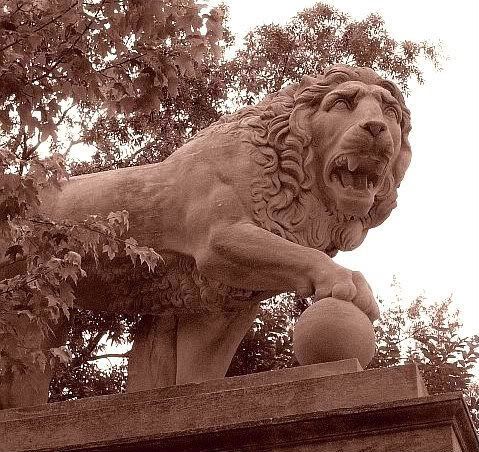
Cozy cold marble lions,
Buds like pussy-willow rabbit's foots.
Sun's gold not yet summer molten,
Lazing in a city statue garden.
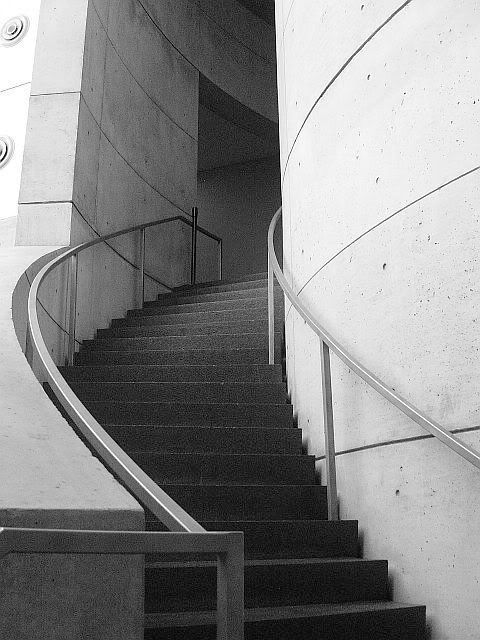
Temple, fortress, circled stairs inside.
Warm marble rings,
Reds and blacks to weep over.
Sounds with eight minute silence.
Looking for meaning behind creation.
Wanting to touch creation--
Would it convey meaning,
or only tactile pleasing?
The sun's golden warmth is intangible,
but elevates just as much.
Buds like pussy-willow rabbit's foots.
Sun's gold not yet summer molten,
Lazing in a city statue garden.
Temple, fortress, circled stairs inside.
Warm marble rings,
Reds and blacks to weep over.
Sounds with eight minute silence.
Looking for meaning behind creation.
Wanting to touch creation--
Would it convey meaning,
or only tactile pleasing?
The sun's golden warmth is intangible,
but elevates just as much.
December 23, 2012
Recent Sunday ramblings
Brunch today at Rocket to Venus, a hipster dive off the strip, or rather, off The Avenue, as it's called in Hampden. For the eyes, tiny white hexagonal tiles on the floor and old silent Popeye cartoons projected on a screen as prelude to the football game that fortunately wasn't on til after I left. For the ears, a diverse in the extreme mix ranging from Kiss to Blind Willie Johnson. For the tastebuds and belly, two sunny-side-up eggs with scrapple and sausage gravy over white rice, washed down with pineapple juice and a maraschino cherry. And down the street, some of Hampden's famous Christmas decorations. This is Baltimore.

A few weeks earlier, I cruised up Howard Street to get to the BMA and stopped on one particular block to snap some seriously eye-catching street art (or graffiti, if you prefer).


Drove by today and found that the skull and the serial killer posters have been completely black-washed. Can only hope that the gramophone & boombox guys across the street don't meet the same fate.
The Baltimore Museum of Art recently re-opened their contemporary wing after months of closure. Supposedly there were extensive renovations, but the layout of the rooms seems the same to me. There's some new art, but much of it was there before. They have, though, changed all of the interpretive/informative signage that accompanies the artwork, disappointingly so in most cases. Information that was previously enlightening is now mostly just dry detail. Some is interesting, but there doesn't seem to be as much insight into the artworks offered now. Which certainly doesn't detract from the art itself, though it does leave some of it less accessible. One exception is a piece by Mark Rothko, the plaque for which includes a very instructional quote from the artist--
"The fact that people break down and cry when confronted with my pictures shows that I can communicate those basic human emotions... the people who weep before my pictures are having the same religious experience I had when painting them. And if you say you are moved only by their color relationships then you miss the point."

I unfortunately missed the point. Though damned if those colors didn't move me. As did these below by another artist, Clyfford Still, who said that "[if a] spectator... finds in [my pictures] an imagery unkind or unpleasant or evil, let him look to the state of his own soul". --

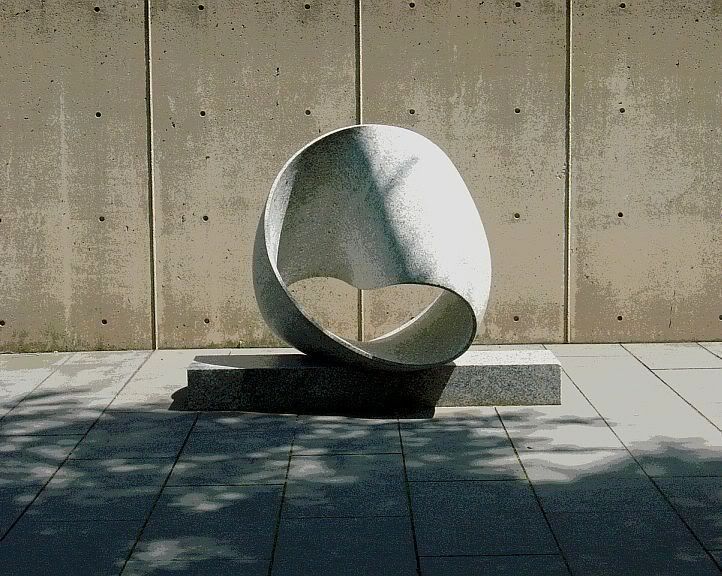
But the piece that moves me most of all, the one I waited through the months of renovation to see again, is one that I've mentioned here before. The Three Rings, by Henry Moore--

I took shot after shot of it this time, exploring it from as many angles as possible.


I am potentially a museum guard's worst nightmare. It takes an immense amount of will-power to not only not touch this piece, but also to not crawl in and nestle inside it.

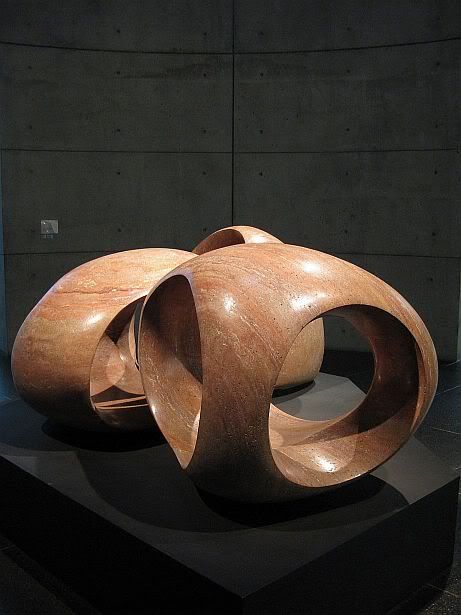
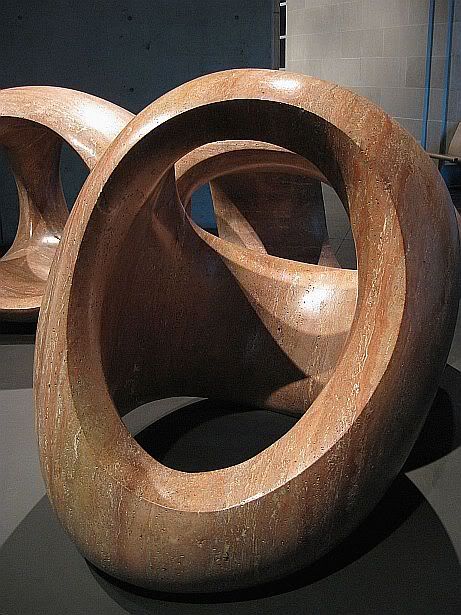
The first time I saw it, I was convinced that it was some highly polished, exotic, possibly petrified, wood. The texture and graining had to be wood. I was and am still amazed that the Rings are red soraya marble, found in Iran.


The exhibit in the yellow room beyond the Rings is titled Words Are Pictures Are Words. It's an interactive display intended to make viewers think about how the way that words are presented visually can affect how they're interpreted. A table with paper, stamps, and colored pencils provides the opportunity to add one's own word pictures on the wall. A few minutes of scribbling and I summed up the day thusly-- "Colors on the wall left me thoughtless. Words on the wall left me speechless".
A few weeks earlier, I cruised up Howard Street to get to the BMA and stopped on one particular block to snap some seriously eye-catching street art (or graffiti, if you prefer).
Drove by today and found that the skull and the serial killer posters have been completely black-washed. Can only hope that the gramophone & boombox guys across the street don't meet the same fate.
The Baltimore Museum of Art recently re-opened their contemporary wing after months of closure. Supposedly there were extensive renovations, but the layout of the rooms seems the same to me. There's some new art, but much of it was there before. They have, though, changed all of the interpretive/informative signage that accompanies the artwork, disappointingly so in most cases. Information that was previously enlightening is now mostly just dry detail. Some is interesting, but there doesn't seem to be as much insight into the artworks offered now. Which certainly doesn't detract from the art itself, though it does leave some of it less accessible. One exception is a piece by Mark Rothko, the plaque for which includes a very instructional quote from the artist--
"The fact that people break down and cry when confronted with my pictures shows that I can communicate those basic human emotions... the people who weep before my pictures are having the same religious experience I had when painting them. And if you say you are moved only by their color relationships then you miss the point."
I unfortunately missed the point. Though damned if those colors didn't move me. As did these below by another artist, Clyfford Still, who said that "[if a] spectator... finds in [my pictures] an imagery unkind or unpleasant or evil, let him look to the state of his own soul". --
But the piece that moves me most of all, the one I waited through the months of renovation to see again, is one that I've mentioned here before. The Three Rings, by Henry Moore--
I took shot after shot of it this time, exploring it from as many angles as possible.
I am potentially a museum guard's worst nightmare. It takes an immense amount of will-power to not only not touch this piece, but also to not crawl in and nestle inside it.
The first time I saw it, I was convinced that it was some highly polished, exotic, possibly petrified, wood. The texture and graining had to be wood. I was and am still amazed that the Rings are red soraya marble, found in Iran.
The exhibit in the yellow room beyond the Rings is titled Words Are Pictures Are Words. It's an interactive display intended to make viewers think about how the way that words are presented visually can affect how they're interpreted. A table with paper, stamps, and colored pencils provides the opportunity to add one's own word pictures on the wall. A few minutes of scribbling and I summed up the day thusly-- "Colors on the wall left me thoughtless. Words on the wall left me speechless".
August 1, 2009
Shameless self-promotion
One of my photos was selected for the most recent edition of the Schmap Baltimore Guide in their section on the Baltimore Museum of Art. I'd never heard of Schmap before but will certainly begin using it now. And I've definitely gotta get more of my photos up on Flickr. Recognition's a nifty thing.


October 25, 2008
Another day at the museum: The BMA, 10/25/08
Rainy day today, so I hit the Baltimore Museum of Art again. Since "a picture's worth a thousand words", I'll throw up a bunch before I toss out much in the way of my own words... (Be forewarned, this is a long'un)
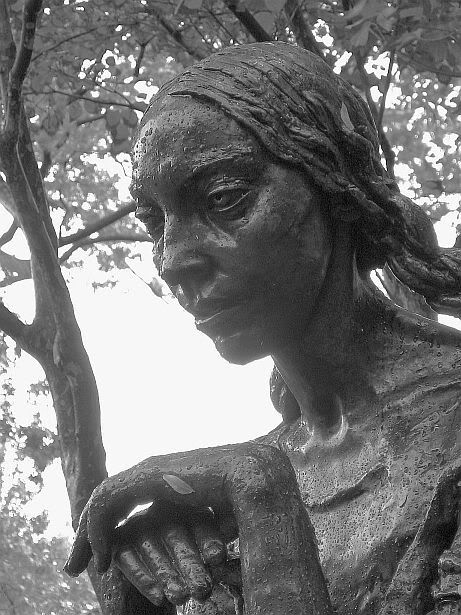
The Visitation


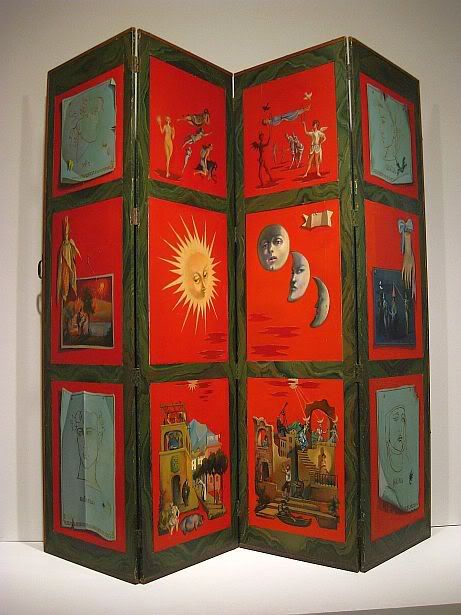
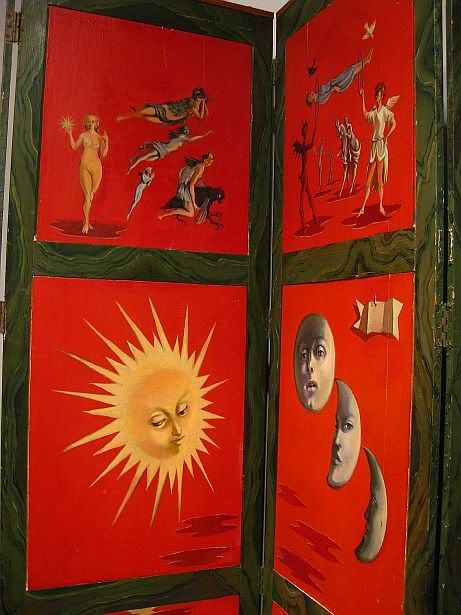
Four-panel folding screen depicting the effects of the phases of the moon by Dario Cecchi, 1948


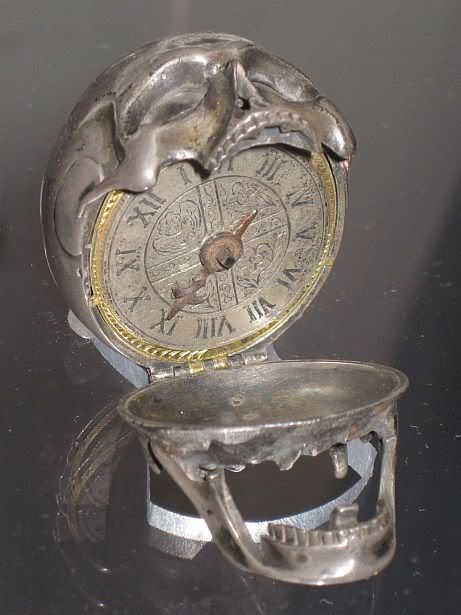
One of the coolest watches I've ever seen: Skull-form watch, ca1637-1658, French, steel


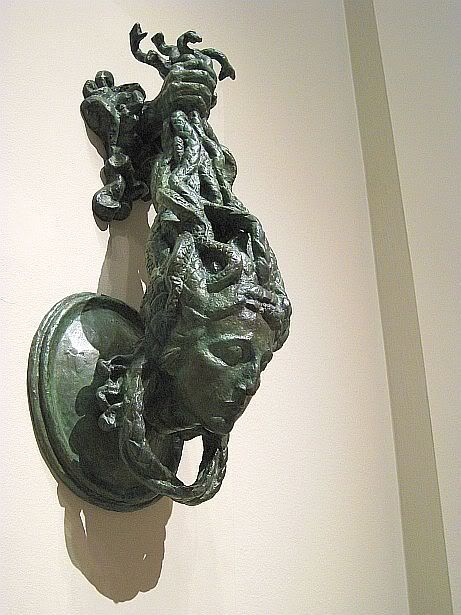
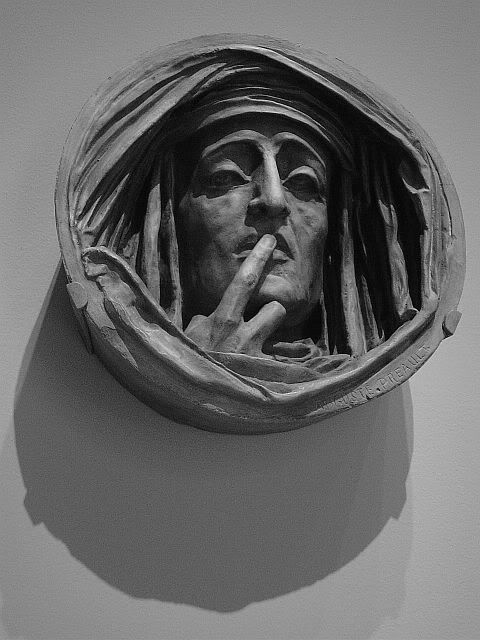
Head of Medusa door knocker, Emile-Antoine Bourdelle, ca1861-1929

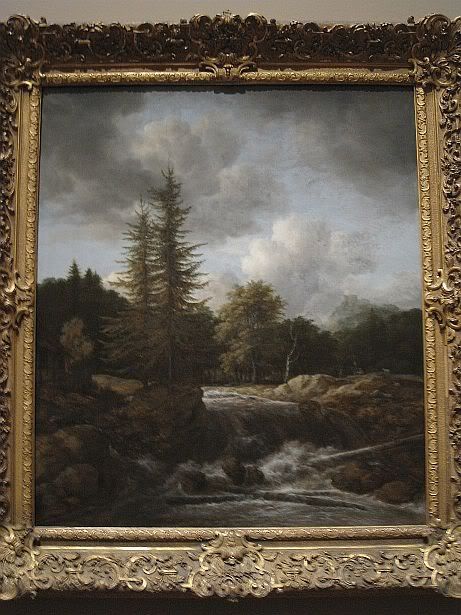
Assorted landscapes, in oil (Jacob Van Ruisdael, Dutch, ca1628-1682)...

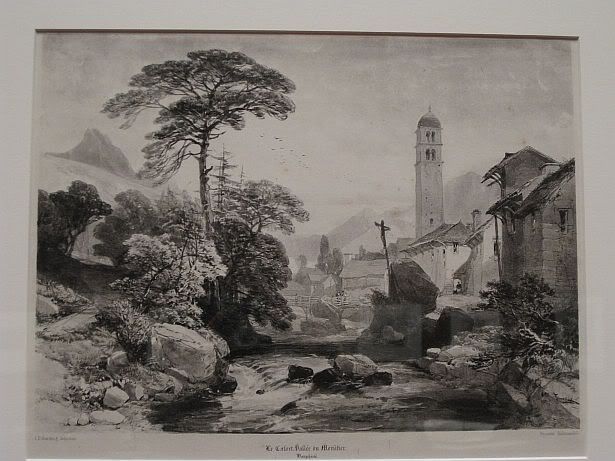
...and lithotint (James Durfield Harding, English, ca1854)...

...and crayon lithograph (Richard Parkes Bonington, English, ca1824)

One of the current special exhibits features the artist Franz West. The description of his work was, for me, more compelling than most of the actual pieces. As I wandered through the exhibit, I found myself repeating "what the fuck...?" over and over.

But then I got to the focal point of the exhibit, a work entitled "das Ich und das Es" (The Ego and The Id), which was designed and built specifically for the room within the BMA in which it was displayed. Note: Photography is not allowed in BMA special exhibits, so I nicked this shot from the museum's page about West.

This piece definitely intrigued me. The scale just isn't evident in this small image. And it's actually thought-provoking. From the description: "...the Latin term "ego" [das Ich]... means "the I". The task of the ego is to find a balance between primitive drives and reality. The term "Id" (inner desire) is a Latinized derivation of das Es, and translates into English as "It". The id is dominated by the pleasure principle." But which is which? Is ego's balance reflected in the uniform, soothing pink loops and id's chaotic drives in the riot of multiple colors? Or is it the reverse, ego finding its balance in a melding of colors, and id focused on throbbing pink pleasure? West apparently hasn't specified.
Moving on to the moderns: Man Pointing (Alberto Giocometti, bronze, 1947)...

...and There is No Finished World (Andre Masson, 1942)

The Three Rings, Henry Moore, red soraya marble, ca1966 (Both times I've seen this piece, I've wanted to put my hands all over it)


Modern, abstract art has always been a mystery to me, something that my visits to the BMA are helping me learn to appreciate. This piece is a prime example. To my uncomprehending eye, it's just a bunch of black smudges on a bright green background. Apparently, there's much more to it:


Metaphysical, huh? Who'da guessed?
And finally, The Baptism of Christ, by Louis Comfort Tiffany, ca1890-1899


After the museum closed, I headed over to the Papermoon Diner to fill my grumbling belly. The place is a riot, in more ways than one. It was hard to concentrate on the book I was reading, with so much stuff to look at around me. But the Eggs Benedict with ham and avocado were freaking fantastic.


Stopped for gas on the way through the city. As I got out of the car, a guy approached and asked if he could pump my gas. I'm probably a sucker, but after only minimal hesitation I said ok. He launched into a story about having just arrived from eight years out in Cumberland. Interesting coincidence, as I'd just vacationed out that way. His time there was apparently no vacation, as he'd just been released from prison and was only given a bus ticket as far as Baltimore. He was trying to raise enough cash to get some dinner (real food, not the prison "suey" he'd been living on) and a bus ticket to Glen Burnie and his grandmother's house. After the tank was filled, I gave him $5 and drove off wondering if I'd been swindled. Meh. There are worse things than being ripped off for $5. And if the guy was genuine, I wish I'd given him more.
Today was one more day in my love affair with Baltimore, a city that is terribly unappreciated. Following my tendency to associate music with places, I've come to identify Baltimore with the same elements I love about Maynard James Keenan and Tool, specifially their masterpiece album Aenima. Like that album, Baltimore contains some things that are beautiful, some things that are humorous and quirky, and some that are seamy, edgy and dirty. And all of those elements are shoved tight up against each other, often within the same song or neighborhood. It makes for a whole that is incredibly stimulating, if you take the time to really listen and look.
Stinkfist
Something has to change.
Undeniable dilemma.
Boredom's not a burden
Anyone should bear.
Constant over stimulation numbs me
and I wouldn't have
It any other way.
It's not enough.
I need more.
Nothing seems to satisfy.
I don't want it.
I just need it.
To feel, to breathe, to know I'm alive.
Finger deep within the borderline.
Show me that you love me and that we belong together.
Relax, turn around and take my hand.
I can help you change
Tired moments into pleasure.
Say the word and we'll be
Well upon our way.
Blend and balance
Pain and comfort
Deep within you
Till you will not have me any other way.
It's not enough.
I need more.
Nothing seems to satisfy.
I don't want it.
I just need it.
To feel, to breathe, to know I'm alive.
Knuckle deep inside the borderline.
This may hurt a little but it's something you'll get used to.
Relax. Slip away.
Something kinda sad about
the way that things have come to be.
Desensitized to everything.
What became of subtlety?
How can it mean anything to me
If I really don't feel anything at all?
I'll keep digging till
I feel something.
Elbow deep inside the borderline.
Show me that you love me and that we belong together.
Shoulder deep within the borderline.
Relax. Turn around and take my hand.
The Visitation

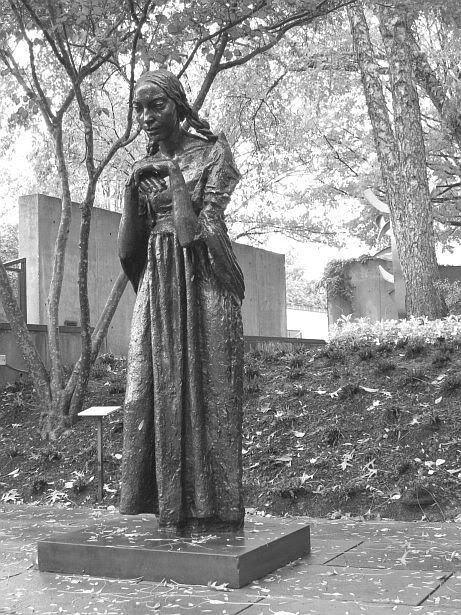
Four-panel folding screen depicting the effects of the phases of the moon by Dario Cecchi, 1948
One of the coolest watches I've ever seen: Skull-form watch, ca1637-1658, French, steel

Head of Medusa door knocker, Emile-Antoine Bourdelle, ca1861-1929
Assorted landscapes, in oil (Jacob Van Ruisdael, Dutch, ca1628-1682)...
...and lithotint (James Durfield Harding, English, ca1854)...
...and crayon lithograph (Richard Parkes Bonington, English, ca1824)

One of the current special exhibits features the artist Franz West. The description of his work was, for me, more compelling than most of the actual pieces. As I wandered through the exhibit, I found myself repeating "what the fuck...?" over and over.
But then I got to the focal point of the exhibit, a work entitled "das Ich und das Es" (The Ego and The Id), which was designed and built specifically for the room within the BMA in which it was displayed. Note: Photography is not allowed in BMA special exhibits, so I nicked this shot from the museum's page about West.

This piece definitely intrigued me. The scale just isn't evident in this small image. And it's actually thought-provoking. From the description: "...the Latin term "ego" [das Ich]... means "the I". The task of the ego is to find a balance between primitive drives and reality. The term "Id" (inner desire) is a Latinized derivation of das Es, and translates into English as "It". The id is dominated by the pleasure principle." But which is which? Is ego's balance reflected in the uniform, soothing pink loops and id's chaotic drives in the riot of multiple colors? Or is it the reverse, ego finding its balance in a melding of colors, and id focused on throbbing pink pleasure? West apparently hasn't specified.
Moving on to the moderns: Man Pointing (Alberto Giocometti, bronze, 1947)...
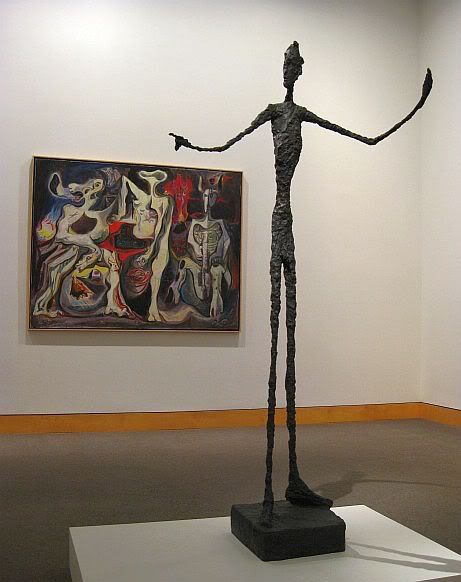
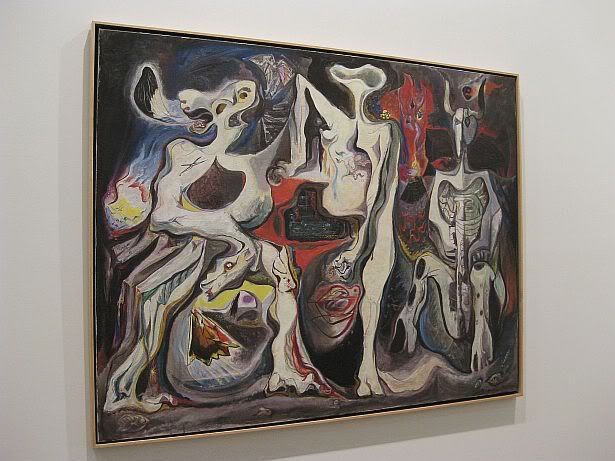
...and There is No Finished World (Andre Masson, 1942)
The Three Rings, Henry Moore, red soraya marble, ca1966 (Both times I've seen this piece, I've wanted to put my hands all over it)

Modern, abstract art has always been a mystery to me, something that my visits to the BMA are helping me learn to appreciate. This piece is a prime example. To my uncomprehending eye, it's just a bunch of black smudges on a bright green background. Apparently, there's much more to it:
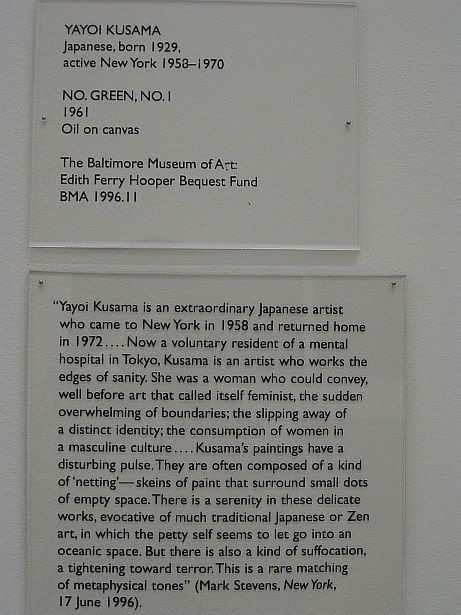
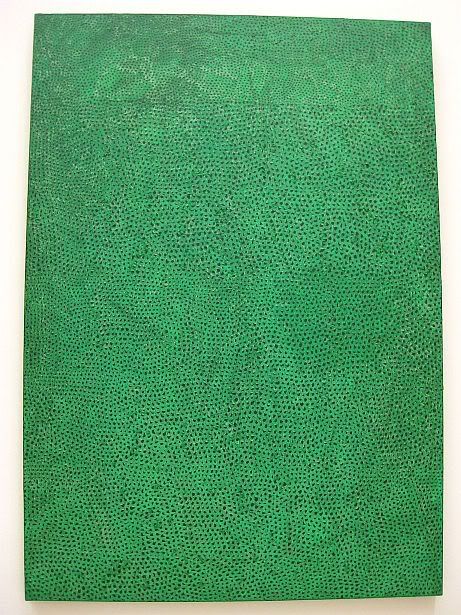

Metaphysical, huh? Who'da guessed?
And finally, The Baptism of Christ, by Louis Comfort Tiffany, ca1890-1899

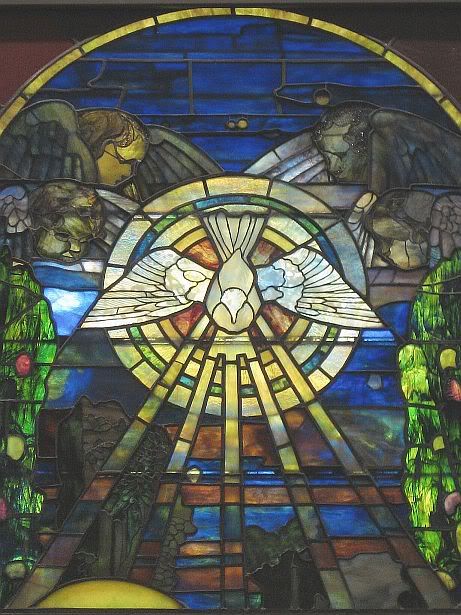
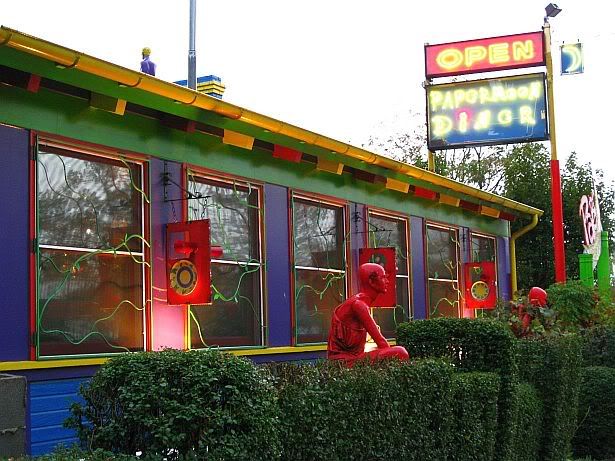
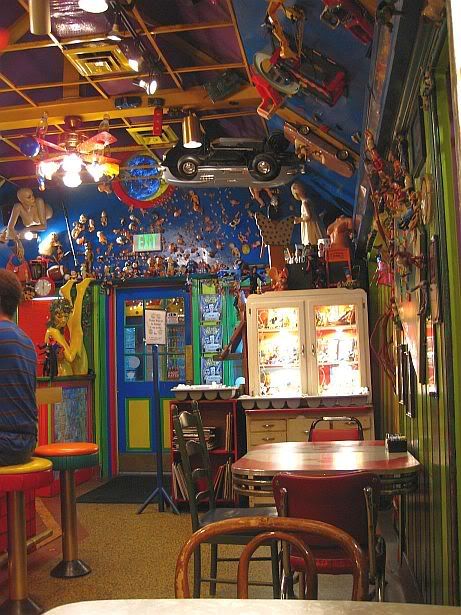
After the museum closed, I headed over to the Papermoon Diner to fill my grumbling belly. The place is a riot, in more ways than one. It was hard to concentrate on the book I was reading, with so much stuff to look at around me. But the Eggs Benedict with ham and avocado were freaking fantastic.
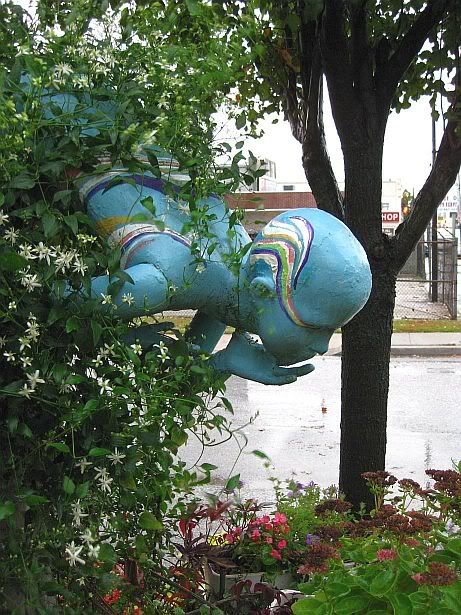

Stopped for gas on the way through the city. As I got out of the car, a guy approached and asked if he could pump my gas. I'm probably a sucker, but after only minimal hesitation I said ok. He launched into a story about having just arrived from eight years out in Cumberland. Interesting coincidence, as I'd just vacationed out that way. His time there was apparently no vacation, as he'd just been released from prison and was only given a bus ticket as far as Baltimore. He was trying to raise enough cash to get some dinner (real food, not the prison "suey" he'd been living on) and a bus ticket to Glen Burnie and his grandmother's house. After the tank was filled, I gave him $5 and drove off wondering if I'd been swindled. Meh. There are worse things than being ripped off for $5. And if the guy was genuine, I wish I'd given him more.
Today was one more day in my love affair with Baltimore, a city that is terribly unappreciated. Following my tendency to associate music with places, I've come to identify Baltimore with the same elements I love about Maynard James Keenan and Tool, specifially their masterpiece album Aenima. Like that album, Baltimore contains some things that are beautiful, some things that are humorous and quirky, and some that are seamy, edgy and dirty. And all of those elements are shoved tight up against each other, often within the same song or neighborhood. It makes for a whole that is incredibly stimulating, if you take the time to really listen and look.
Stinkfist
Something has to change.
Undeniable dilemma.
Boredom's not a burden
Anyone should bear.
Constant over stimulation numbs me
and I wouldn't have
It any other way.
It's not enough.
I need more.
Nothing seems to satisfy.
I don't want it.
I just need it.
To feel, to breathe, to know I'm alive.
Finger deep within the borderline.
Show me that you love me and that we belong together.
Relax, turn around and take my hand.
I can help you change
Tired moments into pleasure.
Say the word and we'll be
Well upon our way.
Blend and balance
Pain and comfort
Deep within you
Till you will not have me any other way.
It's not enough.
I need more.
Nothing seems to satisfy.
I don't want it.
I just need it.
To feel, to breathe, to know I'm alive.
Knuckle deep inside the borderline.
This may hurt a little but it's something you'll get used to.
Relax. Slip away.
Something kinda sad about
the way that things have come to be.
Desensitized to everything.
What became of subtlety?
How can it mean anything to me
If I really don't feel anything at all?
I'll keep digging till
I feel something.
Elbow deep inside the borderline.
Show me that you love me and that we belong together.
Shoulder deep within the borderline.
Relax. Turn around and take my hand.
June 7, 2008
A day at the museum: The BMA, 6/7/08
It was stinking hot in the mid-Atlantic region yesterday, so I decided a visit to the Baltimore Museum of Art would be a great way to beat the heat. And the timing turned out to be right, as this was the last weekend of their Looking Through the Lens exhibit on photography of 1900-1960. The museum's an interesting mix of historical/cultural items, classical art, and modern, abstract works. Picked up a few cool quotes and some decent photos while wandering the sculpture garden and the exhibits.
This small building is located at the corner of the museum grounds along St. Paul Street. Interestingly, the interiors of the windows are covered with newspaper pages.

"The experiment lies with the spectator in his willingness to accept what his eye conveys to him.... The success of the experiment is in proportion to the desire to discover and enjoy."
Man Ray


Click to view full size


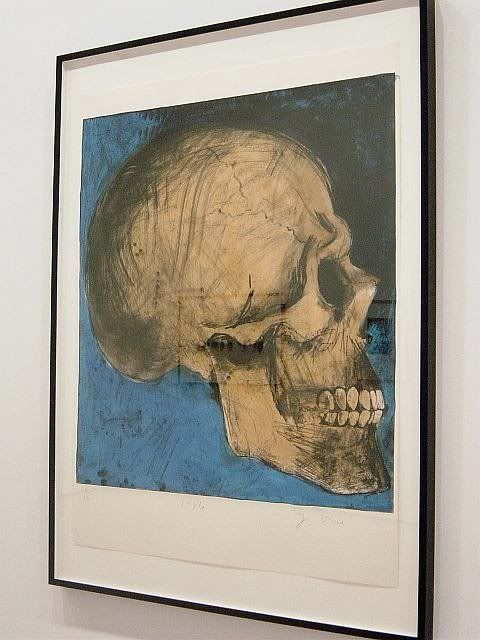
There was an entire room dedicated to Jim Dine, with the striking skull piece, A Side View in Florida, as the focal point upon entering the room. From a museum pamphlet--
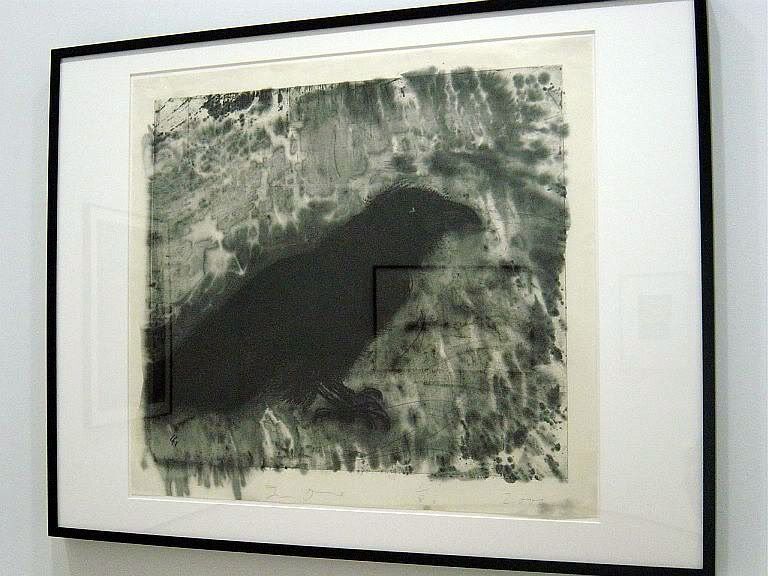
"It is tempting to codify Dine's various symbols, and occasionally the artist has identified specific meanings: ...the raven as a friend and alter ego that first appeared in a dream, the skull as the artist's voice crying to come out..."

Click to view full size

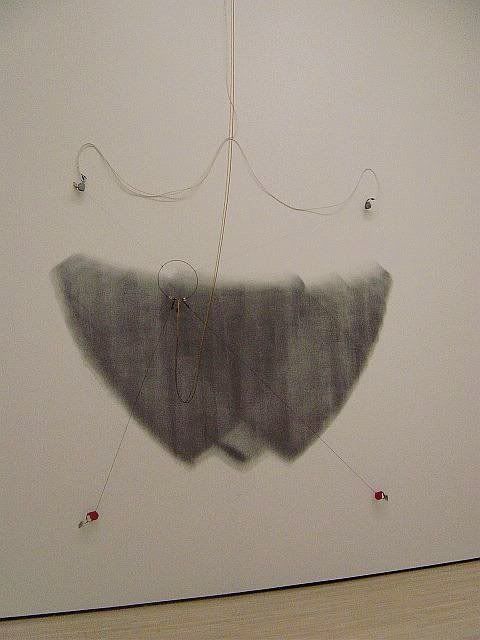
The piece below was mesmerizing. It was almost like a giant, self-automated spirograph, scratching its eternal pattern on the white-washed wall. What's so unusual about it, though, is that there's a microphone attached somewhere on the thing, and the sound of its scratching is played through speakers mounted to the ceiling above it. Hearing as well as seeing the movement of it gives the thing a strange sort of inanimate life.

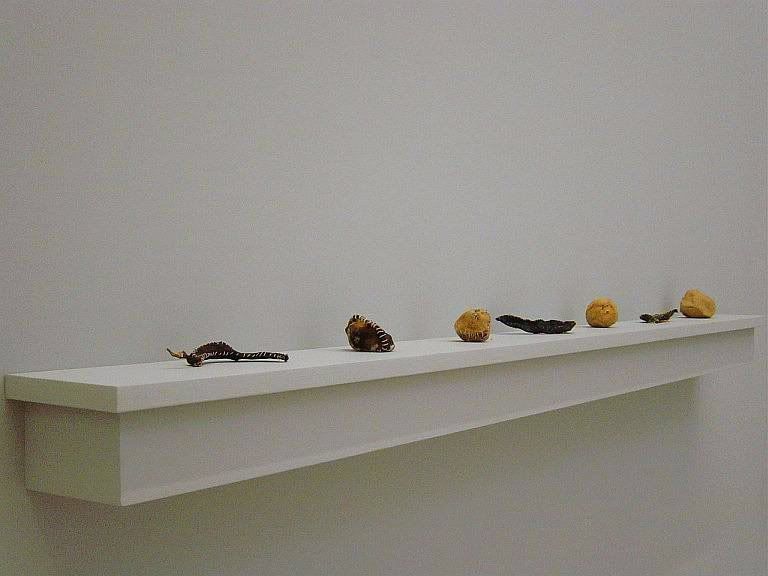
And from artificial life to organic death... For the untitled work below, Zoe Leonard ate 3 bananas, 3 oranges, and 1 grapefruit, then stitched the skins back together. The placard next to the piece explains that a museum's purpose is generally to preserve works of art for perpetuity, but Leonard specifically requested that the skins be left alone, exposed to the degrading effects of the air. Her intention is, apparently, to cause the observer to "reflect upon the desire for timelessness and to contemplate the processes of decay and disappearance".
Click to view full size

This painting was a surprise to me. I've been familiar for a long time with some of the works of Gustav Klimt, but this is very atypical to the pieces he's known for. It makes me think of so many of the forests I've hiked, serene and peaceful, yet darkly moody when the sun hits a certain position in the sky and only small glimpses of light penetrate the density of the trees.

"Irreverence is the champion of liberty and its one sure defense."
Mark Twain


This small building is located at the corner of the museum grounds along St. Paul Street. Interestingly, the interiors of the windows are covered with newspaper pages.

"The experiment lies with the spectator in his willingness to accept what his eye conveys to him.... The success of the experiment is in proportion to the desire to discover and enjoy."
Man Ray


Click to view full size
There was an entire room dedicated to Jim Dine, with the striking skull piece, A Side View in Florida, as the focal point upon entering the room. From a museum pamphlet--
"It is tempting to codify Dine's various symbols, and occasionally the artist has identified specific meanings: ...the raven as a friend and alter ego that first appeared in a dream, the skull as the artist's voice crying to come out..."
Click to view full size
The piece below was mesmerizing. It was almost like a giant, self-automated spirograph, scratching its eternal pattern on the white-washed wall. What's so unusual about it, though, is that there's a microphone attached somewhere on the thing, and the sound of its scratching is played through speakers mounted to the ceiling above it. Hearing as well as seeing the movement of it gives the thing a strange sort of inanimate life.
And from artificial life to organic death... For the untitled work below, Zoe Leonard ate 3 bananas, 3 oranges, and 1 grapefruit, then stitched the skins back together. The placard next to the piece explains that a museum's purpose is generally to preserve works of art for perpetuity, but Leonard specifically requested that the skins be left alone, exposed to the degrading effects of the air. Her intention is, apparently, to cause the observer to "reflect upon the desire for timelessness and to contemplate the processes of decay and disappearance".
Click to view full size
This painting was a surprise to me. I've been familiar for a long time with some of the works of Gustav Klimt, but this is very atypical to the pieces he's known for. It makes me think of so many of the forests I've hiked, serene and peaceful, yet darkly moody when the sun hits a certain position in the sky and only small glimpses of light penetrate the density of the trees.

"Irreverence is the champion of liberty and its one sure defense."
Mark Twain
Subscribe to:
Posts (Atom)


 Posts
Posts


