June 25, 2014
Son House and Foucault on desperate passion
"Then the last type of madness: that of desperate passion. Love disappointed in its excess, and especially love deceived by the fatality of death, has no other recourse but madness. As long as there was an object, mad love was more love than madness; left to itself, it pursues itself in the void."
Michel Foucault, Madness and Civilization.


June 15, 2014
Jung on concealment and repression
"As soon as man was capable of conceiving the idea of sin, he had recourse to psychic concealment-- or, to put it in analytical language, repressions arose. Anything that is concealed is a secret. The maintenance of secrets acts like a psychic poison which alienates their possessor from the community. In small doses, this poison may actually be a priceless remedy, even an essential preliminary to the differentiation of the individual. This is so much the case that, even on a primitive level, man has felt an irresistible need to invent secrets; their possession saves him from dissolving in the unconsciousness of mere community life, and thus from a fatal psychic injury. As is well known, the many ancient mystery cults with their secret rituals served this instinct for differentiation. Even the Christian sacraments were looked upon as mysteries in the early Church, and, as in the case of baptism, were celebrated in private apartments and only referred to under a veil of allegory.
However beneficial a secret shared with several persons may be, a merely private secret has destructive effect. It resembles a burden of guilt which cuts off the unfortunate possessor from communion with his fellow-beings. Yet if we are conscious of what we conceal, the harm done is decidedly less than if we do not know what we are repressing-- or even that we have repressions at all. In the latter case we not merely keep a content consciously private, but we conceal it even from ourselves. It then splits off from consciousness as an independent complex, where it can be neither corrected nor interfered with by the conscious mind. The complex is thus an autonomous portion of the psyche which, as experience has shown, develops a peculiar fantasy-life of its own. What we call fantasy is simply spontaneous psychic activity; and it wells up whenever the repressive action of the conscious mind relaxes or ceases altogether..."
C.G. Jung, from the essay, Problems of Psychotherapy.
June 13, 2014
Get out of my head, Jack White. Or, how the music we love can backfire
In Madness and Civilization, Michel Foucault wrote of Renaissance-era "ships of fools", on which societies would load their madmen and send them out into the harbor to get them out of the cities and isolate them. Or to isolate the cities from them, whichever. On Lazaretto, Jack White sings of being put down in a lazaretto, those old island fortresses where the sick and disabled were quarantined. That idea of separation, of isolation, has become pertinent for me lately and been much on my mind.
I got away from writing here regularly for a while, in part because everything I wrote was beginning to sound so self-obsessed and sometimes self-pitying, to the point that it was becoming tedious even to me, much less to anyone who might've stumbled across those ramblings on the interwebs. But also because as I got deeper and deeper into Jack White's music, I became involved in the community of his fans. It began at a message board, expanded to the Third Man Records Vault and another message board, to a couple of Facebook groups, and, most importantly, to people I've met face-to-face at his shows. I still wrote about Jack's music here because there was so much in it that inspired me and that I wanted to dig into and mentally digest. But more and more, I didn't need this place to get my thoughts out, I was able to do it in all those other places and get instant feedback, have dialogues instead of these rambling monologues. I came out of isolation, at least via the written word. Physically, I'm still separate, as all of these people I relate to are spread around the U.S. and I see them rarely, whenever we gather for a show. The rest of the time, it's me on my own, until I sit down at the computer and reach out.
But lately something's been different. It's been building up gradually for a while, a feeling of disconnection, of distance, from the community I've felt such a part of, from both the internet "friends" I relate to and the real friends I've formed an emotional connection with. Is it my old pattern rearing its head, my apparent inability to have long-lasting relationships with people? What's behind that, anyway? Whatever it is, it started out early. I was always one of those kids who was off by themselves with a book or exploring in the woods. I had friends, but still spent a lot of time alone. Then an incident in 6th grade led to complete ostracism, turning me into one of those kids sitting shunned on the side of the playground. High school was no better, especially after I became one of three punk rockers in the entire school and walked a daily gauntlet of derision from the jocks and popular kids. Exposure to my parents' constant arguing didn't help, either, as it was just one more thing to block out, to build a wall against.
If you've ever read the book Cold Mountain (and I mean the book, not the film Jack White was in), you may understand when I say that I strongly identify with the main female character, Ada, who is described as "eccentric and bristly". Ada's physical isolation in Black Cove is, of course, a metaphor for her isolation from people in general, which is due in large part to how she chooses to relate to those around her. She has little patience for the accepted mores of the city culture she was raised in, and is at a loss in the completely unfamiliar realm of country society. She frequently ends up saying the wrong thing in the wrong way, often as a means to keep people at a distance either intentionally or unconsciously. As a result, there's a wall around her, built by her own hands using the bricks of other people's inability to comprehend her. To say that I understand that alienation would be an understatement, despite the friendships I've formed over the last few years.
For the past couple weeks, that feeling's been intensely strong. Part of it is envy of those friends whose schedules have allowed them to attend recent shows on Jack's current tour for the new album. These are people I genuinely like and have enjoyed spending time with, but I find myself not wanting to hear from them because the few details I've heard of these shows make me bitterly resentful that I've not been there. It's an ugly reaction, one that makes me loathe myself, and that makes me retreat even further from these people because I don't want to expose them to my ugliness. But the last few days, it's become even worse. Without any rational clue why, I've been peevish, angry, melancholy-- lashing out, crying while driving in the car, having arguments with people in my head that I wouldn't allow myself to have anywhere else, stuck in isolation inside my own brain instead of focused outward. Then it dawned on me-- Part of it is this record, Lazaretto. This depressed and angry mood's been with me ever since the night I received it last week, from the moment I read The Admitting of Patience, a play in one act at the beginning of the book that accompanied the album:
THE ADMITTING OF PATIENCE
(one act)
PERSON ONE
(Male or Female)
I fantasize about hospital beds,
jail, work camps, the army.
I thought of branding myself,
tattooing a message to myself
With a symbol that I can't be
at peace with anyone.
A raft, A boy in the water. I'm hurt,
but not afraid of physical pain.
PERSON TWO
(M or F)
I don't feel very good about myself.
People always leave me.
Nobody can stand me for very long.
I wish I could cut my tongue out,
or take out the part of my brain
that has opinions. Or cares.
I wish I could be simple.
Be quiet, introverted, or shy.
I'm half way in between a wallflower
at a party and elvis presley.
People love one or the other.
In between is no place to be.
PERSON THREE
I see.
The impact of that practically brought me to my knees. It did bring me to tears, and I don't mean just welling up in my eyes. I mean shoulder-shaking sobs. Good lord above, talk about identifying with something someone's expressed. And then to put on the record and discover the song Alone In My Home, in which he sings
These stones
That are thrown against my bones
Break through
But they hurt less as time goes on
And alone
I build my own home
To be sure
That nobody can touch me now
That's followed immediately by That Black Bat Licorice, with its refrain of
Don't you want to lose the
Part of the brain that has opinions?
To not even know what you are doing?
Or care about yourself or
Your species in the billions?
Listening to these two songs feels as if he's been in my own head, pulled out my own thoughts and feelings and experiences, all those incidents of feeling the wrong thing, thinking the wrong thing, saying the wrong thing, offending people and pissing them off, alienating and feeling alienated, and retreating into self-imposed quarantine. I'm not quite vain enough to believe I'm the only person who's listened to these songs and felt such things, but that doesn't diminish the impact. It's not been good. I love both songs, one of them is very beautiful, the other very witty, but the effect of them has left me feeling a bit on the edge of madness, or at least sociopathology. Far from the euphoric feeling Jack's music normally inspires in me. How do I reconcile this? Wallow in it and hope it passes on its own? Stop listening to these songs? Smack myself upside the head in the hopes of knocking some rationality back into my brain?
I don't know. But I told someone the other night that I'd caught myself wishing I could be like a crazy homeless person, standing on a street corner ranting and talking to myself. It would be easier than trying to be a normal, civil person, at least until I can figure out how to get back out of this state of isolated insanity.
June 8, 2014
Modes of transportation: How fast is a black castrum doloris?
 |
| Thanks, Wikipedia |
"She's built for speed like a black castrum doloris..."
Delightful irony from a man who professes to dislike irony, at least of the hipster variety. One of the best songs on the new album, too, one that I had a feeling I'd love based on the title alone-- That Black Bat Licorice. The rest of Lazaretto, though...? After being bowled over when I first listened the other night, I ripped the record for the car the next morning and went out for a drive. There's something about listening while driving that gets me deeper into music, probably because the music fills the car in a way that it doesn't fill my apartment and, in the right circumstances, there's nothing else to distract me from listening fully. And I've written before about the combination of high speed and good tunes being my favorite, most easily-accessible high. Somehow, though, I came home from that drive feeling distanced from the music. The drive to and from work the next day was the same. As a devoted addict, it scared me a bit that I might not be able to connect to this record. I felt that all of the songs were good, but I just wasn't having the visceral, emotional reaction that I normally have to Jack White's music. I wasn't getting the junkie rush I've gotten from every one of his other albums. Was it jetlag from the previous week's business trip in Las Vegas? Was it the the songs themselves not grabbing me as much with repeated listenings? Did I overreact on first listen because I'd been anticipating this record for so damned long? I dunno. But today I threw my bike on top of the car and went for a drive with Lazaretto again, heading further from home, out into more rural parts of Maryland. Past the congestion of traffic, able to flow swiftly along first the highway and then curvy backroads, the songs began to sweep me away and I was suddenly transported by them the way I'd expected to be. Would You Fight For My Love?, in particular, soared on the highway in a way that it couldn't in the distractions of heavier traffic closer to the city. That Black Bat Licorice, however, is a great rush hour tune, having inspired me the previous evening to roll down the windows and let it rattle its way out of the car at full volume as I inched along one of downtown D.C.'s main arteries.
So when I arrived at my destination, I pulled the bike off of the car and hit the trail. And damned if the songs didn't come with me. Entitlement, Alone In My Home, Fight For My Love, Black Bat, all played through my head while riding, interweaving with each other. Fight For My Love, again, turned out to be a galvanizing song to move to. When I turned around to head back after a bit over 13 miles, it began a repeated refrain in my head as I kicked into high gear, both literally and figuratively, and began flying along fast enough that I prayed more than once I wouldn't end up having to dodge any snakes or squirrels. (Rabbits are fine, they hop off the trail when they hear you coming. Squirrels, on the other hand, dash back and forth like dingbats before deciding which way to go. And snakes just lie there in the way.) Then Black Bat Licorice and Three Women began alternating and I got into a zone, keeping up the high gear, high speed pace for miles. Got back to the car with rubbery legs and a big smile on my face.
Sometimes the journeys music takes us on just don't follow the road we expect. Does this mean that I broke through my temporary disconnect with Lazaretto? I've no idea. Could be just another phase in my exploration of this record, with today's good vibe expedited by great driving conditions and a terrific bike ride. But that's fine. As the old cliché goes, after all, the journey can be more important than the destination.
So how the hell fast is a castrum doloris, anyway?
June 4, 2014
Lazaretto: The first listen is fortunately not a case of staircase wit
For anyone who feels the same as the anonymous troll who posted a comment a while back blasting me for my fan-girlism, just click away now and pretend you never saw this page of the internet 'cause I'm going to babble about Jack White's new record, Lazaretto. Its official release date is next Tuesday, June 10th, but as a member of the Vault whose name begins with the right letter for a change, I got it a handful of days early. The subscription package it came in includes not only a split-color version of the Ultra LP, but also a 45rpm 7" of demos of two songs from the album and a hard-bound book of lyrics, images, and notes about the record. I was as excited about that book as about the record itself, as I adore both lyric sheets and any insight I can gather into the creation of art.
When I opened up my package this evening and slid all the pieces out, my first thought was "Damn, the book is so small". It's only about 6 x 7 inches in size, which obviously implied that photos would be small and insights limited. But then I opened it and read the first page, a play in one act entitled The Admitting of Patience, and, before I even read the next page or unwrapped the album, found myself standing in my kitchen reduced to weeping.
It's things like that short little one-page, three-character play, just like the liner notes of the first White Stripes album, that I identify with so strongly that they reach through my ribcage, grab my heart, and move me to tears. They're also the things that make it so hard to separate Jack's words from him, to hear them as stories, the way he wants them to be heard, instead of as confessions or exposures of some kind. He talks about such things in interviews-- sometimes directly, sometimes implied-- and then he writes about them and it's pretty much impossible to not make assumptions. I've gone through that, analyzing (or over-analyzing, as the troll accused me of) the shit out of his lyrics with friends, analyzing him through his lyrics, but for what? Yeah, the man is as intriguing as they come, but what does thinking I understand him get me? And the stories are fascinating in their own right, as much as any novel or film that deals in love, relationships (intimate and otherwise), and human nature. So I'll take Jack at his word and view the pronouns in his songs as something pliable, come up with my own faces and figures for them, let the stories play in my mind's eye with characters of my own making.
Three Women is an easy one to impute to Jack himself, considering the hair colors and cities mentioned in the song, but then he goes and credits Blind Willie McTell as co-writer in the liner notes and it becomes even more obvious than it needs to be that this song is an homage. It's Jack making it clear that he's following the lineage of the old blues storytellers, the family that it's always been his goal to be a part of. In that regard, it's completely fitting that this one begins the album.
Lazaretto, the title track, puts me in mind of Icky Thump's Little Cream Soda, with its conversation with a God who answers with no answer at all. But while Little Cream Soda's protagonist is lost and wandering, feeling that he's getting nowhere, the hero of Lazaretto may be imprisoned and trying to escape, but is in no way lost. He knows who and what he is and it's clear this quarantine situation ain't gonna last long.
(Remember: All pronouns, Jack's and mine here, are completely flexible and substitutable.)
Temporary Ground is a song I slightly dreaded hearing the first time, as there's a snippet of it in a recent NPR interview that makes it sound as if backing vocalist Lillie Mae Rische dominates the song. I've never been a fan of female singers, there's something about pretty female voices that has just always turned me off. Rische sounds a lot like Emmylou Harris on the snippet I'd heard and I was indignant that Jack might ruin an otherwise lovely song by overwhelming it with a sound that's always made me cringe. But damned if he didn't make the song overall so beautiful that I found myself overlooking her voice and focusing on his, the music, and the words. One line in particular reached out to me right away-- "Screaming without sound"-- reminding me of a conversation waaaay back in high school in which I talked with a friend about being desperately unhappy and she told me that I shouldn't keep my problems inside, all to myself, that I shouldn't "scream silently". I've no idea yet what the rest of the song might be about, but that line alone creates a connection for me, one worth ignoring an annoying female voice for.
I think that Would You Fight For My Love? is a song meant to be played live. I heard it that way earlier this year at Record Store Day and felt that it strongly resembled the Raconteurs song Blue Veins. While the latter song is a declaration of love and trust and this one struck me as more anguished, the drama of it was comparable. Jack writes in the book that it's constructed of three separate songs and I wonder if that's why it's lacking in passion on the record, because it wasn't just one outpouring. In the studio version, it's just not as effective as Blue Veins is on Broken Boy Soldiers, but I think that, like Blue Veins, it will become something else altogether when played live, when Jack is wired from feeding off of an audience and pours all of his energy and passion into it.
High Ball Stepper blew me away when I first heard it back at the beginning of April, when this album was first announced. I loved that Jack introduced the album to the world with an instrumental track, and it surprised me that I loved this so much. I get into music through words and voice, especially Jack's music, so to love an instrumental track so much was completely unexpected. But I listened to it on repeat for days without feeling that anything was lacking. It's buzzing and vicious and literally, physically, feels as if it's scraping my sternum.
Just One Drink is like Missing Pieces, from Blunderbuss, for me. The old story Jack learned from Son House of "ain't it hard when you love someone who don't love you", told fairly conventionally but with great imagery.
Jack writes in a section of the book "i got so sick and tired of editing these songs at times, frustrated, and disinterested, only to find myself in love with the song the next day and drawn back in. the challenges that keep you up at night, that seem to cause strain, sometimes are the locked door that once opened, relieves you of other stresses in your life. music does that a lot for me, and it makes me scared to think of what could ever take it's place". Replace "music" with "love" or "friendship" or any other word that involves our dealings with other people and life in general, and he's really on to something.
Ghosts are mentioned a few times on this record, and in the thanks at the end of the book. All those mentions remind me strongly of the song that initially yanked me into his music, 300mph Torrential Outpour Blues, with its opening line of "calling out to ghosts that are no longer there". The song on Lazaretto that's the most full of ghosts is Alone In My Home, and here again I was brought to tears. It echoes too many of my own thoughts and feelings, the feeling of being separate from the rest of the human race, some sort of alien in a crowd of people. Like 300mph Blues, it hits way too close to home and, yeah, the pun is fully intended.
And yet again, That Black Bat Licorice brings to mind songs from Icky Thump, the record that introduced me to his music. It's got the same witty and whimsical wordplay as tunes like 300mph Blues, Little Cream Soda, Rag & Bone, and Martyr For My Love For You. I've no idea what the hell the metaphors and references in this song mean, but it doesn't matter. Again, the imagery is so fucking pervasive and vivid that you can get lost in it. Marry that imagery to crazily driving music and vocal delivery and, like Rag and Bone, it's almost too easy to miss the parts that are meant to make you think.
Comments from people who'd listened to Entitlement before I was able to immediately branded it as Jack's most blatant "cranky old man" song, to the point that I was completely taken aback to find it so damned pretty. The music is lovely, as is his delivery of the words. To me, he brilliantly softened the edges of what other people have taken as a complaint and, again, given those who are willing to accept it as such something to think about.
It's going to take me a while to figure out the story of I Think I Found the Culprit, and I've got no problem with that. I can't help, though, but be reminded of an interaction I had with him a few years ago in the Vault chatroom, when I popped in only to find he was there, being inundated with questions from dozens of people, and I began to tell the story of The Crow and The Magpies, an allegory of the chat experience when he's there. I got as far in my tale as describing a flock of magpies descending around the crow when he threw out the line "two magpies together but silent". And here, in this song, two birds perfectly still. Lovely little personal coincidence that means absolutely nothing but still makes me smile.
If for no other reason, I love Want and Able for the fact that it's truly Jack solo. Two tracks, one of his voice accompanied by himself on piano, and another of him singing along with himself on acoustic guitar. It's simple and beautiful and I wish there were more like it (Temporary Ground, for example). The story's a universal one, though I find it interesting that a very meaningful bit of the lyrics that are in the book were left out on the record. Also interesting that the genders were switched from the time of writing to the time of recording, a great example of how fluidly Jack's pronouns should be perceived.
Love or hate this record, there's so much wisdom buried in the words of these songs. And there's the irony, the contradiction that Jack has always summed up and presented so well-- Wisdom doesn't make life any easier. Understanding these elements of human nature doesn't keep us from fucking up, from tripping in the minefields constantly laid by ourselves and others. And this is why his stories resonate. They're our stories as well as his own.
April 27, 2014
The strange and mighty "Power of My Love" **
So, back on New Year's Day of this year, I began a new musical infatuation. I woke up that morning wanting to get into Elvis Presley. Of course, I've heard Elvis' music over the years. I even seem to recall one of my grandmothers having some of his albums and talking about him once or twice. But I never got into him, y'know? But suddenly on January 1st I decided it was time. I had a day-trip planned with a lot of driving, so before leaving the house I did a quick search of Amazon.com, found and downloaded The Essential Elvis Presley, and loaded it onto a flash drive for the car. By the time I got home that night, I was deeply hooked and completely understood why the man became the star he was and still is. Since then, I've picked up the gorgeous six-lp 50th Anniversary box-set, gotten a couple of his movies from Netflix (I highly recommend King Creole, it's a blast) and read a few bios: One heart-breakingly sad, another heart-warming, and one just begun-- Peter Guralnick's two-part Last Train to Memphis/Careless Love.
This new infatuation, though, has in no way eclipsed the already existing one, my addiction to Jack White and his music. It's not inconceivable that Jack might've led me to Elvis, the same way he's led me into so much other music, from blues to rockabilly to garage rock. After all, he's been Elvis--
And the connection doesn't end there. Jack's worked with a few of Elvis' former girlfriends in recent years. Both clearly grasp(ed) the effect of taking the stage in distinctive clothing (Elvis' early pink'n'black getups and those iconic white jumpsuits, Jack's red, white'n'black with the White Stripes and equally color-coordinated outfits in every other incarnation), and both dyed their hair black and play(ed) up their eyes with makeup. Both took existing musical styles and turned them into something just a bit different. But that's all superficial stuff. Something I read in Last Train to Memphis summed up what it really is. Guralnick quoted Tom Perryman, a young dj and promoter from Gladewater, TX, describing Elvis at nineteen, just a couple months after the release of That's Alright:
"You know, he was really a natural. When Elvis was performing, everyone had the same basic reaction. It was almost spontaneous. It reminded me of the early days, of where I was raised in East Texas and going to these 'Holy Roller' Brush Arbor meetings: seeing these people get religion. I said 'Man, that's something.' You'd see it in the later years with the big sound systems and the lights, but Elvis could do it if there wasn't but ten people (in the room). He never realized what he had till later years. He said, 'Man, this sure is a good crowd in this part of the country. Are they always that way?'. I said, 'No, man. They never seen anything like you.' Nobody had."
That's Jack. I missed the White Stripes, as I didn't get into his music until the band was already unofficially over. But I've spoken to many people who did experience the Stripes, read many a review of their shows, and have experienced for myself all of his post-Stripes incarnations. I would bet money that every fellow fan I know would agree that seeing Jack perform live is like getting religion and that they'd never before seen anything like him. And he puts the same passion into every show, whether it's in front of ten people or one of those places with a big sound system and lights and a few thousand people.
So just imagine the degree to which my silly l'il fan-girl brain was blown when my two infatuations recently came together.
Last Saturday was Record Store Day and, like last year, I headed to Nashville to celebrate the day at Third Man Records. The anticipation for this year's event, though, was light years beyond the previous one. On April 3rd, just two days after announcing on April Fool's Day that Jack would be releasing his second solo album, Lazaretto, this summer, Third Man announced that on Record Store Day, he would take the stage of the Blue Room to record, direct-to-acetate, a live version of the first single, also titled Lazaretto. Not only that, but the acetate would then be rushed down the road to United Record Pressing Plant (who presses all of Third Man's releases), an abundance of singles would be pressed, and then said singles would be rushed back to Third Man to sell to the fans waiting in anxious anticipation. And not only that, but tickets to attend Jack's performance would be on sale within a couple of hours of this announcement. Did my stomach immediately begin doing flips? Did I actually tell my boss that I needed to be off the clock for a short while that afternoon with my office door closed? Did I then clock out, shut my door, and pounce on that ticket sale like a hawk after its prey, scoring one of those highly sought-after $100 tickets within a matter of seconds? Affirmative to all of the above.
On Friday two weeks later, I arrived in Nashville and checked into my hotel around 5:30pm. Taking a quick peek at Facebook, I found that two of my show buddies from the 2012 Blunderbuss tour were already at Third Man and had begun the line for Saturday morning's 10am performance. When I commented that they were awesome, the immediate reply was "Get your butt down here!". So I did. And I was glad and grateful for it in so many ways.
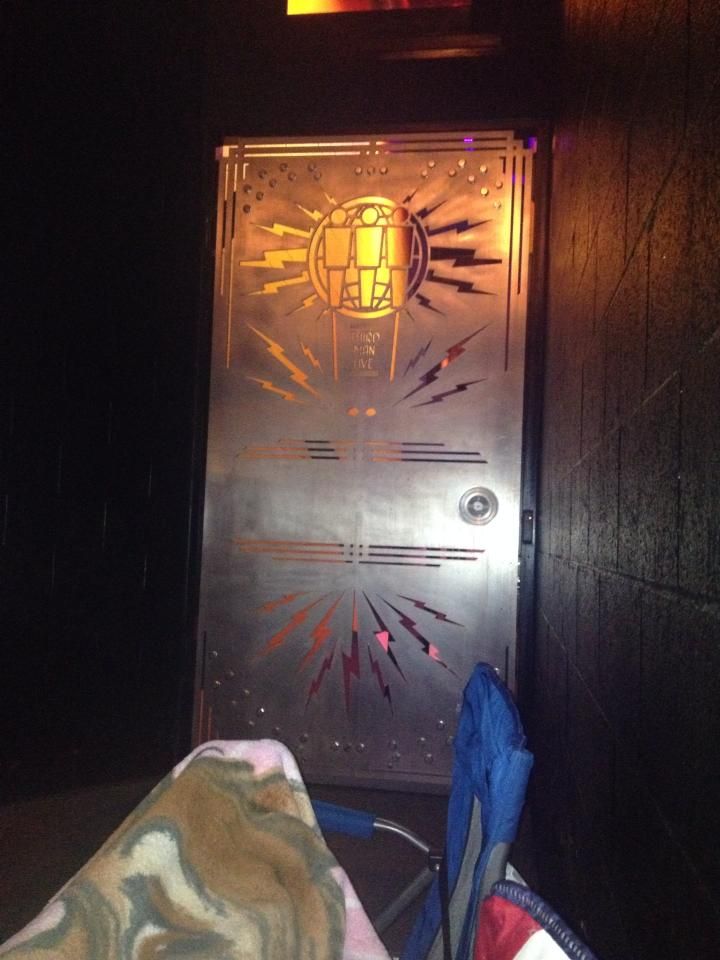
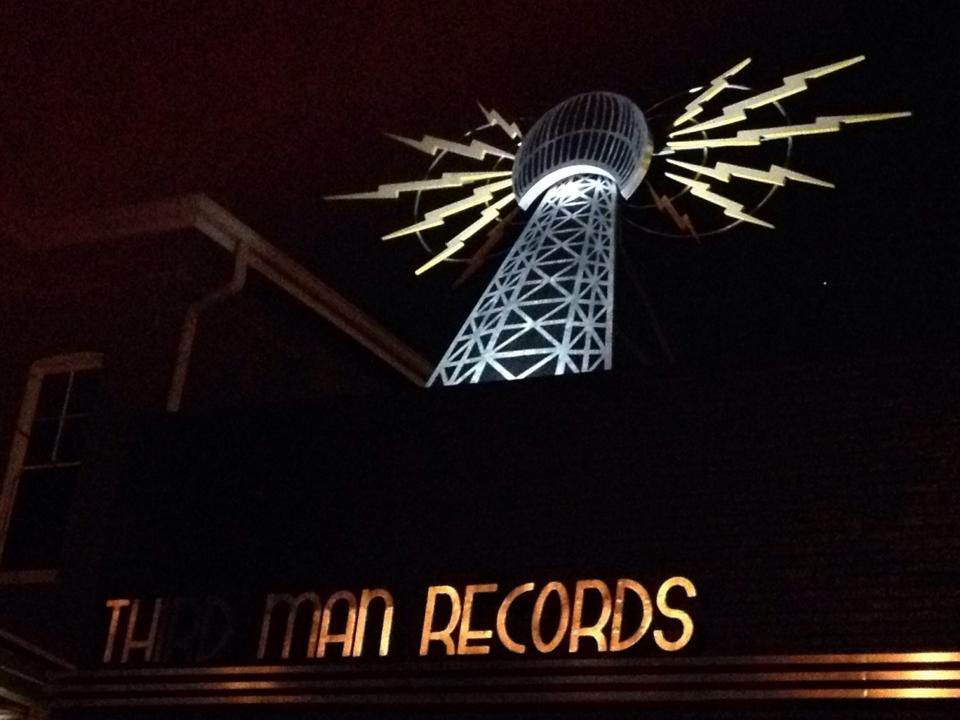
First was the fried chicken that I picked up for our dinner. If you ever find yourself in Nashville, brave the lines at Hattie B's. Lord above, I can pretty much guarantee you won't be sorry. And then I was glad for the night that followed with the terrific bunch of people who were there. From pressing our ears to the metal door that leads to the Blue Room so that we could hear the sound-check (and being chastised for it by Jack's tour manager), to curling up in a camp-chair with a blanket to stake our place in line while my buddies crawled into their tent to sleep, to waking up from a light doze to see an almost-full moon glowing in the sky over the Wardenclyffe tower-replica perched atop Third Man, to taking everyone for a McDonald's run at 6am and coming back to find a bird flying in and out through the TMR logo in the metal door, testing the acoustics inside the hallway, and then perching inside the logo to serenade us before flitting off... Thinking back on that night and morning, I kind of feel sorry for Jack that we've experienced something he'll probably never be able to-- The magic of spending a beautiful, chilly night outside the gleaming black walls of the place he created.


But I was mostly grateful that I'd rushed over there when told to because I was third in line to enter the venue when the doors opened at 8:30am. My buddies and I snagged prime real estate at the front of the stage and, oh, how different it was at this show, considering how tiny that stage is and how close we were to the action upon it. Very kindly, Third Man put together a video re-cap of the entire day to save me from having to babble about it. Suffice it to say, the grin that's visible on my face about 18 seconds in sums up the state I was in pretty much the entire 20+ hours I spent on the premises--
So where's the Elvis connection? You heard a snippet of it in that video, when Jack and the band covered Power of My Love, an Elvis tune I'd not yet heard of, as the b-side of the live Lazaretto World's Fastest Record. As terrific a song as Lazaretto is, it's that cover tune that I and some of my friends have been talking about since.
Where Elvis' version is all self-assured, sultry seduction, Jack's is a blatant, nakedly urgent declaration that this is how it is and now what are you gonna do about it? Elvis croons the words, Jack spits and shrieks them (while still managing to slip in a bit of that Elvis quaver), but both versions have the same knee-weakening effect. Probably not in the least surprising, but I've been giddy over this song all week.
In an interview with Marc Maron (skip ahead to about 29 minutes in) in 2012, Jack described Elvis as an "alien" because of what he did with music. I don't know whether Jack doesn't realize it or would be too modest to say it out loud, but it's time for him to admit that he's one, too.
Been a tad giddy over these, too, so just for the hell of it...
** Yes, I do know that the lyric is "strength and mighty power of my love". But it sounds like "strange" when Jack sings it and that's somehow just so very appropriate.
This new infatuation, though, has in no way eclipsed the already existing one, my addiction to Jack White and his music. It's not inconceivable that Jack might've led me to Elvis, the same way he's led me into so much other music, from blues to rockabilly to garage rock. After all, he's been Elvis--
And the connection doesn't end there. Jack's worked with a few of Elvis' former girlfriends in recent years. Both clearly grasp(ed) the effect of taking the stage in distinctive clothing (Elvis' early pink'n'black getups and those iconic white jumpsuits, Jack's red, white'n'black with the White Stripes and equally color-coordinated outfits in every other incarnation), and both dyed their hair black and play(ed) up their eyes with makeup. Both took existing musical styles and turned them into something just a bit different. But that's all superficial stuff. Something I read in Last Train to Memphis summed up what it really is. Guralnick quoted Tom Perryman, a young dj and promoter from Gladewater, TX, describing Elvis at nineteen, just a couple months after the release of That's Alright:
"You know, he was really a natural. When Elvis was performing, everyone had the same basic reaction. It was almost spontaneous. It reminded me of the early days, of where I was raised in East Texas and going to these 'Holy Roller' Brush Arbor meetings: seeing these people get religion. I said 'Man, that's something.' You'd see it in the later years with the big sound systems and the lights, but Elvis could do it if there wasn't but ten people (in the room). He never realized what he had till later years. He said, 'Man, this sure is a good crowd in this part of the country. Are they always that way?'. I said, 'No, man. They never seen anything like you.' Nobody had."
That's Jack. I missed the White Stripes, as I didn't get into his music until the band was already unofficially over. But I've spoken to many people who did experience the Stripes, read many a review of their shows, and have experienced for myself all of his post-Stripes incarnations. I would bet money that every fellow fan I know would agree that seeing Jack perform live is like getting religion and that they'd never before seen anything like him. And he puts the same passion into every show, whether it's in front of ten people or one of those places with a big sound system and lights and a few thousand people.
So just imagine the degree to which my silly l'il fan-girl brain was blown when my two infatuations recently came together.
Last Saturday was Record Store Day and, like last year, I headed to Nashville to celebrate the day at Third Man Records. The anticipation for this year's event, though, was light years beyond the previous one. On April 3rd, just two days after announcing on April Fool's Day that Jack would be releasing his second solo album, Lazaretto, this summer, Third Man announced that on Record Store Day, he would take the stage of the Blue Room to record, direct-to-acetate, a live version of the first single, also titled Lazaretto. Not only that, but the acetate would then be rushed down the road to United Record Pressing Plant (who presses all of Third Man's releases), an abundance of singles would be pressed, and then said singles would be rushed back to Third Man to sell to the fans waiting in anxious anticipation. And not only that, but tickets to attend Jack's performance would be on sale within a couple of hours of this announcement. Did my stomach immediately begin doing flips? Did I actually tell my boss that I needed to be off the clock for a short while that afternoon with my office door closed? Did I then clock out, shut my door, and pounce on that ticket sale like a hawk after its prey, scoring one of those highly sought-after $100 tickets within a matter of seconds? Affirmative to all of the above.
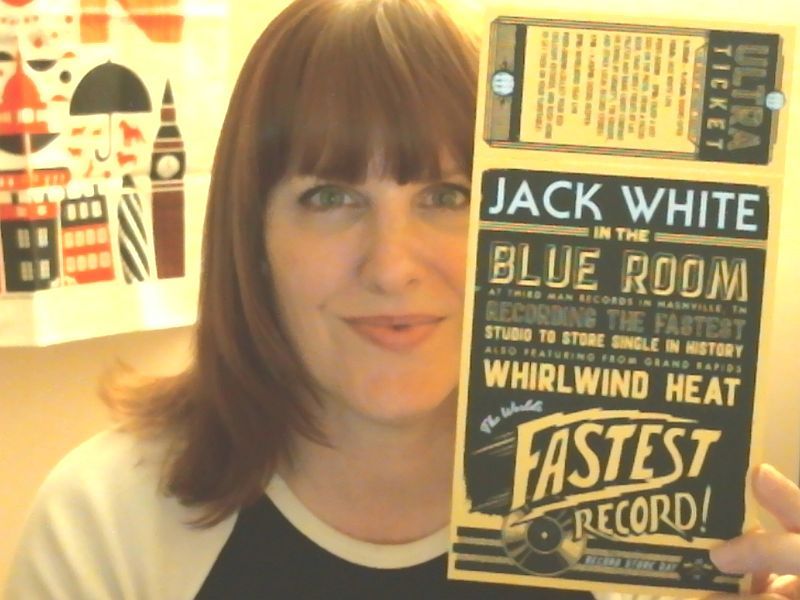 |
| Yup, that'd be me. The thing in itself. |
First was the fried chicken that I picked up for our dinner. If you ever find yourself in Nashville, brave the lines at Hattie B's. Lord above, I can pretty much guarantee you won't be sorry. And then I was glad for the night that followed with the terrific bunch of people who were there. From pressing our ears to the metal door that leads to the Blue Room so that we could hear the sound-check (and being chastised for it by Jack's tour manager), to curling up in a camp-chair with a blanket to stake our place in line while my buddies crawled into their tent to sleep, to waking up from a light doze to see an almost-full moon glowing in the sky over the Wardenclyffe tower-replica perched atop Third Man, to taking everyone for a McDonald's run at 6am and coming back to find a bird flying in and out through the TMR logo in the metal door, testing the acoustics inside the hallway, and then perching inside the logo to serenade us before flitting off... Thinking back on that night and morning, I kind of feel sorry for Jack that we've experienced something he'll probably never be able to-- The magic of spending a beautiful, chilly night outside the gleaming black walls of the place he created.
 | |||
This photo and all following courtesy of and property of Mike Dziama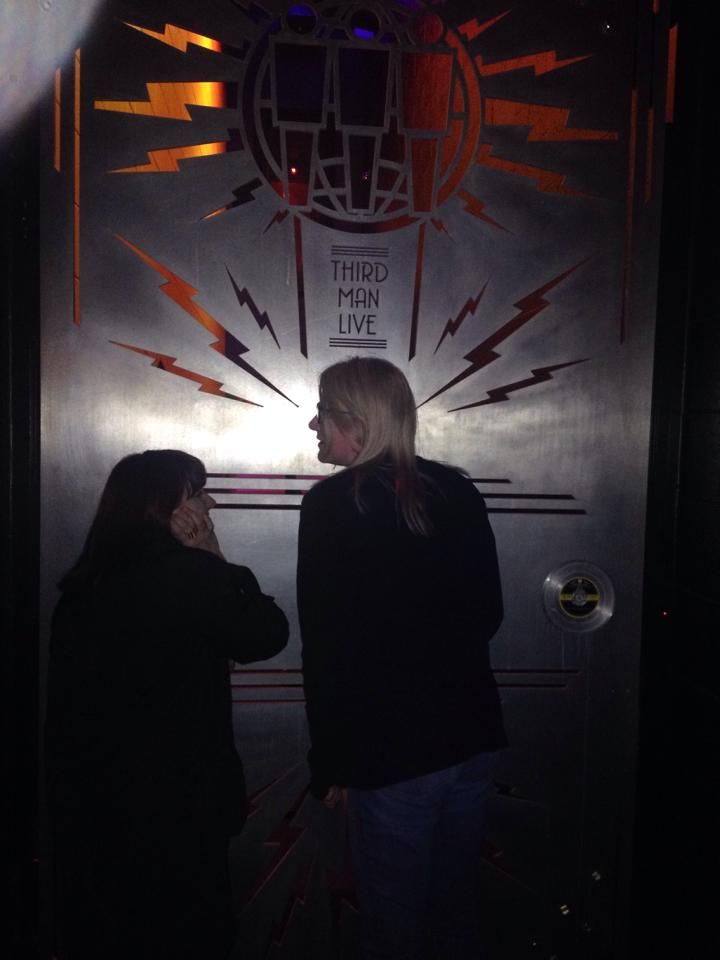 |
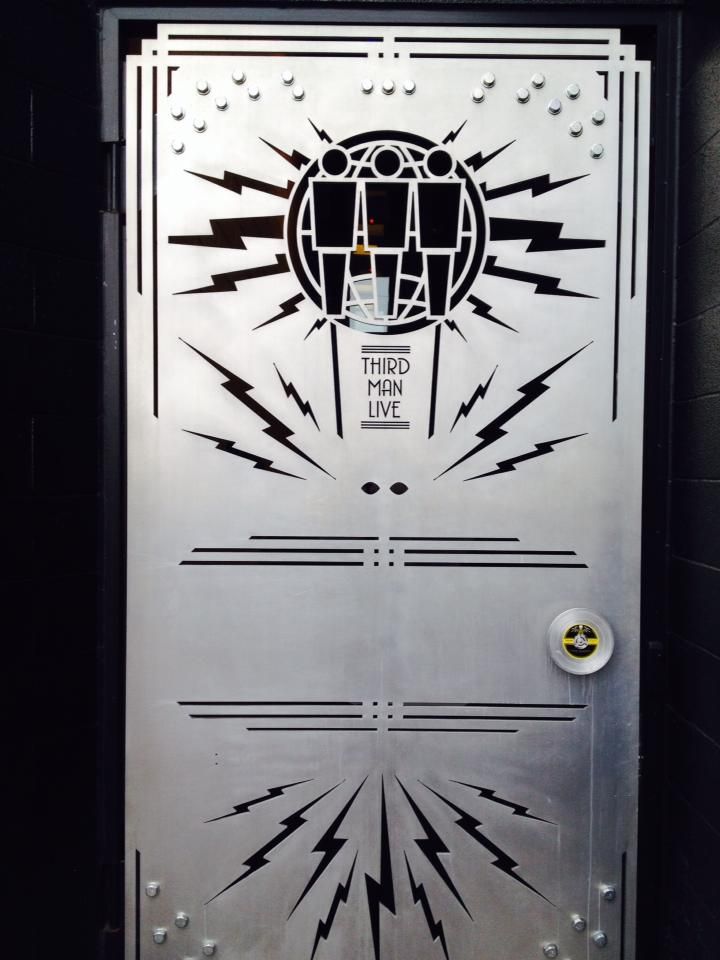

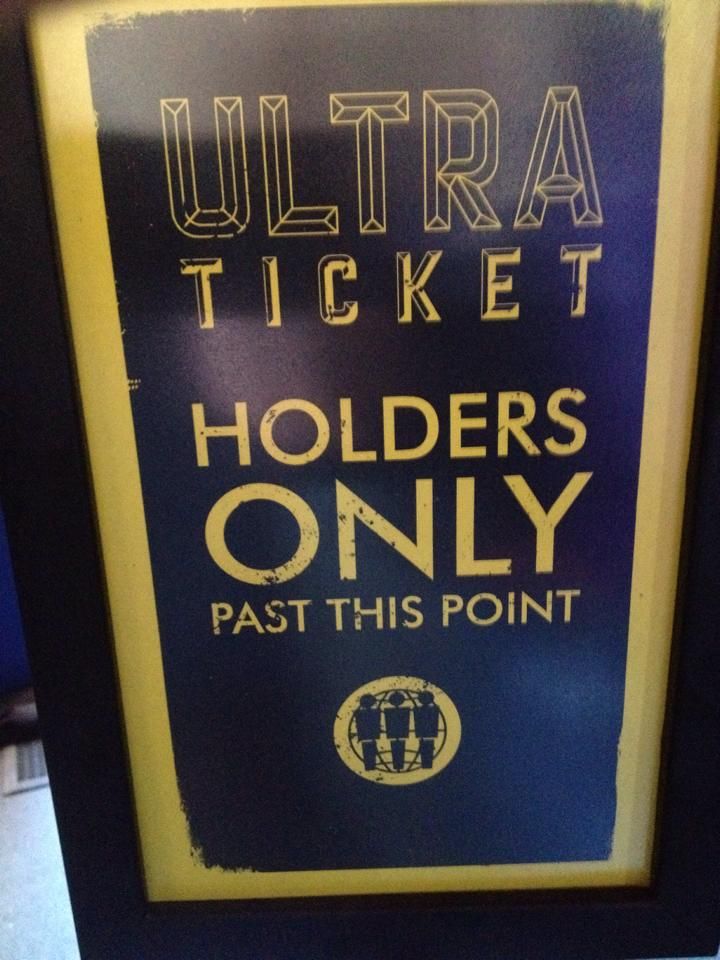
So where's the Elvis connection? You heard a snippet of it in that video, when Jack and the band covered Power of My Love, an Elvis tune I'd not yet heard of, as the b-side of the live Lazaretto World's Fastest Record. As terrific a song as Lazaretto is, it's that cover tune that I and some of my friends have been talking about since.
Where Elvis' version is all self-assured, sultry seduction, Jack's is a blatant, nakedly urgent declaration that this is how it is and now what are you gonna do about it? Elvis croons the words, Jack spits and shrieks them (while still managing to slip in a bit of that Elvis quaver), but both versions have the same knee-weakening effect. Probably not in the least surprising, but I've been giddy over this song all week.
In an interview with Marc Maron (skip ahead to about 29 minutes in) in 2012, Jack described Elvis as an "alien" because of what he did with music. I don't know whether Jack doesn't realize it or would be too modest to say it out loud, but it's time for him to admit that he's one, too.
Been a tad giddy over these, too, so just for the hell of it...
** Yes, I do know that the lyric is "strength and mighty power of my love". But it sounds like "strange" when Jack sings it and that's somehow just so very appropriate.
March 15, 2014
Ever wonder why they called him The King?
On June 23, Elvis recorded "If I Can Dream" in several passionate takes. To Binder and Howe [producers of Elvis' 1968 tv comeback special], his performance was so staggering as to seem almost a religious experience. Out on the floor with a hand mike, standing in front of the string section, Elvis fell to his knees. For a moment, he was back at Ellis Auditorium, at the gospel sings of his youth, or maybe down in Tupelo at the Assembly of God church. Howe, having worked with him before, might have anticipated such an immersion. Not everyone was prepared: "The string players sat there with their mouths open. They had never seen anything like this."
But the more astonishing performance came when the producers sent everybody home and Elvis rerecorded the vocal in the dark. Binder sat motionless, afraid to move as Elvis lost himself in the song. Once again, he fell to his knees. But this time, in a fervent act that was equal parts artistry and emotional regression, he assumed a fetal position, writhing on the cement floor. Then, after four takes, he got up and walked into the control room, and Binder played the recording back for him. Elvis sat in rapt attention and asked to hear it again, until Binder had played it some fifteen times. Only then was he satisfied.
From Baby, Let's Play House, Elvis Presley and the Women Who Loved Him.
January 18, 2014
Lunch-time in the nation's capital
Just went to the Shake Shack up the street from work to grab a hot dog and fries for lunch. Placed my order, took the beeper they give you, and went over to the other counter to get napkins and mustard and such. Homeless dude standing there with a beeper asks how I'm doing. I said I was fine and, out of courtesy, asked how he was. He said he was ok and complimented me on my hair-color. So I complimented him on his hat (which was really very cool, I'd love to have one like it). He then asked if I had any change. I told him I'd just spent the last of my cash. He asked if I had any plastic. I said "Yeah, that's what I'll be using the rest of the day". He said "Will you buy me a burger?" Sucker that I am, I said "Sure", despite the fact that he had a Shake Shack beeper in his hand already. We went back to the counter and I could tell from the clerk's face that this wasn't the first time he'd rung up an order like this for the homeless guy (whose name was Ronald, by the way). While my transaction was being processed, Ronald pulled out a gigantic wallet to show me his last name on his driver's license, and I teased him that he had more plastic than I did (though I couldn't tell whether any of it was credit cards). Transaction complete, I took my receipt, handed Ronald the beeper for his order, then went to sit on the bench next to the other counter where you pick up your order. Ronald stayed by the cash register fiddling with his huge wallet. While he was there, a family of tourists (so they appeared and this is DC, after all) came up to place an order and I watched Ronald finagle another burger (his third, remember) out of the father while the mother just stood there staring and I sat on the bench cracking up. A couple of the people who were already waiting when I sat down chuckled, too, so I assume they had caught on to his racket as well. So then Ronald is called to the counter to pick up his first burger, after which he comes over to the bench and asks if we can make room for him. The guy on my right stands up to let him sit and he plops down right up against me. So I told him that he needed to move over because I don’t let guys sit that close on the first date. He scooted way on over and made a big show of how he was being respectful to me, and then added a quip about “because he didn’t want me to smack his face”. Then he goes on to tell me about how he went to high school with Eddie Murphy at Roosevelt High in Long Island. Then he starts showing me how prepared for the elements he was- First telling me about the hat I'd admired, which was waterproof wool with pull-down ear flaps, then pointing out his waterproof North Face pants and Helly Hansen shirt (which he kept covered with another shirt so that no one would rob him of it). Oh, and then he began telling me about how a lot of people think he's black, but he's not-- Both of his parents are German, and his mother is part Cherokee Indian. So I asked how he ended up with such dark skin (he was a fairly light-skinned seemingly black dude). So he explains that it's not black, it's Cuban. So I started to ask him where the Latin blood fit in, but then he was called up to the counter to pick up the burger I’d bought for him. Out of the corner of my eye, I can see the guy who bought Ronald’s third burger explaining things to his wife. Through all of this, I was still cracking up. When Ronald sat back down, I teased him about the racket he had going, and he started to tell me something about how he liked to help people out and we started talking about “paying it forward”, then he decided he had to go to the bathroom. He got up and started to head towards the back of the place, but stopped to talk to someone else along the way. Just then, my order and that of the tourist family were called, so we put the burger the father had paid for into Ronald’s bag with the one I’d bought for him. By that time, Ronald had apparently made it all the way back to the bathroom, so I asked the clerk to keep an eye on his stuff on the bench and I took my hot dog and went back to work.
See, kids? It's not always wrong to talk to strangers.
See, kids? It's not always wrong to talk to strangers.
October 27, 2013
Revisiting Last Kind Words
Some songs never go out of me... I first wrote about this one three years ago, and today a friend shared an article with me that discusses it in depth.
Back in the winter of 1998/99, John Jeremiah Sullivan spent an evening on the phone with John Fahey trying to decipher the words of Geeshie Wiley's song Last Kind Words Blues for an article being written by Greil Marcus. In the more recent Harper's Magazine article linked above, Sullivan explains how interpreting the words of the song went hand-in-hand with interpreting the meaning of it. Sullivan's perspective is that it's a song about a woman pining for her "ghost-lover" and his explanation of various lines certainly encourages a very eerie feel to the song. But there are places where Sullivan definitely got some words wrong, for instance in the second verse where he wrote that she sings "... send my money... to my mother-in-law." Every website I've found and my own ears insist that Geeshie sang "...send my body", after which she pleads "...don't bury my soul... leave me out, let the buzzards eat me whole." Hard to imagine someone's mother-in-law in Mississippi getting away with leaving a body out for the buzzards, but the imagery is still compelling. But which makes more sense? Sending money to the mother-in-law and just leaving the body out on that battlefield in Germany? Or sending the body back home for the mother-in-law to tend to according to the singer's daddy's last wish? The former seems to be more logical, but the latter definitely seems to be what Geeshie intended. Little debates like this are one of the many things that make songs like this so captivating over so many decades.
Near as I can tell from Sullivan's article, searching the internet (good discussion of the song found here), and listening, these seem to me to be the correct lyrics--
The last kind words I heared my daddy say
Lord, the last kind words I heared my daddy say
If I die, if I die in the German war
I want you to send my body, send it to my mother-in-law
If I get killed, if I get killed, please don't bury my soul
I cry just leave me out, let the buzzards eat me whole
When you see me comin', look 'cross the rich man's field
If I don't bring you flour, I'll bring you bolted meal
I went to the depot, I looked up at the sun
Cried, some train don't come, Lord, be some walkin' done
My mama told me, just before she died
Lord, blessed daughter, don't you be so wild
The Mississippi river, you know it's deep and wide
I can stand right here, see my babe from the other side
What you do to me baby it never gets outta me
I believe I see you after cross the deep blue sea
Dex Romweber's and Jack White's 2009 version takes some definite liberties with the song. Every site I've found when searching for the lyrics to their version posts instead the words to Geeshie's version. But there are some distinct differences--
The lyric that gave Sullivan and Fahey the hardest time is the same that I've seen most debated at internet forums-- The second line of the fourth verse, in which she sings "If I don't bring you flour, I'll bring you bolted meal." Early interpretations apparently thought she sang of flowers and a boutonniere, but Sullivan's research convinced him that she was instead referring to corn meal. It's easy to see why Fahey was skeptical of Sullivan's idea, as most internet dictionary sites bury the definition of "bolt" in terms of sifting near the bottom of the page. Yet Jack and Dex sing of something entirely different being brought across that "rich-land field", something even less intelligible than what Geeshie sang thanks to a crescendo in the music, and with a lot more syllables that definitely seem to end with the word "steel", rather than "meal". What the heck are they singing about?
There's also their change to the sixth verse, "...When you see the dawn, wake up and let a man grow wise", which seems to be a nicely worded attempt at gender reversal to avoid singing "blessed daughter". If that's the case and the intent was to change the perspective of the entire song from female to male, it makes a significant difference-- Is the "daddy" of the first verse now a father instead of a lover/husband? And that leads to...
The switch they made that, to me and presumably to John Jeremiah Sullivan, has a more profound affect on the tone of the song is a very subtle one. In the next to last verse, Sullivan wrote of the distinctly "spooky" feel created by Geeshie singing "I can stand right here and see my baby from the other side". Sullivan's take on it is that the song's narrator is "slipping out of [her] body... and joining [him] on the other side". The "other side", of course, is across a river more spiritual than physical. But when Dex and Jack sing "I can stand right here and see my baby on the other side", are they changing the longing of that line from spiritual back into something more temporal? I don't know which of them made the decision to do this or why, but it initially surprised me coming from both Dex and Jack. Both have spiritual leanings, and Jack's love of metaphor would seem to make the metaphysical interpretation more appealing to him than the concrete one.
But if the "daddy" at the beginning of the song is now the narrator's father, rather than the ghost-lover who died in the war (as per Sullivan's intepretation), then who is singing about whom on the other side of that river? Is the song now sung by that ghost-lover? If that's the case, then the river once more becomes a spiritual one, with him longing for his living lover who still stands on the temporal side.
As Geeshie's words and meanings show, it can take some digging, through one's own brain as much as anywhere else, to make the interpretation of a song come alive. I'm grateful to my friend for handing me such a sturdy spade this afternoon and causing me to dig more deeply into both versions of this one.
August 10, 2013
No metaphor
Witnessed an intense drama today. Heading up the hill where the trail curves up from the creek into the woods, I stopped at the old bench to catch my breath and have a sip of water. In a patch of sunlight beyond the other side of the trail, I don't know how many dozens of feet from where I sat, in an open area between the trees a few times my height above the ground, I noticed a large dark butterfly fluttering fast but not going anywhere. As I looked at it, my eyes gradually focused on the faint strands of the web in which it was caught. I couldn't quite see the whole thing, but it had to've been a damned big web, because it was a very big butterfly. Amazing, too, how strong a spider's web is, because that big butterfly was putting up a crazed struggle to break free. I got up from the bench and walked down the trail a bit to a point where I could see it better. From that angle, my eye was caught by something a ways above the web-- a little blob that was illuminated bright acid-y, lime-y green by the sun. Hanging on an anchor-line that I couldn't see was the spider. After another minute or two, the butterfly suddenly stopped its flapping and hung suspended at the bottom of the web with its wings spread wide. The spider began to crawl down the anchor-line towards the web, which the butterfly must have felt because it began its violent fluttering and pulling again. This routine of rest, advance, response went on one more time before the spider reached the center of the web. The spider stopped there, the butterfly stopped as well and hung deathly quiet for a while, then suddenly went crazy again and I watched as the spider turned back and began climbing back up the web, back up the anchor-line, back to the spot where I first noticed it. Even when the butterfly stopped and hung for the longest minutes yet, the spider just sat, as if it knew it wasn't yet time. I wondered how many other people would stop to watch something of this sort. How many would even realize what was going on? At a glance, all you'd see was a butterfly fluttering. How many would look long enough to realize it was trapped? If you didn't focus your eyes just right, you wouldn't even see the web and the spider, just the crazily flapping butterfly and the trees of the woods beyond it. I looked up at the spider again and began to think of patience, of how wonderful and powerful a thing it is to have, and how simultaneously horrible and frightening it can be if you're the butterfly trapped and panicking to be free. But perhaps that's anthropomorphizing a bit too much. Finally, when the butterfly went into convulsive flapping so violent that it caused the spider all the way up on its anchor-line to bounce around in the air, I turned away and headed up the trail.
This is not a metaphor for anything. It's just life. Just something I saw.
This is not a metaphor for anything. It's just life. Just something I saw.
Subscribe to:
Posts (Atom)


 Posts


