Whatever assumptions you've made about this post based on the title, just go ahead and discard 'em now. This will be a bit of a ramble, so please bear with me...
I saw Jack White last week. For those of you who don't know, the Raconteurs have reformed for a scant half-dozen shows this fall. I bought tickets for two shows immediately when they went on sale, then agonized and changed my mind and agonized some more before dropping a silly amount of money on eBay for a ticket to a third-- at Jack's 'house', Third Man Records. There was just no passing up the opportunity to see this band, one that I wasn't sure I'd ever see, at that location. The place is too special.
So last Wednesday I hopped a plane to Nashville and, upon arrival, headed straight downtown to line up outside TMR with a bunch of fellow fans. My timing turned out to be perfect, as I was close enough to the front of the line to end up at the edge of the stage in the same spot I had for each of the Dead Weather shows I saw last year-- right next to Jack's pedal board. So close, in fact, that I had paranoid visions of knocking a cable loose and creating technical difficulties for him. This didn't come to pass, fortunately, and paranoia ended up eclipsed by bliss.
Here's where you need to begin bearing with me as I ramble-- Of the famed trio of bands in which Jack's been involved, I have to say that the White Stripes are far and away my favorite. That's due in large part to the immensity of their catalog compared to the other two, but also to the mesmerizing interaction between Jack and Meg. But my chance to see the Stripes live was lost before I ever had it and has to be fulfilled through a blessed bounty of recorded performances. The third of the tripartite, the Dead Weather, was my introduction to Jack live, with four shows spread over the spring and summer of last year. Each show was an incredible kick of adrenaline, but that rush was somewhat tempered by the fact that Jack was not the frontperson of the band. So that left the Racs as the band that I've felt a compelling urge to experience, in order to see him up front, at a mic, with a guitar, for the duration of a show. Imagine my thrill when this fall's shows were announced.
But there's another thing about the Raconteurs. It struck me at some point last year, while I was immersing myself in and digesting Jack's catalog, that this triad of bands is very loosely reflective of Sigmund Freud's concept of the Id, Ego, and Superego...
The White Stripes may have been portrayed with a child-like element, but there was nothing childish about the way Jack approached the band. Articles and interviews during the ten years they performed are full of references to the "box" he constrained himself within when writing their music, to his and Meg's intense work ethic, even to their apparent lack of typical rock star partying. It was a rarity to read a cuss word in any of Jack's interviews during that time (though he'd loosened up quite a bit in that regard by their final year of touring, as evidenced in the Under Great White Northern Lights documentary). He was a gentlemanly "brother" to Meg, his demure "sister". Despite the inner complexities depicted in Jack's lyrics, they were characterized as just about the most clean-living, well-mannered, moral rock band conceivable. They were, in many ways, Jack's Superego, "persuading [his] ego to turn to moralistic goals rather than simply realistic ones, and to strive for perfection".
Id, on the other hand, "operates on the Pleasure Principle, which is the idea that every wishful impulse should be satisfied immediately, regardless of the consequences". Listening to even a handful of their songs makes it quite obvious that this was the driving element of the Dead Weather's music. Whether it was Alison Mosshart's influence or something that she and Jack brought out in each other, I've no idea. But he took on a sometimes almost frighteningly dark persona in that band, which manifested itself not only in the music but also, towards the end of last year's tour, in his behavior on stage.
Which leaves us with the Raconteurs and Jack's Ego. Freud's use of that word was very different from the definition most people apply to it. In his concept of the psyche, "Ego controls higher mental processes such as reasoning and problem-solving, which it uses to solve the Id-Superego dilemma, creatively finding ways to safely satisfy the Id's basic urges within the constraints of the Superego". The Raconteurs strike me as Jack's balancing act between the Superego of the White Stripes and the Id of the Dead Weather. While Freud's concept is much more complex, when taken on a simplistic level, it's not a stretch to see this band as the one in which the tensions of the other two are resolved and Jack becomes grounded and, dare I say it, even relaxed. The interaction with Brendan Benson, Jack Lawrence, and Patrick Keeler, combined with the quiet skill of Brendan's songwriting contribution, seems to create a musical equilibrium Jack's not had in either of the other bands. This is what was apparent to me at the two shows I attended last week.
The tone of the TMR show began with the opening act, Pokey LaFarge and the South City Three, four of the most authentic roots musicians and charmingly goofy showmen you could ever hope to see. They had us singing and smiling by the end of the first song, which was the perfect state in which to experience the Raconteurs when they hit the stage and began to blow us away (which I unfortunately can't share with you, as video and photography are not allowed in the Third Man venue). The Racs have been described as four friends who got together to make music, and it was so obvious all night long that that's still what they are. And to be making music on Jack's own stage had to leave them feeling as giddy as it did all of us in the audience. While the setlist was short because the show was being recorded (to be pressed to vinyl for some as-yet-unspecified future release), it was augmented during the reel changes by Jack and Brendan telling stories of when they first met. The smiles up on that stage were almost non-stop, and the band's performance was both loose and intensely electric.
Three days later, I followed the Racs to Michigan for the inaugural MI-Fest. I'm not a fan of festivals. There are just too many people making it that much more difficult to get to the front of the stage. But this was originally announced as the only show the Raconteurs were going to play, so I jumped to get a ticket and make arrangements to fly to Michigan. I won't go into the chaos created by the promoters leading up to the event because, for my intents, everything worked out just fine. The location was beautiful, the weather was gorgeous, the people I hung out with throughout the day were great fun, and, yet again, I ended up in almost exactly my favored spot at the front of the stage-- granted the stage was over six feet from the ground and the pit between it and the barrier was at least ten feet, but I still had as good a view as I could have hoped for. And the band was worth every one of the eight hours (ten, for some folks) my compatriots and I spent waiting for them. What this show lacked in the intimacy provided at Third Man was made up for by the extended setlist that included songs I'd sorely missed hearing on Wednesday night. But you don't have to take my word for it. There were a lot of phones and cameras in the audience that night, for which I will be forever grateful (one person, in particular, filmed some wonderfully high quality footage). My own personal favorite songs of the night--
Top Yourself--
Level--
Broken Boy Soldier. Note the dangling guitar string, which apparently broke just as Jack began the song--
Steady As She Goes--
Blue Veins. Listen for the note Jack holds at the end of "don't mean nothin'..." I've not heard him do anything like that in any show or live recording I've listened to, and it made my hair stand on end--
And, finally, Carolina Drama. It's not complete and you need to keep the sound low due to distortion. But, man, it sure looks good--
These two shows fulfilled every expectation I had for this band. They were energetic and powerful and, most of all, full of an extraordinary joyfulness. Just writing about them has put a huge grin on my face. And the best part is that I've got a ticket to see the Racs again in Atlanta in November, their final show until who knows when. At that point, I'll have completed a trio of shows for the band that is, in so many ways, the most glorious of Jack's triad. His Ego's a beautiful thing.
More reviews --
Live Review: The Raconteurs at Nashville’s Third Man Records, Consequence of Sound
The Inaugural MI Fest, krewechief's Live Music Blog
Raconteurs End Three-Year Hiatus at MI Fest, Spin Magazine
September 19, 2011


August 25, 2011
I used to have some friends, but they wished that I were dead
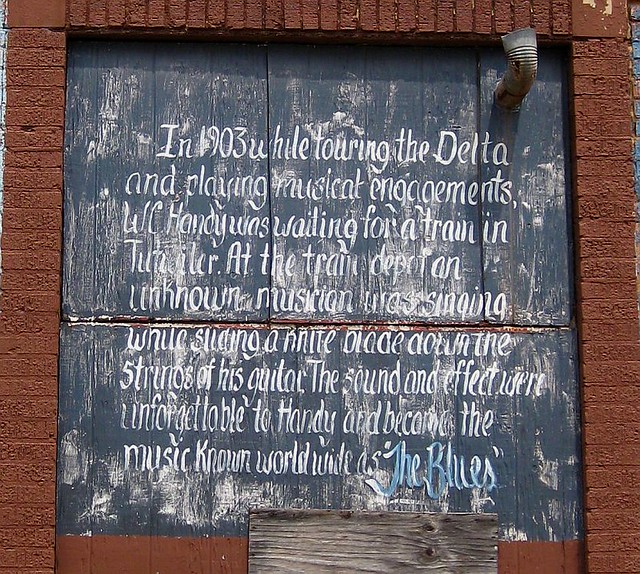 |
| From a mural at the old train station in Tutwiler, Mississippi |
In In Search of the Blues, Marybeth Hamilton goes looking for what she calls "the authentic origins of the blues" and comes back with some interesting conclusions. Describing her thoughts upon looking at a photograph she'd taken during her trip through the Mississippi Delta, she says "Every landscape is a work of the mind, shaped by the memories and obsessions of its observers." Replace the word 'landscape' with 'song' and that one sentence pretty much sums up the gist of her book, as she goes on to discuss how the blues was not shaped so much by the musicians who played it as it was by the white people who sold it then, later, studied it and, later still, revived it. From the record label talent scouts of the 20s and 30s, to Alan Lomax in the 40s, aficionados such as James McKlune in the 50s, John Fahey and Brit rockers like the Rolling Stones and Eric Clapton in the 60s, and even, I would add, all the way up through the early 2000s and Jack White's determination with the White Stripes to "trick teenaged girls into singing Son House"-- It has been people like these who've shaped what the term "blues music" brings to mind.
While the true roots of the blues are generally considered vague and undetermined, its earliest popular incarnation was embodied by full band-accompanied performers singing well-crafted and sophisticated numbers. Women such as Ma Rainey, Bessie Smith, and Mamie Smith were considered the queens of blues music. Band leader W.C. Handy claims to have discovered the blues, but his interpretations of it bear no more resemblance to the genre's current definition than what was crooned by the queens. And even within the commonly recognized genre, there's variety. The early Mississippi Delta/country blues of Charley Patton, Son House, and Robert Johnson migrated north to become the electrified Chicago blues of Muddy Waters and B.B. King, which were eventually usurped by the white boy blues of musicians like Stevie Ray Vaughan and Charlie Musselwhite. It goes on and on. Jazzmen such as Jelly Roll Morton even traced a strong connection to the blues, tangling the skein even further. What it all really boils down to, if you look at it objectively, is that defining what the blues is and what its effects are becomes a highly subjective and personal thing.
My own preferences in blues music were originally inspired by and continue to be influenced by Jack White. A quick look through the blues tunes he's covered reveals an extensive knowledge of the genre-- He's run a gamut through the Mississippi Sheiks, Charlie Jordan, Howlin' Wolf, Muddy Waters, John Lee Hooker, Tampa Red, Tommy Johnson, Blind Willie McTell, Blind Willie Johnson... But it's obvious that he's got a special reverence for the old Mississippi Delta guys such as Johnson, Patton, and, most of all, Son House. What is it about that particular style of blues that he so loves? From what he's said in interviews and how he's crafted his own music, it would seem to be something along the lines of how Hamilton described the singing of these musicians in In Search of the Blues-- '... it was "rough, spontaneous, crude and unfinished," dominated by "stark, unrelieved emotion"...' Even the most polished of Jack's tunes contain elements of that rough spontaneity and stark emotion. And it's even more apparent when he performs live that he's channeling exactly what the blues mean to him. Since his own music has moved me so intensely, it's not surprising that I'm also moved by what inspires him. As a result, my own fast-growing collection of blues records runs straight through the heart of the Delta.
One thing that does surprise me, though, is that I've yet to find evidence that Jack's ever paid homage to one of the most hard-core Delta musicians of all-- Skip James. So my intro to Skip came via a detour from Jack to a record label run by Jimmy Danger, who once played in the band Henry & June with one of Jack's buddies (this digression isn't as aimless as it seems, as Jack has also covered H & J's Goin' Back to Memphis, which is a fantastic modern day blues tune). Danger Limited Records' Black Jesus 7" series was launched with a cover of Skip's Hard Time Killin' Floor Blues that blew me away. So much so that I contacted Jimmy to ask him about the song. Turns out Skip is one of his favorite bluesmen and his description intrigued the hell out of me--
There are many things that set him apart from his contemporaries. The main thing was his choice of tuning. He played primarily in an open D minor tuning. He was the only one at the time to adopt that style and there haven't been many to do it since. He was the master at it. The other often overlooked difference was his piano playing. He was just as good at piano as he was the guitar. His guitar songs are soo haunting. I think it is half the tone of his guitar and half the way he sang. His voice would be the third thing to make him so different. He sang in a high falsetto. If you buy anything by him make sure to pick up the 1931 Grafton Wisconsin sessions. It will change the way you hear the blues.
Well, I've yet to find a good copy of those Grafton sessions, but I did stumble upon another gem, one that hit me even harder once I learned the history behind it. The Biograph release of Hard Time Killin' Floor Blues was recorded in 1964, 20 or so years after the last time Skip had picked up a guitar, and after he'd been hospitalized for a horrendous case of cancer. He was rediscovered that year in a Mississippi hospital by a group of Washington, D.C. blues fans including John Fahey, who brought him to D.C. where he ended up again in the hospital. After more treatments, they eventually took him all the way to the Newport Jazz Festival, at which Skip's performance stood in stark contrast to that of previously rediscovered Mississippi John Hurt. But in between, they took time to record the set of tunes on the Hard Time Killin' Floor Blues collection. Two of those songs were specifically about Skip's time in that D.C. hospital, and they're two of the most heartbreaking songs I've ever heard---
Layin' sick, honey, on my bed
I'm layin' sick, honey, and on my bed
I'm layin' sick, honey, and on my bed
I used to have a few friends but they wished that I were dead
In awful pain and deep in misery
Awful pain and deep in misery
Awful pain and deep in misery
I ain't got nobody to come and see about me
And every dog, baby, got a day
And every dog, baby, got a day
Every dog, baby, got a day
But I said, "Please, ma'am, don't you treat me this-a way"
The doctor came, lookin' very sad
The doctor came, lookin' very sad
The doctor came, lookin' very sad
He diagnosed my case and said it was awful bad
He walked away, mumblin' very low
He said, "He may get some better but he'll never get well no more"
I've got a long trip and I'm just too weak to ride
I've got a long trip and I'm just too weak to ride
I got a long trip and I'm just too weak to ride
Now it's a thousand people standin' at my bedside
I hollered, "Lord, oh Lord, Lord, Lordy, Lord
Oh Lordy, Lord, Lord, Lord
I been so badly misused and treated just like a dog"
I ain't gonna cry no more
I ain't gonna cry no more
I ain't gonna cry no more
Cause down this road every traveler got to go
I been on the ocean, I been across the sea
Been on the ocean, I been across the sea
Been on the ocean, I been across the sea
I ain't found nobody would feel my sympathy
You take a stone, you can bruise my bone
You take a stone and you can bruise my bone
You take a stone and you can bruise my bone
But you sure gonna miss me when I'm dead and gone
In the hospital, now
In Washington D.C.
Ain't got nobody
To see about me
But I was a good man
But I was a poor man
You can understand
All the doctors
And nurses, too
They came and they asked me
'Who in the world are you?'
I says, I'm a good man
But I'm a poor man
You can understand
The doctors and nurses
They shakin' their head
Said, 'Take this poor man
And put him to bed'
Because he's a good man
We know he's a poor man
We can understand
I didn't go hungry
I had plenty to eat
I had good treatment
And a place to sleep
Because I was a good man
They knew I was a poor man
They could understand
I met a little damsel
She promised me
That she would love me
And always be sweet
She found out I was a poor man
And I thought I was a good man
She couldn't understand, no
Now, when she left me
She got in the door
She waved me, good-bye
I haven't seen her no more
She found out I was a good man
She knew I was a poor man
She couldn't understand
The doctors and nurses
They shakin' my hand
Say, 'You can go home now, Skip
You's a sound, well man'
Because you's a good man
You's a poor man
We can understand
I's thankin' my doctor
And I was shakin' his hand
I'm gone play these, 'Hospital Blues'
'Till you's a wealthy man'
You took me as a good man
You knew I was a poor man
You could understand
You know I was a good man
But I'm a poor man
You can understand
That, right there. That's what it is about the blues. Get it? Now see if you can get out.
July 19, 2011
On the bat's back I do fly after summer merrily...
Seems there's another hiatus going on around here. No slump this time, though, rather the opposite. Just haven't been indoors or at the computer enough (except at work) to compose anything. If you have been, then heed the words of Ariel and get the hell up and out...
Where the bee sucks, there suck I;
In a cowslip's bell I lie;
There I couch when owls do cry.
On the bat's back I do fly
After summer merrily.
Merrily, merrily shall I live now
Under the blossom that hangs on the bough.
- Shakespeare, The Tempest

In a cowslip's bell I lie;
There I couch when owls do cry.
On the bat's back I do fly
After summer merrily.
Merrily, merrily shall I live now
Under the blossom that hangs on the bough.
- Shakespeare, The Tempest
May 15, 2011
1 Mississippi, 2 Mississipi
Mississippi's been on my mind lately. The mighty river's flooding and I've been listening to Delta blues. The first situation's so stunning and what people in that part of the country are dealing with is so heart-breaking that I can't begin to figure out what to say about it. Farmland and homes inundated and lost. Not for the first time, of course-- The Great Flood of 1927 was just as horrendous, but when you see the seemingly passive devastation of water every-freaking-where, it's hard to imagine how anyone can clean up and rebuild from that.

As for the music, it's so much easier to think about, so pardon me for shifting gears in that direction. Two of my latest favorite bluesmen just happen to have been nicknamed for the state that's bordered by the river-- Mississippi Fred McDowell and Mississippi John Hurt.
Mississippi Fred played slide guitar in a way that sends chills down my spine and sang with a voice every bit as evocative as any of the better known blues players. Unknown outside of the hill country just north of the Mississippi Delta until Alan Lomax recorded him around 1960, McDowell made up for lost time by recording over a dozen records within a dozen years before cancer took him. A case of better late than never, but still makes you wonder what could've been if he'd been discovered sooner.
Mississippi John's blues had a folkier sound to them but were no less intense in their way, if you pay attention. In songs such as Stackolee and Nobody's Dirty Business, there's a subtly powerful contrast between the violence of the lyrics and the delicacy of Hurt's voice and acoustic finger-picking.
The current condition of much of the U.S. south is the stuff of which the blues are made. Though it's hard not to think that, thanks to artists like Mississippi Fred and John, we've got enough already.

 |
| Flood photos from The Big Picture, more at www.boston.com |
Mississippi Fred played slide guitar in a way that sends chills down my spine and sang with a voice every bit as evocative as any of the better known blues players. Unknown outside of the hill country just north of the Mississippi Delta until Alan Lomax recorded him around 1960, McDowell made up for lost time by recording over a dozen records within a dozen years before cancer took him. A case of better late than never, but still makes you wonder what could've been if he'd been discovered sooner.
Mississippi John's blues had a folkier sound to them but were no less intense in their way, if you pay attention. In songs such as Stackolee and Nobody's Dirty Business, there's a subtly powerful contrast between the violence of the lyrics and the delicacy of Hurt's voice and acoustic finger-picking.
The current condition of much of the U.S. south is the stuff of which the blues are made. Though it's hard not to think that, thanks to artists like Mississippi Fred and John, we've got enough already.
May 1, 2011
Baltimore May Day Roll bike ride
As my friend Lyle pointed out, today was May Day. While she's correct that the majority of U.S. citizens probably aren't even aware of this holiday, 40 or so folks did celebrate the day with a tour of 19th-20th century industrial Baltimore-- the annual May Day Roll.
We started out appropriately enough at the Baltimore Bicycle Works, "Baltimore's only worker owned and operated bike shop" which is located right around the corner from Jack Yates' ghost bike. The ride was sponsored by the BBW, and led by the Baltimore Brew's Mark Reutter, who provided the historical commentary.

We headed from there up Falls Road in the direction of Hampden, but turned off at the old Mount Vernon Mill Company.

A few twists and turns through the old houses of the 1800s milltown brought us to the home of Elisha Tyson, an industrialist and abolitionist who was apparently responsible for the freeing of several hundred slaves in pre-Civil War Maryland.

A swift spin down and into town brought us to Red Emma's bookstore & coffeehouse, whose collective business model helped to inspire the BBW.


From there we meandered further east towards Fells Point, stopping along the way in the alley of Dallas Street to admire both the row homes built by Frederick Douglass after his escape from slavery and a bit of true Bawl'mer.
Next up was what's left of the controversial St. Stanislaus Church. The church has been empty and up for sale for years, and the proposed condos for which the parish hall was demolished have yet to be built (though they're apparently now promised for this coming summer).

The highlight of both last and this year's ride was being able to ride through the decrepit Crown Cork and Seal Company. Today's most fascinating trivia tidbit: The modern day bottle cap was invented in Baltimore. Stop and think about that the next time you jerk the cap off a cold one and toss it in the trash.


The last stop was lunch in Greektown at Ikaros. No photos there, for which I'm sorry. I definitely should've taken a shot of the gorgeous platter of pastichio, potatoes, green beans, dolmades, and spanikopita that was placed before me. Of all the many cool sights on the ride, it was truly one of the prettiest.
Folks headed off in separate directions after lunch, leaving only a handful of us to spin back up across town to BBW through scattered rain drops. Normally, I'd bemoan the lack of sunshine on a day like this, but the ride was so interesting and fun that I didn't miss it. The greyness of the sky actually contributed an appropriately gritty atmosphere for a tour of industrial B'more.
Full set of photos here, and a re-cap of the ride at Baltimore Brew.
We started out appropriately enough at the Baltimore Bicycle Works, "Baltimore's only worker owned and operated bike shop" which is located right around the corner from Jack Yates' ghost bike. The ride was sponsored by the BBW, and led by the Baltimore Brew's Mark Reutter, who provided the historical commentary.
We headed from there up Falls Road in the direction of Hampden, but turned off at the old Mount Vernon Mill Company.
A few twists and turns through the old houses of the 1800s milltown brought us to the home of Elisha Tyson, an industrialist and abolitionist who was apparently responsible for the freeing of several hundred slaves in pre-Civil War Maryland.
A swift spin down and into town brought us to Red Emma's bookstore & coffeehouse, whose collective business model helped to inspire the BBW.
From there we meandered further east towards Fells Point, stopping along the way in the alley of Dallas Street to admire both the row homes built by Frederick Douglass after his escape from slavery and a bit of true Bawl'mer.
 |
| One of the five homes built by Douglass. The marble inset reads 'Douglass House'. |
 |
| This is Baltimore. |
The highlight of both last and this year's ride was being able to ride through the decrepit Crown Cork and Seal Company. Today's most fascinating trivia tidbit: The modern day bottle cap was invented in Baltimore. Stop and think about that the next time you jerk the cap off a cold one and toss it in the trash.
The last stop was lunch in Greektown at Ikaros. No photos there, for which I'm sorry. I definitely should've taken a shot of the gorgeous platter of pastichio, potatoes, green beans, dolmades, and spanikopita that was placed before me. Of all the many cool sights on the ride, it was truly one of the prettiest.
Folks headed off in separate directions after lunch, leaving only a handful of us to spin back up across town to BBW through scattered rain drops. Normally, I'd bemoan the lack of sunshine on a day like this, but the ride was so interesting and fun that I didn't miss it. The greyness of the sky actually contributed an appropriately gritty atmosphere for a tour of industrial B'more.
Full set of photos here, and a re-cap of the ride at Baltimore Brew.
April 24, 2011
Well, it's Easter morning now, and there's no one else around...
There's a mountain near where I live. It's a small one-- only 12 or 13 hundred feet or so at the summit-- a monadnock created by the slow erosion of the land around it. Most folks think of it as a single peak, but it's actually a curved string of peaked ridges. Most people also don't seem to be aware that it's private land, despite the explanatory signs posted at the entrance and parking areas, nor of the fact that they owe a debt of gratitude to the graciousness and foresight of an early-twentieth century industrial magnate. That man, the magnate, bought the mountain and much of the land surrounding it back in the 1920's or so. He built a couple of mansions on it for himself and his family. Before he died, he established a trust to maintain the land for the "recreational and educational use of the public". The foundation that's supported by the trust has done just that-- building a trail system and overlooks, and monitoring the environment of the mountain and the wildlife that exists within it. It's an extremely beautiful place.
What I thought was my first time on the mountain was a bit over 20 years ago. I was still in my high school punk rock phase, with buzz-cut hair, Converse sneakers, and ripped blue jeans, and had just moved out of my parents' house in Virginia into my own apartment in Maryland. I spent much of my spare time in the car, driving around exploring my new territory, discovering not only the lay of the land but also an abiding love for the semi-rural back-roads I found at the edges of the suburbs. One day, one of those back-road drives brought me to the mountain. Being in an exploratory mood, I parked at one of the overlooks near the summit and wandered onto one of the trails. As I went along, it began to feel somehow familiar. Flashbacks from buried memories began popping into my mind's eye until recognition finally dawned-- I had been there before. At some point in my childhood, I remembered that my parents had brought my Girl Scout troop to that same mountain for a hike along that same trail. Childhood in general and Girl Scouts in particular had not been a thrill for me, so I'd not held on to the memory. But I got a kick out of the synchronicity anyway.
And I fell in love with the mountain. The beauty of the woods, the pastoral views from the summit and overlooks, and the solitude-- Combined with the new-found freedom of living on my own, the things I discovered on the mountain opened a new chapter for me and it wasn't long before the Converse sneakers were replaced by hiking boots.
Unfortunately, the population of the D.C. suburbs exploded not long after. As the suburbs expanded and began to encroach upon the area around the mountain, a whole lot of other people began to fall in love with the place, too. The picnic areas and trails began to be overrun. It got to the point that you could sit at the summit and hear radios and loud voices in the parking lot at the base of the cliff. So I stopped going there. Began driving further out and finding other places that hadn't yet been discovered by the masses. Though it didn't take long for those places, as well.
At this point, I'm constantly on the lookout for out-of-the-way wildlife management areas, tucked-away nooks in state parks, or any old abandoned road I can explore in solitude. But one day I wandered back to the mountain via an old road that comes in from the back, all the way around the other side from the main road that heads up towards the overlooks. One of the longer hiking trails swings down and crosses over the old road and there was, at that time, just enough space for a car or two to park along the side. Amazingly, the spot was empty. So I figured, what the hell? I'd visit the mountain for old time's sake. To my surprise, I only passed a few other folks on the trail. I've learned since then that it's a matter of timing-- early morning, late in the day, crappy weather-- and of sticking to the newer trails on the backside of the ridge, away from the main summit.
So, on this Easter morning, while the majority of people were either hunting for salvation in church or for colored eggs in the backyard, I was out in the woods at the mountain, by myself, hunting for a skull. I swear, there are times when I feel like the kid in The Sixth Sense-- He saw dead people everywhere, I see dead animals everywhere. Along the side of the road, out in the woods, if there's an animal carcass around, chances are I'll see it. The one I was checking on today was one I'd seen late-fall/early-winter of last year. I'd wandered off the trail looking for a spot to sit and take a break, only to find a recently deceased white tail deer lying a dozen feet from the fallen tree I sat down on. A buck with four-point antlers. I won't deny it, I coveted the idea of that skull and antlers. It wasn't the first time, and it won't be the last. Funny thing is, much as I love skulls and bones, I'm almost phobic-ly squeamish about decaying flesh. And skulls are surprisingly rare finds for some reason. I couldn't tell you how many headless skeletons and carcasses I've found in the woods, way out-numbering the handful of skulls I've found. Where do they go? Can't all be hunter's trophies, because most of the time I'm in parkland where hunting is prohibited (doesn't stop the occasional poacher, of course). Are they found and taken by people like me? Dragged off by predators so the brain can be picked out and devoured in peace? I dunno, but they are definitely a rarity. So I made plans to come back for this one, after nature'd taken its course and stripped it bare and clean.
Wandered back a few months later to check on it, but it was still half-covered with skin and tendon. Well ravaged, though. The hind legs were still attached to the torso, but the front legs had been strewn several feet away, and the lower mandible was lying behind the carcass. The skull, antlers still attached, had been dragged down to the edge of a nearby small stream. Still not clean enough to pick up and bring home, though.
With all the snow and rain the area had through the end of winter and beginning of spring, I figured the thing had to be bare by now. So I headed out this morning along the blessedly empty trail, back to the fallen tree by the little stream. Found the carcass almost in the same state I'd last seen it, now almost entirely clean, except for... the head. The thing was gone, antlers and all. I crossed the stream and tromped around through the trees, scoping the ground for any glimpse of white bone. Nothing. Where the hell could it have gone? The largest omnivorous and carnivorous wildlife in this area consists primarily of raccoons and foxes and neither of those seem big enough to drag a skull with antlers through undergrowth. There've been rumors of coyotes coming in closer to the D.C. suburbs, but I've not heard of any being seen near the mountain. And the foundation that maintains the area has posted signs warning visitors to stay on the trails (signs I ignore, obviously) because of a black bear and cubs in the area, but those signs have been up for a few years now and the bears have likely moved on. It crossed my mind to wonder if some other explorer like myself had also found the thing and beaten me to it. I ended up baffled but resigned.
It got me thinking, though, as such things always do. The sight of the white rib cage and spinal column surrounded by little white wildflowers was striking. Some might consider the image morbid, but to me it was a beautiful contrast between decay and growth, a gorgeous reminder of the cycle of nature that we forget about in day-to-day living. All around me in the woods were indications of that cycle-- The sun shining through new leaves, casting a green glow on tree trunks that were bare, dreary grey and brown just two months ago. Along the trail, little baby ferns were unfurling next to violets. Puddles created by all the recent rain were full of tadpoles. But winter wasn't over long enough ago for me to forget that it'll all turn back to grey and brown in another handful of months, as the cycle continues and the tender growth now bursting forth dies off.
This is the most profound sort of thing I've learned from the mountain-- that life is a series of cycles, but that in the end we all come to the same state as that headless deer. It's a good thing to remember when we feel that life is a constant battle. The problem is often that we don't pick our battles wisely. So many of the things we fight for and against are really just us banging our heads against a wall. And no matter who we're fighting against, both we and they will die and come to that state. What difference do so many of those trivial battles make against the knowledge that we all will end up in the ground, our decaying remains becoming food for new life?
Unless, of course, we decide to have those remains turned into a vinyl record instead.
What I thought was my first time on the mountain was a bit over 20 years ago. I was still in my high school punk rock phase, with buzz-cut hair, Converse sneakers, and ripped blue jeans, and had just moved out of my parents' house in Virginia into my own apartment in Maryland. I spent much of my spare time in the car, driving around exploring my new territory, discovering not only the lay of the land but also an abiding love for the semi-rural back-roads I found at the edges of the suburbs. One day, one of those back-road drives brought me to the mountain. Being in an exploratory mood, I parked at one of the overlooks near the summit and wandered onto one of the trails. As I went along, it began to feel somehow familiar. Flashbacks from buried memories began popping into my mind's eye until recognition finally dawned-- I had been there before. At some point in my childhood, I remembered that my parents had brought my Girl Scout troop to that same mountain for a hike along that same trail. Childhood in general and Girl Scouts in particular had not been a thrill for me, so I'd not held on to the memory. But I got a kick out of the synchronicity anyway.
And I fell in love with the mountain. The beauty of the woods, the pastoral views from the summit and overlooks, and the solitude-- Combined with the new-found freedom of living on my own, the things I discovered on the mountain opened a new chapter for me and it wasn't long before the Converse sneakers were replaced by hiking boots.
Unfortunately, the population of the D.C. suburbs exploded not long after. As the suburbs expanded and began to encroach upon the area around the mountain, a whole lot of other people began to fall in love with the place, too. The picnic areas and trails began to be overrun. It got to the point that you could sit at the summit and hear radios and loud voices in the parking lot at the base of the cliff. So I stopped going there. Began driving further out and finding other places that hadn't yet been discovered by the masses. Though it didn't take long for those places, as well.
At this point, I'm constantly on the lookout for out-of-the-way wildlife management areas, tucked-away nooks in state parks, or any old abandoned road I can explore in solitude. But one day I wandered back to the mountain via an old road that comes in from the back, all the way around the other side from the main road that heads up towards the overlooks. One of the longer hiking trails swings down and crosses over the old road and there was, at that time, just enough space for a car or two to park along the side. Amazingly, the spot was empty. So I figured, what the hell? I'd visit the mountain for old time's sake. To my surprise, I only passed a few other folks on the trail. I've learned since then that it's a matter of timing-- early morning, late in the day, crappy weather-- and of sticking to the newer trails on the backside of the ridge, away from the main summit.
So, on this Easter morning, while the majority of people were either hunting for salvation in church or for colored eggs in the backyard, I was out in the woods at the mountain, by myself, hunting for a skull. I swear, there are times when I feel like the kid in The Sixth Sense-- He saw dead people everywhere, I see dead animals everywhere. Along the side of the road, out in the woods, if there's an animal carcass around, chances are I'll see it. The one I was checking on today was one I'd seen late-fall/early-winter of last year. I'd wandered off the trail looking for a spot to sit and take a break, only to find a recently deceased white tail deer lying a dozen feet from the fallen tree I sat down on. A buck with four-point antlers. I won't deny it, I coveted the idea of that skull and antlers. It wasn't the first time, and it won't be the last. Funny thing is, much as I love skulls and bones, I'm almost phobic-ly squeamish about decaying flesh. And skulls are surprisingly rare finds for some reason. I couldn't tell you how many headless skeletons and carcasses I've found in the woods, way out-numbering the handful of skulls I've found. Where do they go? Can't all be hunter's trophies, because most of the time I'm in parkland where hunting is prohibited (doesn't stop the occasional poacher, of course). Are they found and taken by people like me? Dragged off by predators so the brain can be picked out and devoured in peace? I dunno, but they are definitely a rarity. So I made plans to come back for this one, after nature'd taken its course and stripped it bare and clean.
Wandered back a few months later to check on it, but it was still half-covered with skin and tendon. Well ravaged, though. The hind legs were still attached to the torso, but the front legs had been strewn several feet away, and the lower mandible was lying behind the carcass. The skull, antlers still attached, had been dragged down to the edge of a nearby small stream. Still not clean enough to pick up and bring home, though.
With all the snow and rain the area had through the end of winter and beginning of spring, I figured the thing had to be bare by now. So I headed out this morning along the blessedly empty trail, back to the fallen tree by the little stream. Found the carcass almost in the same state I'd last seen it, now almost entirely clean, except for... the head. The thing was gone, antlers and all. I crossed the stream and tromped around through the trees, scoping the ground for any glimpse of white bone. Nothing. Where the hell could it have gone? The largest omnivorous and carnivorous wildlife in this area consists primarily of raccoons and foxes and neither of those seem big enough to drag a skull with antlers through undergrowth. There've been rumors of coyotes coming in closer to the D.C. suburbs, but I've not heard of any being seen near the mountain. And the foundation that maintains the area has posted signs warning visitors to stay on the trails (signs I ignore, obviously) because of a black bear and cubs in the area, but those signs have been up for a few years now and the bears have likely moved on. It crossed my mind to wonder if some other explorer like myself had also found the thing and beaten me to it. I ended up baffled but resigned.
It got me thinking, though, as such things always do. The sight of the white rib cage and spinal column surrounded by little white wildflowers was striking. Some might consider the image morbid, but to me it was a beautiful contrast between decay and growth, a gorgeous reminder of the cycle of nature that we forget about in day-to-day living. All around me in the woods were indications of that cycle-- The sun shining through new leaves, casting a green glow on tree trunks that were bare, dreary grey and brown just two months ago. Along the trail, little baby ferns were unfurling next to violets. Puddles created by all the recent rain were full of tadpoles. But winter wasn't over long enough ago for me to forget that it'll all turn back to grey and brown in another handful of months, as the cycle continues and the tender growth now bursting forth dies off.
This is the most profound sort of thing I've learned from the mountain-- that life is a series of cycles, but that in the end we all come to the same state as that headless deer. It's a good thing to remember when we feel that life is a constant battle. The problem is often that we don't pick our battles wisely. So many of the things we fight for and against are really just us banging our heads against a wall. And no matter who we're fighting against, both we and they will die and come to that state. What difference do so many of those trivial battles make against the knowledge that we all will end up in the ground, our decaying remains becoming food for new life?
Unless, of course, we decide to have those remains turned into a vinyl record instead.
April 2, 2011
Random babblings: Abandoned but found
So I learned over the course of this past winter that my old place along the river up in West Va is now off-limits. The land was apparently acquired by a local rafting outfitter-- On the plus side, they cleaned up the burned-out trailer and garbage along the riverbank. On the negative, though, they also put up a passel of 'no trespassing' signs all over the place, including at the beginning of the dirt road that heads upstream. But never fear, I've found a new spot. Same river, different state. And closer to home, to boot. And just as solitary, despite it being adjacent to one of the most popular parks in the area.
Ma Nature was in a mercurial mood this spring day. A gloomy, chilly overcast in the morning suddenly began alternating with teasing patches of blue sky as the wind blew banks of clouds from west to east. One such patch was overhead as I drove down the road and through the tunnel under the railroad tracks, splashing through puddles left by a just-passed rain shower. There's enough graffiti in the tunnel that it's a surprise the old farm farther down the road hasn't been taken over by the marauding vandals. Apparently the locked gate and all of the CSX and NPS property signs are enough to keep them out. Either that, or it's just too far a walk for them beyond that gate. Their loss, my gain.
My guess is that the old homestead is used for Boy Scout campouts-- There are a couple of porta-johns up near the empty, locked house, and the first time I wandered back and found the place there was actually a portable sink nearby. One of the old barns, a shed-style structure open on both ends, has been maintained by the NPS for storage of picnic tables and such. On a day like today, the shed makes a perfect spot to sit and smoke and ruminate. It looks out on the old house on one side, and an almost-collapsed livestock barn and empty cornfields on the other.


What is it that draws me to spots like this? It's more than just the solitude, certainly. That's something that can be found fairly easily-- along a trail in the woods, in a kayak in the middle of the river, in my car flying down a country road, hell, at home in my apartment if I'm desperate enough. But there's something to these abandoned places that were once lived in, an inexplicable something that I find comforting despite the eeriness of their emptiness. It has to do with the history of them, I think, and the time period in which they were inhabited. It's an easily romanticized time, that era that ended six or more decades ago, a time that was in many ways more full of hardship than now, but is always cast with a nostalgic glow of authenticity and simplicity that so often seems lacking these days. It was a time when one of the most important things people strove for was survival-- not just day-to-day, but of the spirit. Something that I have a hard time finding in the crowded hustle of today's society.
One of the first times I visited this place, I was stopped on the way in by a young park ranger who first informed me that "this is Park Service property", which didn't fool me for a minute, and then warned that the nearby woods were full of hunters. Which also didn't faze me, seeing as how hunting is illegal on Park Service property, but random wandering isn't. I played dumb and stayed at the car, though, pretending that I had just been looking for a quiet place to sit and read and didn't realize that there was anything worthwhile back there. Today, though, I was caught all the way back at the farm when a pair of rangers drove back to check the place out. Dark clouds had rolled in again and I was just heading back to the road when they pulled up next to me and the older of them very courteously explained that they were looking for "sheds" and had noticed the turkey feather on the dashboard of my car back out by the gate. He asked if I was looking for feathers and I realized that "sheds" was a reference to feathers and probably, in their lingo, a sign of poachers. I grinned at him and said that, no, I was just looking for a place with no other people around. He smiled back and apologized for interrupting me in that pursuit, then they drove on down to the barns. He must've taken me at my word, because when they passed again on their way out, as the rain began falling, they waved and kept going. Which was fine. A lonesome walk in the rain ain't ever a bad thing.
Ma Nature was in a mercurial mood this spring day. A gloomy, chilly overcast in the morning suddenly began alternating with teasing patches of blue sky as the wind blew banks of clouds from west to east. One such patch was overhead as I drove down the road and through the tunnel under the railroad tracks, splashing through puddles left by a just-passed rain shower. There's enough graffiti in the tunnel that it's a surprise the old farm farther down the road hasn't been taken over by the marauding vandals. Apparently the locked gate and all of the CSX and NPS property signs are enough to keep them out. Either that, or it's just too far a walk for them beyond that gate. Their loss, my gain.
 |
| The old farm gate, not the newer Park Service one at the beginning of the road |
What is it that draws me to spots like this? It's more than just the solitude, certainly. That's something that can be found fairly easily-- along a trail in the woods, in a kayak in the middle of the river, in my car flying down a country road, hell, at home in my apartment if I'm desperate enough. But there's something to these abandoned places that were once lived in, an inexplicable something that I find comforting despite the eeriness of their emptiness. It has to do with the history of them, I think, and the time period in which they were inhabited. It's an easily romanticized time, that era that ended six or more decades ago, a time that was in many ways more full of hardship than now, but is always cast with a nostalgic glow of authenticity and simplicity that so often seems lacking these days. It was a time when one of the most important things people strove for was survival-- not just day-to-day, but of the spirit. Something that I have a hard time finding in the crowded hustle of today's society.
One of the first times I visited this place, I was stopped on the way in by a young park ranger who first informed me that "this is Park Service property", which didn't fool me for a minute, and then warned that the nearby woods were full of hunters. Which also didn't faze me, seeing as how hunting is illegal on Park Service property, but random wandering isn't. I played dumb and stayed at the car, though, pretending that I had just been looking for a quiet place to sit and read and didn't realize that there was anything worthwhile back there. Today, though, I was caught all the way back at the farm when a pair of rangers drove back to check the place out. Dark clouds had rolled in again and I was just heading back to the road when they pulled up next to me and the older of them very courteously explained that they were looking for "sheds" and had noticed the turkey feather on the dashboard of my car back out by the gate. He asked if I was looking for feathers and I realized that "sheds" was a reference to feathers and probably, in their lingo, a sign of poachers. I grinned at him and said that, no, I was just looking for a place with no other people around. He smiled back and apologized for interrupting me in that pursuit, then they drove on down to the barns. He must've taken me at my word, because when they passed again on their way out, as the rain began falling, they waved and kept going. Which was fine. A lonesome walk in the rain ain't ever a bad thing.
February 13, 2011
Random babblings: On keys, seeking, doors, and music
There are moments in our lives when we come across things that open doors for us. The frame of it can be anything-- a book, a song, a place, a person --but what provides the key? So often we walk by doors that seem interesting, yet they remain locked because we aren't drawn to explore what's on the other side. It seems we have to be at the right place intellectually and/or emotionally for the door to swing open and that first step to be taken over the threshold.
I can easily think of the times when this has happened to me and every one of them relates to a significant interest in my life --
Reading Dostoevsky's Crime and Punishment in high school was the first big one. Class discussions of Nietzsche's idea of man vs. superman led to an exploration of existentialism that opened out into the entire field of philosophy.
A similar opening occurred upon hearing 46+2 by Tool, as I stepped straight from that song into Carl Jung's writings about the psyche and, specifically, the shadow.
It didn't take long after moving to Maryland in my early 20's to begin finding all of the U.S. Civil War battlefields that are practically in my backyard. The beauty of these preserved places drew me to the door, but the fascination of learning about the battles and the experiences of the people who lived (or died) during them was what pulled me through. It's continuously amazing to me just how much can be learned from such a short period in history.
One thing I've never written about is the vision quest that led to my discovery of Buddhism. The path through that door was a convoluted one but its eventual impact has probably made a bigger difference in my life than any other.
So what is it that puts the key into our hand? In Animals in Translation, Temple Grandin talks about the four primal emotions that drive animals: Rage, prey chase drive, fear, and curiosity/interest/anticipation. Obviously, these can easily be applied to human behavior and it's that last, curiosity/interest/anticipation, that opens these pivotal doors and pushes us through--
"...this part of the brain [is called] the SEEKING circuit. Animals and humans share a powerful and primal urge to seek out what they need in life. We depend on this emotion to stay alive, because curiosity and active interest in the environment help animals and people find good things, like food, shelter, and a mate, and it helps us stay away from bad things, like predators."
When projected beyond our most basic needs, such seeking keeps us not only alive but also sane by triggering our reception to those things that will stimulate us and make us grow intellectually and emotionally. Without it, we become stagnant and stunted, stumbling down an ever darkening hallway of locked doors.
I babbled recently about being stuck in that hallway and casting about for a key. Which is funny, really, because at the same time that I've felt stuck in so many ways, I've also been busy exploring an extraordinarily stimulating set of doors opened around this time last year by my discovery of Jack White. Anyone following this blog who's not a fan of Jack is probably becoming tired of seeing his name, but it's not going to end any time soon because the further I go the more I get. First was a compulsion to explore his music, then it was the blues music that inspires him, and now, suddenly, it's a desire to understand music in general. Why now? I've been exposed to a wide variety of music since I was old enough to hear-- No one in my family sang or played an instrument, but my parents constantly had music playing on the radio or stereo. You name a musical artist in the 60's-70's, from Burl Ives to the Beatles, and I listened to them at some point. Branching off into my own exploration of music took me down some unfortunate roads (Kiss and hair-metal), and perhaps that's why music was always an important soundtrack to my life, but not quite an inspiration. But Jack's passion for music is infectious and watching him play has apparently stimulated that SEEKING circuit in my brain.
The latest door opened yesterday when I picked up a copy of This Is Your Brain On Music, The Science of a Human Obsession, by Daniel Levitin. The combination of the words 'music' and 'obsession' in the title made me grab the book off of the shelf. The idea of understanding not only what music is but also why it's so addictive (a favorite theme of mine) is exactly where my head is at these days, and Levitin's book started out on just the right note: a comparison of how "the work of both artists and scientists is ultimately the pursuit of truth" leading into concise explanations of musical concepts such as pitch, timbre, melody, and harmony had me squirming in my chair in excitement. When he used the way children sing the alphabet song to explain rhythm, I almost laughed out loud because it was so simple and perfect. And yet so much of what this book is about is not simple, and that makes it intriguing.
Today's music lesson is on the element of harmony. As described by Levitin--
"Harmony has to do with relationships between the pitches of different tones, and with tonal contexts that these pitches set up that ultimately lead to expectations for what will come next in a musical piece-- expectations that a skillful composer can either meet or violate for artistic and expressive purposes."
As a band, the Raconteurs are a terrific example of this concept. Anyone who followed the White Stripes might have had trouble imagining Jack working in harmony with other musicians. Meg was as much muse as partner for him, a springboard that launched his ideas and allowed him the freedom to explore them in a different direction every night on stage. But sitting down with a song-writing partner? Adding not only that second singer/guitarist/songwriter, but also an experienced drummer and bass player to the equation? In many ways, working with these other musicians could have been as difficult a set of constraints for Jack as the red and white box he created for the music of the Stripes.
Typically, the results confounded the sort of expectations that Levitin described. The Racs created moments of gorgeous harmony in songs such as Together and These Stones Will Shout. Other songs like Intimate Secretary were a combination of both meeting and violating harmonic expectation, when Jack's voice or Patrick Keeler's crashing cymbals would be used as a jarring contrast to the mellowness of Brendan Benson's singing. Then they'd throw in an entire song that would be dissonant to the rest of the album, as with Broken Boy Soldier or Five On the Five. But one song sums up for me the dynamic that defined this band, that balance of harmony and dissonance that electrified them. From the glorious blending to the quirky separation of Jack and Brendan's voices and guitars, the only thing wrong with this song is that it's just too short.
Official video of the studio version of Level--
Live version recorded on set--
I've come to feel that discovering Jack has been like walking up to a huge mansion and being handed a ring of keys to every door inside it. It's led into one room after another, each containing new sounds, new genres, new understandings, new experiences... and for that I couldn't possibly thank him enough.
I can easily think of the times when this has happened to me and every one of them relates to a significant interest in my life --
Reading Dostoevsky's Crime and Punishment in high school was the first big one. Class discussions of Nietzsche's idea of man vs. superman led to an exploration of existentialism that opened out into the entire field of philosophy.
A similar opening occurred upon hearing 46+2 by Tool, as I stepped straight from that song into Carl Jung's writings about the psyche and, specifically, the shadow.
It didn't take long after moving to Maryland in my early 20's to begin finding all of the U.S. Civil War battlefields that are practically in my backyard. The beauty of these preserved places drew me to the door, but the fascination of learning about the battles and the experiences of the people who lived (or died) during them was what pulled me through. It's continuously amazing to me just how much can be learned from such a short period in history.
One thing I've never written about is the vision quest that led to my discovery of Buddhism. The path through that door was a convoluted one but its eventual impact has probably made a bigger difference in my life than any other.
So what is it that puts the key into our hand? In Animals in Translation, Temple Grandin talks about the four primal emotions that drive animals: Rage, prey chase drive, fear, and curiosity/interest/anticipation. Obviously, these can easily be applied to human behavior and it's that last, curiosity/interest/anticipation, that opens these pivotal doors and pushes us through--
"...this part of the brain [is called] the SEEKING circuit. Animals and humans share a powerful and primal urge to seek out what they need in life. We depend on this emotion to stay alive, because curiosity and active interest in the environment help animals and people find good things, like food, shelter, and a mate, and it helps us stay away from bad things, like predators."
When projected beyond our most basic needs, such seeking keeps us not only alive but also sane by triggering our reception to those things that will stimulate us and make us grow intellectually and emotionally. Without it, we become stagnant and stunted, stumbling down an ever darkening hallway of locked doors.
I babbled recently about being stuck in that hallway and casting about for a key. Which is funny, really, because at the same time that I've felt stuck in so many ways, I've also been busy exploring an extraordinarily stimulating set of doors opened around this time last year by my discovery of Jack White. Anyone following this blog who's not a fan of Jack is probably becoming tired of seeing his name, but it's not going to end any time soon because the further I go the more I get. First was a compulsion to explore his music, then it was the blues music that inspires him, and now, suddenly, it's a desire to understand music in general. Why now? I've been exposed to a wide variety of music since I was old enough to hear-- No one in my family sang or played an instrument, but my parents constantly had music playing on the radio or stereo. You name a musical artist in the 60's-70's, from Burl Ives to the Beatles, and I listened to them at some point. Branching off into my own exploration of music took me down some unfortunate roads (Kiss and hair-metal), and perhaps that's why music was always an important soundtrack to my life, but not quite an inspiration. But Jack's passion for music is infectious and watching him play has apparently stimulated that SEEKING circuit in my brain.
The latest door opened yesterday when I picked up a copy of This Is Your Brain On Music, The Science of a Human Obsession, by Daniel Levitin. The combination of the words 'music' and 'obsession' in the title made me grab the book off of the shelf. The idea of understanding not only what music is but also why it's so addictive (a favorite theme of mine) is exactly where my head is at these days, and Levitin's book started out on just the right note: a comparison of how "the work of both artists and scientists is ultimately the pursuit of truth" leading into concise explanations of musical concepts such as pitch, timbre, melody, and harmony had me squirming in my chair in excitement. When he used the way children sing the alphabet song to explain rhythm, I almost laughed out loud because it was so simple and perfect. And yet so much of what this book is about is not simple, and that makes it intriguing.
Today's music lesson is on the element of harmony. As described by Levitin--
"Harmony has to do with relationships between the pitches of different tones, and with tonal contexts that these pitches set up that ultimately lead to expectations for what will come next in a musical piece-- expectations that a skillful composer can either meet or violate for artistic and expressive purposes."
As a band, the Raconteurs are a terrific example of this concept. Anyone who followed the White Stripes might have had trouble imagining Jack working in harmony with other musicians. Meg was as much muse as partner for him, a springboard that launched his ideas and allowed him the freedom to explore them in a different direction every night on stage. But sitting down with a song-writing partner? Adding not only that second singer/guitarist/songwriter, but also an experienced drummer and bass player to the equation? In many ways, working with these other musicians could have been as difficult a set of constraints for Jack as the red and white box he created for the music of the Stripes.
Typically, the results confounded the sort of expectations that Levitin described. The Racs created moments of gorgeous harmony in songs such as Together and These Stones Will Shout. Other songs like Intimate Secretary were a combination of both meeting and violating harmonic expectation, when Jack's voice or Patrick Keeler's crashing cymbals would be used as a jarring contrast to the mellowness of Brendan Benson's singing. Then they'd throw in an entire song that would be dissonant to the rest of the album, as with Broken Boy Soldier or Five On the Five. But one song sums up for me the dynamic that defined this band, that balance of harmony and dissonance that electrified them. From the glorious blending to the quirky separation of Jack and Brendan's voices and guitars, the only thing wrong with this song is that it's just too short.
Official video of the studio version of Level--
Live version recorded on set--
I've come to feel that discovering Jack has been like walking up to a huge mansion and being handed a ring of keys to every door inside it. It's led into one room after another, each containing new sounds, new genres, new understandings, new experiences... and for that I couldn't possibly thank him enough.
February 7, 2011
Three bands, three songs, one strange bird
In a blurb in the December 2010 issue of Vanity Fair, Jack White was asked whether he prefers playing guitar or drums. He replied, "The guitar is a strange bird for me. I never really had a desire to be a guitar player-- it just fell on me. The drums would be an actual passion of my life." Fans the world over probably sat frowning and scratching their heads over that one. The man plays as if the guitar is both a natural extension of himself and at the same time some alien creature that he's dead set on beating into submission.
In each of his three bands (the three that most people know about, I mean), there's been one song that became a showcase for his bizarrely contradictory relationship with the guitar. One song played at pretty much every show, during which he seemed to turn himself inside out and wrench forth a part of his soul. All three are impressive enough in their studio versions, but became something definitive when performed live.
In the White Stripes, that song was Death Letter. The choice is fairly obvious-- originally performed by Son House, this is what the Stripes were all about. Jack has stated that everything about the band, from their child-like demeanor to the color scheme, all of the "gimmicks", were intended as a distraction from the fact that they were two white kids from Detroit playing the blues. In some of the best performances of this song, Jack would segue into House's Grinnin' In Your Face or Blind Willie Johnson's Motherless Children at the end of his solo, but this version from the 2005 Glastonbury Festival contains no extras. It doesn't need them.
Much has been made of the scene in the film It Might Get Loud in which Jack smears blood all over his guitar during the solo of the Raconteurs song, Blue Veins. It's certainly amazing to think he'd be so possessed as to keep shredding after slicing open a finger. My own personal favorite performance of this song is one in which he's so overcome that he stops playing and stands transfixed at the mic for an entire, electric minute. But the performance that most people would direct you to, the one so intense that Jack demolishes his guitar, a monitor, three mics, and then stalks off the stage a jittery mess, is the one from the 2008 Bonnaroo Festival.
Though he went back to the drums for the Dead Weather, any fan will tell you that the highlight of that band's shows was the moment each night when he stepped out from behind the kit to play guitar on Will There Be Enough Water. The song is sparse lyrically but gives Jack multiple opportunities to open up on the guitar. Even on one occasion when he was seemingly trashed to the point of needing to lean against a speaker stack for support, he was still able to rip incredible sounds from his guitar. But just about the best performance of this song I've found is one that I was fortunate enough to witness, at the 9:30 Club in DC in 2010. (Recorded in two parts, be sure to watch both.)
With the Stripes finally officially ended, and his band-mates from both the Raconteurs and the Dead Weather off playing with their original outfits, there's a lot of speculation currently amongst fans about what Jack will do this year. The one thing that every single one of us seems to agree on is that we desperately hope he'll continue his weird relationship with the guitar, that thing he's apparently never had a passion for yet plays so damned passionately.
Edit 9/29/2011: Here's another take on this theme-- The Many Shades of Jack White from Gilles LeBlanc at ROCKthusiast.
In each of his three bands (the three that most people know about, I mean), there's been one song that became a showcase for his bizarrely contradictory relationship with the guitar. One song played at pretty much every show, during which he seemed to turn himself inside out and wrench forth a part of his soul. All three are impressive enough in their studio versions, but became something definitive when performed live.
In the White Stripes, that song was Death Letter. The choice is fairly obvious-- originally performed by Son House, this is what the Stripes were all about. Jack has stated that everything about the band, from their child-like demeanor to the color scheme, all of the "gimmicks", were intended as a distraction from the fact that they were two white kids from Detroit playing the blues. In some of the best performances of this song, Jack would segue into House's Grinnin' In Your Face or Blind Willie Johnson's Motherless Children at the end of his solo, but this version from the 2005 Glastonbury Festival contains no extras. It doesn't need them.
Much has been made of the scene in the film It Might Get Loud in which Jack smears blood all over his guitar during the solo of the Raconteurs song, Blue Veins. It's certainly amazing to think he'd be so possessed as to keep shredding after slicing open a finger. My own personal favorite performance of this song is one in which he's so overcome that he stops playing and stands transfixed at the mic for an entire, electric minute. But the performance that most people would direct you to, the one so intense that Jack demolishes his guitar, a monitor, three mics, and then stalks off the stage a jittery mess, is the one from the 2008 Bonnaroo Festival.
Though he went back to the drums for the Dead Weather, any fan will tell you that the highlight of that band's shows was the moment each night when he stepped out from behind the kit to play guitar on Will There Be Enough Water. The song is sparse lyrically but gives Jack multiple opportunities to open up on the guitar. Even on one occasion when he was seemingly trashed to the point of needing to lean against a speaker stack for support, he was still able to rip incredible sounds from his guitar. But just about the best performance of this song I've found is one that I was fortunate enough to witness, at the 9:30 Club in DC in 2010. (Recorded in two parts, be sure to watch both.)
With the Stripes finally officially ended, and his band-mates from both the Raconteurs and the Dead Weather off playing with their original outfits, there's a lot of speculation currently amongst fans about what Jack will do this year. The one thing that every single one of us seems to agree on is that we desperately hope he'll continue his weird relationship with the guitar, that thing he's apparently never had a passion for yet plays so damned passionately.
Edit 9/29/2011: Here's another take on this theme-- The Many Shades of Jack White from Gilles LeBlanc at ROCKthusiast.
February 5, 2011
A White weekend: The Meg version
I wasn't going to write any further about the end of the White Stripes. I've read so many wonderful articles and blogs about it, it seems like every music writer out there has already had a crack at saying anything I might say better than I possibly could. But this weekend is the first anniversary of my "White weekend", when I was stuck at home during the 2010 east coast blizzard and spent five days watching It Might Get Loud and trolling YouTube, discovered the fantastic White Stripes message board called The Little Room, and became hopelessly addicted to Jack White's music. So the occasion seems to call for expounding just a bit about the most special of his three known bands.
Unfortunately, I didn't have the chance to see this band in their element. Back when I first heard of the White Stripes, a bit after the release of Icky Thump, they were taking Canada by storm and titillating the whole world by playing surprise shows at bowling alleys, back-country bars, on fishing boats, even, most famously, on a municipal bus. I listened to the album, heard the stories from that tour, and thought that this was a band I should be into. For whatever reason, though, I didn't latch onto them at the time. By the time I realized my mistake last year and dove headfirst into their albums, it was too late. They were already over, though no one knew it at the time.
This is not as gutting for me as it is for those people who were in the right place at the right time and avoided my error. For those fans who were attached to this band for years, who were actually fortunate enough to experience them live, last week's announcement must have seemed like a bomb had dropped. I can't fully know what that felt like, though I definitely recognize the sadness of it and feel regret at being so very late to what was such an incredible party.
Fortunately, I still have much to look forward to from one half of the band. It sounds cliché to say it, but Jack's a force of nature. He'll always make music, it's apparently as essential to him as oxygen. Whether he'll revive the Raconteurs or the Dead Weather, create a new band, finally make that long-asked-about solo album, or just contribute searing guitar riffs on the recordings of other musicians he produces at Third Man Records, he's sure to continue providing the world with excitement and stimulation for years to come.
But what about Meg? It seems that many people overlook her contribution to the White Stripes. There are endless debates at message boards and in YouTube video comments about her abilities as a drummer. And, even if it was subconsciously, Jack must have realized how having a cute bare-footed girl with pigtails behind the drums would attract attention and make people stop to listen to his music. But just like the debate over her and Jack's marital status vs sibling-hood, any question of Meg's contribution to the band is entirely academic. She was essential because she did something undefinable that inspired Jack to tremendous heights. Jack's said that he wrote the majority, if not all, of the songs in the Stripes catalog on his own, on piano or acoustic guitar, and then brought them into the studio where they became White Stripes "covers" of his initial words and music. What would any of those songs have been without Meg? It was her "childlike, caveman" drumming that inspired him to begin with, she brought some spark to the equation that alchemized his writing and created magic. As Jack put it:
“Meg is the best part of this band. It never would have worked with anybody else, because it would have been too complicated. When she started to play drums with me, just on a lark, it felt liberating and refreshing. There was something in it that opened me up. It was my doorway to playing the blues, without anyone over my shoulder going, 'Oh, white-boy blues, white-boy bar band.' I could really get down to something.”
And he was fiercely protective of her as his partner and band-mate. In one of the many blogs written about the Stripes in the last few days, one writer mentioned that Jack would "turn vicious when people would slag Meg, because they just didn’t get it." In a thread at the Little Room forum, someone mentioned the belief that Jack wrote the song Truth Doesn't Make a Noise about Meg, which is something I've also felt--
My baby's got a heart of stone
can't you people just leave her alone
she never did nothing to hurt you
so just leave her alone
The motion of her tiny hands
and the quiver of her bones below
are the signs of a girl alone
and tell you everything
you need to know
I can't explain it
I feel it often
every time I see her face
but the way you treat her
fills me with rage and I
want to tear apart the place
You try to tell her what to do
and all she does is stare at you
her stare is louder than your voice
because truth doesn't make a noise
For all Meg's silence, the moments when she did use her voice made a difference.
Aside from fan favorites such as In the Cold, Cold Night, her accompanying vocals on songs like This Protector and Little Ghost add a subtle touch that couldn't be achieved with Jack's voice alone. And Rag and Bone is probably the best example of a song that just did not work without Meg's participation-- There were three versions of the song recorded for the album. One was never pressed and has apparently never been heard. The version on the vinyl release of the album is Jack singing altered lyrics alone. While the words and delivery are still clever, the tune falls flat. It's the addition of Meg on the cd version that provides the sass necessary to bring Jack's part to life and elevate this song to one of the best on the album.
But while her effect in the studio might still have been all but invisible to people not paying attention, it was blatantly apparent on stage. I envy anyone fortunate enough to have seen this live. I've watched it countless times in recorded performances and the writer of a tribute article in the Chicago Tribune described it perfectly:
"In concert, the interaction between Jack White’s vocals and guitar and the way Meg White answered him on drums was as snappy, witty and cutting as the dialogue in a Humphrey Bogart-Lauren Bacall movie. Play out the scene a little further, and anything from a kiss to a gun could be produced.
Meg White took a lot of heat for not being a particularly accomplished drummer, at least technically. But she was the perfect drummer for the White Stripes, listening to and playing off Jack White better than any other human being on the planet could have. The body language, the glances between the two, were a theater all their own. That’s why the element I will miss most about the band is not the recordings, great as many of them are, but the live performances. The 'tension' that Jack White spoke of was real, and it could be revealed in a smile, a smirk, a flick of Jack’s hip or the way Meg came crashing down on a cymbal with just a little extra force to punctuate one of Jack’s lyrics."
The chances of Jack ever finding anyone else who creates the same seemingly psychic, magnetically endearing interaction with him are slim. I would assume that Meg's going to continue living her life as discreetly as she has since the Stripes first went on hiatus back in 2007. She obviously never felt the compulsion to perform that Jack does and is probably very happy to be out of the spotlight. But for 10 magical years, she gave it her all and was a true partner in a band that made so many people so very happy. How could anyone not love her for that?
Unfortunately, I didn't have the chance to see this band in their element. Back when I first heard of the White Stripes, a bit after the release of Icky Thump, they were taking Canada by storm and titillating the whole world by playing surprise shows at bowling alleys, back-country bars, on fishing boats, even, most famously, on a municipal bus. I listened to the album, heard the stories from that tour, and thought that this was a band I should be into. For whatever reason, though, I didn't latch onto them at the time. By the time I realized my mistake last year and dove headfirst into their albums, it was too late. They were already over, though no one knew it at the time.
This is not as gutting for me as it is for those people who were in the right place at the right time and avoided my error. For those fans who were attached to this band for years, who were actually fortunate enough to experience them live, last week's announcement must have seemed like a bomb had dropped. I can't fully know what that felt like, though I definitely recognize the sadness of it and feel regret at being so very late to what was such an incredible party.
Fortunately, I still have much to look forward to from one half of the band. It sounds cliché to say it, but Jack's a force of nature. He'll always make music, it's apparently as essential to him as oxygen. Whether he'll revive the Raconteurs or the Dead Weather, create a new band, finally make that long-asked-about solo album, or just contribute searing guitar riffs on the recordings of other musicians he produces at Third Man Records, he's sure to continue providing the world with excitement and stimulation for years to come.
But what about Meg? It seems that many people overlook her contribution to the White Stripes. There are endless debates at message boards and in YouTube video comments about her abilities as a drummer. And, even if it was subconsciously, Jack must have realized how having a cute bare-footed girl with pigtails behind the drums would attract attention and make people stop to listen to his music. But just like the debate over her and Jack's marital status vs sibling-hood, any question of Meg's contribution to the band is entirely academic. She was essential because she did something undefinable that inspired Jack to tremendous heights. Jack's said that he wrote the majority, if not all, of the songs in the Stripes catalog on his own, on piano or acoustic guitar, and then brought them into the studio where they became White Stripes "covers" of his initial words and music. What would any of those songs have been without Meg? It was her "childlike, caveman" drumming that inspired him to begin with, she brought some spark to the equation that alchemized his writing and created magic. As Jack put it:
“Meg is the best part of this band. It never would have worked with anybody else, because it would have been too complicated. When she started to play drums with me, just on a lark, it felt liberating and refreshing. There was something in it that opened me up. It was my doorway to playing the blues, without anyone over my shoulder going, 'Oh, white-boy blues, white-boy bar band.' I could really get down to something.”
And he was fiercely protective of her as his partner and band-mate. In one of the many blogs written about the Stripes in the last few days, one writer mentioned that Jack would "turn vicious when people would slag Meg, because they just didn’t get it." In a thread at the Little Room forum, someone mentioned the belief that Jack wrote the song Truth Doesn't Make a Noise about Meg, which is something I've also felt--
My baby's got a heart of stone
can't you people just leave her alone
she never did nothing to hurt you
so just leave her alone
The motion of her tiny hands
and the quiver of her bones below
are the signs of a girl alone
and tell you everything
you need to know
I can't explain it
I feel it often
every time I see her face
but the way you treat her
fills me with rage and I
want to tear apart the place
You try to tell her what to do
and all she does is stare at you
her stare is louder than your voice
because truth doesn't make a noise
For all Meg's silence, the moments when she did use her voice made a difference.
Aside from fan favorites such as In the Cold, Cold Night, her accompanying vocals on songs like This Protector and Little Ghost add a subtle touch that couldn't be achieved with Jack's voice alone. And Rag and Bone is probably the best example of a song that just did not work without Meg's participation-- There were three versions of the song recorded for the album. One was never pressed and has apparently never been heard. The version on the vinyl release of the album is Jack singing altered lyrics alone. While the words and delivery are still clever, the tune falls flat. It's the addition of Meg on the cd version that provides the sass necessary to bring Jack's part to life and elevate this song to one of the best on the album.
But while her effect in the studio might still have been all but invisible to people not paying attention, it was blatantly apparent on stage. I envy anyone fortunate enough to have seen this live. I've watched it countless times in recorded performances and the writer of a tribute article in the Chicago Tribune described it perfectly:
"In concert, the interaction between Jack White’s vocals and guitar and the way Meg White answered him on drums was as snappy, witty and cutting as the dialogue in a Humphrey Bogart-Lauren Bacall movie. Play out the scene a little further, and anything from a kiss to a gun could be produced.
Meg White took a lot of heat for not being a particularly accomplished drummer, at least technically. But she was the perfect drummer for the White Stripes, listening to and playing off Jack White better than any other human being on the planet could have. The body language, the glances between the two, were a theater all their own. That’s why the element I will miss most about the band is not the recordings, great as many of them are, but the live performances. The 'tension' that Jack White spoke of was real, and it could be revealed in a smile, a smirk, a flick of Jack’s hip or the way Meg came crashing down on a cymbal with just a little extra force to punctuate one of Jack’s lyrics."
The chances of Jack ever finding anyone else who creates the same seemingly psychic, magnetically endearing interaction with him are slim. I would assume that Meg's going to continue living her life as discreetly as she has since the Stripes first went on hiatus back in 2007. She obviously never felt the compulsion to perform that Jack does and is probably very happy to be out of the spotlight. But for 10 magical years, she gave it her all and was a true partner in a band that made so many people so very happy. How could anyone not love her for that?
Subscribe to:
Posts (Atom)


 Posts
Posts


