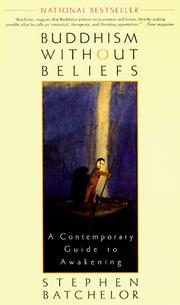
Living with the Devil, A Meditation on Good and Evil andBuddhism Without Beliefs, Stephen Batchelor: I got into Batchelor's writing because I was attracted to the cover of Living With the Devil (human being, check it out). What I found inside was, as much as I hate to resort to cliche, a revelation. Like Brad Warner, Batchelor espouses a version of Zen Buddhism that doesn't so much strip away mysticism as make realism magical. In LWtD, he begins by explaining the importance of learning to "encounter the raw, unfiltered contingency of life itself":
...Contingency reveals a chaotic freedom at the heart of of causally ordered events. However tempting it is to invoke the hand of God, karma, or destiny to inject a hidden order into what seems random, embracing contingency requires a willingness to accept the inexplicable and unpredictable instead of reaching for the anesthetic comfort of metaphysics.
The opposite of "contingency" is "necessity." No matter how ephemeral and insignificant I recognize this human life of mine to be, I cannot shake off an intuitive conviction that, deep down, my existence is necessary in the scheme of things. By paying close and sustained attention to the contingent nature of experience, the practice of Buddhist meditation challenges the instinctive feeling that we are, in the words of Milton's Satan, "self-begot, self-raised / By our own quick'ning power." In eroding this sense of our own necessity, we come to see how the unprecedented and unrepeatable person we are emerges from a sublime matrix of myriad contingent events-- no one of which need have happened either. Insight into the emptiness of self is achieved not by eliminating self but by understanding it to be contingent rather than necessary.
In BWB, he takes this freedom from necessity further by applying it directly to Buddhism and stating that "the dharma is not something to believe in but something to do." The book begins with one of the most definitive of quotes from the Buddha's Kalama Sutta:
"Do not be satisfied with hearsay or with tradition or with legendary lore or with what has come down in scriptures or with conjecture or with logical inference or with weighing evidence or with liking for a view after pondering it over or with someone else's ability or with the thought 'The monk is our teacher.' When you know in yourselves: 'These things are wholesome, blameless, commended by the wise, and being adopted and put into effect they lead to welfare and happiness,' then you should practice and abide in them."
Both books encompass so much more than their titles suggest, and both have become manuals of a sort for me to use in navigating the pitfalls of both life and my own nature. Most concretely, Batchelor's meditation instruction was what it finally took for me to get my ass on the mat and begin a daily practice (well, almost daily. Let's say every other day). Settling my monkey-mind has been a serious challenge, as it is for so many others, and focusing on the breath has been more a distraction than a means to open into emptiness. The light bulb went off while reading LWtD, though, when Batchelor wrote:
The trick is to remain fully aware of the breath without awareness impeding its natural ebb and flow... One way to do this is to wait for the breath to happen. After each inhalation and exhalation, there follows a brief pause as the muscles change gear, as it were, before releasing the pent-up air or drawing a fresh breath. The self-consciousness of breathing is most pronounced at these two moments: suddenly it feels as though "I" must inhale or exhale. To dispel this sense of agency, during each pause remain a disinterested observer, curious to notice when and how the muscles will engage of their own accord to initiate the next inbreath or outbreath. Just wait for the next phase in the breathing to kick in: with no expectation as to when it should start, no preparation for it to be deep or shallow, no anticipation for it to be forceful or gentle.
I still often find the breath to be like Schrodinger's Cat-- being conscious of it does affect its nature, no matter how long I wait for that inhalation. But Batchelor's advice is something specific to practice, and that has made all the difference.
The change in my mood and equilibrium since finding these two books has been subtle yet profound. As Batchelor himself puts it, "life [has become] less of a defensive stance to preserve an immutable self and more of an ongoing task to complete an unfinished tale." And that's tremendously freeing.
(My impressions of Brad Warner's books can be found here, for anyone who's interested.)
A Year in the Maine Woods, Bernd Heinrich: The linked review is an excellent summation of this book, but I disagree strongly with its criticisms. I just re-read AYitMW for about the fourth time, and the elements that so disturb the reviewer are exactly what I love about it. It's to the point that, like Inman in Cold Mountain, randomly opening up his copy of Bartram's Travels and finding peace within the pages, I can open Heinrich's book to any page and become immersed. I did this recently when I found myself between books and unsure of what I was in the mood for, beginning sometime mid-winter both in the book and in the real world outside. When I reached the last page at spring-time, I went back to the start and continued into the beginning of summer. And all the while that I read about the return of song-birds and blossoming of leaves on trees, it was bitterly cold outside my window (thought nowhere near the minus temperatures Heinrich experienced in the Maine winter). The fact that the narrative follows the seasons rather than a linear story-line gives the book a circular quality that easily allows it to be read in this way, and Heinrich's descriptions are so explicit that the reader is transported and doesn't even realize the amount of scientific information being digested and tucked away. Anyone looking for a deeper connection to the natural world would do well to pick this one up.
I knew something felt familiar about this photo that I shot in Fells Point almost a year ago:
It's been a while since I've randomly perused images at the A. Aubrey Bodine site, but voila!, what should come up but my photo's possibly apparently unconscious inspiration:
So, does this mean I'm derivative, influenced by, or just have a similar (though much less talented) eye?
The state of the economy is beginning to hit home. It first affected me indirectly when my brother was laid off almost a year ago. But we don't see or speak with each other more than a handful of times a year, so it's something I've been aware of almost abstractly. I feel for him, certainly, but his situation is unfortunately not in my sphere of immediate awareness despite the fact that he's family. Impending lay-offs where I work are, though. We laid off three people last fall, but they were definitely un-productive employees whose positions weren't necessary to begin with. It was a sad thing for those people on a personal level, but it was difficult to refute the sense it made for the business. Last night, the boss confided to me about new lay-offs coming up, as they will have a direct impact on my own work load. We're closed today for the Inauguration, and the plan is apparently for upper management to meet with the unfortunately chosen on Wednesday and announce it to the rest of the store family in a meeting Thursday morning. I can't help but find irony in the timing of this. The day after our new President is sworn in, the President who has promised hope and change (albeit with struggle and sacrifice), four people I work with on a daily basis will face a demoralizing change in their lives.
Pertinent to my own recent career considerations, I recently found out that Shaharazade's was finally sold. The new owner is apparently a student at the local college who's working on a degree in physical therapy and who already has his own marketing business. His intention is to maintain the tea shop as it is, and he's kept on the previous owner's daughter as manager. He sounds quite the young entrepreneur and I hope the shop thrives under his direction. I felt a stab or two of remorse on learning this news, but the current situation (see link above and the economy in general) reassures me in my decision.
And, a fellow blogger who's writing I much admire seems to have turned off the comments feature at her site. So I'm going to sing the praises of some of human being's latest pieces here and hope that she sees this--
These each touch me deeply, as I've wondered before why the heck I maintain this blog. What is it that compels the spewing of my self-indulgent, self-obsessed babblings? It's apparently one part therapy, one part reaching out for connection and communication, and one part attempt at a marginally creative outlet. But, as human being makes so beautifully clear, I'm not alone in that wondering. It's apparently part and parcel of that state of being a blogger, whether being one makes you officially a 'writer' or just someone wishing/pretending to be one. The "disease" is a compulsion, an urge, to "[ooze] dubious words" and "inessential images" out into the "colossal cosmos". That's one of the double-edged beauties of the intarwebs-- a blog allows one to reach out and release, but to whom? Is there really any connection, if the connection remains anonymous and distant? Does it open us up to wider worlds, or fool us into believing such while shackling us more firmly into our "cozy corner"? Jodi, another fellow blogger, recently wrote along similar lines in regards to Facebook and I was reassured by her view. Of course all of this speculation will vary from person to person, depending on one's natural introverted or extroverted tendencies, but the intarwebs are what you make of them. I'm grateful for what they've led me into. If anything, the various social networks and message boards I frequent, and my own little cozy corner here, have helped me to understand the value of connection "irl". So I'll continue to babble, hopefully you'll continue to read, and together we'll weave a few more strands into that great big web that spreads so wide over the world.
Sitting here like uninvited company Wallowing in my own obscenities I share a cigarette with negativity Sitting here like wet ashes with X's in my eyes And drawing flies
Bathed in perspiration drowned my enemies Used my inspiration for a guillotine I fire a loaded mental cannon to the page Leaning on the pedestal that holds my self denial Firing the pistol that shoots my holy pride Sitting here like wet ashes with X's in my eyes And drawing flies
Hey what you yellin' about Conditions, permission, mirrored self-affliction Hey what you yellin' about Sadists' co-addiction, perfect analogies Hey what you yellin' about Conditions, permission, mirrored self-affliction
Leaning on the pedestal that holds my self denial Firing the pistol that shoots my holy pride Sitting here like wet ashes with X's in my eyes And drawing flies
I'm sure that the young, 20-something Chris Cornell who wrote this song years ago had no clue as to its Zen-ness. To him, it was probably nothing more than an expression of existential angst. But, man, if that isn't the human condition in a nut-shell. From our denial of the reality of what we are to the afflictions we create for ourselves, and letting all that crap get in our own way because we forget that we're a pile of wet ashes dying with every breath we take.
Most of the rewards we get in life come to us obliquely. (Bernd Heinrich, A Year in the Maine Woods)
I'm not talking about anything as ambitious as getting off yer duff and realizing your life's dream. It's just being aware, every day, seeing the world as greater than ourselves, noticing the little, oblique things and relishing them. It can make all the difference in helping us let go of that holy pride.
The process of awakening is like walking on a footpath. When we find such a path after hours of struggling through the undergrowth, we know at last that we are heading somewhere. Moreover, we suddenly find that we can move freely without obstruction. We settle into a rhythmic and easy pace. At the same time we are reconnected to others: men, women, and animals who have walked here before us. The path is maintained as a path only because of the tread of feet. Just as others have created this path for us, so by walking on it we maintain it for those who will come after us.
(Stephen Batchelor, Buddhism Without Beliefs)
As always, I read those words through the prism of my own experiences and mind-set, and used them as a springboard for self-analysis.
Paths are a common feature in my life, from the Buddhist path I've been attempting to follow to the literal paths I tromp through the woods. Along each of these sorts of paths, the greatest source of conflict for me has been that connection to others to which Batchelor refers. I've written before (ad naauuuuseaum) of how I go through periods of connection, when I find a handful or so of people with whom I can relate and try to develop friendships, and, at other times, through periods of solitude. Invariably, at some point, the periods of connection contain moments of inconvenience, annoyance, frustration, and/or anguish. It's often hard for me to balance all of that against the moments of fun, sharing, learning, and/or growth that are also part of connection. And the periods of solitude can be full of richness and contentment, yet at the same time feed my egoistic misanthropy.
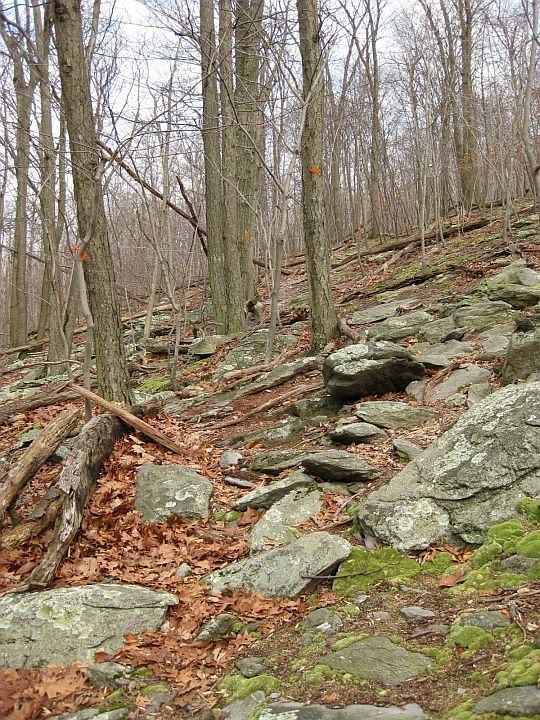
In the woods, on those literal footpaths, I'm also frequently annoyed by the presence of others, and not just the noisy, oblivious folks who are so busy making sure they say "Hi!" that they scare away the deer I've been watching for five minutes... First, an example of that type: I recently headed up to a state park that allows hunting in season, hoping that would deter most other hikers. The trail I planned to hike is aptly named Old Misery. It's short, but ascends 500 feet or so within the first half-mile, through a series of switchbacks so rocky it's sometimes hard to follow where the trail's headed.
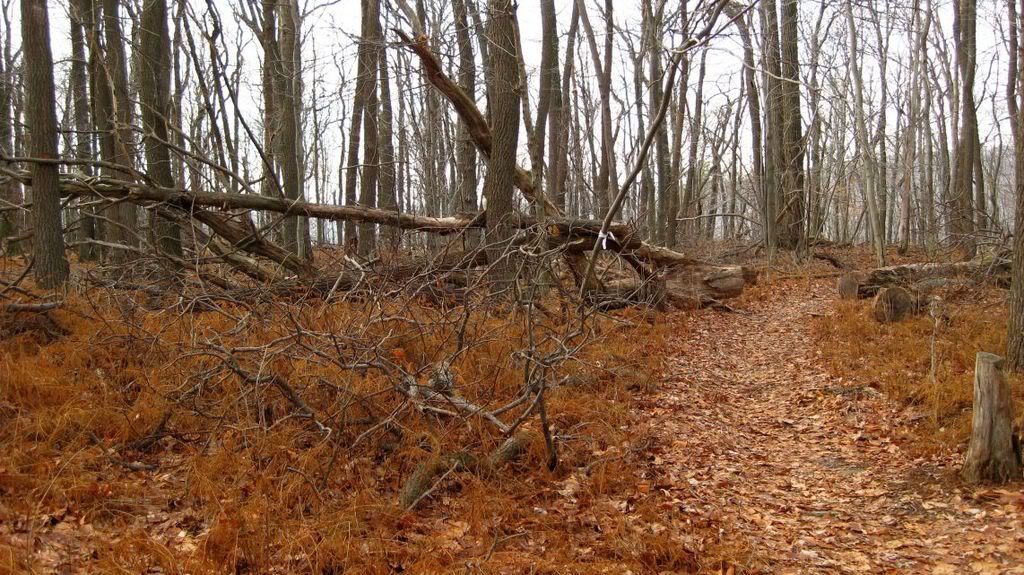
Beyond this, though, it levels out along the top of the ridge and passes through a dense fern sea.
Picture all of that orangey-red growth as lush green ferns in the summer-time...
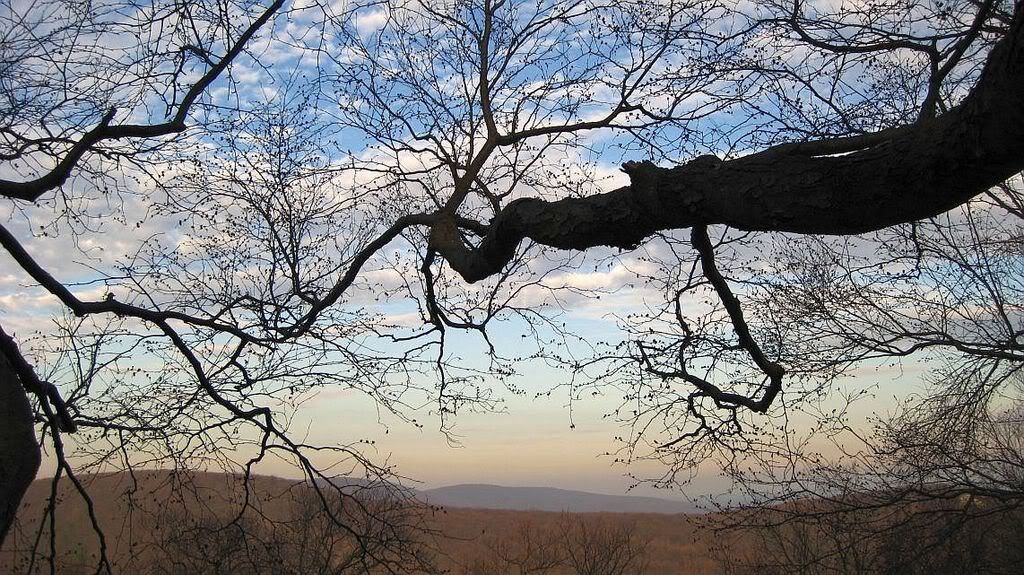
It then skirts the edge of the ridge and at one point runs next to a talus slope that overlooks the spine of the mountains heading north.
That's where I was, relaxing in the crook of a low-growing tree limb and taking in the vista. From behind, I suddenly heard "Hey! Hey there!" I turned and traded the beautiful view for the sight of a yuppie doofus in what appeared to be ski tights, big-ass shin-high climbing boots, and a backpack. He stood in the middle of the trail and called down the hill to ask me what was ahead. We went back and forth for a while as I tried to orient him to the area in order to explain what his options were. Three times I asked which way he had come to get to the trail (i.e. along what road), and three times I was told that he had come from the Old Misery trailhead down by the lake. No duh, dude, that's only way you could have come on the trail considering the direction you were headed. The equally big-booted teen-aged boy with the guy (who at least wore his big-ass boots with plain old jeans) finally spoke up and I was able to describe to him what other trails they would meet and where those led. But I spent the rest of my hike wondering what someone like that guy was doing out in the woods. What could he get out of it? Laughably over-equipped, he didn't know where he had come from and was clueless where he was going. Being so incredibly oblivious, what sort of connection could he possibly have with his surroundings, what intimacy with nature, if any? That boggles my mind.
Even when physically absent, the implied presence of other people on the trail irks me. As the population in the mid-Atlantic has grown, attendance in local parks has increased along with it. The result is trails that were once the width of my two feet are now side-walk wide. And trail stewards in the parks suddenly feel obliged to mark these trails with painted blazes every hundred feet or so. I assume this helps limit their liability, as there's less chance of oblivious types wandering off and getting lost if they can always see at least five blazes away into the distance and follow them like beacons. But for those of us who are more comfortable in the woods, such thoroughly defined trails spoil much of the fun. The tread of others may maintain the trail, but also diminishes the sense of discovery. Early on, I picked up a habit of bush-whacking-- wandering off the established trail to follow animal paths, or just picking a break in the trees and plunging in. The occasional struggle through the undergrowth was a challenge that could exhilarate at the same time that it frustrated. And, more often than not, these solitary, off-the-beaten-path wanderings have led to fantastic discoveries-- a gorgeous overlook, a small cave, a bleached turtle shell or deer antler.
So, just what sort of metaphor is this for the figurative path I've been stumbling along? What does it mean that I prefer the unbeaten path, the road less taken, or even no trail at all? Can I find just as many treasures on my own as I would through personal connections? Or can I awaken only by following the paths trod by others? I'd like to think that there's a middle ground to the Middle Way, that I can spend time on both sorts of paths, that I can be both "out of the line and indivisible", and yet still find my way to some semblance of enlightenment.
A Crow Left of the Murder
Unlearn me. Ditch what I read Behind what I heard.
Look. Find. Free. Yet! Do you get it yet? Do you get it?!
From here on it's instinctual, Even straight roads meander. Every piece contains a map of it all! It all!
Evidence In the march of the ants, Pulse of the sea.
Look. Find. Free. Yet! Do you get it yet? Do you get it?!
From here on it's instinctual, Even straight roads meander. Every piece contains a map of it all! It all!
Out of the line and indivisible, A crow left of the murder. Every piece contains a map of it all! It all!
Everything I wanted, Wanted to know... Everything I wanted, Wanted to see. Unlearn me...
Do you get it yet? Look, find, free. Do you get it yet?
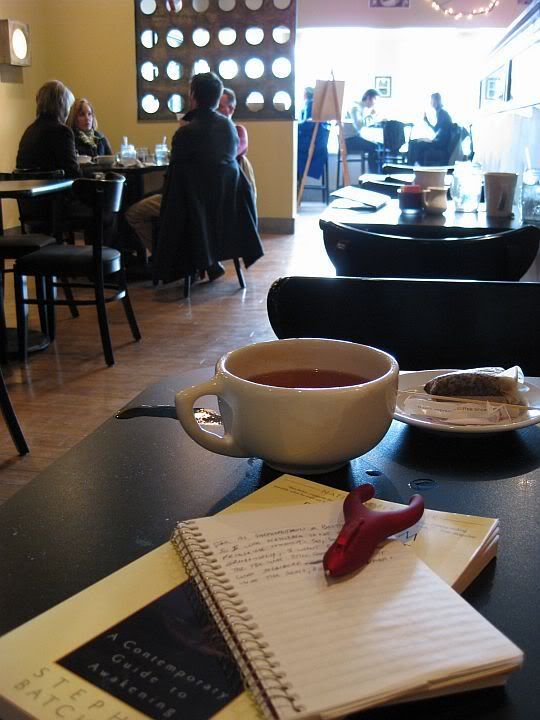
So, it's officially winter and I'm continuing my cold-weather trend of finding places to hang out, read, write, drink tea, and eat. I've recently added a fourth favorite to my repertoire-- Cafe Nola, in Frederick, MD. Nola has its roots in the defunct Downtime Cafe, which was located across the street. You literally walked down about four steps into the tiny, cramped basement of one of the historic townhouses on Patrick St. The tea assortment was fairly small, but eclectic and good. And the sandwiches on the equally small food menu were terrific, which is saying something because I'm not a sandwich fan. Unkempt and artsy, punky and funky, Downtime felt cozy to me. I didn't go there often, but often enough that I was seriously bummed when the place closed.
Seems the owners had a new concept in mind. Before long, Cafe Nola opened on the other side of Patrick in what was once a lunch counter/diner and has since been hard to keep occupied. Word was that Nola was being billed as a "coffeehouse/bar/kitchen". Before even seeing the place, visions of wanna-be-hip yuppies began dancing in my head. Sure enough, the first time I walked in, the sofa in the corner had been taken over by a 30-ish guy with a laptop and a toddler who was lolling all over the coffee table and floor. Yet there was also a dude with a mohawk and a black trench coat at one of the front window tables. After being ignored at the front counter for several minutes, I finally ordered a Battling Bamboo tea to go and left with a less than stellar first impression.
Now, while Frederick has a generous handful of very good restaurants, those places are just that: somewhere to be seated and served, dine, pay, and go. Places where one can feel comfortable just hanging out with a book and a meal have been few and generally haven't lasted long. Downtime Cafe was one of those few.
So there I was, feeling unmoored and bereft of a nearby hangout. There's just not always time to drive as far as Shepherdstown or Baltimore so, somewhat grudgingly, I went back to Nola. The tea was still the same good assortment, but the meal was mediocre. A third visit was just as poor, but the funky espresso cup collection and the same punky staff as at Downtime caused the atmosphere to begin growing on me.
Finally, on my fourth visit, I discovered Nola nirvana: the Grilled Cheesy sandwich, consisting of provolone, tomato, pesto and, optionally, prosciutto, grilled on focaccia. The combination of greasy, gooey cheese and the place being empty enough for me to read and eat in peace finally clicked and I left feeling content.
I've since been back a few more times for that sandwich and have discovered that their chef also does some pretty fantastic things with pumpkins and a soup pot. I've begun exploring more of the tea menu, as well-- while Battling Bamboo is still the first choice when I'm under the weather, I've found that Gypsy Love makes for a smooth, mellow compliment to a meal. The last test was Sunday brunch, for which I headed up to Frederick today. Veggies in Bed (tomato, basil, mozzarella and asparagus grilled on open-faced focaccia) seriously gives the Grilled Cheesy a run for its money, though the thicker focaccia required a steak knife to cut into.
So I've gone from turning my nose up at Nola to being totally won over by the place. Moral of the story: Always be willing to revise your first impressions, especially where food is concerned.
Cats are such elegant, dignified, beautiful creatures. But give them a bit of discarded Christmas wrapping paper, and they turn into three-eyed goofballs...
A lot of folks these days are into the Showtime series Dexter. Since I'm too cheap to spring for anything more than basic cable, I've been missing the boat. But a recent review of the season 3 finale (Spoiler Alert: don't click that link if you're a fan and haven't yet seen the episode) intrigued me more than anything else I'd heard yet, so I hit the video store today and rented the first disc of the first season. Now, after watching those four episodes back-to-back, I'm disturbed.
It's not the show itself, really, though both the premise and all of the assorted severed limbs that pop up on camera are unsettling, as I'm sure was the intent. No, the idea of the show, of a character like Dexter, is right up my alley. I've always been drawn to the macabre and morbid. As a kid, one of my favorite tv shows was The Addams Family. In high school, I delighted in memorizing and reciting Edward Gorey's Gashlycrumb Tinies to anyone who would listen. I read Victorian-era ghost stories to relax, and can't pass an old cemetery without making plans to return and photograph it. Even my father confirms all of this: To this day, any reference to the movie Beetlejuice causes him to point at me and proclaim of Winona Ryder's character "That's you!"
So Dexter, the show itself, doesn't bother me. What popped into my head as I turned off the dvd player was: Why on earth is this show so popular? What has changed in our society to make a fairly graphic, somewhat violent television show about a serial killing forensic analyst not only accepted, but lauded? As television goes, Dexter's got a lot going for it-- witty and compelling writing, tension in both plot and character, and a great cast of actors. And for any fan of the much-missed HBO series Six Feet Under, the fact that it stars Michael C. Hall as the title character isn't the only thing it has in common with Alan Ball's great work. All of those factors definitely merit the acclaim the show's received.
Yet its popularity still bugs me. Where I was once glanced askance at for being "weird", I'm finding that "weird" is the In Thing these days. Goth is cool, skulls as decorative items are hip, and Dexter is a hit. And the idea that it's suddenly popular to be a weirdo like me leaves me, well, honestly... a bit freaked out.
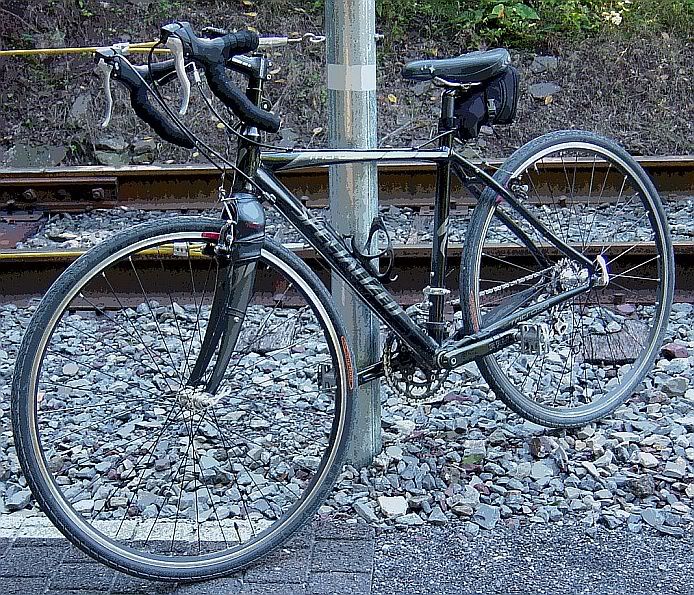
This has been a hard year for me and the bike. Sadly, I've fallen out of love with it and only occasionally glance at where it leans against the wall on one side of the "sunroom" in my apartment. The downtube and fork are crusted with dried mud from a few wet late-summer/early-fall rides, and the spokes are probably collecting cat hair from the kittehs rubbing against the wheels. A fellow blogger recently wrote about the development of his own bike love affair. Mine's unfortunately taken a different course. So what happened? What caused my nearly obsessive, addictive two-wheeled adoration to fade?
I've always had a bike, ever since the first tricycle Santa left under the Christmas tree four decades ago. As I outgrew one, my folks would make another one magically appear. Back then, there was no thought involved in riding, it was just something you did, either with the neighborhood kids or alone. As I hit adolescence, the bike took me farther. I somehow discovered that we lived near something called a "bike path" (the 45-mile long W&OD Trail, to be specific) and suddenly I was off, riding my bike to the comic book shop, to 7-11 for Slurpees, or just to explore. There was never any thought of how fast or far I was going, and having to get off and push the bike up that last incredibly steep hill on the way home was just something all the kids did and the idea of being humiliated by not being able to pedal up it never crossed my mind.
When I grew up enough to move out and live on my own, whatever bike I happened to own at the time went with me. It was casual riding, just around the neighborhood (and still to 7-11 for Slurpees) to learn my way around the new digs. Sidewalk, road, school ball-field, it was all fair game for my wheels. Then, as happened in my teen years, I discovered a nearby trail: the C&O Canal towpath. I had to drive to get to it, so I scrimped from a few paychecks and shelled out for a bike rack on the car, then began loading the bike up to explore the sections of the C&O closest to home. This was like discovering Nirvana. I quickly developed an appreciation for the car-free atmosphere and the gorgeous natural surroundings, the peace and the solitude (though there were more than a few bumpy rides that left my hooty-hoo wishing I'd take the bike back to the sidewalk). I was blissfully happy on the C&O for years, zooming or cruising along on my cheap little Schwinn Frontier as the mood struck me.
But as time went on, I began to think about my riding. The milepost markers on the C&O made it possible to keep track of how far I was going. And, by keeping track of my miles and the time I was out, I was able to begin estimating how fast I rode. But I seemed to have a limit to both mileage and speed, and it didn't take long before the craving to increase one or the other, or both, grabbed hold of me. The first bit of advice I was given was to get a bike computer and watch my cadence in order to pace myself for longer rides. Done. Worked for a while, but then the insidious craving for a new bike began to creep up on me. I think I talked to salespeople at a total of three shops, and ended up buying the first bike I test rode (the guys in that shop were the only ones smart enough to actually get the bike down and tell me to go ride it, and I fell for it).
The difference was amazing. The computer showed that I was immediately riding faster, and the carbon fork on the bike smoothed out a significant amount of the towpath bumpiness that had left my hooty-hoo so frequently disgruntled. Within a few rides, I was clocking twice the mileage per ride. Is there a second level to Nirvana? If so, I'd found it.
Then I discovered the forums at Team Estrogen.com. The forums attact a tremendously wide variety of female cyclists, from comfort-beast cruisers to custom carbon racers and everything in between. I could relate to the women who rode at a more relaxed pace (though I'll admit I was a bit perturbed to discover that I qualified as a slow rider) and I could learn from the very experienced roadies and mtb'ers in the bunch. A handful of us in the DC area even began meeting to ride together, and these ladies soon tempted me off of my beloved towpath onto hilly country roads and gentle singletrack. They've challenged and inspired me, and we've had a lot of fun together.
So what happened this year?
There've been a couple of things, I think. First and most obvious to me is that I had a handful of bad rides this year. Some were just a case of unpleasant circumstances (crappy weather, etc), but others were more serious and indicated a possible medical condition that I need to have checked out. After so many years of riding the pancake-flat C&O and similar paved bike trails, beginning to ride hills has been a hellatious challenge for me. I had more than one ride this summer that left me gasping at the top of a comparatively small hill, light-headed and in a cold sweat, feeling that I would pass out if I stood upright and with my heart erratically pounding as if it would beat its way out of my ribcage. Heatstroke? Perhaps, but the symptoms made me paranoid that I've developed a heart condition. (And of course I'm procrastinating in getting to the doctor about this. Denial's become stronger than the urge to ride.)
There's also, though, been that issue of thinking about my rides. That desire to go farther and faster, and to try to conquer the hills, led to logging every ride at bikejournal.com. Once upon a time, a good ride was one on which I'd just plain had fun, and the endorphins from just pedaling were more than enough. Suddenly, a ride wasn't good unless I'd accomplished something. I had to either maintain a smooth pedal stroke at a high cadence, or I had to maintain a high (for me) speed for the entire ride, or I had to reach a farther distance than I had before, or I had to get up a certain hill without stopping three times on the way. I had to when I rode.
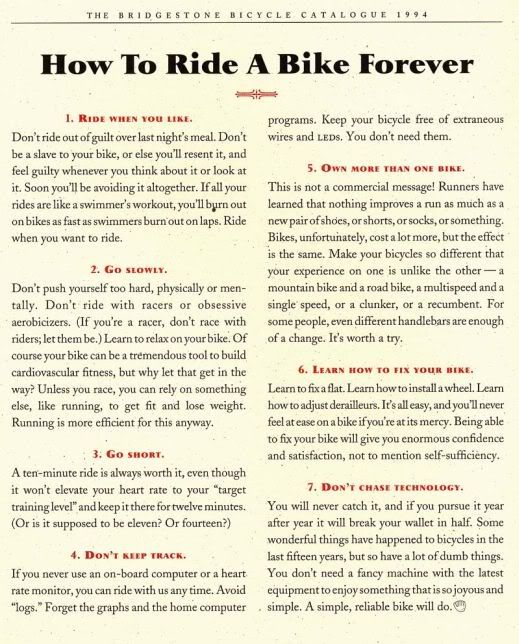
I think this has all been in the back of my mind for a while. I'd gotten to the point this summer that I was flipping the bike computer around the handlebar so I couldn't see it while I rode. And days would go by before I'd log rides at bikejournal. I started thinking more about just riding the bike to do nearby errands and such. Finally, in October, I leaned the bike against the wall and ignored it. Then, this morning, urbanvelo.org posted this:
Eureka. That makes me want to ride, though it's a damned shame that the folks at urbanvelo couldn't have posted it before temps in the DC area dove into the 40-ish degree range (that is one obstacle to riding I doubt I'll ever overcome). But I'm inspired to do things differently next year. Whether it means removing my bike computer or just not logging into bikejournal, whether I ride 40 miles on the C&O or just up the street to the 7-11, I want to get back to riding just for the sake of riding. Whatever it takes, just so that it's once more "joyous and simple".
All images and text herein (excepting song lyrics, quoted material, and otherwise attributed images) are licensed under a Creative Commons Attribution-Noncommercial-No Derivative Works 3.0 Unported License. Feel free to use my words or photos, but please link back to the post from which you pulled them. Like anyone else, I find it gratifying to be acknowledged for my work. Thank you.

 Living with the Devil, A Meditation on Good and Evil and Buddhism Without Beliefs, Stephen Batchelor: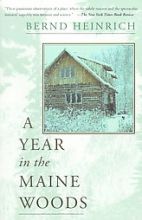








 Posts
Posts


