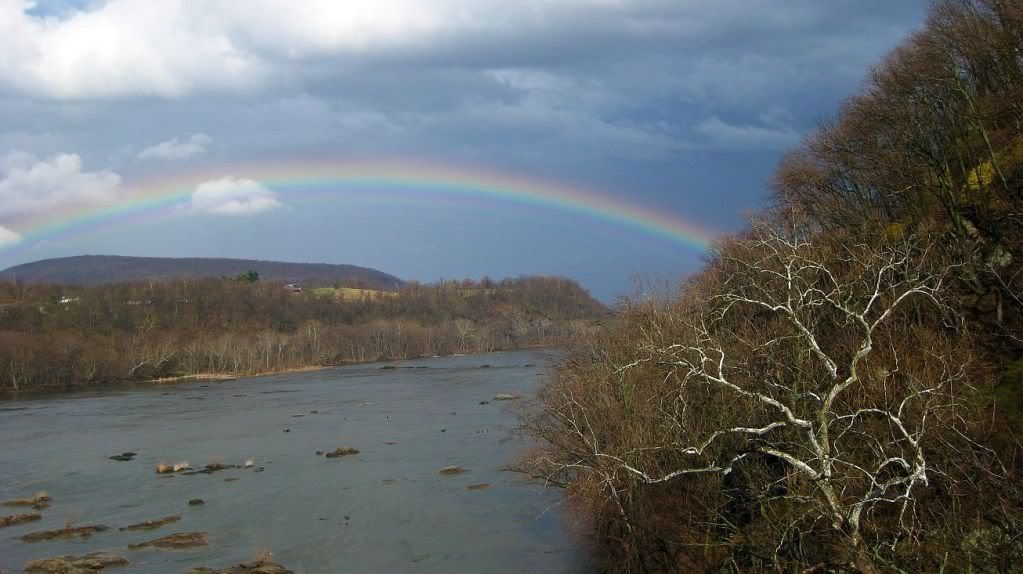
Today's weather was the most schizophrenic I've seen in a long time. From dense, milky fog in the morning, to thicker stratus clouds and drizzle, to blue sky and fluffy mixed cumulus and cumulonimbus, to being pelted with rain under a sky mixing all of the above. At one point, though, I managed to hurriedly park the car along route 340, then dash across heavy traffic and run out onto the bridge just in time to catch this before the clouds shifted and it faded away:
Click image for larger view
Look Alive
The hardest thing is rendering a moment moving too fast to endure But you abide and smile wide 'cause I want to remember this for sure Give me guns and politics and I'll just make a mess of it, y'know Give me art as sustenance and the wiser, wider part of me will show
A picture says with sight what we can't say with words But you've been walking eyes-to-feet in dark sunglasses A picture will survive So smile and look alive The camera lens is opening, a wider angle is yours
Every empty one of us have methods to quell the madness of this place But yours have bled and are running south
like dollar-store mascara down your face You can take that wait and all that fuss and I'll just get the best of us, y'know Give me love not suicide
and the wiser, wider part of me will show
A picture says with sight what we can't say with words But you've been walking eyes to feet in dark sunglasses A picture will survive So smile and look alive The camera lens is opening, a wider angle is yours
Got out on the bike yesterday for the first time in five months. I left the computer at home, and my intention was to just ride easy with no care for mileage, cadence, or speed. It started out well enough, easy as I'd intended, turning the pedals at a smooth, loping pace. But then it became... not quite hard, but... effortful. I can blame part of it on a slight wind that kicked up periodically (always a cross-wind, never a tail-wind, of course), but the rest? So many of last year's rides were like this, easy one moment, the next a concerted effort to keep the cranks turning smoothly at the same rhythm. I've begun a series of doctor's appointments to check out everything from my asthma to the heart flutters I experienced last summer and fall. There's got to be something at the root of this fatigue, whether it's my heart, my lungs, diet, poor sleep, the beginnings of inherited fybromyalgia, I want to find the deficiency and correct it.
So this morning I woke up feeling sluggish and out of it, not to mention sore in the saddle area. Not getting on the bike today, how about a nice, easy hike instead? Almost thought I was too tired even for that, but I finally forced the car in the direction of one of the many local trails and headed out. By that point I felt absolutely no desire to exert myself, but wanted badly to be out in the woods under the vibrant blue sky. After wandering probably less than a mile, I found a good spot and plopped my fatigued ass down by the creek, where my mind turned to a series of thoughts that've been fermenting in the vat of my brain over the last few weeks.
Between my own gradually increasing physical limitations (fuck it, let's call a spade a spade-- middle-age is slowing me down) and recent synchronistic reminders of Ego (it's a big subject, so it gets a capital 'E'), a bit of Baudelaire struck me that I may as well share...
Carrion
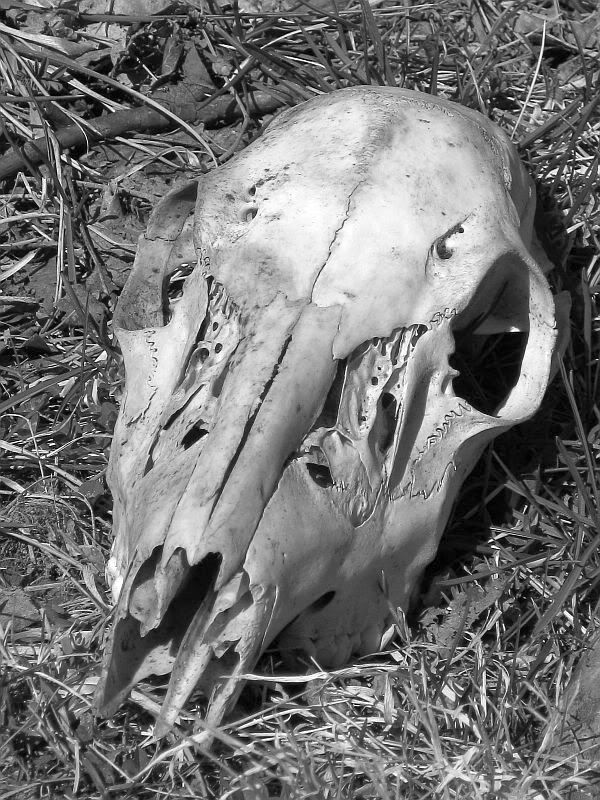
Remember, my soul, the thing we saw that lovely summer day? On a pile of stones where the path turned off, the hideous carrion --
legs in the air, like a whore -- displayed, indifferent to the last, a belly slick with lethal sweat and swollen with foul gas.
The sun lit up that rottenness as though to roast it through, restoring to Nature a hundredfold what she had here made one.
And heaven watched the splendid corpse like a flower open wide -- you nearly fainted dead away at the perfume it gave off.
Flies kept humming over the guts from which a gleaming clot of maggots poured to finish off what scraps of flesh remained.
The tide of trembling vermin sank, then bubbled up afresh as if the carcass, drawing breath, by their lives lived again
and made a curious music there -- like running water, or wind, or the rattle of chaff the winnower loosens in his fan.
Shapeless -- nothing was left but a dream the artist had sketched in, forgotten, and only later on finished from memory.
Behind the rocks the anxious bitch eyed us reproachfully, waiting for the chance to resume her interrupted feast.
-- Yet you will come to this offence, this horrible decay, you, the light of my life, the sun and moon and stars of my love!
Yes, you will come to this, my queen, after the sacraments, when you rot underground among the bones already there.
But as their kisses eat you up, my Beauty, tell the worms I've kept the sacred essence, saved the form of my rotted loves!
(as translated by Richard Howard)
Somehow, that's both alarming and comforting to me. Alarming when I think in the short, egoistic term, as it reminds me of the decay within that will only continue to make physical exertion more and more difficult. Comforting, though, when I let go of ego and realize that we all come to this. No matter our beauty, intelligence, physical prowess, or lack of any thereof, the one thing that unites us all, the greatest reminder of our sameness, is the way we end. The thought is humbling and reassuring, albeit a bit morbid in its inspiration.
There've been words bouncing around in my head for the past few weeks trying to become a couple of blog posts, but so far they're not coalescing into anything coherent. So, in the meantime, you get some spring fever babblings...
I was reminded today that the first day of spring signals the new year in the Persian world. I haven't researched why the middle of winter was chosen to begin the calendar year pretty much everywhere else, but the Zoroastrian idea makes so much more sense symbolically. Spring is when everything comes back to life and begins, for crying out loud. Winter has its moments of snowy prettiness but, really, the Greeks nailed it when they designated it the season of death. Why would anyone choose to begin a new year when everything around is in stasis?
The sticky little leaves are forming here in the mid-Atlantic region and elsewhere, and will soon open to their new beginnings. If you've got 'em where you are, go, get out there and appreciate them.
So, there was another lunatic on the subway this evening. On the way home from work, I boarded a half-empty train and found a spot standing in the aisle facing out towards the windows. As the train flew through the dark tunnel, the reflection in the window revealed a grizzled, disheveled gentleman sprawled across the row of seats behind me, with his belongings sprawled across the row of seats ahead of him. Before the train had gotten very far, he began sputtering and grumbling. I continued watching in the reflection as a fellow commuter noticed, shifted, and moved to the other end of the car. Despite his apparent weirdness, the lunatic had the presence of mind at the next stop to gather himself and his belongings into one row of seats and offer the row he emptied to some new passengers.
As the train continued, the volume of his mutterings increased until it became clear to us all that he had a serious issue with air travel. "Don't fly the goddamned airplanes up in the sky! I don't unnerstand you people, why you wanna fly? God said keep your feet on da ground! I'm tryin' to save you, like Jesus Christ, I try to save you!" All of this tumbling out of his almost toothless mouth in the most gravelly voice I've ever heard. He'd occasionally become more excited, at one point standing and leaning over between the two people in the row in front of him. One of the two, commendably, remained calm and quietly urged the lunatic to take a break, telling him that we understood, it was ok, he should sit down. It worked. He gradually calmed a bit, telling us again in a lower voice that he loved us and just wanted to save us.
As always in these situations, my attention shifted between the lunatic and the reactions of the people around him. On a few of the faces nearby, I sensed alarm, annoyance, stifled giggles. Most, though, stoically gave no indication that they noticed anything at all out of the ordinary.
On and on the guy went, standing and waving his arms, sitting back down and grumbling, then standing again to exhort us all to stay outta the goddamned airplanes up in the sky. I wanted so badly to turn around and ask him what he thought of cars. What held me back? Sure, a part of me was apprehensive of further setting him off, uncertain of how close he might be to whatever line kept him from physically accosting any of us. But I think a bigger part of me feared something else. What if he didn't understand the question? What if he flat out ignored me? I honestly think I was afraid of being rebuffed by a lunatic.
After a while, he again quieted down and sprawled back in his seat, letting out periodic low cackles. I glanced up from scribbling at one point and happened to catch his eye. A moment later I heard him mutter "What's she writin' over there? She writin' a book?" A young couple a few rows up captured his attention then and he began babbling about how nice it is to have a girlfriend. Next minute, though, we heard over and over about how the girlfriend had been kidnapped, and that "They gonna kill da white girl on tv." But he was an equal opportunity lunatic, because very soon "They gonna kill da white man, too..."
Thirty-five minutes after I boarded, when the train reached the end of the line and we all got off, he stayed sprawled and rambling in his seat. I can picture him now, riding into the night, warning his fellow subway passengers of the dangers of "the goddamned airplanes." Hopefully, at some point, his mind will let his body rest.
David Bowie sings that line in Young Americans, which is a pretty intense tune in its own right. I was recently reminded of the one song that always has that effect on me, and it just so happens to be another of his. I go through long periods during which I forget about this song, then I'll hear it somewhere, on the radio, over a store intercom and... it'll hit me. An emotional reaction that I feel all the way down in my toes. I have no idea what it is that does it-- the lyrics are profoundly meaningful, the vocals are beautiful and evocative, and both are perfectly complimented by the softenings and swellings of the music. But dozens of other songs contain those same elements. Bowie somehow combines them all in a way that never fails to put a lump in my throat and tears in my eyes. The statement at the end of the video is apt, Bowie does indeed rox.
Changes
I still don't know what I was waiting for And my time was running wild A million dead-end streets Every time I thought I'd got it made It seemed the taste was not so sweet So I turned myself to face me But I've never caught a glimpse Of how the others must see the faker I'm much too fast to take that test
Ch-ch-ch-ch-Changes (Turn and face the strain) Ch-ch-Changes Don't want to be a richer man Ch-ch-ch-ch-Changes (Turn and face the strain) Ch-ch-Changes Just gonna have to be a different man Time may change me But I can't trace time
I watch the ripples change their size But never leave the stream Of warm impermanence and So the days float through my eyes But still the days seem the same And these children that you spit on As they try to change their worlds Are immune to your consultations They're quite aware what they're going through
Ch-ch-ch-ch-Changes (Turn and face the strain) Ch-ch-Changes Don't tell them to grow up and out of it Ch-ch-ch-ch-Changes (Turn and face the strain) Ch-ch-Changes Where's your shame You've left us up to our necks in it Time may change me But you can't trace time
Strange fascination, fascinating me Changes are taking the pace I'm going through
Ch-ch-ch-ch-Changes (Turn and face the strain) Ch-ch-Changes Oh, look out you rock 'n rollers Ch-ch-ch-ch-Changes (Turn and face the strain) Ch-ch-Changes Pretty soon now you're gonna get older Time may change me But I can't trace time I said that time may change me But I can't trace time
Spring fever has begun creeping up on me yet again, with its usual symptoms of restlessness and agitation. I'm digging through cds and pulling out old music for a change of pace, having flashbacks in my mind's eye to summer bike rides and the scenery that accompanied them, and itching to hit the road for far away places. The winter's chilly grip is loosening, leaving me with a need to sweat. A hike in the woods or flowing yoga routine just won't cut it, I need to get out on my bike and really make my body work.
More compellingly, I want to get out on my bike, the first I've had that feeling in months. Knowing that the weather's oh-so-gradually warming up means it's time to get the bike cleaned and ready. I won't spring-clean my apartment, but I will give the bike a thorough going-over-- removing the chain and lovingly wiping down each link, polishing up the frame with a bottle of aptly-named Bike Lust, cleaning and adjusting the components to the best of my ability. This year, inspired by #4 of the How to Ride a Bike Forever manifesto, I've decided to remove the computer from the bike. I'll be doing this with a high level of trepidation. Despite riding statistic-less for the majority of my life, I quickly became addicted to entering those numbers on a log. None of them were particularly impressive by "serious" cyclist standards, but my left-brain was tickled pink by logging, reviewing, comparing, and analyzing. But I feel strongly that it's time to get back to right-brain riding for at least a while, so left-brain's just gonna have to handle its numbers withdrawal as best it can. Besides, getting all those wires out of the way will make cleaning the bike just that much easier.
On the subject of the increasingly run-down looking apartment that I hate to clean, it's becoming a major source of dukkha. After re-painting half of the place a few years ago and then having the bathroom somewhat professionally remodeled, I'd been planning to begin tackling other things in increments-- new dishwasher and refrigerator, then new flooring in the kitchen and sunroom, finally finishing the re-painting job... But $12,000 of veterinarian bills over the course of 2008 completely side-tracked those ambitions. Meanwhile, the list has continued to grow even as the money has shrunk. While I was in Vegas on a 10-day business trip last summer, the cats tore down a chunk of wallpaper in the kitchen, which means that room's just that much closer to needing a complete remodel. A crack in some small component of the furnace is being monitored at bi-annual maintenance checks, in the hopes that it won't necessitate a whole unit replacement for a few more years. And, more recently, I came home to find that some numb-skull left my storm door unlatched while distributing menus for a pizza place that I'll never call. The wind apparently then caught the door and blew it back against the wall of the building, yanking the retracting door closures out of the door frame and breaking the wood of the frame. I should be glad it didn't shatter the glass of the door, but as I picked screws, bolts, and other assorted parts off the ground, all I wanted to do was punch the un-thinking doofus in the face (for which I'll certainly spend another lifetime in samsara, if the whole Hindu/Buddhist reincarnation thing really holds water).
The houses we lived in when I was growing up always had the same hodge-podge, borderline decrepit feeling my place is beginning to take on. My father is a fairly competent, energetic handy-man, but he's also easily distracted, never fully completing any of the projects he begins. I'm in some sort of handy-person limbo, myself. I can swap out a door-knob or hang a curtain rod lickety-split, but was flummoxed in my attempts to remove and replace a worn-out kitchen faucet. And my only excuse for not getting back to re-painting the rest of the apartment is pure laziness. Painting's fun for about two hours, and then I can't take it anymore and want to just go play. I'm to the point that I feel like I need to begin sketching or writing poetry, just so I can absent-mindedly look around the place and shrug, using the excuse that I'm too busy being creative to worry about mundane things like the appearance of my home. It would be better than this feeling that I'm too broke and/or lazy to do anything about it.
Fuck it all, I'm outta here. It's flipping cold outside, but the woods are calling.
Got this from Jim over at Unholy Rouleur (who is smart, thoughtful, and funny, so go read his stuff):
What can you say to that? It just makes too much sense and should be required viewing by everyone. (To give credit where it's due, here's where Jim snagged his link.)
Zen... is nondoctrinal, concrete, existential, and seeks above all to come to grips with life itself, not with ideas about life, still less with party platforms in politics, religion, science or anything else. (Thomas Merton, Zen and the Birds of Appetite)
Merton's description of Zen fairly well sums up the point of Brad Warner's latest book, Zen Wrapped in Karma Dipped in Chocolate. Brad uses himself and the chaos of his life in 2007 as a visceral example of the ways in which Buddhism, Zen specifically, is misunderstood. Now, I should say off the bat that Warner's writing is not for everyone. Near the end of the book, Brad describes himself as "too shy and indirect." That may be so in person, but his writing is blatant and direct, sometime vulgar, and very often goofily funny. His books tend to hit you like a Three Stooges poke in the eyes. After you rub the shock away, you can't help but see things differently.
Now, for that misunderstanding. I'll admit, I immediately fell for the neat little myth that Buddhism brings an all-encompassing calm to one's life. I mean, heck, folks like the Dalai Lama and Pema Chodron are always shown with happy, almost impish, grins on their faces. That's how we're all supposed to end up after enough time on the cushion, right? Wrong, at least where Zen is concerned:
The Middle Way was not some kind of spiritual path designed to make us all holy with shiny pink halos on our noggins. It was a way to live a life that wasn't a piece of shit. It was a way to find happiness and stability in an unhappy and unstable world. That's really all any of us are looking for, when it comes down to it. The stability of the Middle Way comes in our practice of zazen [meditation], which is the actual physical and mental practice of stability and happiness. A bit of zazen... radiates throughout the rest of the day and night and makes everything better. That's all there is to it.
And yet:
You may be wondering why, with all my Zen training, I would still feel this kind of tension. If you are, I understand. When I first started all this meditation stuff I also believed that it would fix me so that I'd never feel a bad feeling ever, ever again. It doesn't work that way, I'm afraid.
The practice does make this kind of stuff easier. But no amount of enlightenment will eliminate all stress and tension from your life. We all have a certain amount of karma to get through, and nothing can change that... The best you can do is learn how to add as little new garbage to the pile as possible. But this in itself is a very significant thing.
Sound a tad contradictory and confusing? What it all comes down to is expectation. Ultimately, the source of all our dukkha, all our squirmy dissatisfactions and outright suffering, is that we expect the world and our lives to be a certain way. We expect to be happy, to never feel emotional anguish or physical pain, to never be divorced or lose a job, to never break a leg or get cancer, and for the sun to always come out tomorrow. But we never see that the problem is the expectation itself. We become so caught up in the contrast between what is and what we were hoping for that just dealing with the situation as it is becomes unbearable. We forget to "...on every occasion ask thyself, what is there in this which is intolerable and past bearing?" (Marcus Aurelius, Meditations, Book VII, 36. Those Stoics sure had a lot in common with Buddhism.)
In ZWiKDiC, Warner clarified this for me succinctly, yet indirectly. In describing the questions he was asked during a sesshin dharma talk, he mentions that one participant asked how to avoid expectations in Zen practice. Brad's answer speaks specifically to all that crap I babbled about above:
...anyone doing this practice is going to have expectations. You expect to achieve peace of mind. You expect to deepen your understanding. You expect to get enlightenment.... There's no way to stop having expectations. The best you can do is understand that your expectations will never be realized... Just know that your expectations are only thoughts in your head, and keep on doing what you do.
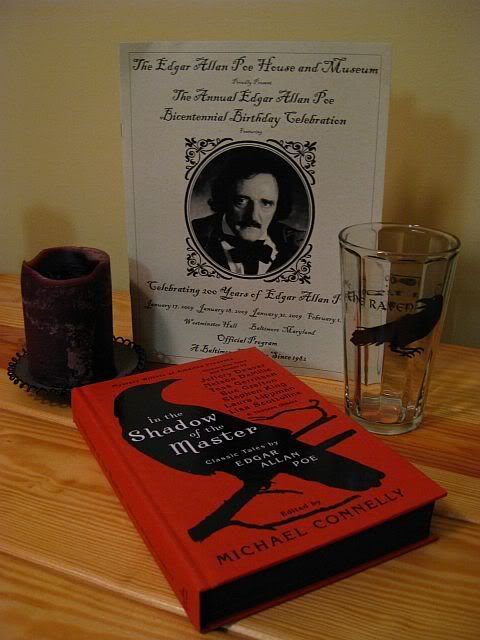
Today was the final day of the bicentennial edition of Baltimore's annual Edgar Allen Poe birthday celebration. I've attended a few times in years past, but had to go again to laud Eddie on his 200th year. The event took place, as always, at Westminster Hall, which was once Westminster Burial Ground, which is where Poe, his young wife/cousin and his mother-in-law/aunt are buried together. Unfortunately, photography was not allowed during the performances, so I'll have to try to sum it up in words.
The celebration began with the singing of "Annabel Lee" by a female soprano. I'm sure her voice would be considered lovely, but high-pitched female voices make me cringe so I could have done without. She was followed by a very cheesy, low-budget pantomime/puppet performance of Hop Frog, after which the event really got good. Third on the bill was local actor Tony Tsendeas in the role of the narrator of The Tell-Tale Heart. Tony's portrayal of this short story has been a recurring part of the annual Poe Halloween celebration at Westminster and this was probably the 5th or 6th time I've seen it. He still had me on the edge of my seat. I'd love to see him do a similar performance of Poe's The Black Cat.
After a short intermission, Jeff Jerome (curator of the nearby Poe House and Museum) introduced the night's special guest, John Astin. It's been several years since Astin's last appearance at the birthday event. When I saw him on that occasion, he was a dead-ringer (no pun intended) for Poe. Tonight, I almost didn't recognize him as he strode up the aisle to the stage. The years have altered him from Gomez Adddams into a bald-pated, white-bearded grandfather-ly figure. Still hearty and spry, though, and dashing in his tuxedo as he sat on the stage in a chair once used by Poe himself. Then, in the unmistakable voice of Gomez, he read some of Eddie's darkest works as if they were bed-time stories, relating each piece to the highs and lows, the few joys and many losses, of Poe's life. I didn't recognize the first piece as it was brief and over too quickly, but the rest of Mr. Astin's selections were:
- "Conqueror Worm" - The Masque of the Red Death - "To Helen" - "A Dream Within a Dream" - "Eulalie" - A portion of a letter written by Poe, in which he describes the prolonged death of his beloved Virginia from tuberculosis, and his resultant "insanity" - "The Raven" (can't leave that one out, especially in Baltimore) - "To One in Paradise" - Passages from the prose poem, Eureka, which apparently displays Poe's prescient predictions in cosomology. - "For Annie" - '"Annabel Lee" (Astin's reading was much preferable to the female vocalist earlier in the evening) And finally, - "Eldorado"
The evening concluded with the annual apple cider toast to Poe and more squirming from me as the female vocalist returned to wail Amazing Grace and Auld Lang Syne. I'd have been happy for things to have just ended with Poe's own words from an 1844 letter, as quoted in the toast:
"You speak of 'an estimate' of my life'-- and, from what I have already said, you will see that I have none to give. I have been too deeply conscious of the mutability and evanescence of temporal things, to give any continuous effort to anything-- to be consistent in anything. My life has been whim-- impulse-- passion-- a longing for solitude-- a scorn of all things present, in an earnest desire for the future."
I'm sure Eddie had no clue just how those of us in the future would come to regard him. I hope it would have brought him satisfaction and a measure of peace.
Memorabilia of the night
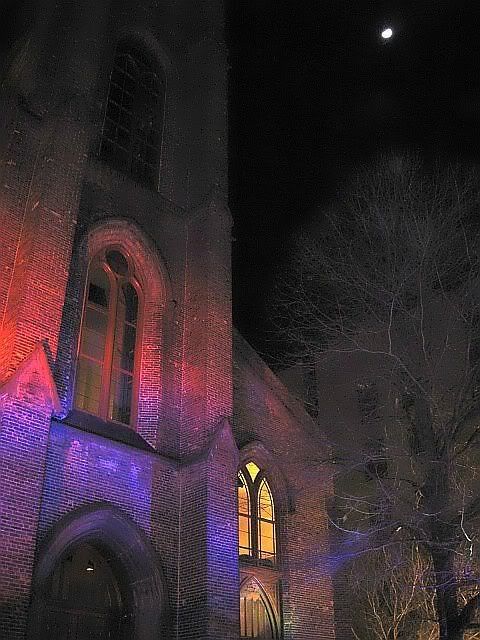
Westminster Hall
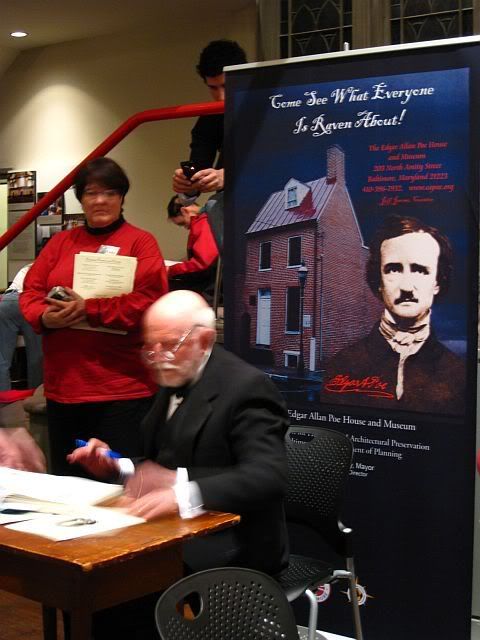
John Astin signing autographs. The guy would not sit still-
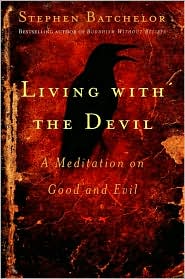
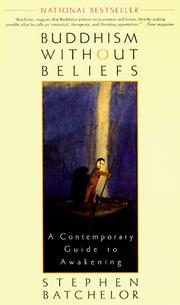
Living with the Devil, A Meditation on Good and Evil andBuddhism Without Beliefs, Stephen Batchelor: I got into Batchelor's writing because I was attracted to the cover of Living With the Devil (human being, check it out). What I found inside was, as much as I hate to resort to cliche, a revelation. Like Brad Warner, Batchelor espouses a version of Zen Buddhism that doesn't so much strip away mysticism as make realism magical. In LWtD, he begins by explaining the importance of learning to "encounter the raw, unfiltered contingency of life itself":
...Contingency reveals a chaotic freedom at the heart of of causally ordered events. However tempting it is to invoke the hand of God, karma, or destiny to inject a hidden order into what seems random, embracing contingency requires a willingness to accept the inexplicable and unpredictable instead of reaching for the anesthetic comfort of metaphysics.
The opposite of "contingency" is "necessity." No matter how ephemeral and insignificant I recognize this human life of mine to be, I cannot shake off an intuitive conviction that, deep down, my existence is necessary in the scheme of things. By paying close and sustained attention to the contingent nature of experience, the practice of Buddhist meditation challenges the instinctive feeling that we are, in the words of Milton's Satan, "self-begot, self-raised / By our own quick'ning power." In eroding this sense of our own necessity, we come to see how the unprecedented and unrepeatable person we are emerges from a sublime matrix of myriad contingent events-- no one of which need have happened either. Insight into the emptiness of self is achieved not by eliminating self but by understanding it to be contingent rather than necessary.
In BWB, he takes this freedom from necessity further by applying it directly to Buddhism and stating that "the dharma is not something to believe in but something to do." The book begins with one of the most definitive of quotes from the Buddha's Kalama Sutta:
"Do not be satisfied with hearsay or with tradition or with legendary lore or with what has come down in scriptures or with conjecture or with logical inference or with weighing evidence or with liking for a view after pondering it over or with someone else's ability or with the thought 'The monk is our teacher.' When you know in yourselves: 'These things are wholesome, blameless, commended by the wise, and being adopted and put into effect they lead to welfare and happiness,' then you should practice and abide in them."
Both books encompass so much more than their titles suggest, and both have become manuals of a sort for me to use in navigating the pitfalls of both life and my own nature. Most concretely, Batchelor's meditation instruction was what it finally took for me to get my ass on the mat and begin a daily practice (well, almost daily. Let's say every other day). Settling my monkey-mind has been a serious challenge, as it is for so many others, and focusing on the breath has been more a distraction than a means to open into emptiness. The light bulb went off while reading LWtD, though, when Batchelor wrote:
The trick is to remain fully aware of the breath without awareness impeding its natural ebb and flow... One way to do this is to wait for the breath to happen. After each inhalation and exhalation, there follows a brief pause as the muscles change gear, as it were, before releasing the pent-up air or drawing a fresh breath. The self-consciousness of breathing is most pronounced at these two moments: suddenly it feels as though "I" must inhale or exhale. To dispel this sense of agency, during each pause remain a disinterested observer, curious to notice when and how the muscles will engage of their own accord to initiate the next inbreath or outbreath. Just wait for the next phase in the breathing to kick in: with no expectation as to when it should start, no preparation for it to be deep or shallow, no anticipation for it to be forceful or gentle.
I still often find the breath to be like Schrodinger's Cat-- being conscious of it does affect its nature, no matter how long I wait for that inhalation. But Batchelor's advice is something specific to practice, and that has made all the difference.
The change in my mood and equilibrium since finding these two books has been subtle yet profound. As Batchelor himself puts it, "life [has become] less of a defensive stance to preserve an immutable self and more of an ongoing task to complete an unfinished tale." And that's tremendously freeing.
(My impressions of Brad Warner's books can be found here, for anyone who's interested.)
A Year in the Maine Woods, Bernd Heinrich: The linked review is an excellent summation of this book, but I disagree strongly with its criticisms. I just re-read AYitMW for about the fourth time, and the elements that so disturb the reviewer are exactly what I love about it. It's to the point that, like Inman in Cold Mountain, randomly opening up his copy of Bartram's Travels and finding peace within the pages, I can open Heinrich's book to any page and become immersed. I did this recently when I found myself between books and unsure of what I was in the mood for, beginning sometime mid-winter both in the book and in the real world outside. When I reached the last page at spring-time, I went back to the start and continued into the beginning of summer. And all the while that I read about the return of song-birds and blossoming of leaves on trees, it was bitterly cold outside my window (thought nowhere near the minus temperatures Heinrich experienced in the Maine winter). The fact that the narrative follows the seasons rather than a linear story-line gives the book a circular quality that easily allows it to be read in this way, and Heinrich's descriptions are so explicit that the reader is transported and doesn't even realize the amount of scientific information being digested and tucked away. Anyone looking for a deeper connection to the natural world would do well to pick this one up.
All images and text herein (excepting song lyrics, quoted material, and otherwise attributed images) are licensed under a Creative Commons Attribution-Noncommercial-No Derivative Works 3.0 Unported License. Feel free to use my words or photos, but please link back to the post from which you pulled them. Like anyone else, I find it gratifying to be acknowledged for my work. Thank you.






 Posts
Posts


